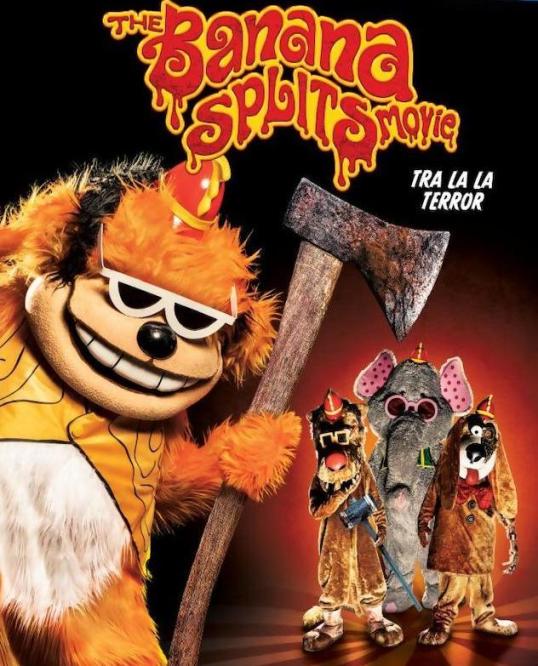
The TSL’s Horror Grindhouse: The Banana Splits Movie (dir by Danishka Esterhazy)


The Banana Splits Movie takes viewers behind the scenes of a children’s television show and shows us the sordid world that nobody knows about.

The stage manager is overworked.  The new head of the network is a jerk.  The star of the show is a drunk.  The lovable Banana Splits, who play silly games and all play music instruments, are all actually robots who are looked down upon by their human coworkers.  When Stevie (Richard White), the star of the show, learns that the show is being canceled, he makes the mistake of telling the robots and, before you know it, all Hell is breaking lose.  People are getting stabbed to death with lollipops.  Network executives are getting dismembered.  One unfortunate person gets slammed in the head with a giant hammer.  You gotta be careful who you piss off, folks.  Robots are ruthless.

To me, the most shocking thing about The Banana Splits Movie was the discovery that it was based on an actual show.  Apparently, the Banana Splits were real and they had their own show in the late 60s and early 70s.  I’m going to guess that the Banana Splits were played by people in costumes as opposed to just being big robots.  At least, I hope that’s the case because, after watching The Banana Splits Movie, I’m kind of over wanting anything to do with robots.

I will say this.  If I imagine the characters from this movie not killing people, I can kinda understand why they would have their own TV show.  I mean, they’re all really cute, except for when they’re covered in blood and brain matter.  My personal favorite was Snorky, who was a big elephant and was a bit less murderous than the other three members of the Banana Splits.  In fact, I have to admit that the film kind of left me feeling a little bit depressed because all of the robots are so cute that you really don’t want to see them murder people or get damaged themselves.  The film actually does a pretty good job of contrasting the adorableness of the Banana Splits with the pain and carnage that they caused.

And make no doubt about it.  There’s a lot of blood spilled in this movie.  The Banana Splits are ruthless murderers and they don’t care how nice you are or if you paid money to see the show or if you’re just trying to make your daughter into a big star.  If they see you, they’ll kill you.  In fact, I have to admit that it sometimes got to be a bit too much for me.  I got a little bit tired of all the violence but, at the same time, I also appreciated the film’s satiric intent.  In a world gone mad, why wouldn’t the stars of a children’s TV show turn out to be a bunch of killer robots?  When you think about all of the once beloved celebrities that have fallen from grace over the past 10 years, it makes an odd sort of sense.

Anyway, The Banana Splits Movie is well made splatter film with a satiric vein running through all blood and guts.  It was a bit much for me but I respected it for sticking to its subversive premise and I do think it will be appreciated by a lot of other horror fans and pop culture fanatics.

I’m just hoping that the sequel features more Snorky.

The TSL’s Horror Grindhouse: The Children (dir by Tom Shankland)


Poor Casey (Hannah Tointon)!

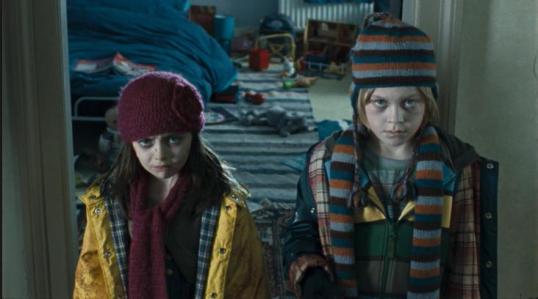
As 2008’s The Children opens, all she wants to do is celebrate New Year’s with her friends.  Instead, her mom and her stepfather are dragging her off to some stupid house in the middle of nowhere, where she’ll have to hang out with her aunt and her dorky uncle and she’ll also be expected to look after not only her two much younger cousins but her two half-siblings as well!  Even worse, once they arrive at the house, all of the young children start to complain about feeling sick.  One of them even throws up.  Everyone assumes it’s just car sickness but could it be something worse?

(Of course.  There’s always something worse!)

In fact, perhaps the only positive thing about the holiday is that it’s snowed!  All of the snow sure does look pretty and it’s a lot of fun to play in.  Once the kids get over being sick, they can’t wait to go outside and have some fun!  One of the adults accompanies them.  While he’s sledding, the kids use a garden rake to kill him.  They even disguise it to look like an accident…

Yep, there’s definitely something going on with the children.  At first, Casey is the only one who understands that the children have turned evil.  (Of course, her first clue comes when they attack her in the woods.)  All the adults are either in shock or denial.  At first, they refuse to even consider that their children are trying to kill them.  Of course, once the children lay siege to the house, the adults are in for a rude awakening…

This is actually the second film called The Children that I’ve reviewed for this site.  The first one was a film from the early 80s that featured a school bus driving through a toxic cloud with the end result being a bunch of homicidal, radioactively-charged children.  In the second version, it’s left a bit more ambiguous as to why the children have suddenly turned homicidal.  While it’s established that that they’re suffering from a virus, the film never tells us where the virus came from or even how it was contracted in the first place.  In fact, until the film’s last few minutes, the audience is never quite sure just how far the infection has spread.  That ambiguity is what gives this film its power.  There’s nothing scarier than not being sure what’s going on.

The Children is a grim and disturbing horror film, one the features very little humor and which ends on an ominous note.  It’s a film that exploits something that we all know but rarely want to admit, which is that children can be incredibly creepy.  We tend to idealize children, which is exactly what the children in this movie use to their advantage.

The Children is also a very well-acted horror film.  Hannah Tointon is sympathetic in the lead role while all of the killer children are played with a proper combination of savagery and innocence.  This may very well be the best killer children film ever made.

The TSL’s Horror Grindhouse: Blood Cult (dir by Christopher Lewis)


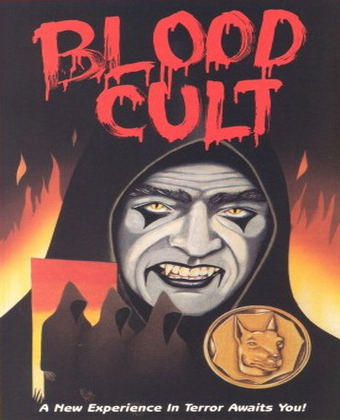
Oh no!  There are bad things happening!  On a small college campus, co-eds are being stalked and killed by a masked murderer who carries a cleaver.  With each murder, the killer chops off a limb and carries it off with him.  He also leaves behind a mysterious gold medallion, one that appears to feature an etching of a dog on it.  It’s a bit of a mess, really.

Early on, in the 1985 film, Blood Cult, a narrative crawl informs us that the events that we’re watching occurred during the previous winter.  These murders, we’re told, were “the strangest crimes in recent recorded history.”  The film opens with one of those crimes.  In an homage to Psycho and every other slasher movie ever made, the first murder occurs in a shower.  The showering victim looks straight at the camera during her scenes.  When she delivers her lines (“Is that you?  Did you get the pizza?  Did you get my anchovies?”), she does so in a flat, Oklahoma accent.  In short, these scenes proudly announce that we are watching an amateur, regional production.

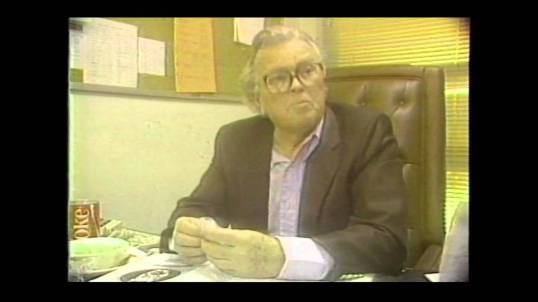
Anyway, the film itself deals with Sheriff Ron Wilbois (Charles Ellis), who must solve the murders before they harm his chances of being elected to the U.S. Senate.  Fortunately, he has some help from his daughter, Tina (Judi Adelman).  Tina is a librarian, which means that she has magical research powers.  All she has to do is open up a book and, thirty seconds later, she will have discovered whatever needs to have been discovered.  Unfortunately, Tina may have some secrets of her own.  She’s also dating an rather dorky guy named Joel (James Vance).  Joel is the type of guy who, when he meets his girlfriend’s father in a diner, lazily props his feet up in the seat across from him.  I mean, come on, Joel!  At least try to impress the old man!  I kept expecting Sheriff Wilbois to yell, “Get the Hell away from my daughter!” and maybe draw his gun but apparently, that was not the Sheriff’s style.  The Sheriff’s a good, honest lawman.  He’s not the type to abuse his powers.  He just wants to solve the murders, go to the Senate, and drink a lot of Coke.  Seriously, there are so many Coke cans in this movie that, if not for the film’s amateur status, one could be forgiven for assuming that the film was produced by the Coca-Cola Corporation.

Can you spot the Coke?

There’s a twist to Blood Cult but it’s not a particularly surprising one.  In fact, there’s really nothing surprising about Blood Cult.  Some of the gore effects are effective in a low-budget way.  One victims gets beaten to death by another victim’s severed head.  That was kind of creative.  For the most part, though, Blood Cult never escapes the constraints of its low budget and its status as an amateur production.  I did feel that Charles Ellis, who was a regional theater actor, gave a fairly good performance as Sheriff Wilbois.  He came across like being a genuinely nice guy.  I would have voted for him.  The rest of the cast was forgettable at best and painfully stiff at worst.

Blood Cult is historically significant because it was actually the first movie to ever specifically be made for the home video market.  Every straight to video movie ever made is a descendant of Blood Cult.  Apparently, it was filmed in nine days, with the cast and crew taking a week off from their days jobs.  To the film’s credit, there are a few atmospheric scenes, largely because Oklahoma is a naturally atmospheric state.  But, for the most part, Blood Cult has a “Grandpa Picked Up a Video Camera And Made A Horror Film” look and feel to it.  I have a weakness for amateur, regional horror movies and the DVD of Blood Cult comes with a likable director’s commentary but, for the most part, this is a film that’s significant mostly as a piece of historical trivia.


The TSL’s Horror Grindhouse: Psycho III (dir by Anthony Perkins)


Norman Bates is back!

Released in 1986 and directed by Anthony Perkins himself, Psycho III picks up a few months after Psycho II ended.  Norman (Anthony Perkins, of course) is still free.  He’s still got his motel.  He’s still talking to his dead mother.  Of course, at the end of Psycho II, Norman was told that the woman who Norman thought was his mother actually wasn’t his mother.  Instead, Emma Spool told Norman that she was his mother, which led to Norman promptly hitting her with a shovel and then keeping her preserved body hidden away in the motel.  Got all that?  Great, let’s move on….

In Psycho III, business suddenly starts booming at the Bates Motel!  All sorts of people come by to visit.

For instance, there’s the obnoxious tourists who show up at the motel so they can watch a football game and get drunk.  Future director Katt Shea plays one of the unfortunate tourists, who ends up suffering perhaps the most undignified death in the history of the Psycho franchise.  Shea later ends up being stored in the motel’s ice chest.  At one point, the local sheriff grabs a piece of ice and tosses it in his mouth without noticing that it’s covered in blood.

And then there’s Duane Duke (a young Jeff Fahey!), who is superhot but also super sleazy.  For reasons that are never quite clear, Norman hires Duke to be the assistant manager at the motel.  Duke turns out to be thoroughly untrustworthy but he’s Jeff Fahey so he remains strangely appealing even when he shouldn’t be.

Red (Juliette Cummins) shows up at the motel so that she can have sex with Duke and then get stabbed to death while taking off her top in a phone booth.  That, I guess, is Psycho III‘s equivalent of the first film’s shower scene.  Later, Duke comes across Norman mopping up all the blood in the phone booth but he doesn’t say anything about it.  Duke knows better than to ask why there’s blood in the phone booth.

Tracy Venable (Roberta Maxwell) is a journalist whose sole purpose in life is to prove that Norman murdered Emma Spool.  Tracy’s main function in this film is to explain just why exactly so many different women have claimed to be Norman’s mother.  It’s a rather complicated story and you’ll get a migraine if you think about it for too long.

And finally, there’s Maureen (Diana Scarwid), the former nun who has lost her faith and her sanity.  She shows up at the motel and stays in Marion Crane’s old room.  She takes a bath instead of a shower and slits her wrists.  When Norman storms into the room to kill her, the barely lucid Maureen mistakes him for the Virgin Mary and sees his knife as being a crucifix.  Maureen survives and Norman is hailed as a hero for rescuing her.  Later, Norman and Maureen fall in love.  You can guess how that goes.

When compared to the first sequel, Psycho III is much more of a standard slasher film and there’s certainly never any doubt over who is doing the killing.  However, Perkins again does a great job in the role of Norman, making him both sympathetic and creepy.  Fahey, Scarwid, Maxwell, and Hugh Gillin (as the hilariously clueless sheriff) all provide good support.  There’s really not a single character in this film who doesn’t have at least one odd or memorable quirk.  Duane Duke, for instance, is one of the most amazingly sleazy characters in the history of American cinema.  Just when you think that the character can’t get any worse, he proves you wrong.

As mentioned above, Perkins directed this film.  It was one of two movies that Perkins would direct before his death.  As a director, Perkins had a good visual sense, even if he did allow the narrative to meander a bit.  There’s nothing particularly subtle about Perkins’s direction and several of the scenes — like the sex scene between Duke and Red — are so over the top that they become rather fascinating to watch.  That said, there was really no longer any need to be subtle when it came to Norman Bates and his story.

With the exception of the weird Gus Van Sant remake with Vince Vaughn, Psycho III would be the last Psycho film to be released into theaters.  It would also be Perkins’s second-to-last time to play Norman.  (The last time would be in a 1990 made-for-TV sequel, Psycho IV: The Beginning.  Despite it’s title, Psycho IV pretty much ignored everything that happened in the previous two sequels.)  Perkins passed away in 1992, at the age of 60 but the character of Norman Bates would live on, both in his own performances and in the later work of Freddie Highmore in Bates Motel.

The TSL’s Horror Grindhouse: Living Space (dir by Steven Spiel)


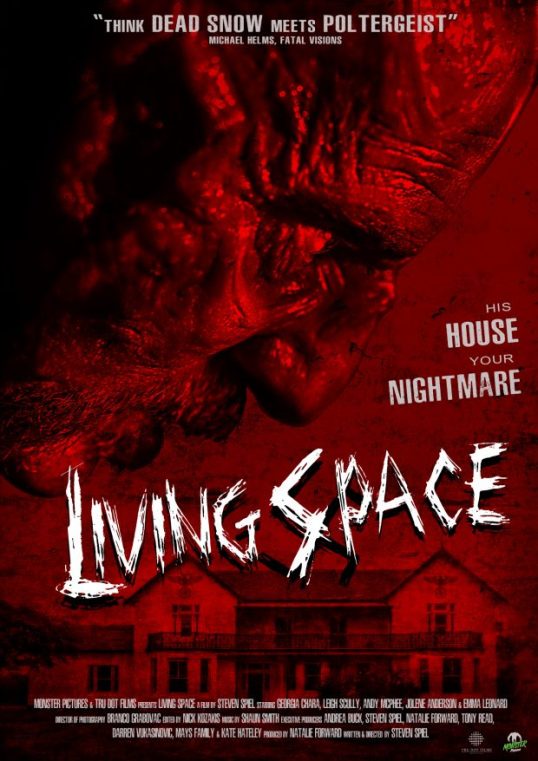
So, before I talk about this movie, I want to talk about the title.  This is an independent Australian film from 2018 and, when it was originally released, its title was Living Space.  That’s not a particularly exciting title but it’s a title that goes along with the plot of the film and, in context of the story, it makes sense.

The film has since been retitled Nazi Undead.  That’s the title that’s used on the imdb.  That’s the title that’s used when it airs on Showtime and Starz.  When I recorded the film, I specifically set the DVR to record Nazi Undead.  I’m going to assume that it was felt that Nazi Undead was a more “commercial” title and I suppose it is.  For me, I saw the title and I immediately thought of the great 70s zombie flick, Shock Waves.  That said, it’s not a title that I plan on using in this review.  Living Space may not carry the punch of Nazi Undead but it’s still a far more appropriate title for this film, which involves a very evil spirit but no actual zombies.

As for the film itself, it opens with two Americans tourists driving through Germany.  Ashley (Georgia Chara) and Brad (Leigh Scully) should be having the time of their lives but they just can’t stop arguing.  At one point, Brad even calls Ashley a “whore” and it’s shortly afterwards that a house appears in the distance.  They’re having car trouble.  Brad wants to go in the house and get help.  Ashley is haunted by a horrific sense of deja vu and doesn’t want to.  Brad orders her to enter the house.

It turns out that Ashley was right.  The house is not a place you want to enter.  The house was once owned by a Nazi officer (Andy McPhee) who, one night, murdered his entire family.  His spirit is there and it’s still filled with the hatred and the sadism that fueled the Third Reich.  Brad is killed.  Ashley is next….

Suddenly, Ashley and Brad are sitting in the car again.  The house is sitting in front of them.  Ashley again has a horrific feeling of deja vu.  Brad again orders her to go into the house.  It’s a time loop, always starting with them at the car and always ending with a night of torture and death inside the house.  Each time, Ashley’s sense of deja vu grows stronger.  And each time, Brad is insistent that she enter the house….

It’s an interesting idea, really.  The evil of the Nazis, the film seems to be saying, cannot just be forgotten and, due to stubbornness  or willful blindness, we’re destined to suffer through their evil again and again unless people are willing to listen to and heed the warning signs.  The film opens with a title card that explains the idea behind Hitler’s concept of a “living space,” that room had to be made for the Aryan people and, in order to make that room, all undesirables would have to be moved somewhere else.  The house is a living space, one that is dominated not just by the evil ideology of its former inhabitant but also by the officer’s overwhelming hatred of women.  (Both the ghost and Brad use the word “whore,” which suggests that the whole reason the house appeared was because of Brad’s uttering of that word.  Brad and the ghost are in league, whether Brad realizes it or not.)  Every time, it’s Ashley who know what waits inside the house and Brad who insists that she enter it….

If only the execution was as assured as the idea behind it!  Georgia Chara does a good job in the role of Ashley but the rest of the cast is less impressive and, once they enter the house, the film sometimes seems to get so caught up in trying to duplicate other recent “torture” films that it runs the risk of trivializing exactly what it’s meant to condemn.  The film has a lot of ambition and, flaws and all, I do look forward to seeing what Steven Spiel does next.  Hopefully, whatever it is, it won’t get saddled with a name like Nazi Undead.

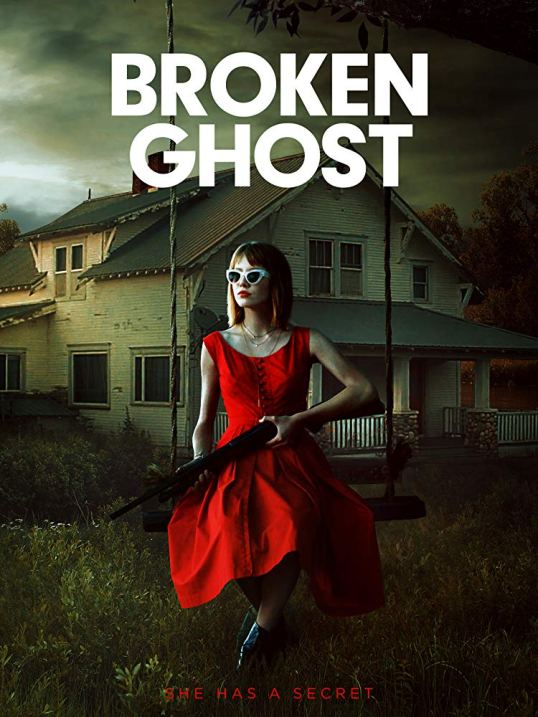
The TSL’s Horror Grindhouse: Broken Ghost (dir by Richard Gray)


Odd film, Broken Ghost.

It opens with two bikers slowly approaching a big house that appears to be sitting out in the middle of nowhere.  They enter the house, we hear gunshots, and then suddenly….

….a new family is moving into the house!  The Day family is full of secrets, some of which we learn about immediately and others of which are only gradually revealed.  Samantha Day (Scottie Thompson) has recently bought the local drug store and is frustrated by the fact that her husband, William (Nick Farnell), is impotent.  William is a moody artist who is struggling to get over an addiction to pornography.  And then there’s their teenage daughter, who insists on being called Imogen (Autry Haydon-Wilson) even though her real name is Grace.  Or maybe she now wants to be Grace and her original name was Imogen.  To be honest, it’s hard to keep track because everyone refers to her by both names throughout the film.  We do know that Samantha occasionally calls her the wrong name because everyone yells at her about it.

Anyway, Imogen is the reason that the Days have moved to a new house.  Apparently, something bad happened at Imogen’s old school and, as a result, she’s changed her name and her hair.  Imogen is an interesting character and Autry Haydon-Wilson does a good job playing her.  Imogen’s moods swing back and forth, between depression and angry, insecurity and defiance.  You’re on her side as soon as you meet her.  Imogen suffers from a severe vision impairment and the film occasionally shows the world through her eyes.  It’s a uniquely threatening place.

As soon as the Days move into their new home, strange things start to happen.  The television turns on at random and it’s usually showing porn.  Imogen starts to hear a voice calling her name.  Samantha finds herself tempted to run off with every strange man that she sees at the local bar.  William, at least, finds himself artistically inspired.  When his wife and his daughter point out to him that the house is obviously haunted and that it might be a good idea to move somewhere else, William replies, “I’m doing my best work!”

It turns out that the house has quite a history, one that goes beyond those two bikers that we saw earlier.  The house was previously owned by another artist, one who murdered his wife and his children.  When William finds the murderer’s artwork, he starts to slip even further into insanity.  Could it be that William is possessed by the murder’s malevolent spirit or is there a twist lurking in the shadows….

Yes, there is a twist.  I won’t spoil it, beyond saying that it was a pretty bad twist and that it didn’t really make any sense.  In fact, it made me want to throw something at the television.  But, oh well.  I guess we should be happy that Broken Ghost tried to do something unexpected.  Still, as a result of the twist, the movie ends on a rather sour note and it’s hard not to feel that one member of the Day household has been excessively punished while another member of the family has basically gotten away with acting like a complete asshole.  And that’s all I’ll say about that.

So, it’s a flawed film that doesn’t really work but there are still some effective moments.  As I said, Imogen’s an interesting character and I almost wish that the film had dropped all of the supernatural mystery stuff and instead just focused on her character and her struggle to move on with her life.  Say what you will about the script but the cinematography is gorgeous and full of atmosphere.  There’s good moments all through Broken Ghost.

It’s just a shame about that ending.

The TSL’s Horror Grindhouse: The Yesterday Machine (dir by Russ Marker)


The 1965 film The Yesterday Machine opens with dancing!

Well, okay, actually, it opens with two college students out in the middle of nowhere, listening to an old radio.  Howie Ellison (Jay Ramsey) is working on his car, trying to get the engine to work again.  Margie de Mar (Linda Jenkins) is working on her baton twirling, as one tends to due when stuck out in the middle of nowhere.

As soon as the film started and I got one look at the barren landscape, I knew that it had to have been filmed in my part of the world.  The whole thing just screamed Texas/Oklahoma border.  Then I saw Margie’s boots and then I heard Howie and Margie’s accents and I yelled, “OH MY GOD, THEY FILMED THIS IN TEXAS!”

And, indeed, they did.  The Yesterday Machine is a regional production, through and through.  Nearly everyone in the film has a strong accent and the North Texas landscape is notably flat.  (The film’s harsh black-and-white cinematography actually gives it something of a apocalyptic feel.)  After I watched this film, I did some research and I discovered that this film was shot in Dallas.  Director Russ Marker was a Texas filmmaker and actor.  He apparently directed two films over the course of his short career, this and The Demon From Devil’s Lake.  He also had an uncredited role as a bank guard in Bonnie and Clyde.

(There were actually quite a few low-budget filmmakers working in Texas in the 60s.  The best-known, of course, would probably be Larry Buchanan.  But, at the same time that Russ Marker was shooting this film, Hal Warren was filming Manos: The Hands of Fear.)

Anyway, Howie and Margie are supposed to be heading to a college football game but it turns out that Howie is totally useless when it comes to fixing cars.  So, instead, they leave the car and go looking for help.  After wandering around for a bit, they run into some soldiers who are dressed in Confederate army uniforms.

“Those are some crazy threads, Dad!” Howie says.

Having no respect for Howie’s beatnik ways, the soldiers shoot him and then kidnap Margie.

What’s going on, you may ask.  Well, fear not!  Lt. Partane (Tim Holt) is on the case!  And yes, classic film fans, you read that actor’s name correctly.  Tim Holt, star of both The Magnificent Ambersons and Treasure of the Sierra Madre, lends his gravitas to The Yesterday Machine!  According to the imdb, Holt grew disillusioned with Hollywood in the 50s and gave up the movies, retiring to his ranch in Oklahoma.  He only came out of retirement to play Lt. Partane in this film and Agent Clark in Herschell Gordon Lewis’s moonshiner epic, This Stuff’ll Kill You.  According to imdb, Holt only came out of retirement as a “favor for his friends.”  So, in other words, Tim Holt probably did this movie to be nice.

Helping out Lt. Partane is a reporter named Jim Crandall (James Britton) and Margie’s sister, a singer named Sandy (Ann Pelligrino).  Working together, they investigate why Confederate soldiers are wandering around North Texas and what they discover is that it’s because a fugitive Nazi scientist, Dr. Blake (Charles Young), has built a time machine!  He’s planning on using it to go to the past and help Hitler win World War II!

However, before he does that, he wants to make sure that everyone knows how time travel works.  This leads to a — I kid you not, dear readers — TEN MINUTE LECTURE IN FRONT OF A BLACKBOARD, during which Dr. Blake goes into meticulous detail about how he can travel in time!  It’s interesting because you can tell that the filmmakers actually did go to the trouble of researching all of the theories about how time works and how man might be able to travel into the past and it’s also obvious that they really wanted to show off what they had learned.

But, here’s the thing.  It’s totally unnecessary.  We’ve already seen the Confederate soldiers.  If we’re still watching the film by the time that Dr. Blake shows up then it’s safe to assume that we’ve suspended our disbelief enough to accept that time travel is possible.  There’s no need to convince us.  And, since Young wasn’t exactly the best actor in Texas, having him spend ten minutes madly lecturing the audience wasn’t exactly going to convince anyone that time travel was a plausible reality.  Instead, it just brings the entire film to a halt and kills the small amount of narrative momentum that it had going for it.

Anyway, once Dr. Blake finally shuts up, it’s time to stop his nefarious plans and hopefully make the world safe for college football games.

The Yesterday Machine is a really bad movie but I have to admit that I always kind of enjoy watching these regional oddities.  There’s something touching about everyone’s attempt to turn The Yesterday Machine into a “real” movie and, at its best, the film features the type of enthusiasm that you can only get from a low-budget amateur production.  If nothing else, this movie about time travel is a real time capsule.  Movies like this are about as close to real time machine as we’ll ever get.

The TSL’s Horror Grindhouse: Night School (dir by Ken Hughes)


Someone is decapitating women in Boston and police Lt. Judd Austin (Leonard Mann) is determined to discover where the killer’s head is at!

The victims seem to come from all walks of life.  A teacher’s aide loses her head while spinning around on a carousel. A worker at the local aquarium has her head tossed into a fish tank where it’s promptly nibbled at by a turtle.  (Interestingly enough, the sharks ignore it.)  Another head shows up in a kitchen and then another one in a toilet and then another one in a pond and …. well, you get the idea.  There’s a lot of heads rolling around.  The only thing that all of the victims have in common is Wendell College.  Some were merely killed near the college.  Others were enrolled in night classes.

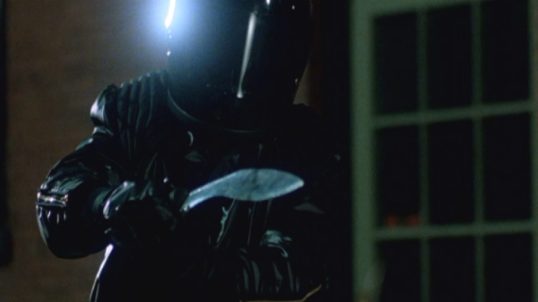
Because the murderer wears a motorcycle helmet and a full black leather bodysuit, we’re not sure who the killer is.  However, Lt. Austin promptly comes to the conclusion that the murderer is probably anthropology professor Vincent Millett (Drew Snyder), an unlikely lothario who is notorious for sleeping with his students and who has a collection of skulls in his apartment.  Austin’s attitude is that no normal person would teach anthropology and since it also stands to reason that no normal person would run around Boston chopping off people’s heads, Millett must be the murderer.  Millett doesn’t help himself by continually coming across as being a bit of an arrogant prick.

But is Millett the murderer?  There are other suspects!

For instance, there’s Millett’s teaching assistant (and lover) Eleanor Adjai (Rachel Ward), on whom Millett performs some sort of odd blood ritual while the two of them are taking a shower together, the better so that director Ken Hughes can toss in a playful homage to Psycho.

And then there’s Gary (Bill McCann), the obviously disturbed busboy at the local diner who tries to follow Eleanor home one night.

And let’s not forget the dean of students, Helene (Annette Miller), who is portrayed as being a predatory lesbian because this movie was made in 1981.

And then there’s….

Well, actually, that’s it.  One of the problems with Night School is there there really aren’t enough suspects.  For a film like this to really work, you need a lot more red herrings.  Savvy filmgoers already know that the most likely suspect isn’t going to be guilty because they never are.  Unfortunately, that wipes out 50% of Night School‘s suspects and only leaves two others, one of whom is soon murdered.  It all leads up to a surprise ending that’s not much of a surprise.

Night School is usually described as being a part of the slasher boom of the early 80s.  While it’s true that Night School probably would never have been made if not for the financial success of Halloween and Friday the 13th, the film itself, with its whodunit plot and it’s gloved and masked killer, is more an American giallo than a traditional slasher film.  That said, Night School never reaches the over-the-top, operatic heights of an Italian giallo.  Instead, it’s a rather subdued version of the genre, happy to efficiently do it’s job without getting too caught up in issues of guilt, sin, and absolution.  At the same time, some of the murders are cleverly staged and Rachel Ward brings some class to a film that could obviously use it.  Night School gets the job done, even if it’s ultimately not that memorable.

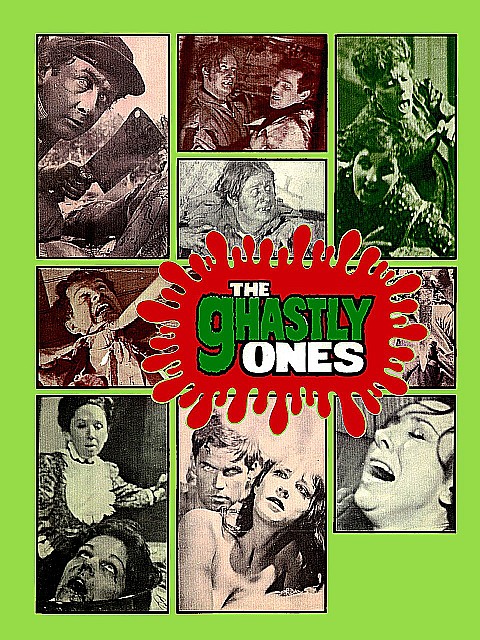
The TSL’s Horror Grindhouse: The Ghastly Ones (dir by Andy Milligan)


A young couple — both of whom are dressed in clothes that appear to come from the 1890s — enjoys a romantic and sunny excursion to an isolated island.  Unfortunately, their day is ruined when they’re discovered by a buck-toothed hunchback named Colin (played by Hal Borske).  Death and dismemberment follows.

Somewhere in New York, three sisters are informed that their father has died but that neither they nor their husbands can receive a cent of their inheritance until they fulfill one very specific requirement.  According to their father’s impossibly elderly attorney (played by Neil Flanagan, who is made up to look like an old witch from a community theater production of MacBeth), the sisters and their husbands must spend three nights in their father’s mansion.  Of course, the sisters agree.

Upon arriving at the mansion, they discover that the mansion is being looked after by two maids and a hunchbacked, buck-toothed handyman named …. COLIN!  Within a few minutes of meeting everyone, Colin eats a live rabbit while everyone watches.  Later the remains of the rabbit shows up in one of the sister’s bed, along with a note that reads, “Blessed are the meek for they shall inherit!”

Speaking for myself, I would probably leave as soon as I saw the handyman eating a live rabbit.  I mean, none of the sisters appear to be struggling financially but then again, greed is a powerful force.  Instead, everyone settles in for their three-night stay, which leads to 1968-style sex scenes and a lot of footage of people sitting around and talking about nothing.  For a low-budget grindhouse film, this is an extremely talky movie.

Anyway, eventually people start dying.  Someone gets pitchforked.  Another person is found hanging by his ankles.  There’s a rather bloody disembowelment and someone else loses their head.  Bloody X’es are left on doorways.  Who is doing the killing?  Hmmm …. well, Colin is the obvious suspect since we already saw him kill two people for absolutely no reason.  But, it turns out that Colin has a little help.  That’s right!  The Ghastly Ones comes with a twist ending that you’ll see from miles away.

So, what exactly is The Ghastly Ones?  It’s an extremely low-budget film, full of unlikable people dying in various grotesque ways.  It’s an oddly moralistic film, with everyone dying because their greed prevents them from doing the sensible thing and leaving the house.  It’s also apparently a period piece, with everyone dressed like they belong in the 1890s even though you can clearly hear the sound of cars in the background of a few scenes.

In short, this is another Andy Milligan film!  Filmed on Staten Island and featuring a largely amateur cast (though one of the husbands is played by Richard Romanus, who went on to appear in Martin Scorsese’s Mean Streets and has since had a respectable career as a character actor), The Ghastly Ones is just as bad and weirdly hypnotic as you would expect any Andy Milligan film to be.  Milligan even makes a cameo of sorts in the film.  Listen closely and you can occasionally hear him off-camera, feeding the actors their lines and, at one point, telling one of the sisters to “roll over.”

It’s a terrible movie and yet, it’s also strangely fascinating.  I think that’s because Milligan’s ineptness was matched only by his anger and that anger (along with a lot of pressimism) courses through the entire film.  Every frame of the film drips with Milligan’s sincere disdain for the greedy and selfish characters who appear throughout the movie and, as you watch, it becomes obvious that Milligan had more sympathy for Colin than for any of his victims.  (Of course, two of Colin’s victims were just two innocent people in love who were trying to have a nice picnic so perhaps it’s for the best not to dwell too much on what that might mean.)  Milligan directs this story with an intensity that doesn’t quite make up for the lack of talent involved but, at the very least, it does keep things vaguely interesting.  “Who are the Ghastly Ones?”  Andy Milligan seems to be asking.  “We all are.”

By the way, between this and Guru, The Mad Monk, I have now watched two Andy Milligan films in one week.  Pray for me.

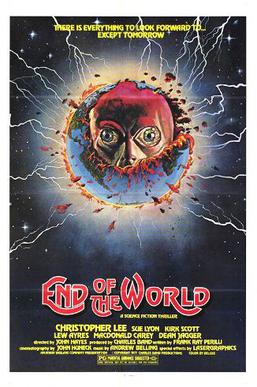
The TSL’s Horror Grindhouse: End of the World (dir by Charles Band)


The 1977 film End of the World has got a great opening scene.  An obviously distraught priest (played by none other than Christopher Lee!) steps into an isolated diner.  He tells the counterman that he needs to use the phone.  The counterman says, “Sure, father.”  And then suddenly, everything in the dinner starts blowing up.  The phone, the coffee, the pinball machine, everything explodes.  The counterman ends up trying to unsuccessfully throw himself through a window.  The priest, looking rather confused, steps outside of the diner and he runs into …. his exact double!  Christopher Lee meets Christopher Lee!

Again, that’s a great opening and it’s really not a surprise that the rest of the film can’t live up to it.  Once the two Christopher Lees disappear into the darkness, the focus of the story shifts to a scientist named Andrew (Kirk Scott) and his wife, Sylvia (Sue Lyon, who years previously played Lolita).  Andrew spends a lot of time sitting in front of a boxy computer and staring at the screen.  He’s picking up strange transmissions from space and he’s trying to translate them.  Andrew goes home.  He and his wife got a party.  Andrew sits in front of the computer a while longer.  Andrew goes home.  Andrew goes to work.  Andrew keeps staring at the computer….

“Wait,” you’re saying at this point, “isn’t this is a Christopher Lee movie?”

Yes, it is.  Christopher Lee is indeed top-billed and he’s hardly in the movie at all.  I’d like to think that, when asked why by an intrepid reporter why he agreed to star in End of the World, Lee laughed and replied, “For the money, of course.”  But, according to Lee’s autobiography, he did the film because he was told that he would be appearing with a cast of distinguished actors like Jose Ferrer, Dean Jagger, and John Carradine.  Now, Dean Jagger does have a small cameo in the film but Ferrer and Carradine are nowhere to be seen.  Either they left the production or someone lied to Sir Christopher!

Anyway, back to the plot.  Eventually, Andrew figures out that the space transmissions are predicting natural disasters.  We don’t actually see any of these disasters because, after all, this is the end of the world on a very low budget.  But we are assured that the disasters are happening.  Andrew and Sylvia discover that the transmissions are coming from a convent in the middle of the desert.  Andrew and Sylvia go to investigate and they discover that the nuns are….

ALIENS!

Now, this is actually a pretty good twist and there are some vaguely humorous scenes of the the nuns working in a space lab.  It turns out that the nuns (and one of the Christopher Lees) are stranded on this planet because their spaceship broke down.  They don’t really like Earth, considering it to be an ugly and polluted place.  They’re planning on ending the world but they need to leave before the whole place blows up.  They demand that Andrew help them fix their transporter and they’re going to hold Sylvia hostage until he does so….

It’s all a bit silly but, as you’re watching the film, you can’t help but wish that it had been even sillier.  I mean, alien nuns and Father Christopher Lee?  That sounds like the makings of a certain type of classic!  But, unfortunately, the film never fully embraces the full potential of its absurdity.  It takes forever for Andrew and Sylvia to actually reach that convent and even the alien nuns become rather passé after a few minutes.  Christopher Lee is fun to watch as always and his character’s irritation with being stuck on Earth was obviously mirrored by Lee’s irritation with being in the film.  And, despite all else, let’s give credit where credit it is due — the title lives up to its promise.  The world may end in a pile of stock footage but an end is an end.

Anyway, this one is pretty much for Christopher Lee completists only.  Watch the opening and then fast forward to the end.