The TSL’s Horror Grindhouse: Disconnected (dir by Gorman Bechard)


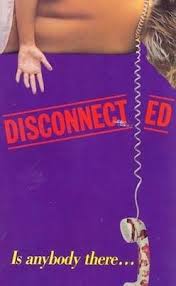
Disconnected, an independent and low-budget horror film from 1984, is an odd one.

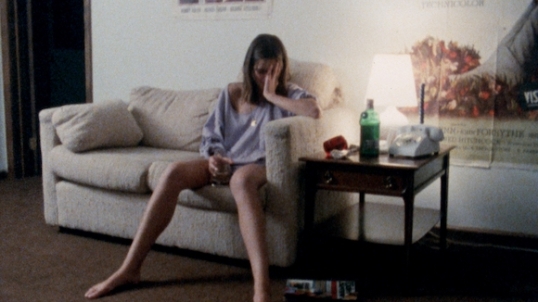
Actually, odd might be too mild of a description of this film.  It’s about Alicia (Frances Raines, niece of Claude) who works in a video store and who keeps getting strange phone calls.  Alicia has a boyfriend named Mike (Carl Koch) and a twin sister named Barbra Ann (Raines, again) and, one night, she answers her landline phone and suddenly hears Mike and Barbara Ann talking about the affair that they’re having!  She then starts having nightmares in which Mike and Barbara Ann team up to kill her.

At the same time that Alicia is dreaming about being murdered, Franklin (Mark Walter) actually is murdering women all over town.  Franklin also keeps asking Alicia for a date and, after she discovers that Mike has been cheating on her, Alicia finally says yes.  One morning, Franklin wakes up in bed, grabs a knife, and attempts to stab Alicia, just to discover that she’s already left for the day.  Franklin just ends up stabbing a pillow, which is unfortunate because it was a nice pillow.

Meanwhile, Detective Tremaglio (Carmine Capobianco) is trying to figure out the identity of the serial killer.  For some reason, Detective Tremaglio spends a good deal of the film talking directly to the camera, as if he’s being interviewed.  Tremaglio is quick to point out how cheap the police station looks and he also says, at one point, that he feels like he’s in a low-budget horror film.

It creates a rather odd atmosphere.  On the one hand, you’ve got Franklin wandering around town, hitting the bars and searching for new victims.  On the other hand, you’ve got Alicia isolated in her apartment, dealing with the phone constantly ringing and basically having a Repulsion moment.  Who is calling Alicia?  It’s hard to say.  It’s definitely not Franklin.  Is Alicia imagining the phone calls?  Or is it some sort of a supernatural force?  And how is it connected to the mysterious old man who keeps wandering through the film at certain points, popping up like a red herring from the 2nd season of Twin Peaks?

Disconnected raises a lot of questions but it doesn’t answer many of them.  And while it’s tempting to suggest that this is just a case of sloppy storytelling, there’s enough intentionally arty moments in the film that I actually think that Disconnected was intentionally designed to be a riddle wrapped in an enigma.  For instance, there’s a scene where Alicia answers the phone.  For some reason, the camera is placed directly in front of a window.  The sun is streaming in through the window, which leads to an almost blinding lens flare.  The viewer is vaguely aware of Alicia moving around the room and answering the phone but, due to that lens flare, it’s impossible to actually make out any real details.  It sounds like an error in camera placement and yet the scene goes on for so long that there’s no way it wasn’t intentional.  (It should also be noted that the scene itself wasn’t particularly important so, if that lens flare was an honest mistake, there’s no reason why the scene couldn’t have been left on the cutting room floor.)  Obviously, the director liked the effect and just decided to go with it.  And yes, it’s kind of annoying but it’s kind of fascinating too.

The entire plot of Disconnected has a kind of “let’s make this up as we go along” feel to it and it’s hard not to appreciate the film’s enthusiastic incoherence.  At its best the film achieves a sort of dream-like intensity.  In the end, it all means nothing and yet, thanks to Frances Raines’s better-than-average performance, you are invested in what happens to Alicia.  You want to know what it all means, even if it only adds up to the ringing of that cursed phone.
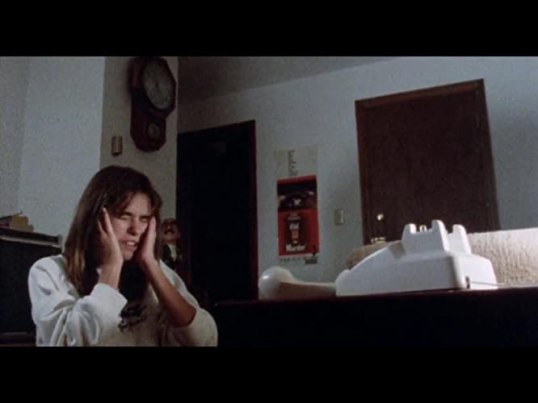
So, does that means I’m recommending Disconnected?  Kinda.  As I’ve said many times in the past, I have a weakness for low-budget, amateur films.  This one was filmed out in the middle of Connecticut and most of the actors were obviously not professionals.  There’s something oddly likable about a film like this, one that makes no sense but, at the very least, was still made and — 36 years later — is still being watched and reviewed.  So …. yeah, I am kind of recommending this film.  It’s weird enough to be worth at least one viewing.
The TSL’s Horror Grindhouse: 2001 Maniacs (dir by Tim Sullivan)


A lot of people die over the course of this 2005 film but none of them are particularly likable so who cares.

A remake of the Herschell Gordon Lewis classic (though Lewis’s film only featured Two Thousand Maniacs!), 2,001 Maniacs is about a small town called Pleasant Valley in Georgia.  During the Civil War, Union soldiers killed 2,001 of the residents of Pleasant Valley so, as a result, the angry spirits of the town will not be happy until they’ve killed 2,001 Northerners.  Luckily, for them, some yankee college students come driving through on their way to Daytona Beach for Spring Break.  That means it’s time to bring out the hooks, the blades, the flames, and all the other things that can be used to dismember people on screen.  It’s a bloody good time in Pleasant Valley.

The mayor of Pleasant Valley is played by Robert Englund and, if nothing else, Englund brings a lot of demented glee to the role.  One thing that I’ve always liked about Englund is that, even though he could probably get away with it, he’s always refused to coast on the fact that he’s a horror icon.  No matter the quality of the film in which he’s appearing, Englund always goes all out and gives a memorable performance.  As played by Englund, the mayor comes across as being an affable and welcoming guy, or at least he does until he starts killing people.  The viewers automatically know that the mayor’s a bad guy because they know the type of role in which Robert Englund typically gets cast.  But, and this is the important, you can at least understand why the film’s victims didn’t automatically run in fear as soon as they met him.  The mayor is all about hospitality.  (That, and bloody revenge.)

Anyway, it’s tempting to view 2,001 Maniacs as being some sort of statement about Confederate war memorials but …. eh.  I mean, again, it’s tempting but I think it’s ultimately kind of pointless.  This is not a subversive film.  This is not a film that’s attempting to scratch the surface of any major issues.  This is just another gory film that examines the amount of ways someone’s body can pulled apart.  That’s not necessarily a bad thing.  There’s a lot of classic horror films that are centered around people dying in gory ways.  The problem with 2,001 Maniacs is that, since none of the people dying are particularly interesting, you don’t really care about how they die or even the fact that they’re dead.  “Oh hey,” you find yourself saying, “at least I won’t have to listen to that guy talk anymore.”

Despite being a bit on the dull side for most of its running time, 2,001 Maniacs does have an effective final few minutes.  There’s a big battle between a survivor and a ghost that is surprisingly well-directed and would have been exciting if we actually cared about whether or not the survivor was actually going to …. well, survive.  As for the film itself, it ends on a properly macabre note.  I actually laughed at the film’s ending, even though perhaps I shouldn’t have.  Again, it all comes down to not really caring that much about anyone in the movie.

Anyway, 2,001 Maniacs didn’t do much for me.  The Lewis version is still the version to go with.  Thank God for Robert Englund, though.  That man can act.


The TSL’s Horror Grindhouse: Man on the Prowl (dir by Art Napoleon)


Man on the Prowl is a surprisingly intense film from 1957.

Doug Gerhardt (played by James Best) is an overly friendly young man with a pompadour and a quick smile.  Doug works as a deliveryman for a car dealership and he seems like a nice enough person.  He’s maybe a little bit goofy and, if you talked to him, you might think that he’s a little bit slow.  Still, it’s hard not to get caught up in his endless enthusiasm.  Doug is a very friendly man and he certainly does seem eager to help everyone that he meets.

Of course, Doug is also a sociopathic murderer.  He’s just been released from a mental hospital and, as we see when he strangles his date during the first few minutes of the movie, he’s still got some issues.  However, no one ever seems to really notice, just because he is so friendly and kind of dorky.  Even though his own mother (Vivi Janiss) tries to warn people that Doug is not well, most people just think that he’s a little bit eccentric.

When Doug nearly runs over Marian Wood (Mala Powers) and her son, Marian is not very happy with him.  Doug apologizes for driving too fast and he even insists on helping Marian carry in her groceries.  Marian goes from hating Doug to being somewhat forgiving of his reckless driving.  That’s the power of Doug’s charm.  He can go from nearly killing someone to making a new friend in just a matter of minutes.

Marian is married to Woody (Jerry Paris), though it’s not a particularly happy marriage.  Woody is always traveling on business, leaving Marian to take care of the house on her own.  Seeing an opening, Doug starts to casually drop by so that he can do things like help Marian fix the washing machine.  Of course, it’s hinted that Doug might be the one who broke the washing machine in the first place.  Doug is determined to replace Woody in Marian’s life.  When it turns out that Marian isn’t ready for husband to be replaced by a delivery boy (even if that delivery boy can fix a washing machine) …. well, Doug doesn’t take it well.

Man on the Prowl really took me by surprise.  For a film made in 1957, the story didn’t feel particularly dated, beyond a few things that couldn’t be helped.  (Doug’s pompadour comes to mind.)  If anything the film feels refreshingly honest in its willingness to admit that not all marriages are happy and not all wives are content with the idea of just sitting at home and waiting for their husband to return.  However, the thing that really took me by surprise was how Doug was portrayed.  Considering that the term “serial killer” wouldn’t be coined until 23 years after this film was originally released, Man on the Prowl is a surprisingly realistic portrayal of a serial killer.  Doug is someone who is empty on the inside but who keeps the world from noticing by deploying a charming smile and a friendly manner.  He’s Ted Bundy, decades before Bundy became a household symbol of evil.  As played by James Best, Doug is a very realistic and very frightening modern monster.

In many ways, Man on the Prowl is a prophetic film.  In 1957, someone like Doug was probably seen as being an aberration, a once-in-a-lifetime example of the natural order of things getting screwed up.  Now, however, we know that the world is full of Doug Gerhardts.  And we all feel a little less safe as a result.

The TSL’s Horror Grindhouse: The Burning (dir by Tony Maylam)


Among some horror fans, the 1981 film, The Burning, has long had a reputation for being one of the best of the many films to come out of the early 80s slasher boom.

I have to admit that the first time I saw it, my thought process went something like this:  Oh great, more campers …. I can’t wait to see all of these people die …. God, these campers are annoying …. Thank God I never went to summer camp …. Wait, is that Jason Alexander …. when is the killer going to show up …. oh hey, that is Jason Alexander …. if I wanted to sit through a bunch of silly summer camp hijinks, I wouldn’t have gone searching for a horror film …. goddammit, was it really necessary for Jason Alexander to moon the camera …. wow, this movie is boring …. I don’t know who said this was scary but seriously …. oh God, now it’s turning into a movie about rafting …. I’ve about had it …. this movie is so bor–OH MY GOD WHAT THE HELL JUST HAPPENED! AGCK!  THERE GO HIS FINGERS OH MY GOD….

Seriously, The Burning is a film that requires a bit of patience.  You got to sit through a lot of silliness before you actually get to the horror but once you do …. oh my God!  It’s intense.  The killer in The Burning is Cropsy, a former groundskeeper who was set on fire by a bunch of campers years ago.  Now, he’s everyone’s worst nightmare — a madman with gardening shears.  It takes a while for Cropsy to really get into the spirit of things.  In fact, for a good deal of The Burning, no one is even talking about Cropsy, which is always a mistake when you’re trying to make a movie about a killer in the woods.  A young camper named Alfred (Brian Backer) keeps thinking that he see Cropsy sneaking around the camp but nobody believes him, largely because Cropsy doesn’t ever do anything to let people know that he’s back and ready to demonstrate how gardening tools can be used as an instrument of revenge.

However, once Cropsy actually gets going, he is terrifying!  The Burning is a good example of the type of horror movie that was made before the Nightmare on Elm Street series introduced the idea that killers could not only talk but also tell a lot of corny jokes.  Cropsy doesn’t speak.  Crospy doesn’t joke.  All Cropsy does is kill.  What makes Cropsy especially disturbing is that — much like the killer in The Prowler — he seems to get a lot of joy out of killing as brutally as possible.  He’s not Jason or Michael, killers who killed because that’s all they knew how to do.  Cropsy plots and calculates and hides and is basically everyone’s campfire nightmare come to life.

Now, as I said before, it does take Cropsy a while to get started.  And we do end up spending a lot of time watching campers do stupid things.  Yes, Jason Alexander is one of the campers.  He not only has hair but I think he’s supposed to be a teenager in this film.  He was 21 when the film was shot and he looks like he’s about 35.  He delivers his lines in such a way that it’s impossible not to think of The Burning as being a lost episode of Seinfeld where George Costanza goes camping.  On the plus side, he does get some vaguely funny lines, which is more than his co-stars get.

Speaking of co-stars, keep an eye out for Holly Hunter.  She was dating Jason Alexander at the time (as well as rooming with Frances McDormand) and she makes her film debut as one of the campers.  She gets one line.  “What if they don’t come back?”  It’s a good question.  What if they don’t?  (Cue dramatic music!)

Anyway, The Burning is a slasher film that requires some patience but when it needs to be scary, it gets the job done.  (The gore effects are by the one and only Tom Savini and yes, they are shocking and a bit disturbing.  If you’ve ever wanted to know what losing four fingers at once would look like, this is the film for you.)  It’s a bit too padded for its own good but Cropsy is an effective villain and the movie actually catches you by surprise regarding who survives and who doesn’t.  Amazingly, there was never a sequel to The Burning.  Personally, I don’t think it’s too late.  I want to see Jason Alexander return to the camp and finish Cropsy off, once and for all!

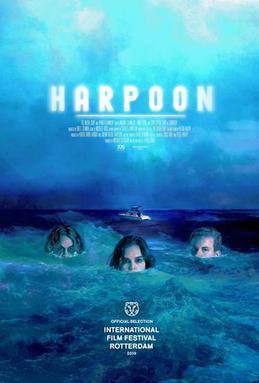
The TSL’s Horror Grindhouse: Harpoon (dir by Rob Grant)


The 2019 Canadian film, Harpoon, tells the friends of three friends and a boat.

The three friends are Jonah (Munro Chambers), Richard (Christopher Gray), and Sacha (Emily Tyra).  Jonah is a perhaps overly sensitive young man who is struggling to come to terms with not only the death of his parents but also the mountain of debt that they left for him.  Richard is wealthy, has an anger problem, and it is suggested that his father might have murdered at least one person.  Sacha is a nurse who is going out with Richard.  Richard claims to love Sacha but that still doesn’t stop him from cheating on her.  Jonah is obviously in love with Sacha but, just as obviously, he would never betray his best friend …. or would he?

The boat is a yacht known as the Naughty Bouy.  It’s a really nice yacht.  Richard owns it, though he doesn’t appear to be much of a sailor.  The film’s rather sardonic narrator (voice of Brett Gelman) lists a number of superstitious beliefs that Richard, Jonah, and Sacha overlooked when they boarded the yacht for the day.

Here’s just a few of them:

  1. It’s never safe to have someone named Jonah on a boat.
  2. It’s not safe to take your first step onto a boat with your left foot.
  3. Apparently, it’s bad luck to have a redhead (like Sacha and, for that matter, me) on a boat.
  4. Never kill a sea gull.  “That’s a big one,” the narrator tells us, right after Jonah and Richard kill a sea gull.

Now, I really can’t go into too many specifics about what happens on the boat without spoiling the film.  And this is a film that you really should watch without any knowledge of what’s about to happen.  However, I will say that the friends eventually end up stranded out in the middle of the ocean.  Some of it’s because of bad luck.  Some of it’s because the friends all seem to secretly hate each other.  Two of them may have teamed up to try to kill the other one …. or maybe someone’s just being paranoid.  One of the friends ends up with hole in their hand, courtesy of a spear gun.  The important thing is that they eventually find themselves trapped out in the middle of the ocean, forced to depend on one another even while possibly thinking about killing each other.  Secrets and lies are revealed and hard decision are made.  It would all be really dark, if not for the sardonic commentary of the narrator, who not only tells us who these three are but who also keeps informed as to what they’re doing wrong.

It’s a good movie, one that immediately captured my attention and kept me guessing as to what was going to happen.  If I’ve been vague about the film’s plot, it’s because this film earned the right to not be spoiled.  It’s an occasionally grisly thriller with a wonderfully dark sense of humor.  The three actors all did a wonderful job bringing their three less-than-lucky characters to life.  Fans of Degrassi will especially be interested to see Munro Chambers, giving an excellent performance as a character who might initially remind them of Eli Goldsworthy but who eventually turns to be someone else altogether.

Harpoon really surprised me.  Keep an eye out for it and, for the love of God, don’t kill any seagulls.


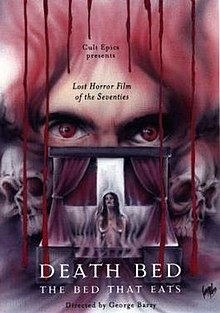
The TSL’S Horror Grindhouse: Death Bed, The Bed That Eats (dir by George Barry)


Perhaps one of the most brilliant films ever, the 1977’s Death Bed: The Bed That Eats is a film about a bed that eats people.  Yes, just like the title says.

Seriously, that’s almost the entire film.  The bed sits in an abandoned, dilapidated mansion that appears to be located out in the middle of nowhere.  People break into the mansion.  People find the bed, which is surprisingly well-cared for considering the fact that it’s sitting in the middle of a dusty, abandoned house.  Some people make love.  Some people try to get some sleep.  Some people just sit down so they can take off their shoes.  But in the end, all of them get eaten.

The bed is vaguely alive, which is to say that, if you listen carefully, you can hear it breathing and chewing.  Many years ago, the bed was conjured up by a demon who needed a place to make love to his girlfriend.  Unfortunately, his girlfriend died while they were having sex which caused the demon to cry.  The demon’s tears brought the bed to life and now, every ten years or so, it has to feed.

We know all of this because the painter Aubrey Beardsley tells us so.  Much like Paganini Horror, Death Bed is unique in that it features an actual historical figure as a key part of the story.  Aubrey Beardsley was an English illustrator who specialized in pictures of the grotesque, the decadent, and the erotic.  Beardsley was only 25 years when he lost his life to tuberculosis, dying in France in 1898.  However, Death Bed suggests that Beardlsey did not actually die but was instead imprisoned for eternity inside one of his paintings, forced to helplessly watch as Death Bed feasted.  Though Beardsley knows how to destroy the Death Bed, no one can hear his words.

One of the more interesting things about Death Bed is that we actually get to see the inside of the bed while it’s digesting it’s victims.  The bed literally eats everything that’s dropped on it, except for one woman who reminds the bed of the woman whom the demon loved.  Whenever the bed sees this particular woman, it cries out in pain and we get a shot of red blood shooting through the inside of the bed.

The woman is Sharon (Rosa Luxemburg), a runaway who has come to the mansion with two of her friends.  Why they’re at the mansion is never really quite clear, beyond the fact that they want to take care of the place for some reason.  Suzan (Julie Ritter) brings flowers, just for Diane (Demene Hall) to point out that the mansion is in the middle of the wilderness and is therefore already surrounded by flowers! The bed eats Suzan and half of Diane.

Meanwhile, Sharon’s brother shows up and, believe it or not, he’s played by a vaguely recognizable actor, William Russ.  (Russ is probably best known for playing Cory’s father on Boy Meets World.)  Sharon’s brother — who doesn’t get a name beyond that — gets his hands eaten down to the bone by the bed but it doesn’t seem to bother him that much.  He just sits there and stares down at his skeletal fingers.  Can Sharon and her brother end the bed’s reign of terror?  Will Aubrey Beardsley ever find peace?

Earlier, I called Death Bed brilliant and I was not joking.  Death Bed plays out like a dream, full of weird images and off-kilter dialogue and strangely subdued performances.  As odd as the story may be, the film delivers exactly what it promises.  This is a film the promises a bed that eats people and that’s exactly what this bed does.  The film plays out in a collection of strange, vaguely-connected images, mixed in with odd moments of humor.  There’s a random shot of an elderly woman reading hardcore pornography.  The bed drinks pepto bismol after having too much to eat.  William Russ explains why his bony hands are falling apart.  Death Bed is a dream of dark and disturbing things, a film that creates its own reality and dares you to stop watching.  Much like An American Hippie In Israel, there’s no other film like it and therefore, it’s important that it be watched and appreciated.  Death Bed is a unique spectacle, one that exists in a universe of its very own.

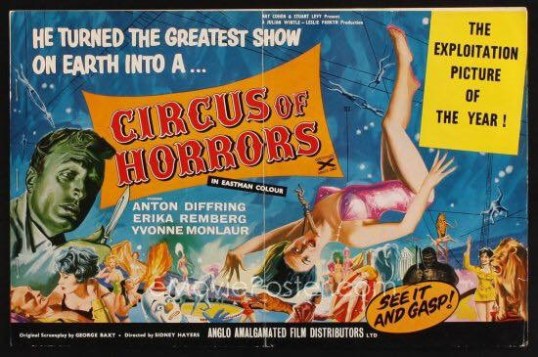
The TSL’s Horror Grindhouse: Circus of Horrors (dir by Sidney Hayers)


About 15 minutes into this film from 1960, Donald Pleasence gets mauled to death by a dancing beer.

Pleasence plays a character named Vanet.  Vanet is an alcoholic who, circa 1947, owns a circus.  He also has a daughter named Nicole (Yvonne Monlaur), whose face is scarred as a result of wounds that she received during Germany’s bombing of London.  When a plastic surgeon named Dr. Bernard Schuler (Anton Diffring) operates on Nicole and manages to “take away” her scars, Vanet is so thankful that he signs over ownership of the circus to Schuler.  Vanet then promptly tries to dance with a bear and gets killed.  Poor Vanet.

It turns out that Schuler is a brilliant plastic surgeon but he’s also kind of insane.  He and his associates (played by Kenneth Griffith and Jane Hylton) are on the run from the police.  However, even with the cops after him, Schuler has to experiment.  His plan is to use the circus as a front.  He’ll recruit scarred criminals, operate on them, and then require them to perform in his circus.  That plan doesn’t really make much sense but I guess a fugitive plastic surgeon has to do what he has to do.  Still, it’s hard not to be amused by Schuler describing his plans for the circus as if he’s just come up with the most brilliant plan ever as opposed to just a bunch of gobbledygook.  At no point do any of his assistants point out that his plan makes no sense so I guess he must pay well.

Anyway. the film jumps forward twelve years and what do you know!  The plan worked!  The circus is a hit!  People from all over Europe come to Schuler’s circus.  The circus is famous for featuring the most beautiful women in the world.  The circus is also famous for several mysterious and fatal accidents.  INTERPOL thinks that it’s possible that Schuler is intentionally killing his performers for the free publicity.  When Schuler makes plans to take his circus back to the UK, Scotland Yard is given a call and a heads up about what Schuler’s been doing.  A nosy reporter investigates while the murders continue unabated….

Circus of Horrors is odd.  It’s as if someone reached into a bag and pulled out random cards that read, “Circus,” “plastic surgery,” and “Word War II subtext” and then did what they had to do to construct a plot out of those three elements.  Of those three elements, the World War II subtext is probably the most interesting.  The majority of Schuler’s patients were scarred as a result of the war (which Europe was still recovering from in 1960) and Schuler is played by German actor Anton Diffring.  It’s easy to see Schuler, with his German name and his love for medical experimentation, as a stand-in for Nazi fugitives like Josef Mengele and Klaus Barbie. Schuler and his circus move across Europe and, in the end, it’s going to take Europeans working together to stop him.  The shadow of World War II hangs over every scene.

Beyond that, Circus of Horrors is a flamboyant mix of horror and soap opera.  The colors are bright, the blood flows freely, and the melodrama is definitely embraced.  It’s like a Hammer film, just without a Hammer cast.  Unfortunately, Anton Diffring is a bit bland in the role of Schuler.  One could imagine an actor like Christopher Lee or Peter Cushing working wonders with the role but Diffring often seems to be bored with the whole thing.  As well, the film sometimes get bogged down with footage of the circus performers doing their thing.  For instance, do we need to see the clowns and the acrobats when what we really want to see is the murderous knife thrower?  Circus of Horrors has its moments but, while watching it, it’s hard not to think about how much more fun it would have been if it had been a Hammer film.

The TSL’s Horror Grindhouse: Die Cheerleader Die! (dir by Jerry Patterson)


Hey, what do you think this film is about?

Die Cheerleader Die! is a film that was first released in 2008. It’s an independent film out of Chicago and it’s about cheerleaders. It’s also about someone who is murdering all of the cheerleaders at a …. well, I’m not sure if they were supposed to be in high school or college. All of the cheerleaders appeared to be grad student age but all the classrooms looked like they belonged in a high school.

Anyway, Tiffany (Inga Draper) is in charge of the cheerleading squad at this high school or college and she basically runs it like a dictator. She tells everyone what they can and cannot do. For instance, she orders Robin (Maria Perez) to starve herself, even though Robin is not overweight at all. Robin finds herself being tempted away from the cheerleaders by a group of body acceptance activists who are referred to as being “Pretty Intelligent Girls” or …. well, you can figure out the acronym for yourself. When cheerleaders start to turn up dead, the Pretty Intelligent Girls are the number one suspects but could it be someone else?

Who knows? This film is a difficult one to sit through, largely because it was shot on video with amateur actors, fluorescent lighting, and natural sound. That’s another way of saying that Die Cheerleader Die is essentially a 90-minute YouTube video and it’s perhaps appropriate that that’s where I saw it. There’s no suspense, the kills aren’t particularly interesting, and the whole thing just gets kinda boring pretty quickly.  As I always do whenever watching a horror film about cheerleaders, I forced my sister to watch it with me so that I could get her thoughts on whether or not the film accurately captured the high school cheerleader experience.  Erin abandoned the film after about seven minutes but I stuck with it because I though it might turn out to be a Coen Brothers-style commentary on high school films.  It wasn’t.

But, I don’t like being totally negative in any review so I am going to point out two good things. Number one, Inga Draper gave a pretty good performance as Tiffany. She was like every aspiring dictator that you ever knew in high school. Secondly, regardless of whether the film is any good or not, you can’t deny that it actually got made. The filmmakers may have made some poor production choices but they still got their film made and, 11 years later, it’s still being watched and reviewed. That’s more than most people who have, at some point, said, “I’m going to make a movie!” have accomplished.

Finally, cheerleaders always seem to be at a disadvantage in horror movies. I’ve always found that pretty strange because most of the cheerleaders that I’ve known were tough-as-nails athletes who, because they were constantly having to deal with snarky comments and pervy flirtation, knew how to take care of themselves. In a real life horror movie, the cheerleaders would probably be the only ones to survive.

Trust me, when the apocalypse hits and the world is burning all around you, you’re going to be looking to the cheerleaders to not only keep up your spirits but save the world as well.

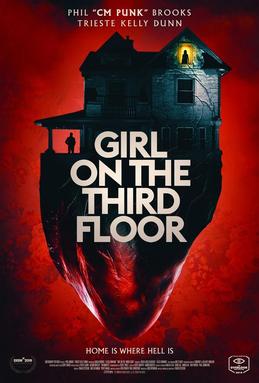
The TSL’s Horror Grindhouse: Girl on the Third Floor (dir by Travis Stevens)


The 2019 film, Girl on the Third Floor, tells the story of Dan Koch (Phil Brooks), a former criminal who says that he’s trying to turn his life around.  Phil is married to Liz (Trieste Kelly Dunn) and they’ve not only got a baby on the way, they’ve also got a new house!  It’s a surprisingly big house and you have to kind of wonder why no one else has bought it.  Maybe it’s because there’s an Episcopalian church right across the street.  That definitely would have kept me from moving in.

Still, despite the presence of Anglicans in the neighborhood, Phil moves into the house.  He wants to get the house ready before his pregnant wife comes out to join him.  Helping Phil out are his dog Cooper and his best friend, Milo (Travis Delgado).  Ellie (Karen Woditsch), the rather judgmental pastor who lives in the church, also comes by and visits.

Of course, any old house is going to have its issues.  There’s the mysterious sludge that pours out of the walls.  There’s the mysterious marbles that keep rolling through the house.  There’s the mysterious bumps in the nights and the fact that Cooper seems to be weary of the new home.  Dogs can always pick up on evil.  Of course, along with being a bit of an idiot, Don is too busy banging his new neighbor, Sarah (Sarah Brooks), to notice.

Don, if you haven’t guessed, is a bit of a jerk.  Even though he swears that he feels guilty for cheating on his wife, he still does it.  When his friends mysteriously disappear while helping out around the house, Don doesn’t make much of an effort to find them.  When Don thinks that there’s a chance his wife might find out what’s been going on at the house, he goes to extreme methods to try to cover everything up.  Don thinks that he can control every situation but Sarah and the House both appear to be intent to prove him wrong.

Girl on the Third Floor is a deliberately-paced …. well, I guess you’d call it a haunted house story.  I was tempted to call it a ghost story but the film is frequently ambiguous as to whether or not the house is haunted by ghosts or by something far worse.  Eventually, we do learn a bit about the house’s past but Girl on the Third Floor is at its best when it leaves you wondering what exactly is going on.  Not all questions have to be answered, especially not in a horror movie.  In fact, the key to most successful horror tales is the knowledge that some questions will never be answered, no matter how effort we put in to  searching for a solution.

Phil Brooks, who wrestled under the name CM Punk, is well-cast as the frequently brutish Don.  Brooks convinces us that he does want to be a better person while also showing that he doesn’t really have the inner strength necessary to do so.  Trieste Kelly Dunn also does a good job as Don’s wife, who seems like she really does deserve better.  Not surprisingly, the film is stolen by Sarah Brooks as the mysterious neighbor.  Not only does she get to wear all the best clothes but she also gets all of the best lines and her confidence that Don will fail whatever test she puts before him is both chilling and understandable.

Despite being a little bit slow-paced (especially early on in the film), Girl on the Third Floor has enough atmosphere to hold one’s attention and the final third of the film is enjoyably surreal.  Girl on the Third Floor is currently on Netflix.  Watch it the next time you’re wondering whether or not to start a home improvement project.


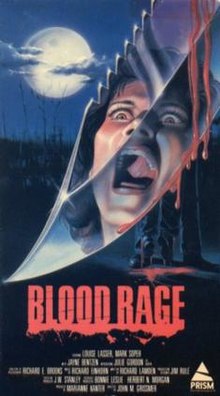
The TSL’s Horror Grindhouse: Blood Rage (dir by John Grissmer)


Filmed in 1983 but not released until 1987, Blood Rage tells the heart-warming story of two twin brothers, Todd and Terry Simmons (both played by Mark Soper).

In 1974, young Todd and Terry go to a drive-in movie with their mother, Maddy (Louise Lasser) and Maddy’s boyfriend.  (It’s suggested that Maddy has had many boyfriends over the years.)  The twins fall asleep in the back of the station wagon but, when they wake up, they discover that Maddy is making out with her date.  This inspires Terry to sneak out of the car, grab a nearby hatchet, and walk from car to car.  When he comes across another couple making love, he hacks the man to death and then watches as the man’s naked date runs into the night.  Realizing that he’s about to get in a lot of trouble, Terry hands the hatchet to Todd and then rubs blood on his brother’s face.  As a result, everyone assumes that Todd is the murderer.

Nine years later, Terry is living with Maddy at a secluded apartment complex called Shadow Woods.  Todd, on the other hand, is stuck in an asylum and not very happy about it.  On Thanksgiving, Todd escapes from the asylum and heads off to Shadow Woods.

Here’s where things get strange.  Everyone assumes that Todd is heading to Shadow Woods to get revenge.  That’s certainly what I assumed when he first escaped.  But it turns out that Todd, despite all he’s been through, is still a gentle soul.  He just wants to be free and to see his family.  However, when Terry learns that Todd has escaped, he sees it as a perfect excuse to go on another killing spree.

So, while Todd is sneaking around the complex, Terry is killing Maddy’s latest boyfriend and all of their neighbors.  Everyone who sees Todd asumes that he’s Terry and almost everyone who sees Terry assumes that he’s Todd.  It’s an intriguing premise that has a lot of potential.  Unfortunately, Blood Rage never gets as much mileage out of the idea as it should.  It’s not until the last few minutes of the film that it really digs into just how messed up Maddy and her sons really are.

Every by the standards of an 80s slasher film, Blood Rage is brutal.  Hands are hacked off.  Heads are separated from necks.  One unfortunate victim is chopped in half and spends what seems like several minutes feeling around for the lower half of her body.  As opposed to emotionless killing machines like Jason Voorhees and Michael Myers, Terry Simmons seems to get real kick out of what he’s doing, which makes him all the more disturbing.  Interestingly, it’s not just the killing that Terry enjoys.  Terry also seems to enjoy knowing that he’s specifically going to get Todd in even more trouble.  He’s the ultimate bad sibling.

Mark Soper plays both Todd and Terry and he does a good enough job in the role that you can tell the two twins apart.  Occasionally, Soper does occasionally go a bit overboard as Terry but then again, most murderers aren’t known for their subtle personalities.  The film is pretty much stolen by Louise Lasser, who gives a memorably eccentric performance as Maddy who is, in her own way, just as unstable as her sons.  Some of the performances from the surprisingly large number of victims are inconsistent but, in the end, everyone dies convincingly and that’s what really matters in a film like this.

As I mentioned at the start of this review, Blood Rage was filmed in 1983 and sat on the shelf for four years.  Apparently, several different versions of the film have been released.  There’s a version called Nightmare at Shadow Woods that has almost all of the gore cut out.  The version that’s on Shudder is apparently uncut but it also opens with a title card that reads Slasher.  Blood Rage is a bit of a generic title but it is appropriate.  There is a lot of blood and there’s a lot of rage.

In the end, Blood Rage is an effective, if uneven, slasher movie.  Though the budget was undeniably low, the gore effects are convincing and the whole twin subplot allows from some unexpected moments.  The low-budget look of the film actually works to Blood Rage‘s advantage.  The grainy images occasionally give the film a rather dream-like feel.  At its best, it looks like a filmed nightmare.  At its worst, it just looks like another low-budget slasher flick from Florida.

Blood Rage may not be a masterpiece but it is a good film for the Halloween (and, given the film’s set-up, Thanksgiving) seasons.