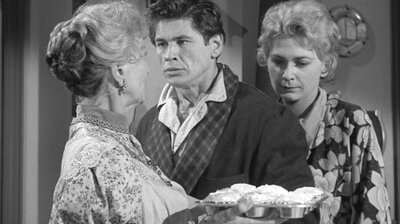
ALFRED HITCHCOCK PRESENTS (TV Series) – S1, E25: “There was an Old Woman,” starring Estelle Winwood and Charles Bronson!


For a little bit of historical perspective, Charles Bronson was an up and coming young character actor when he appeared in the 25th episode of season 1 of ALFRED HITCHCOCK PRESENTS, “There Was an Old Woman,” which originally aired March 18, 1956. Having already shared the screen with the likes of Gary Cooper, Spencer Tracy, Katherine Hepburn and Burt Lancaster, Bronson had an interesting face that would allow him to comfortably play a wide range of roles in 1950’s Hollywood, from Native Americans (DRUM BEAT and APACHE), murderous criminals (CRIME WAVE and BIG HOUSE USA), compassionate doctors (the TV series MEDIC), and even deaf mutes (HOUSE OF WAX). In the mid-1950’s, Bronson was alternating between character parts on the big screen and guest starring roles on the small screen. For someone like me, it’s fun looking back at these early years and roles when Bronson was a hungry, young actor just trying to keep working. Not blessed with matinee idol looks, he attacked his roles with a gusto that, with the benefit of hindsight, would form a foundation that would eventually lead to him becoming the most popular actor in the world a decade later.

In “There Was an old Woman,” down-on-their-luck married couple, Frank Bramwell (Charles Bronson) and Lorna Bramwell (Norma Crane), are desperate for cash. While finishing off their breakfast at the local cafe, they overhear a private conversation between a milkman and the counter guy concerning the vast wealth of a local old woman named Monica Laughton (Estelle Winwood), an eccentric widow who lives alone in a grand, outdated Victorian house. The Bramwell’s think they’ve won the lottery and soon they’ve hatched a scheme to work their way into Mrs. Laughton’s home in hopes of relieving her of all that money. Once inside her home, the young couple gets much more than they bargained for when they discover that the kind and proper old woman lives in a fantasy world of imaginary people, imaginary dinner parties, and imaginary funerals. They play along with her delusions for a while and set about looking for the money, but when they can’t find it, Frank pulls out his knife and threatens to kill Mrs. Laughton and all her “guests” if she doesn’t give them her money. Needless to say, Mrs. Laughton may be nutty, but she has a few tricks up her sleeve and the Bramwell’s just may be on their way to being permanent guests! 

If you enjoy entertainment that features black comedy, ironic twists of fate, and deadly danger in the most unexpected of places, you’ll enjoy this macabre gem of an episode. “There Was an Old Woman” sets the Bramwell’s up to think that they’re the ones in charge, until it’s revealed in an instant that they are in way over their head with the eccentric Mrs. Laughton. Bronson and Norma Crane are good as the married couple with bad intentions. I guess it would be more accurate to say that Bronson’s character has the bad intentions while Norma’s character just seems to have picked the wrong man. Bronson is in his amoral, bully-thug mode here, a type of role he played very well in the early years of his career. I thought Norma Crane projected a sort of innocent sweetness, and I felt sorry for her as events spiraled out of control. But the real star of the episode is Estelle Winwood as the delusional “old woman” of the title. She steals the show as Monica Laughton, delivering a fun and deceptively cunning performance as the grande dame who’s much more aware of the dangers around her than she lets on. She may be eccentric, but she’s nobody’s fool. Estelle Winwood is perfect in the role, a testament to a woman who was 73 years old when this episode aired and who would go on to work for over 20 more years, with her final role on an episode of the TV series QUINCY, M.E. that aired in 1980. One of the joys of watching older TV shows and movies is discovering more about some of these talented actors and actresses who starred in them. Winwood had an incredible, five decade career, and she would pass away in 1984 at 101 years of age. 

Overall, I recommend “There Was an Old Woman” to any person who appreciates Alfred Hitchcock, vintage TV, black comedy, Charles Bronson, Norma Crane, and Estelle Winwood. It’s interesting and fun stuff! 
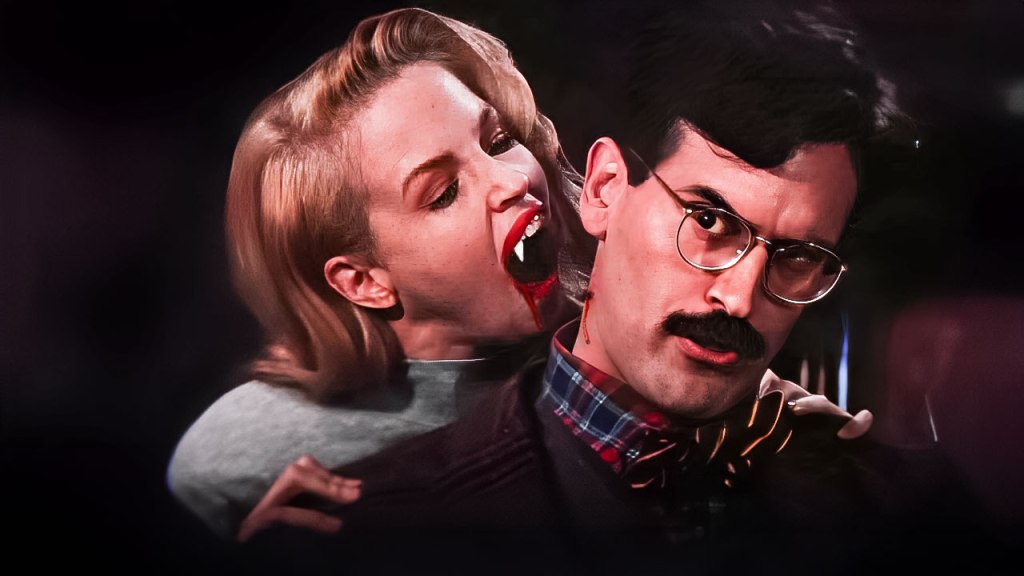
Brad reviews SUNDOWN: THE VAMPIRE IN RETREAT (1989), starring David Carradine and Bruce Campbell!


In honor of Bruce Campbell’s 67th birthday, I decided to watch a movie he’s featured in that I’ve never seen before. I thought the horror-comedy SUNDOWN: THE VAMPIRE IN RETREAT looked like it might be fun so I went for it! 

In the desert town of Purgatory, a colony of vampires led by Count Mardulak (David Carradine) want to live in peace, abstaining from human blood, and instead, drinking a blood substitute called “Necktarine,” which is produced in a local factory. They also use high powered sunscreen that allows them to go out in the day time as long as they wear thick sunglasses, big hats or umbrellas, and gloves. Unfortunately, the blood factory begins experiencing production issues, so Mardulak asks David Harrison (Jim Metzler), the unsuspecting human who designed the production process, to come to town and fix their problems. Harrison brings his family with him, including his wife Sarah (Morgan Brittany), and their two daughters. The Harrison family soon find themselves in the middle of an other worldly war as Jefferson (John Ireland) and Shane (Maxwell Caulfied), rebellious local vampires, plot to overthrow Mardulak so they can return to their murderous ways. Meanwhile, Robert Van Helsing (Bruce Campbell), the great grandson of the famed vampire hunter, walks into town, ready to romance the local vampire beauty Sandy (Deborah Foreman) and drive stakes into the hearts of as many bloodsucking freaks as possible!

As far as I’m concerned, SUNDOWN is a blast as a completely absurd horror-comedy that puts an interesting spin on traditional vampire legend, with its endless sunscreen slathering and a growing local weariness over “Necktarine” adding to the good times. It’s campy and silly, with purposely terrible stop motion bat effects, over-the-top family drama, and lots of cheesy one-liners, but of course that’s all part of the charm. 

The B-movie dream cast is what I enjoyed the most about SUNDOWN. David Carradine plays it pretty straight as the town leader Count Mardulak, which is effective when you consider all of the craziness going on around him. Bruce Campbell, and his mustache, steals all of his scenes with his goofy charm and misguided heroics. And, of course, the inimitable M. Emmet Walsh is perfect as old man Mort, a vampire who loses his temper and beheads a disrespectful city slicker. He just can’t help himself. Throw in other veteran character actors like Bert Remsen and John Ireland and it’s easy to enjoy the movie no matter how silly it all gets.

On a personal note, I did want to point out a couple of performances in SUNDOWN that have Arkansas connections. First, Jim Metzler had a solid part a couple of years after this movie in the crime thriller ONE FALSE MOVE (1991), which was co-written by Billy Bob Thornton and partially filmed in Eastern Arkansas. It’s a great movie and Metzler is good in it. Second, Elizabeth Gracen has a small part in the film. Gracen, whose actual name is Elizabeth Ward, won the title of Miss Arkansas in 1981 and then went on to win Miss America in 1982. My uncle Billy was her hair stylist as she made her run to beauty pageant immortality. Other notable Gracen life events include her affair with Arkansas Governor Bill Clinton in 1983, her appearance in Steven Seagal’s MARKED FOR DEATH in 1990, and her Playboy spread in 1992. Interestingly, 18 years old at the time, I saw the layout when my girlfriend’s mom bought the issue and let me look at it! 

Overall, SUNDOWN lets us know right off the bat the kind of absurd movie we’re dealing with, so you’ll either be into it or want to just move on. I was into it, mainly due to its strong cast. It’s not perfect, and it overstays its welcome by a good 15 minutes, but SUNDOWN is a fun watch for fans of silly horror-comedies and the excellent cast. I had a great time with it!

Horror on TV: Circle of Fear 1.16 “Earth, Air, Fire, and Wind” (dir by Alex Singer)


On tonight’s episode of the show that was once Ghost Story, six artists rent out a space to create and show their art.  Unfortunately, they also find a trunk, one that contains six ancient glass containers.  Everyone’s work starts to take a dark turn as the artists become more and more obsessed with the containers.

That plot description might not sound like much but this is a pretty good episode, one that’s full of atmosphere and sly humor.  The script was by Harlan Ellison and D.C. Fontana.  Anyone who has ever spent any time in a commune will be able to relate!

This episode aired on January 19th, 1973.

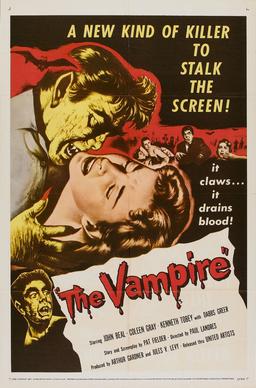
Horror Film Review: The Vampire (dir by Paul Landres)


Headaches are a bitch!

And if you didn’t already know that, you will know it after watching the 1957 film, The Vampire.

Like many films of this kind, The Vampire starts with death.

Actually, I take that back.  Technically, it’s true but it’s also little bit too melodramatic.  And, to be honest, The Vampire starts with a 14 year-old boy, who is very much alive, riding his bicycle down the street of Anytown USA.  He has a box with him, one that has air holes.  On the back of his bike, a cardboard sign reads: “Bobs Pet Zoo!  If Its Alive We Got It!”  Apparently, the kid is smart enough to run his own zoo but not smart enough to know when to use an apostrophe.

Anyway, the kid comes up to a creepy old house, one that looks somewhat out of place in the otherwise pristine suburban neighborhood.  Originally, I thought that maybe Pennywise lived in the house but then I reminded myself that The Vampire was made decades before It.  Instead, the house belongs to Dr. Campbell, a scientist who is doing experiments with blood and who needs a never-ending supply of animal test subjects.  (Boooooo!  Animal testing!  Hiss!)  Apparently, the kid keeps Dr. Campbell supplied with animals.  When the kid enters the house, Dr. Campbell is nowhere to be seen.  It’s not until the kid enters the laboratory that he discovers Campbell, dead and slumped over his desk.

As news spreads of Campbell’s death, his friend, Dr. Paul Beecher (John Beal), searches through Campbell’s belongings and he comes across a mysterious bottle of pills, which he promptly takes home with him.  Dr. Beecher is kindly doctor, the type that we all wish we could deal with whenever we had to go in for a check up.  However, he suffers from terrible migraines.  That night, when he’s literally blinded with a headache, he asks his daughter to get him his pills.  She retrieves a bottle of pills but guess what?  They’re the wrong pills!  They’re not headache pills!  Instead, they’re Dr. Campbell’s vampirism pills!

The pills cause Beecher to blaxk out.  Whenever he comes to, he never has any memory of what he may or may not have done while he was out.  However, strange things are happening to his friends and his patients.  One of his longtime patients dies of fright when he comes by her house.  On her neck, he finds two puncture wounds…

So, it’s not a spoiler for me to tell you that Dr. Beecher has been transformed into a vampire.  And I know what you’re thinking.  Why doesn’t he just stop taking the pills?  The simplest answer is that the pills are addictive.  The more complex answer is that he doesn’t want to.  The pills have brought out his dark side and, now that it’s free, it’s not planning on going anywhere.

In a strange way, The Vampire reminded me of Nicholas Ray’s Bigger Than Life.  In Bigger Than Life, James Mason plays a gentle and good-hearted professor who, after taking steroids, turns into a monster who dreams of creating a master race.  Bigger Than Life was unsettling for the exact same reason that The Vampire is unsettling.  Both suggest that the pills didn’t turn their user into a monster.  Instead, the pills just allowed his true self to come out.

The Vampire was a low-budget film, a B-movie as many would probably call it.  The musical score is overly melodramatic and so are some of the actors.  But I would say that The Vampire is actually a bit of a subversive masterpiece.  This 1957 film suggests that behind the pristine facade of suburbia, there lurked monsters.  Even an outwardly successful and respected man like Dr. Beecher can turn into something totally different behind closed doors, this film is saying.  That’s a message that it as relevant today as it was when this film was first released.  In its own way, The Vampire is a brilliant and important movie.