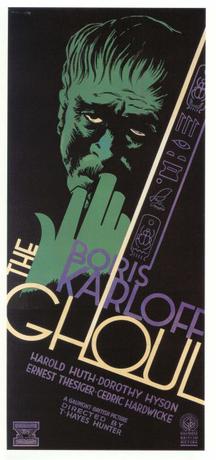
Horror Film Review: The Ghoul (dir by T. Hayes Hunter)


Some actors can make just about anything worth watching.  That’s certainly the case with Boris Karloff and 1933’s The Ghoul.

In The Ghoul, Karloff plays Prof. Henry Moriant.  The professor is an Egyptologist, a world-renowned expert on the dead.  Moriant is now facing death himself, sick in bed and ranting about how he wants to be treated after he passes.  Nigel Hartley (Ralph Richardson) stops by the mansion while pretending to be a vicar and offers to comfort Prof. Moriant in his last moments.  The butler, Laing (Ernest Thesiger), explains that Moriant has never had much use for traditional religion.  Instead, Moriant believes in the Gods of Egypt.

In death, Moriant wants to be buried with an Egyptian jewel in his hands.  He believes that, after he dies, he will exchange the jewel with the Egyptian God Anubis and he will be reborn with amazing powers.  However, when Moriant passes, Laing keeps the jewel for himself and attempts to hide it from the countess number of people who show up at the mansion, all seeking either the jewel or just information about Moriant’s estate.  Moriant may not have been loved in life but everyone clearly loves his money.

Boris Karloff is not actually in that much of The Ghoul.  He dominates the start of the film, ranting from his deathbed.  And then, towards the end of the film, he rises from the dead and attacks those who he thinks have betrayed him and stolen the jewel.  He’s only onscreen for a few minutes but he dominates those minutes.  Karloff’s screen presence is undeniable.  When he’s in a scene, he’s the only person that you watch.  When he’s not in a scene, you find yourself wondering how long it’s going to take for Karloff to return.

That’s not to say that the other actors in The Ghoul aren’t good.  The cast is full of distinguished names.  Along with Richardson and Thesiger, Cedric Hardwicke, Anthony Bushnell, Dorothy Hyson, and Kathleen Harrison all wander through the mansion and try to avoid getting caught up in Karloff’s vengeance.  Harrison provides the film’s comic relief and I actually enjoyed her flighty performance.  The film itself is so darkly lit and full of so many greedy characters that it was nice to have someone on a totally different wavelength thrown into the mix.  That said, the majority of the actors are stuck with paper-thin characters and aren’t really allowed the time to make much of an impression.  This is Karloff’s film, from the beginning to end.  And while the film itself is definitely a bit creaky, Karloff is always enjoyable to watch.

The Ghoul was made at a time when Karloff, having become a star with Frankenstein, was frustrated with the roles that he was being offered in America.  He returned to his native UK and promptly discovered that he was just as typecast over there as he was in the United States.  For a long time, The Ghoul was believed to be a lost film.  However, in 1968, a copy was discovered in Egypt of all places.  It’s unfortunate that the film itself isn’t better but there’s no denying the power of Karloff the performer.


Lisa Reviews An Oscar Nominee: Quo Vadis (dir by Mervyn LeRoy)


The 1951 best picture nominee, Quo Vadis, is actually two movies in one.

The first movie is a rather stolid historical epic about life in ancient Rome.  The handsome but kind of dull Robert Taylor plays Marcus Vinincius, a Roman military officer who, after serving in Germany and Britain, returns to Rome and promptly falls in love with the virtuous Lygia (Deborah Kerr).  Complicating Marcus and Lygia’s relationship is the fact that Lygia is a devout Christian and a friend to Peter (Finlay Currie) and Paul (Abraham Sofaer).

Marcus’s uncle, meanwhile, is Petronius (Leo Genn), a government official who has a reputation for being a bon vivant.  In real-life, Petronius is believed to have been the author of the notoriously raunchy Satyricon.  You would never guess that from the way that Petronius is portrayed in Quo Vadis.  We’re continually told that Petronius is a notorious libertine but we don’t see much evidence of that, beyond the fact that he lives in a big palace and he has several slaves.  In fact, Petronius even falls in love with one of his slaves, Eunice (Marina Berti).

The second movie, which feels like it’s taking in a totally different cinematic universe from the adventures of Marcus and Lygia, deals with all of the intrigue in Nero’s court.  Nero (Peter Ustinov) is a giggling madman who dreams of rebuilding Rome in his image and who responds to almost every development by singing a terrible song about it.  Nero surrounds himself with sycophants who continually tell him that his every idea is brilliant but not even they can resist the temptation to roll their eyes whenever Nero grabs his lyre and starts to recite a terrible poem.  Nero is married to the beautiful but evil Poppaea (Patricia Laffan) and there’s nothing that they love more than going to the arena and watching people get eaten by lions.  It disturbs Nero when people sing before being eaten.  “They’re singing,” he says, his voice filled with shock an awe.

It’s difficult to describe just how different Ustinov’s performance is from everyone else’s in the film.  Whereas Taylor and even the usually dependable Deborah Kerr are stuck playing thin characters and often seem to be intimidated by playing such devout characters, Ustinov joyfully chews on every piece of scenery that he can get his hands on.  Nero may be the film’s villain but Ustinov gives a performance that feels more like it belongs in a silent comedy than a biblical epic.  Ustinov bulges his eyes.  He runs around the palace like he forgot to take his Adderall.  While Rome burns, Nero grins like a child who has finally figured out a way to outsmart his parents.  “You won’t give me more money?  I’ll just burn down the city!”

And the thing is — it all works.  The contrast between Ustinov and the rest of the characters should doom this film but, instead, it works brilliantly.  Whenever Ustinov’s performance gets to be too much, Robert Taylor and Leo Genn pop up and ground things.  Whenever things start to get too grounded, Ustinov throws everything back up in the air.  The conflict between the early Christians and the Roman Empire is perfectly epitomized in the contrast between Robert Taylor and Peter Ustinov.  It makes for a film that is entertaining almost despite itself.

Quo Vadis was nominated for best picture but lost to An American In Paris.