Back to School #14: The Teacher (dir by Howard Avedis)


3df3d

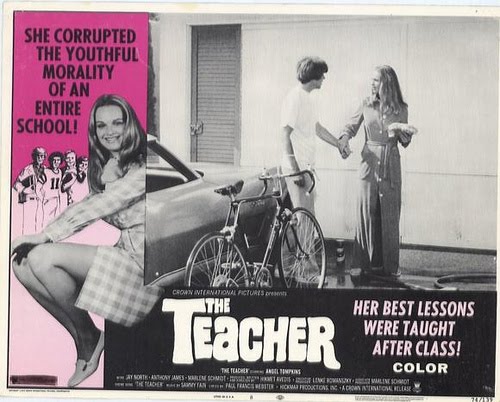
“She Corrupted The Youthful Morality of an Entire School!” the tagline for the 1974 film The Teacher screams out.

Uhmmm, no.

In fact, that’s probably one of the most deceptive taglines in the history of film advertising.  However, we shouldn’t be surprised that it was used.  Like The Young Graduates, The Teacher was produced by Crown International Pictures.  Crown International was all about getting people to buy tickets and they probably figured that more people would pay to see a movie about a teacher corrupting “an entire school” than they would for a film about a 28 year-old teacher having an affair with one (and only one) 18 year-old who has recently graduated high school.

The relationship is between Diane (Angel Tompkins) and Sean (Jay North).  Diane lives next door to Sean’s family.  She’s married to a man who spends most of his time on the road, racing motorcycles and only occasionally calling his wife.  Diane is a teacher but we only briefly see her standing outside of the local high school.  While Sean admits that he has always had a crush on her and, at the start of the movie, even spies on her while she’s sunbathing, it’s never made clear whether or not Sean was ever actually in any of her classes.  In fact, the only thing controversial about their eventual relationship is that there’s a 10 year age difference between them.  But that really doesn’t seem to bother anyone, with the exception of two old women who happen to see Diane and Sean out on a date.
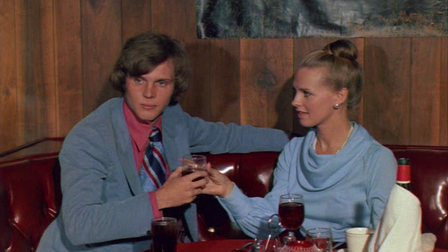
Teacher and Not A Student

Teacher and Not A Student

That, of course, doesn’t mean that Diane doesn’t have anything to teach Sean.  As the film’s theme song tells us, “Every boy needs a teacher, to help show him the way…”

But here’s the thing.  Considering how tawdry one would naturally expect a film like The Teacher to be, it’s actually treats Diane and Sean’s relationship with a lot of sensitivity.  Tompkins and North have a lot of chemistry together and both of them give natural and believable performances.  In many ways, this film is a sincere attempt to explore an unlikely relationship.  I’ve always felt that in almost every 70s exploitation film, there’s an art film waiting to break out.  That’s certainly the case with The Teacher.

However, The Teacher isn’t just about Diane “teaching” Sean.  It’s also about a guy named Ralph, who also happens to be obsessed with Diane.  (When, at the start of the film, Sean is spying on Diane, little does he suspect that Ralph is spying on him.)  We know Ralph is a bit off because he’s always talking to himself, he drives a hearse, and he’s played by Anthony James.  You may not recognize his name but if you’re a fan of 70s and 80s exploitation cinema, you know who Anthony James is.  He’s one of those very intense, very creepy-looking character actors who would always show up playing psychos and evil henchmen.
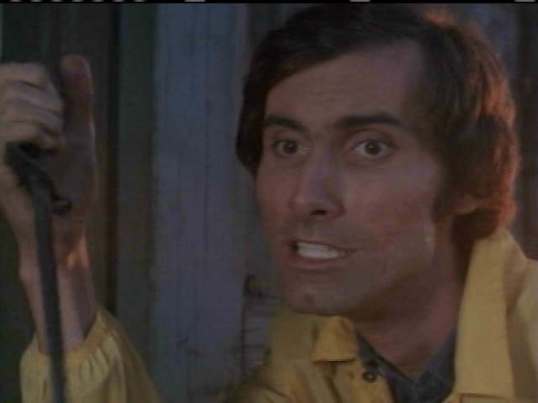
Anthony James

Anthony James

Ralph is not only obsessed with Diane but he also blames Sean for the death of his younger brother.  It seems that Sean and Ralph’s brother were spying on Diane when, somehow, Ralph’s brother ended up falling to his death.  (If you get the feeling that literally every male in this film appears to spend the majority of his time watching Diane — well, you’re right.)  Ralph wants vengeance and, in his defense, Sean never really does seem to be that upset about the death of his best friend.

Because this film was made in the 70s, it all leads to surprisingly somber ending that will probably inspire you to reconsider any belief you may have in a benevolent God.

I have to admit that, out of all the Crown International films that I’ve recently watched, The Teacher was a favorite of mine.  Watching the film — with its constantly shifting tone and it’s mix of arthouse pretension and grindhouse melodrama — is an odd experience that epitomizes everything that I love about old exploitation films.

Thank you, Crown International, for always being you.

CIP_Logo

Back to School #9: The Young Graduates (dir by Robert Anderson)


I have to admit that, as someone who watches a lot of movies that were made before she was even born and who is just fascinated by history in general, I have often wondered what the 60s and the 70s were really like.  Oh, don’t get me wrong.  I know what everyone says they were like — hippies, disco, cocaine, Watergate, Jimmy Carter, Viet Nam, and all the rest.  But people’s memories usually fade with the passage of time and it’s always hard not to feel that whatever I’m hearing is either an idealization or an exaggeration.  That’s one reason why I like watching the often critically reviled, low-budget films of that period.  Since these films were usually made by people who didn’t really care what judgmental viewers like me would think 20 years in the future, they are usually far more accurate when it comes to portraying the world from which they came than a film that was by a big studio whose main concern was to present an idealized portrait of existence that would not alienate any potential ticket buyers.  Crown International Pictures may never have been an acclaimed film studio but, as one of the more prolific producers of 70s exploitation fare, their films now serve as a valuable historical record of the time in which they were made.

If I want to know what it was like to be young and perhaps stupid in the 70s, I go to Crown International Pictures.

CIP_Logo

Take The Young Graduates for example.  First released all the way back in 1971, The Young Graduates was advertised as being “a report card on the love generation.”  The Young Graduates gives us a clue as to what it was like to be a teenager in 1971.  Judging from the film, it really sucked.

The Young Graduates tells the story of Mindy (Patricia Wymar), who is on the verge of graduating from high school.  She has a boyfriend named Bill (Gary Rist) but wow, is he boring!  All he wants to do is compete in drag races and it quickly becomes apparent that he’s incapable of expressing his emotions.  (Assuming that he has any.  The film is a bit ambiguous on this point.)  So, Mindy gets bored and has an affair with one of her teachers, the very married Jack Thompson (Steven Stewart).  Soon after realizing that Mr. Thompson will never leave his wife for her, Mindy suspects that she might be pregnant.  So, she and her friend Sandy (Marly Holliday) decided to take a road trip to Big Sur.  Along the way, they meet a sweet hippie (Dennis Christopher), a bunch of bad hippies, and some really bad bikers.  During their entire journey, they are pursued by Bill, Mr. Thompson, and Sandy’s boyfriend, Les (Bruno Kirby).

Though you wouldn’t know it from the film’s peppy soundtrack or Wymar’s cheerful performance as the continually put upon Mindy, The Young Graduates is actually a pretty dark movie.  With the exception of Pan, everyone that Mindy meets outside of high school is not to be trusted.  Essentially, she’s exploited by everyone that she meets and what makes it all the more disturbing is that Mindy smiles throughout the whole ordeal, almost as if Candide had been reincarnated in the form of a teenage girl.

So, The Young Graduates is really not much of a film.  Subsequent Crown International films would revisit high school and almost all of them would feature better acting and a far more interesting plot than the The Young Graduates.  No, the film does not work as a drama.  But as a documentary and as a time capsule, there’s a lot to enjoy about The Young Graduates.  The fashion, the haircuts, the music, and just the film’s general attitude are such relics of the late 60s and early 70s that the film is the next best thing to owning a working time machine.

That said, if The Young Graduates was an accurate picture of that time — well, I might not be asking for a time machine this Christmas after all!

younggraduates-1

Lisa Goes Back To College: Jocks (dir by Steve Carver)


A typically exciting scene from Jocks

A typically exciting scene from Jocks

Having already watched 3 campus protests from 1970, I decided that maybe I should watch something a little bit less heavy-handed for my next college film.  But I knew that, in order to find a college film that would have nothing serious on its mind, I would have to find a film that was made after the 70s.

That’s what led to me getting out my Too Cool For School DVD boxset and watching Jocks, a “comedy” from 1987.  As you can probably guess from the sarcastic use of quotation marks, I probably would have been better off staying in the 70s.

Christopher Lee (!) plays the President White, the strict president of L.A. College.  President White is upset because the athletic department has failed to win a championship in over ten years so he gives Coach Bettlebom (played by veteran character actor R. G. Armstrong) an ultimatum: win a championship or lose his job.  Bettlebom argues that the rest of the athletic department would be able to win if it wasn’t for the financial obligation of supporting the school’s tennis team.  Bettlebom then tells tennis Coach Williams (played by Shaft himself, Richard Roundtree) that he’s canceling the tennis program and all of the tennis players are going to lose their scholarships.  Williams responds by making a bet.  If the tennis team wins the national championship, the tennis program will continue.  And if they don’t, the team will cease to exist, Williams will be out of a job, and the members of the tennis team will all be forced to drop out of college and have their lives totally ruined…

Wait a minute.

That makes absolutely no sense.

What the Hell is Coach Williams thinking!?

That’s the sort of thinking that leads students to protest and occupy buildings and basically act like they’re extras in Getting Straight, Zabriskie Point, and R.P.M.

But anyway, let’s just move on and not worry about things like logic and narrative sense.  It’s time to meet the tennis team!

There’s Tex (Adam Mills), who doesn’t have a Texas accent.  Tex doesn’t really do much but he’s certainly in a lot of scenes.

There’s Andy (Stoney Jackson), the flamboyant black guy who freaks out his opponents by pretending to be gay, because this film was made in the 20th Century.

There’s Chito (Trinidad Silva), who speaks Spanish and dramatically crosses himself before playing each set.

There’s Ripper (Donald Gibb), who has a thick beard, growls a lot, and appears to be in his 40s.

There’s Jeff (Perry Lang), the nice guy.  In a film full of unlikable characters, Jeff seems to be, at the very least, a decent guy.  Plus, he has a fairly funny drunk scene and, when you’re watching a film like Jocks, you come to appreciate fairly funny.

And then there’s The Kid (Scott Strader), who apparently doesn’t have a name.  Seriously, even President White calls him “The Kid.”  As you might guess about someone with a permanent nickname, The Kid is a master tennis player.

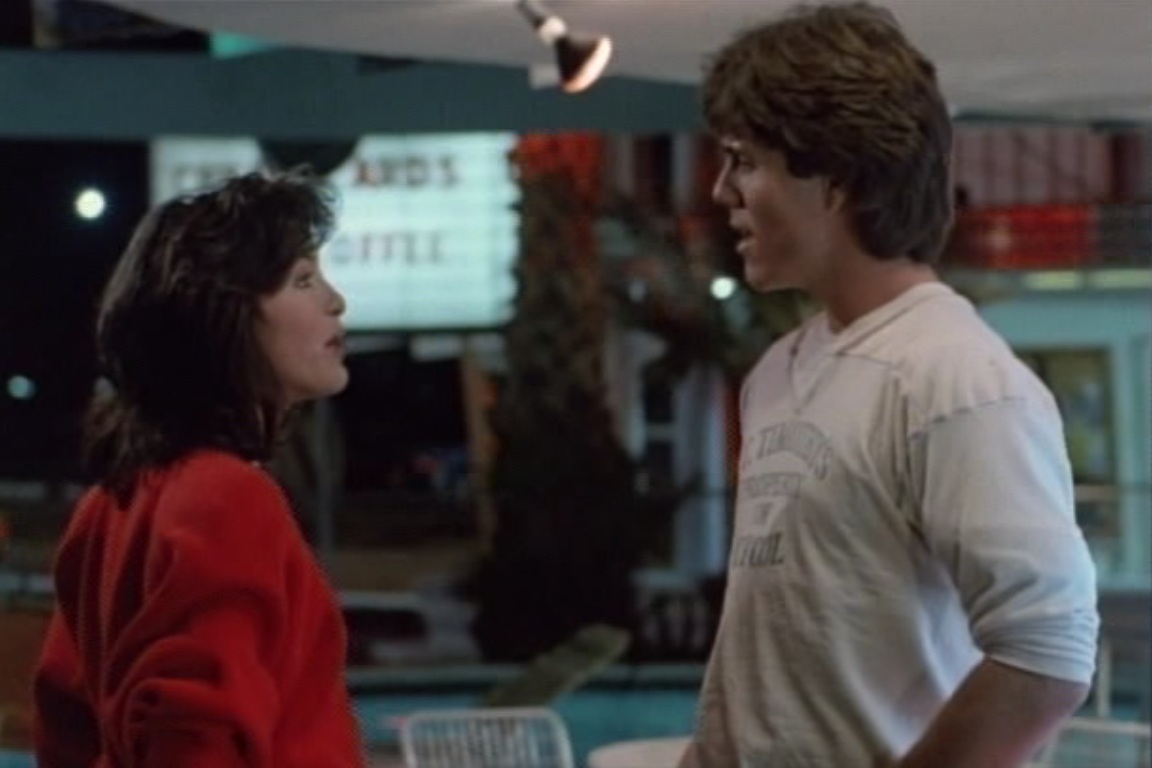
Anyway, the team goes to the championships in Las Vegas where they engage in the usual drunken hijinks and basically act like a bunch of jerks.  They also play some rather boring tennis games.  The Kid falls for a tennis groupie played by future Law & Order: SVU star Mariska Hargitay.  Eventually, it all comes down to whether or not the team can beat Dallas Tech and, as a proud Texas girl, I’m not ashamed to admit that I was saying, “Go Dallas!” the entire time.

So, is Jocks worth watching?

If you’re a Christopher Lee fan, maybe.  But, honestly, I think Sir Christopher would forgive you if you skipped this one.

But if you really want to, check out Jocks below!

Grindhouse Classics : “Pick-Up”


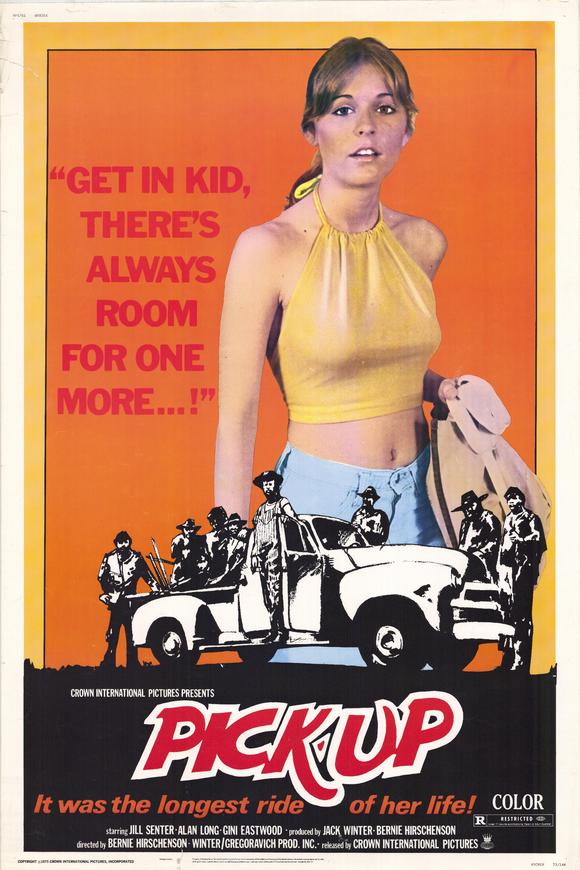
pick_up_poster_01

One word that doesn’t usually (if ever) come to mind when you’re talking about the drive-in fare churned out by Crown International Pictures in the 1970s is weird.

Yeah, okay, fair enough — I suppose just about any CIP flick looks a little bit “weird” to a contemporary audience, given that they’re all very much  products of their time, but honestly, pretty much everything released under their banner boils down, story-wise,  to a simple morality play with a generous helping of sex (always) and violence (sometimes) thrown in — and more often than not, as with most exploitation fare, the most common themes in the Crown back catalog are “don’t set your sights above your station in life” and “don’t talk to strangers.”

At first glance, 1975’s Pick-Up, directed (and produced, and shot, and edited) by Bernard Hirschenson, would appear to fit comfortably into the “don;t talk to strangers” category, since it’s the story of two footloose-and-fancy-free hippie chicks named Carol (Jill Senter) and Maureen (Gini Eastwood — no relation, at least that I know of, to you-know-who), who hitch a ride across Florida with a far-out guy named Chuck (Alan Long) who is, like them, at loose ends and just “taking in what the world has to offer, one day at a time, man” in his fuck-pad RV.

Come on — he’s gotta be trouble, right? I mean, he’s an Aries, and according to the supposedly-metaphysically-tuned-in Maureen, Aries guys are bad news these days because of some state of flux going on in the universe or something. Still, the girls hop in for a ride anyway —

31361

Trouble eventually does come their way, but Chuck isn’t the cause. After a deluge, the RV gets stuck in the Everglades mud, and that’s when things, as I promised at the outset, get weird. Chuck and Carol get busy screwing their brains out, but Maureen in between reading star charts and tarot cards and having waking (and sleeping) visions of her childhood, is visited by Pythia, a priestess of Apollo, who gives her a sacred dagger for some reason or other. And if you think that sounds strange, wait until the slimy politician and latex-faced clown show up.

Okay, yeah, none of this makes a tremendous amount of narrative sense — or even common sense — but it sure is interesting. It turns out that Maureen was molested by a priest as a child (guess they were into girls in the ’70s) and this is at the root of her psychological disturbances, which culminate in quite possibly the most bizarre  scene (of many contenders) in the film, where she and Chuck finally “make it” on a stone altar with the clown, the politician, and the priestess watching on. And all this right after Chuck kills a wild boar (be warned, this film does feature genuine animal slaughter, although hardly of Cannibal Holocaust proportions) What does it all mean? Who knows. And honestly, who really cares? Pick-Up was clearly made with the stoner crowd in mind and, frankly, was probably made by members of the stoner crowd, as well. It’s all good, man. Just go with the flow.

4517859_l2

There are some notable things to point out in relation to this film while we have a moment — the Florida Everglades locations are authentic, and were probably an absolute bitch to film in (good thing everybody was probably high), and both Senter and Eastwood are not only reasonably talented actresses, but absolutely gorgeous, as well — yet neight ever made another film. Go figure.

Drive-in-cult-classics

Like most of the Crown stuff we’ve covered both here and at my “main” site — http://trashfilmguru.wordpress.com , for those of you who don’t know — Pick-Up is available on Mill Creek’s 12-disc, 32-movie “Drive-In Cult Classics” DVD boxed set collection. There are no extras, but the remastered widescreen transfer looks surprisingly crisp and clean and the mono sound is, at the very least, perfectly adequate. This may not be the best film in the collection by any stretch, nor is it the most fun, but it’s definitely one of the most interesting, and it’s well worth the 80 minutes of your life it takes to watch it.