Retro Television Reviews: Blood Sport (dir by Jerrold Freedman)


Welcome to Retro Television Reviews, a feature where we review some of our favorite and least favorite shows of the past!  On Sundays, I will be reviewing the made-for-television movies that used to be a primetime mainstay.  Today’s film is 1973’s Blood Sport!  It  can be viewed on YouTube.

David Birdsong (played by Gary Busey, who was 29 at the time) is a high school senior with a potentially bright future ahead of him.  He’s the quarterback of his high school’s football team and it looks like he’s on the verge of leading his team to an undefeated season.  He’s getting recruited by all the big schools.  Scouts are coming to his games to watch him play.  He also has one of the highest GPAs at his school, though it’s suggested that might have more to do with his importance to the football team than his actual study skills.

“Don’t you have anything else you want to do with your life?” his high school principal (David Doyle) asks him and David’s reaction indicates that he’s never really given it much thought.  From the time he was born, David’s father, Dwayne (Ben Johnson), has been shaping his son to become a star athlete.  Dwayne is happiest when he’s watching David play, whether on the field or in the highlight reels that he keeps down in the basement.  When Dwayne sees that his son isn’t on the field, he’s the type of father who will get out of the stands and argue with the coach on the sidelines.  Dwayne continually tells David not to stay out too late.  The one time that David does, Dwayne slaps him hard enough to send his son to the floor.

Coach Marshall (Larry Hagman) is determined to get his undefeated season, no matter how hard he has to push his players.  The coach is the type who is convinced that his players respect him for his stern ways and his long-winded speeches but little does he realize that they all secretly despise him.  When one of his players drop dead of a heart attack during practice, Coach Marshall demands that the player stop being lazy and get up.  When he realizes that the player is never going to get up, Coach Marshall angrily asks, “Why did this have to happen now!?”  Later, at a pep rally, Coach Marshall announces that his team had a private meeting and agreed that they would win the final game in the player’s memory.  The team is disgusted but the rest of the town loves their coach.

David is never happier than when he’s on the field, playing football and being cheered by both the crowd and his team.  But, through it all, he sees reminders that the future in uncertain.  On the sidelines, David spots an injured player, watching the game with the knowledge that his dreams of getting a scholarship have ended.  When David visits a college, he’s reminded that being the best high school player doesn’t mean much in college and when he says that he’s a quarterback, he is told that his coach will ultimately decide who he is and David will accept the coach’s decision because David isn’t being offered a scholarship to think for himself.

When the film originally aired in 1973, it was called Birdsong but the title was changed to Blood Sport for both subsequent showings and for a European theatrical release.  Blood Sport is the more appropriate title because, even though the main character is named David Birdsong, the film is ultimately about all of the athletes who are expected to put their health at risk for the people on the sidelines.  It’s not just football that’s a blood sport, the film suggests.  It’s the entire culture that has sprung up around it, the one that cheers when players are at their best but which also looks away at the times when the players need the most help.

At 29 years of age, Gary Busey is a bit too old to be totally convincing as a high school senior but he still does a good job of capturing David’s gradual realization that he’s never really had any control over his own life.  Ben Johnson and especially Larry Hagman also give good performances as the two men who are living vicariously through David’s accomplishments.  Hagman is so believably obnoxious as the coach that you’ll want to cheer when someone finally finds the guts to stand up to him and tell him to just shut up for a minute.

The film ends on an ambiguous note, leaving many questions open about David’s future.  One hopes that he’s started to find the strength necessary to live his own life but it’s ultimately hard to say.  In the end, nothing is guaranteed, no matter how far you can throw a football.
Cleaning Out The DVR Yet Again #15: Quintet (dir by Robert Altman)


(Lisa recently discovered that she only has about 8 hours of space left on her DVR!  It turns out that she’s been recording movies from July and she just hasn’t gotten around to watching and reviewing them yet.  So, once again, Lisa is cleaning out her DVR!  She is going to try to watch and review 52 movies by Wednesday, November 30th!  Will she make it?  Keep checking the site to find out!)

quintet

The 1979 post-apocalyptic film Quintet aired on FXM on November 15th.  I recorded it because this film is often cited as being one of director Robert Altman’s worst but I’ve also read some very passionate defenses of Quintet.  Since I’ve enjoyed several of Altman’s films (Nashville, Gosford Park, Short Cuts, The Company, The Player, The Long Goodbye, and many more), I wanted to experience Quintet for myself.

I mean, seriously — a postapocalyptic sci-fi film from Robert Altman!?  That would have to be at least interesting, right?

Anyway, I watched Quintet and to be honest, I wasn’t really sure what the Hell was going on for most of the film.  Things made a bit more sense after I did a little bit of research and I discovered that Quintet was 1) inspired by a fragment of a dream that Altman had and 2) went into production despite not having a completed script.

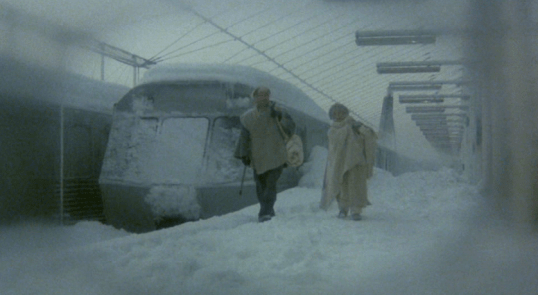
Quintet opens with a breath-taking shot of a frozen landscape.  There’s been a new ice age.  The entire Earth is frozen.  There’s only a few hundred humans left and their number is rapidly dwindling.  Some, like Essex (Paul Newman) and Vivia (Brigitte Fossey) spend their days hiking across the tundra and hunting seals.  Others — like practically everyone else in the entire freaking film — spend their times in ramshackle villages, pursuing what little pleasure they can find while waiting to die.

In this new frozen world, the most popular activity — outside of getting drunk — is playing a board game called Quintet.  I have no idea how Quintet is played, though the film is full of scenes of people playing it.  From what we do see, it really doesn’t look like that fun of a game but I guess you can’t be picky when you’re waiting to freeze to death.  I mean, honestly, if the world’s ending, I’d rather play a board game than charades.

Anyway, in one of the frozen towns, a group of people are having a Quintet tournament, with the rule being that, once you’re eliminated in the board game, you are also killed in real life.  (And again, this is where it would have been helpful for the film to take just a few minutes to clarify just how exactly Quintet is played.)  One of the Quintet players is killed by a bomb, which unfortunately blows up Viva as well.  Seeking revenge (or, at least, I’m guessing that was his motivation because Paul Newman didn’t exactly give the most communicative performance of his career in Quintet), Essex assumes a fake identity and enters the tournament.

Soon, he’s running around the frozen landscape, killing people.  He knows that the final player standing will receive a prize of some sort but he doesn’t know what the prize is.  How deep!  Or something.

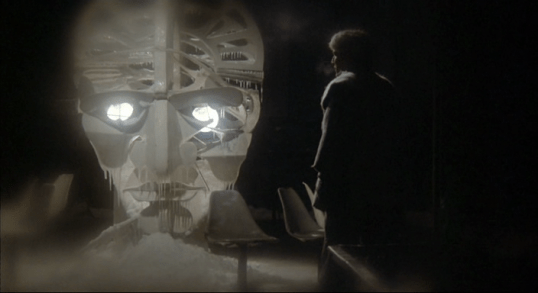
Dammit, I really wanted to defend Quintet.  I really did.  Whenever I see a movie that has gotten almost universally negative reviews, my natural instinct is to try to find something good about it.  And I will say this: visually, Quintet is fascinating.  A lot of care was put into creating this frozen world and it’s interesting to note how every location is decorated by elaborate ice sculptors.  The ice may be destroying civilization but it can’t squelch humanity’s natural creativity.

Unfortunately, Quintet  may be well-designed but it’s also a painfully slow film.  Just because the film takes place on a glacier, that doesn’t mean that it needs to move like one.  The slow pace is not helped by the fact that many of the characters have a tendency to suddenly start delivering these faux profound philosophical monologues, the majority of which are about as deep as the typical Tumblr post.

Quintet stars Paul Newman, who was both an iconic movie star and a legitimately great actor.  He spends most of Quintet alternating between looking confused and looking stoic.  That said, it’s always interesting to watch an actor like Paul Newman slog his way through an artistic misfire like WUSA or Quintet.  Let’s give Paul Newman some credit: he delivered his lines with a straight face. Just as Essex knew he was trapped on a glacier, Paul Newman understood that was trapped in Quintet.  Both did what they had to do to survive.

Robert Altman was a great director but Quintet is not a great film.

It happens.

quintettrain

Film Review: Prime Time (1977, directed by Bradley R. Swirnoff)


Prime TimeThe great character actor Warren Oates appeared in a lot of fairly obscure movies but none are as obscure as Prime Time.

With a running time of barely 70 minutes, Prime Time is a comedic sketch film that was meant to capitalize on the then-recent success of The Groove Tube, Tunnelvision, The Kentucky Friend Movie, and the first season of Saturday Night Live.  According to the Unknown Movies Page, Prime Time was financed independently and was picked up for distribution by Warner Bros.  After the Warner execs saw the finished film, they decided it was unreleasable so the film’s production team sold the film to Cannon Pictures, who were famous for being willing to release anything.  The movie played in a few cities under the terrible title American Raspberry and then went straight to VHS obscurity.

Sketch comedies are usually hit-and-miss and Prime Time is definitely more miss than hit.  The majority of the film is made up of commercial parodies but, since most of the commercials being parodied are no longer on the air, the humor has aged terribly.  There is also a wrap-around story.  The President (George Furth) and a general (Dick O’Neill) try to figure out where the commercial parodies are coming from and stop them before the broadcast leads to a riot.   There are a few funny bits (including Harry Shearer as a stranded trucker looking for a ride and Kinky Friedman singing a song about “Ol’ Ben Lucas who has a lot of mucus”) but, for the most part, the film is epitomized by a skit where people literally get shit dumped on their head.  The film’s opens with an incredibly racist commercial for Trans Puerto Rican Airlines and it’s all downhill from there.

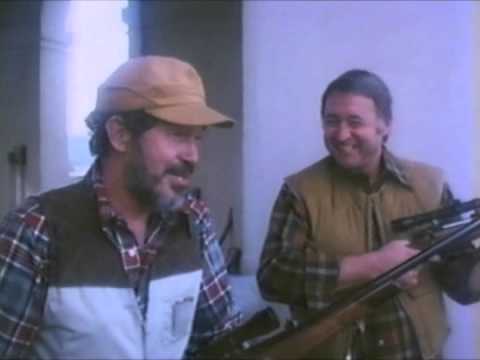
As for Warren Oates, he appears in an early skit.  He and Robert Ridgely (best known for playing Col. James in Boogie Nights) play hunters who take part in the Charles Whitman Celebrity Invitational, climbing to the top of the Tower on the University of Texas campus and shooting at the people below.  It’s even less funny now than it probably was in 1977.

How did Warren Oates end up in a movie like Prime Time?  Even great actors have bills to pay.  As for Prime Time, it is the one Warren Oates film that even the most dedicated Warren Oates fan won’t regret missing.

Warren Oates and Robert Ridgely in Prime Time

Warren Oates and Robert Ridgely in Prime Time