Welcome to Retro Television Reviews, a feature where we review some of our favorite and least favorite shows of the past! On Sundays, I will be reviewing the made-for-television movies that used to be a primetime mainstay. Today’s film is 1972’s Call Her Mom! It can be viewed on YouTube!
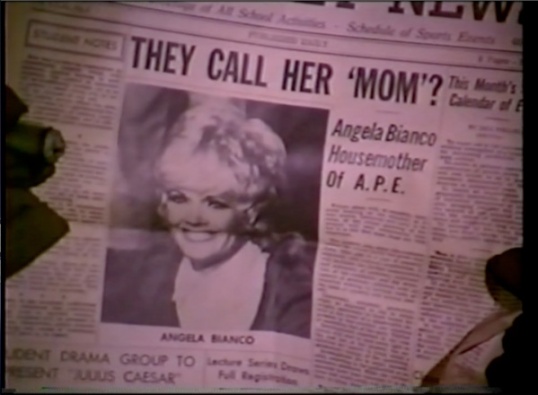
While all of the other college campuses across America are in turmoil with protests and student walk-outs, Beardsley College remains at peace. It’s a place where the 50s never ended. Everyone is perfectly behaved. No one is into politics. Fraternity Row is a peaceful place, largely due to the elderly housemothers who keep the frats in order.
Except for Alpha Phi Epsilon, that is. The A.P.E. House is known for being the wildest house on campus and every housemother that they get walks out on them. If they can’t find a new housemother, they’ll lose their charter. President Chester Hardgrove (Van Johnson) and Assistant Dean Walden (Charles Nelson Reilly) are practically salivating at the possibility of kicking A.P.E. off of campus. And who can blame them? Take a look at how wild these guys are:
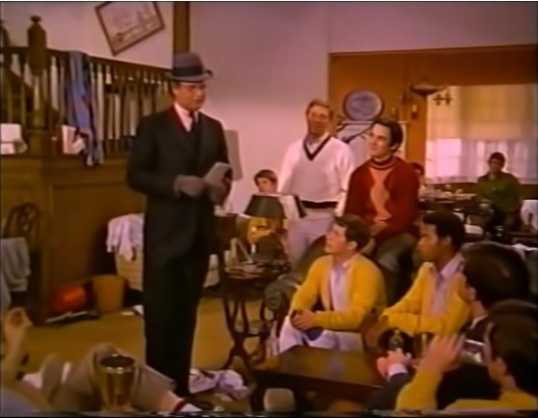
These guys are crazy! They wear yellow sweaters! They play tennis indoors! Occasionally, they leave a towel or two hanging on the bannister. A.P.E. is out of control!
A.P.E. tries to find a new housemother but the word is out that A.P.E. is no good. Not a single elderly woman in town is willing to work with them. However, when the members of the frat realize that there’s not actually an age requirement for housemothers, they offer the job to Angie Bianco (Connie Stevens), who works as a waitress at the local pizza place. Angie accepts the job.
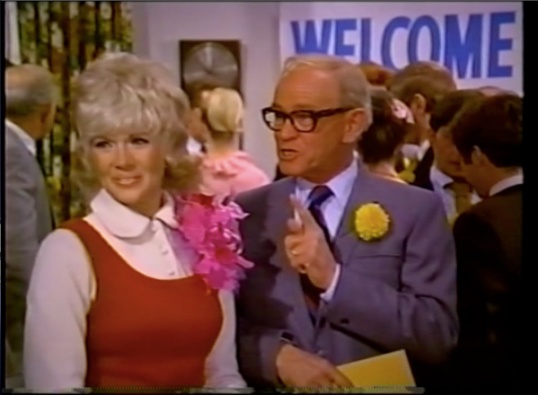
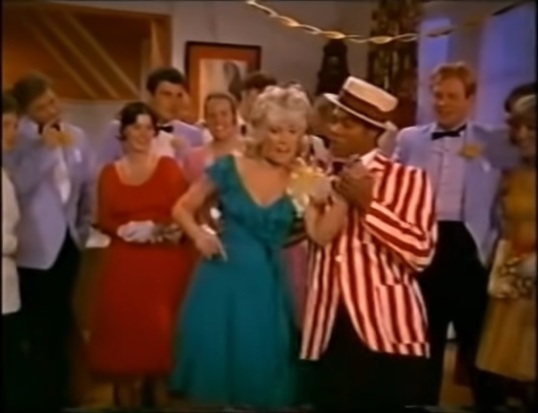
It’s a scandal! All of the older folks say that Angie is too young and too attractive to be trusted as the housemother for A.P.E. Angie, however, proves herself to be a lot tougher than anyone was expecting. The members of the frat soon come to respect her. However, President Hardgrove is determined to force her out of the job and off of the campus. Rumor has it that she’s encouraging the A.P.E. brothers to hold rollicking 20s style parties and she’s also allowing them to dance!
Check out this decadence!
 The attempts to force Angie out of her job makes national news. Soon, Angie and the frat brothers are featured in Time Magazine. President Hardgrove points out that he’s never appeared in Time Magazine. While an group of middle-aged women march outside of the A.P.E. House and demand that Angie be fired, the younger female students rally to Angie’s side. Suddenly, Beardsley College is home to a protest! (The protest is about as a wild as the 20s dance party at the A.P.E. House.) President Hardgrove realizes that keeping Angie at the A.P.E. House will actually lead to the college getting more donations but Angie has decided that she has to quit. Not only is she in love with A.P.E.’s sponsor, Prof. Calder (Jim Hutton), but a member of the fraternity has decided that he’s in love with her and he’s going to drop out of school to be with her.
Can A.P.E. convince Angie to come back?
Call Her Mom is a silly movie that was obviously meant to serve as a pilot for a television show, one in which I imagine Angie would have solved the fraternity’s problems on a weekly basis. Seen today, it’s mostly memorable for its thoroughly innocent portrayal of college life. A.P.E. House is the wildest frat on campus but no one is ever seen drinking. Certainly no one is indulging in anything stronger than perhaps a Coke or a Pepsi. I imagine this show was an accurate portrayal of what most parents hoped college was like. That said, Connie Stevens and Jim Hutton made for a cute couple. Hopefully, there were many good times in the future for the residents of A.P.E. House.


 Through the Shattered Lens