Lisa Reviews An Oscar Nominee: East Lynne (dir by Frank Lloyd)


In the history of the Academy Awards, East Lynne is a curiosity.

Released in 1931, East Lynne was one of the five films to be nominated for Best Picture at the fourth annual Academy Awards.  Best Picture was the only nomination that East Lynne received, which of course leaves you to wonder just what exactly was so good about it.  Why was it nominated as opposed to something like A Free Soul, which received nominations for Best Actress and Director and which won the Best Actor Oscar for Lionel Barrymore?  East Lynne was a success at the box office but so were The Public Enemy, Little Caesar, and Scarface.  None of those classic gangster films made much of an impression with the Academy but all of them are better remembered today than East Lynne.

One reason why East Lynne has fallen into obscurity is because it’s not an easy film to see.  There is only one complete print of East Lynne still in existence.  It’s housed at the UCLA’s Instructional Media Lab but it can only be viewed by appointment.  There are, however, a few bootleg copies on DVD.  The picture is grainy.  The sound is inconsistent.  Even worse, the bootleg is missing the last 12 minutes of the film.  Still, for those of us who don’t live near UCLA, that bootleg copy is the only convenient way to watch East Lynne.

That’s how I watched it.  (I also looked up how the film ended so I know where the story eventually led, despite those missing 12 minutes.)  Having now seen the film, I can now say that it makes even less sense that the film was nominated because it’s pretty bad.  I can only imagine that it received its nomination as a result of Fox Film Corporation (which would later merge with 20th Century Pictures to be come 20th Century Fox) demanding that its employees vote for it.

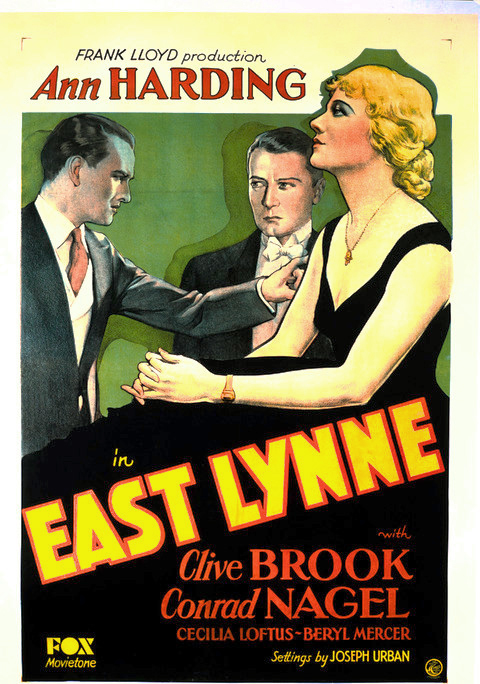
Based on a Victorian novel that had already been filmed several times during the silent era, East Lynne tells the story of Lady Isabella (Ann Harding), a British noblewoman who marries a stuffy attorney named Robert Carlyle (Conrad Nagel).  From the beginning it’s an awkward marriage.  Isabella is sociable and popular and wants to enjoy life.  Carlyle is a humorless jerk.  Not even the fact that they live in a nice mansion called East Lynne provides much comfort.

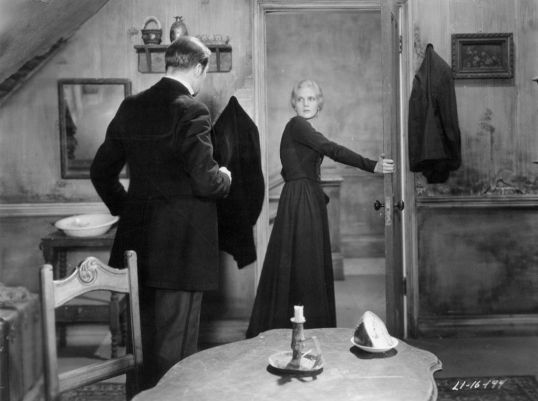
When Isabella accepts a kiss from a cad named Captain William Levinson (Clive Brook), Isabella’s sister-in-law uses it to drive a wedge between Isabella and Carlyle.  Carlyle, being a jerk, kicks Isabella out of the house and takes custody of their child.  Now viewed as being a figure of scandal, Isabella goes abroad with Levinson.  (Since this is a pre-code film, going abroad amounts to going to a then-racy show in Vienna.)  However, through a series of improbable events, Levinson ends up dead and Isabella ends up very slowly going blind.  However, Isabella is determined to see her child just once more before losing her sight so it’s up to her to convince a maid to sneak her back into East Lynne late at night….

And then the bootleg version of the film ends!  Now, I did my research and I discovered — here’s your SPOILER ALERT — that the film apparently ends with a blind Isabella stumbling over a cliff and her husband realizing too late that maybe he was kind of a jerk.  I’m kind of sorry that I didn’t get to see that.  I may have to book a flight to UCLA.

Anyway, from what I did see, East Lynne is a creaky old film.  This is one of those films where you can tell that the cast was still adjusting to the new sound era.  Ann Harding’s screen presence is a bit too insubstantial to keep the film’s melodramatic story grounded and neither Conrad Nagel nor Clive Brook seem to be worth all of the trouble that Isabella goes through.  Frank Lloyd’s direction is painfully slow and stagy, though things do pick up briefly when the action moves to Vienna.  Worst of all, the film is pretty much on Carlyle’s side.  He’s a jerk, the movie says, but Isabella should have made more of an effort to keep him happy.  Welcome to 1931!

East Lynne lost the best picture race to Cimarron, which was another fairly forgettable film.  Though there were plenty of good films to choose from in 1931, it doesn’t appear that the Academy nominated any of them.  Of course, that wouldn’t be the last time that would happen.
 

Lisa Reviews An Oscar Nominee: The Divorcee (dir by Robert Z. Leonard)


Before I get into reviewing the 1930 best picture nominee, The Divorcee, I want to share something that I recently posted on twitter:

I’m not just sharing this because it’s one of the best things that I’ve ever tweeted.  I’m also sharing it because it’s a beyond perfect description of Jerry (played, in an Oscar-winning performance, by Norma Shearer), the lead character in The Divorcee.  (Whenever you tweet something that is beyond perfect, you’ve earned the right to make sure everyone else knows it.)  The Divorcee came out in 1930 so, needless to say, it’s a bit dated but I totally related to the character of Jerry and that’s perhaps the main reason why I enjoyed this film.

The Divorcee tells the type of story that, today, would probably make for a memorable Lifetime film.  It’s a film that follows four friends over several years.  They are the idle rich, the type who go to parties, dance on tables, and cheerfully ignore the ban on liquor.  Jerry (Norma Shearer) loves Ted (Chester Morris).  Dorothy (Helen Johnson) loves Paul (Conrad Nagel).  However, Paul loves Jerry and when Jerry announces that she and Ted are engaged to be married, Paul doesn’t handle it well.  In fact, Paul gets drunk, Paul drives a car with Dorothy in the passenger’s seat, and eventually Paul crashes the car, leaving Dorothy so disfigured that she spends the rest of the movie wearing a black veil.

The years pass.  In order to make up for horribly disfiguring her, Paul agrees to marry Dorothy.  Jerry marries Ted.  They’re happy until they’re not.  On the day of their third anniversary, Jerry discovers that Ted has been cheating on her.  So, Jerry cheats on Ted.  When Ted gets upset, they file for divorce.

Suddenly, Jerry is …. (dramatic music cue) … THE DIVORCEE!

Ted becomes an alcoholic, the type who makes scenes at parties and destroys ornate wedding cakes.  In the past, I assume Jerry would have been forced to wear a scarlet D and she would have made it work because there’s nothing that Jerry can’t do.  However, since this film takes place in the 1920s, Jerry spends her time flirting and plotting to steal Paul away from Dorothy.

And it would have worked too if not for the fact that Dorothy is a complete and total saint…

Drinking, sex, adultery, disfigurement, and Norma Shearer!?  That’s right, this is a pre-code film!  The Divorcee is actually a pretty typical example of a type of film that was very popular during the 1930s and actually remains rather popular today.  This is a film where rich people do stupid things but look good doing it.  When an audience watches a film like this, they can both look down on the rich and vicariously experience their lifestyle.  No wonder these movies are so popular!

Anyway, I liked The Divorcee.  It’s an incredibly silly little film but it’s hard for me not to enjoy something this melodramatic.  Chester Morris and Conrad Nagel are stuck playing heels and Helen Johnson is a bit to saintly but it doesn’t matter because the film is pretty much designed to be a showcase for Norma Shearer, the most underrated of all of the Golden Age actresses.  (Far too often, Shearer is dismissed as simply being Irving Thalberg’s wife.)  Shearer gives a great performance.  She seems to be having the time of her life and it’s fun to watch.

The Divorcee was nominated for best picture but it lost to a far different picture, All Quiet On The Western Front.

the_divorcee_poster

Lisa Reviews An Oscar Nominee and It’s Damn Important: The Hollywood Revue of 1929 (dir by Charles Reisner)


220px-The_Hollywood_Revue_of_1929_(film)_poster

Last night, I really needed a break from thinking about this stupid, asinine presidential election that we have coming up here in the U.S.  Fortunately, TCM provided me with one by showing The Hollywood Revue of 1929!

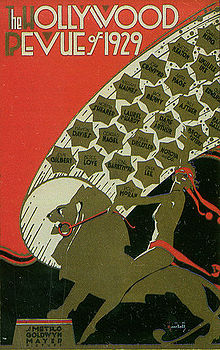
The Hollywood Revue of 1929 is probably one of the most obscure film to ever be nominated for best picture.  It’s a plotless collection of songs and comedy bits, all performed by actors who were under contract to MGM.  In fact, the movie might be best described as a two-hour commercial for MGM.  The message of the film seems to be: “Now that movies have sound, look what MGM can do!”

With the exception of Greta Garbo and Lon Chaney, every MGM star makes an appearance in Hollywood Revue.  Everyone sings a song and does a dance, even if some of them are better singers and dancers than others.  The revue is hosted by Conrad Nagel (who looks very dapper in a tux but still seems to be strangely uncomfortable with his hosting duties) and Jack Benny (who plays his violin and gets annoyed every time he’s interrupted by an MGM stock player).  Joan Crawford (who Nagal describes as being “one of my favorites”) sings, “Got A Feeling For You,” and she may be off-key but you can’t help but appreciate the fact that she’s doing her best.  Buster Keaton does a dance.  Laurel and Hardy perform a magic act that doesn’t go very well.  Marion Davies does a tribute to the military and I’m sure that, somewhere, William Randolph Hearst was smiling.  Chorus girls sit in the background and smile at the camera and, as someone who knows what it’s like to be in the chorus, I enjoyed watching as a few of the smarter and braver ones attempted to steal the audience’s attention away from the headliners.

At one point, Jack Benny reached into his suit jacket and revealed that a miniature version of actress Bessie Love was apparently living in the pocket.  He held Bessie in the palm of his hand and proceeded to have a conversation with her and all I could think about was the end of Mulholland Drive, when that tiny old couple cornered Naomi Watts in her apartment.  When Benny placed Bessie on the ground, she grew to normal height and sang a song.

During the second half of the film, silent screen star John Gilbert plays the balcony scene from Romeo and Juliet, opposite Norma Shearer.  First he does it in Shakespeare’s words and then he does it again in 1929 language.  Lionel Barrymore directs them.  Interestingly enough, Shearer (who was married to The Hollywood Revue‘s producer, Irving Thalberg) would later play Juliet in 1936’s Romeo and Juliet.  Barrymore, though best remembered as Mr. Potter from It’s A Wonderful Life, actually was a prominent film director in 1929 and would even invent the boom mic.  As for Gilbert, legend has it that the Hollywood Revue was the first time that audiences actually heard him speak and they were so unimpressed with his voice that his career ended.  Having now seen Gilbert speak — well, he didn’t have the greatest or sexiest voice but he still sounded better than Jean Hagen did in Singin’ In The Rain.

Speaking of Singin’ In the Rain, that song was specifically written for Hollywood Revue!  The entire cast sings it at the end of the film.

Seen today, there’s something charming about how old-fashioned and corny The Hollywood Revue is.  I imagine that some people will laugh at it but, honestly, it’s still more entertaining than that stupid live version of The Sound of Music that they put on TV two years ago.  The Hollywood Revue is basically the classic film equivalent of a high school talent show, where everyone does their best and a good deal of the charm comes from seeing how silly it all is.  If you love TCM, you’ll enjoy seeing all the Golden Age performers trying to do their best.  If you don’t love TCM, then go to Hell.

The Hollywood Revue is usually listed as being a nominee for best picture.  Actually, the truth is a little bit more complicated.  For the 2nd annual Academy Awards, there were no nominees.  Instead, the awards were determined by a select committee and only the winners were announced.  Much like the Cannes Film Festival, no film received more than one award.  Broadway Melody (which starred Hollywood Revue‘s Bessie Love) was named best picture.

However, notes were kept of the committee’s meeting and those notes indicate that Hollywood Revue was considered as a possible pick for best picture.  Hence, Hollywood Revue is considered to be a best picture nominee even though there were no official nominees that year.

Anyway, if you’re a classic film lover, keep an eye out for Hollywood Revue the next time that it shows up on TCM!