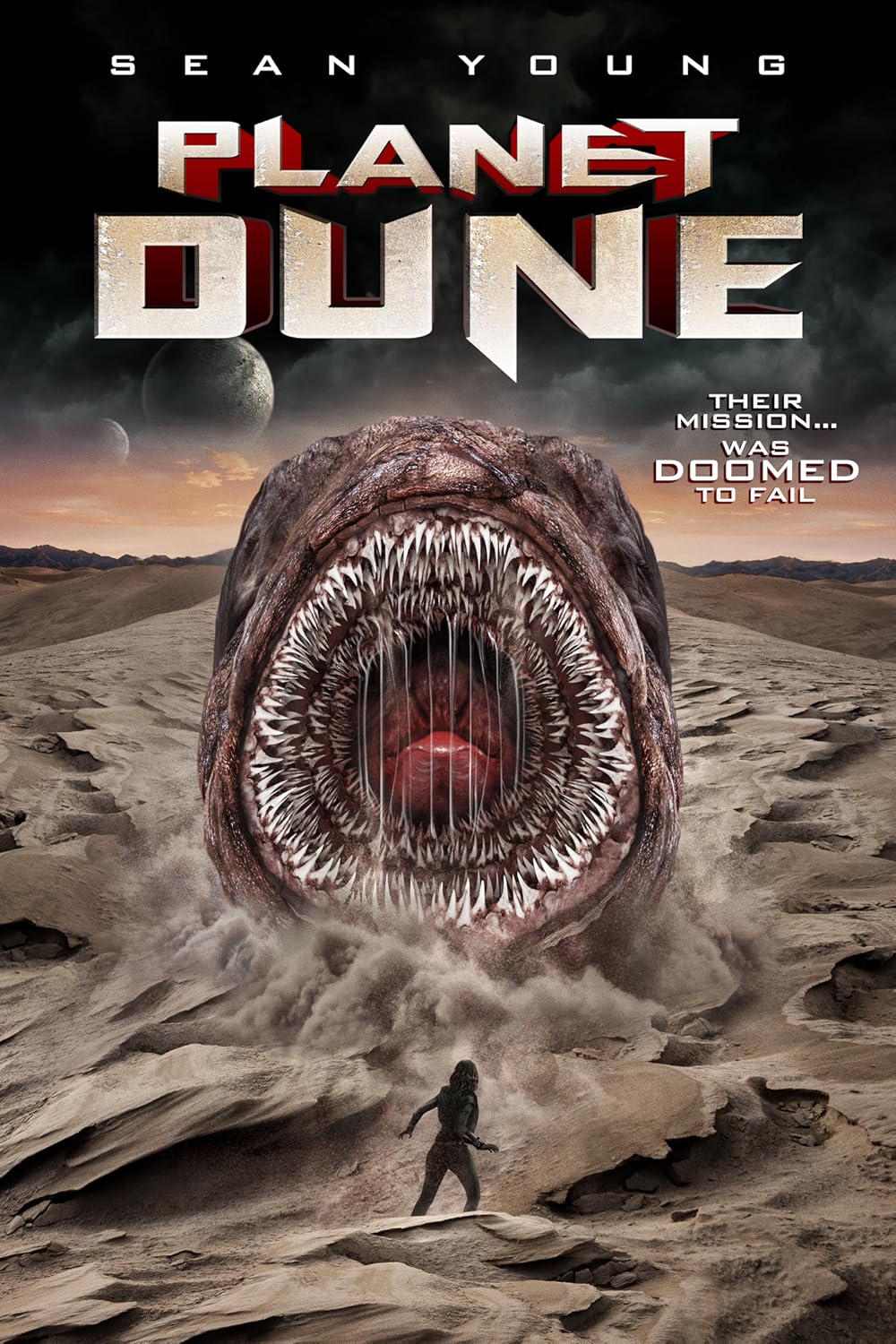
“We came here for a rescue mission, and now we’re just something on the menu.” — said by someone, maybe.
Planet Dune is a scrappy, low‑budget sci‑fi creature feature that knows exactly what it is, and that self‑awareness helps it go down easier. It is not a polished prestige production, but it does deliver a simple survival story, some intentionally goofy monster‑movie energy, and enough visual invention to keep genre fans from completely checking out. It also practically announces itself as another in‑name‑only knock‑off in the vein of The Asylum’s mockbuster factory, clearly trying to ride the coattails of Denis Villeneuve’s Dune: Part One. The timing, the desert‑planet setting, the sand‑worm menace, and the threadbare plot all feel calculated to cash in on the renewed mainstream buzz around the Dune name, rather than to build something original.
From the start, Planet Dune leans hard into its B‑movie identity. The setup is straightforward: a rescue mission heads to a desert planet, only to find itself trapped in a fight for survival against giant sand worms. That premise is thin, but the movie understands the appeal of the concept and does not waste time pretending to be deeper than it is. The result is a film that moves quickly, stays focused on its basic threat, and mostly avoids getting bogged down in overcomplicated mythology. At the same time, every decision feels like a stripped‑down version of choices made in Villeneuve’s Dune—just without the budget, scope, or attention to subtext. It’s the kind of project that exists because someone saw a big‑budget, heavily marketed Dune release and realized they could slap a vaguely similar title on a sand‑worm actioner and sell it to undiscerning genre fans.
What works best is the movie’s commitment to its own absurdity. The sand worms are the obvious attraction, and the film uses them as a constant source of danger rather than saving them for a single big reveal. That gives the story a pulpy urgency, and in a movie like this, momentum matters more than subtlety. The effects are clearly on a modest budget, but they are used with a certain charm, and the film often benefits from embracing cheapness instead of trying to hide it. That kind of approach can make a low‑budget creature feature feel more fun than fake grandeur ever could, even if it never comes close to matching the visual or thematic richness of Villeneuve’s work.
There is also a strange meta‑layer in the casting of Sean Young, who played Chani in David Lynch’s Dune (1984). Her presence turns Planet Dune into a weird echo chamber of the Dune universe: it’s a cheap, micro‑budget knock‑off trading on the name and imagery of a franchise, while also bringing in a legacy face from one of the older big‑screen adaptations. That gives the film a faintly nostalgic, almost self‑aware vibe, as if it’s winking at fans who know the history of Dune on screen, even while it rushes through a script that’s functionally just a monster‑survival thriller with a desert‑planet paint job. It’s a choice that underscores how this movie is less about telling its own story and more about trading on the weight of other people’s Dune work.
The pacing is also one of the movie’s stronger points. A lot of smaller sci‑fi films spend too much time explaining the world or padding out the runtime with empty dialogue, but Planet Dune keeps things relatively lean. It gets in, sets up the threat, and lets the characters deal with one problem after another. That makes it easier to forgive some of the rough edges, because the film does at least understand that the audience is here for monster attacks, not a lecture on space politics. Compared with Villeneuve’s slow‑burn world‑building and political maneuvering, Planet Dune feels like a stripped‑down amusement‑park version of the same concept: same core idea, none of the fuss.
That said, the movie is not above criticism. The biggest issue is that the characters are more functional than memorable. They do what the plot requires, but they are not written with enough personality to make every relationship or loss land with real weight. When the film pauses for emotional beats, those moments can feel undercooked because the script has not given the cast enough room to become more than survival‑movie placeholders. In a genre piece like this, that does not automatically sink the experience, but it does limit the impact, especially when viewers are already thinking of how Villeneuve’s Dune strained and expanded its characters across multiple films.
The performances are mixed in the way you would expect from a project like this. Nobody seems to be phoning it in, and that effort matters, but the material does not always give them much to build on. Some scenes benefit from the actors treating the material seriously, while others feel a little stiff because the dialogue is plainly there to move people from one danger zone to the next. The movie works best when it leans into the adventure and stops pretending it is a character drama. Sean Young gives a more grounded presence, but even that can’t fully offset how thin the script is; her casting feels more like a symbolic nod to Dune’s cinematic history than a way to deepen this particular story.
Visually, Planet Dune has the same plus‑and‑minus quality common to many independent sci‑fi films. The desert setting gives the movie a strong sense of scale, and even when the effects are rough, the barren environment helps sell the idea of isolation. At the same time, there are moments where the limitations are obvious, and the production does not always disguise them elegantly. Still, the film’s look is consistent enough that it rarely becomes distracting in a way that breaks the whole experience. Compared with Villeneuve’s meticulously composed frames and sweeping desert vistas, Planet Dune feels like a backyard‑budget cousin: same basic palette, significantly smaller scale.
There is also a pleasant lack of pretension here. Some genre movies try to compensate for weak writing by becoming self‑important, but Planet Dune seems content to be a monster chase with a space wrapper. That honesty is refreshing. It does not make the movie great, but it does make it easier to enjoy on its own terms. If you approach it like a serious epic, it will probably disappoint you, especially with the memory of Villeneuve’s Dune still fresh in your mind. If you approach it like a scrappy midnight movie—one that exists mainly because someone saw Dune in theaters and figured they could sell a knock‑off soundtrack on the same name—it has a better shot at working.
The film’s weaknesses are still hard to ignore. The story is very familiar, and viewers who have seen enough desert‑planet sci‑fi will recognize the beats immediately. There is also some repetition in how the danger is staged, and not every sequence feels equally inspired. A tighter script and a stronger sense of character could have lifted the whole thing a few notches. As it stands, Planet Dune is more effective as a mood piece and monster showcase than as a fully satisfying drama. It never reaches for the political, religious, or ecological weight of Villeneuve’s Dune, and it never really tries; it’s closer to a DVD‑rack detour for genre fans who just want sand worms and a vaguely Dune‑adjacent name.
What saves it is that it rarely feels cynical. Even when it is clumsy, it is trying to entertain rather than impress. That gives the movie a bit of personality, and personality goes a long way in low‑budget genre cinema. The casting of Sean Young, the desert‑planet premise, and the obvious Dune name‑play all point to a project that knows exactly what it is: a small‑scale, opportunistic creature feature that wants to surf the wave of a bigger franchise without the heavy lifting. It may not be the kind of film that wins over skeptical viewers, but it is also not a total write‑off. For viewers in the mood for a cheap, goofy, sandworm‑infested sci‑fi ride—one that openly trades on the legacy of both Villeneuve’s and Lynch’s Dune—Planet Dune gets the job done on its own very modest terms.

 Through the Shattered Lens