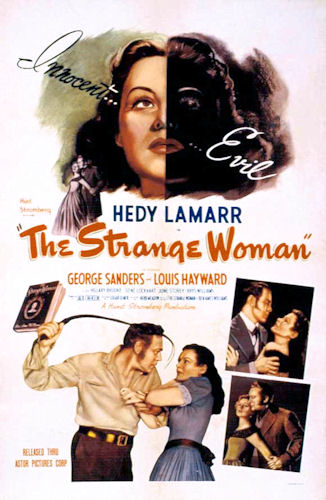
The Fabulous Forties #11: The Strange Woman (dir Edgar G. Ulmer)


The_Strange_Woman_1946_poster

The eleventh film in Mill Creek’s Fabulous Forties box set was 1946’s The Strange Woman.  The Strange Woman is one of those film noir/small town melodrama hybrids that seem to have been something of a cinematic mainstay in the mid to late 40s.

The Strange Woman of the title is Jenny Hager (Hedy Lamarr) and she’s not just strange because she’s got an Eastern European accent despite having grown up in Bangor, Maine.  The film opens in 1824 and we watch as tween Jenny pushes one her classmates into a river, despite the fact that he can’t swim.  At first, she seems content to let him drown.  However, once she realizes that an adult is watching, Jenny jumps into the river and saves his life.

Ten years later, Jenny has grown up to be the most beautiful woman in Maine.  However, her father is abusive and regularly whips her as punishment for being too flirtatious.  Jenny has plans, though.  She wants to marry the richest man in town, a store owner and civic leader named Isaiah Poster (Gene Lockahrt).  Isaiah also happens to be the father of Ephraim (Louis Hayward), the young man who Jenny tried to drown at the beginning of the film.

And eventually, Jenny’s dream does come true.  She marries Isaiah, even though she doesn’t love him.  She just wants his money and is frustrated when the sickly Isaiah keeps recovering from his frequent illnesses.  She starts to flirt with the weak-willed Ephraim, trying to manipulate him into killing his father.

Of course, even as she’s manipulating Ephraim, she’s also flirting with John Everd (George Sanders), despite the fact that John is already engaged to the daughter of the local judge.  Though Everd is a good and decent guy, he still finds himself tempted by Jenny.

What makes all of this interesting is that Jenny isn’t just a heartless femme fatale.  Throughout the film, there are several instances when she wants to do good but can’t overcome her essentially heartless nature.  She gives money to charity and, whenever she listens to one of the local fire-and-brimstone preachers, she finds herself tempted to give up her manipulative ways.

The Strange Woman was directed by Edgar G. Ulmer, who is probably best known for directing the ultimate indie film noir, Detour.  He was a childhood friend of Hedy Lamarr’s and she specifically asked that he direct her in The Strange Woman.  As a result, this film represents one of the few times that Ulmer was given a budget that was equal to his talents.  What makes The Strange Woman stand out from other 40s melodramas — like Guest In The House, for example — is that, even with the larger budget, Ulmer’s direction retains the same deep cynicism and dream-like intensity that distinguished his work in Detour.  The film remains sympathetic to Jenny, even as she often suffers the punishments that were demanded by the production code.

In the role of Jenny , Hedy Lamarr is a force of a nature.  She is so intense and determined that watching her as Jenny is a bit like seeing what Gone With The Wind would have been like if Scarlet O’Hara had been a total sociopath.  Even the fact that Lamarr’s accent is definitely not a Maine accent seems appropriate.  It sets Jenny apart from the boring people around her.

It reminds us that, even if she is “strange,” there is no one else like Jenny Hager.
6320831_3_l

Lisa Watches An Oscar Winner: Mrs. Miniver (dir by William Wyler)


Mrs_Miniver_poster

Mrs. Miniver, which won the Academy Award for Best Picture of 1942, is often treated somewhat dismissively by film historians.  The film tells the story of the Minivers, an upper middle class British family whose peaceful lives are changed forever by the start of World War II.  When the film initially went into production, the U.S. was still a neutral country.  As shooting commenced, the U.S. edged closer and closer to entering the war and, as a result, the script was continually rewritten to make Mrs. Miniver even more pro-British and anti-German than before.  The finished film was released four months after the attack on Pearl Harbor, by which point Mrs. Miniver had gone from being domestic drama to being both a celebration of British resilience and the Allied war effort.  “If the Minivers can do it,” the film told audiences, “why can’t you?”  As a result, Mrs. Miniver is often described as being merely effective propaganda.

Well, Mrs. Miniver may indeed be propaganda but it’s amazingly effective propaganda.  I recently DVRed it off of TCM and I have to admit that, as a result of those previously mentioned film historians, I wasn’t expecting much.  But I was in tears by the end of the film.  Yes, World War II has long since ended.  And yes, I could watch the movie and see all of the tricks and the heavy-handed manipulations that were employed to get the desired emotional response from the audience but it didn’t matter.  The film is so effective and so well-acted that you’re willing to be manipulated.

(Of course, it helps that there’s not much nuance to World War II.  As far as wars go, WWII was as close to a fight between good and evil as you can get.  If you can’t celebrate propaganda that was designed to defeat the Nazis, then what can you celebrate?)

As for the film itself, Greer Garson plays Kay Miniver, matriarch of the Miniver Family.  Her husband, Clem (Walter Pidgeon) is a successful architect.  When we first meet Kay and Clem, the only thing that they have to worry about is the annual village rose show.  (Henry Travers — who everyone should love because he played Clarence in It’s A Wonderful Life — plays the eccentric stationmaster who is determined to win with his rose.)  However, that all changes when they go to church and the vicar (Henry Wilcoxin) announces that Great Britain has declared war on Germany.

Life changes.  Soon, Kay must hold her family together while bombs are falling from the sky.  When Clem is away, helping out with the Dunkirk evacuation, Kay comes across a wounded German flyer (Helmut Dantine) in her garden.  The flyer demands that Kay give him food and when she does, he snarls that the Third Reich will be victorious.  He then passes out from his injuries, allowing Kay to take his gun and call the police.  (Reportedly, this scene was rewritten and reshot several times, with the German becoming progressively more hateful with each new version.)

Kay’s son, Vincent (Richard Ney), joins the Royal Air Force.  He also falls in love with Carol Beldon (Theresa Wright), the daughter of the aristocratic Lady Beldon (Dame May Whitty).  Over the concerns of Lady Beldon, Carol marries Vincent and she becomes the second Mrs. Miniver.  They do so, despite knowing that Vincent will probably be killed before the war ends.

Of course, there is tragedy.  People who we have come to love are lost, victims of the German onslaught.  Throughout it all, the Minivers (and, by extension, the rest of Great Britain) refuse to give into despair or to lose hope.  The film ends with them singing a hymn in a church that no longer has a roof and listening as the vicar tells them why they will continue to fight.

And yes, it’s all very manipulative but it’s also very effective.  I did cry and the film earned those tears.  In many ways, Mrs. Miniver is perhaps most valuable as a time capsule.  It’s a film about World War II that was actually made during the war and, as such, it provides a window into the attitudes and culture of the time.  But, if the film is valuable as history, it’s also just as valuable as a well-made melodrama.

I’m not sure if I would say that Mrs. Miniver deserved to defeat Kings Row for best picture of 1942.  But it’s still an undeniably good film.