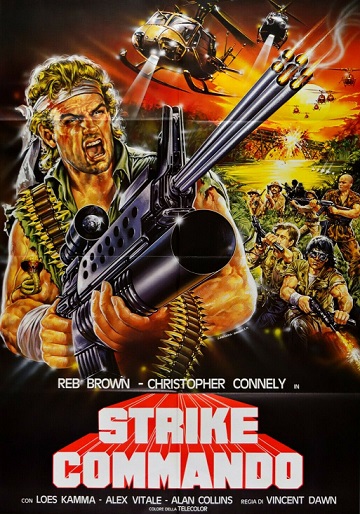
The TSL’s Grindhouse: Strike Commando (dir by Bruno Mattei)


“American,” a young Vietnamese refugee says to Sgt. Mike Ransom, “tell me about Disneyland.”

Ransom tells him all about Disneyland, a magical place where, according to Rasom, the trees are made of ice cream and genies pop out of lamps.  Ransom breaks down in tears, sobbing as he realizes that his friend will never get to experience Disneyland firsthand.

Years later, Ransom is in Manila, blowing up a former American military officer who gave aid to the communists.  “DIE!  DIE!” Ransom shrilly yells as the man literally explodes in front of him.  And while the man may not have been one of the good guys and he did a lot of bad things during the Vietnam War, it’s hard not to feel that Ransom’s attitude would get him banned from Disneyland.  Not even the ghost hitchhikers at the Haunted Mansion would want to accept a ride from the “Die!  Die!” guy.

That Mike Ransom, he’s a complicated man.  As played by Reb Brown, he’s also at the center of the 1987 Italian film, Strike Commando.  As you can probably guess from the film’s title, he’s the leader of an elite squad of soldiers, a team of strike commandoes who are determined to lead America to victory during the Vietnam War.  We’re continually told that Ransom is the best, though we don’t see much of evidence of it.  He’s the type of commando who specializes in sneaking behind enemy lines and hitting the communists before they even realize he’s there but he’s so bulky and loud that it’s hard to imagine that he’s ever been able to successful sneak around anywhere.  He has a particularly bad habit of shrilly screaming every word that he says.  Even when he’s not telling people to die, he’s yelling.  He’s like the athletic coach from Hell.

In fact, as I watched Strike Commando, I started to wonder what it would be like to live next door to someone like Mike Ransom.

“Hi, Mike, are you doing okay?”

“I’M DOING GREAT!  GREAT!  GREAT!”

“Any plans for the day?”

“I’M MOWING THE LAWN!  MOWING!  MOWING!  MOWING!”

“I think I’ve got some mail for you that accidentally left in my mailbox….”

“THE POSTAL SERVICE LIED!  LIED!  LIED!  LIED!”

At first, living next door to Mike Ransom would probably be entertaining but I imagine it would get kind of boring after a while.  Yelling can be an effective way to express yourself but it loses its power if that’s the only thing you ever do.  The same can be said for Strike Commando as a film.  It gets off to a good start, with several extremely over-the-top action sequences and, of course, Mike telling a little refugee child about Disneyland.  But the second half of the film, which involves Mike being held in a POW camp and meeting a fearsome Russian torturer named Jakoda, drags a bit because there’s only so much time you can listen to Ransom yell before you start to tune him out.  It doesn’t help that the second half of the film features some particularly nasty torture scenes.  Still, it is somewhat redeemed by a scene where the Viet Cong attempt to force Ransom to broadcast a propaganda message over their radio station.  “KEEP FIGHTING!” Ransom yells into the microphone.  Hell yeah! You tell ’em, Ransom!

Strike Commando was directed by Bruno Mattei, an Italian exploitation filmmaker who was never one to just turn things up to ten when he could turn them up to 11 instead.  Strike Commando was obviously meant to capitalize on the success of the Rambo films.  In typical Mattei fashion, the action is over-the-top, nonstop, and more than a little silly.  Mattei was never shied away from embracing excess and Strike Commando has everything that you would expect from one of his war films: lots of stuff blowing up, heavy-handed use of slow motion, and plenty of grainy stock footage.  You have to admire Mattei’s dedication to always finding something for Reb Brown to yell about.

The Martian Chronicles: Episode 3: The Martians (1980, directed by Michael Anderson)


Episode 2 of The Martian Chronicles ended with Sam Parkhill (Darren McGavin) helplessly watching as Earth was consumed by nuclear fire.  Episode 3 opens with Col. John Wilder (Rock Hudson) returning to Earth in 2006 and discovered that the entire planet is dead.  He had hoped to find his brother and rescue him but instead, all Wilder finds is a video of his brother being vaporized by an atomic blast.

Back on Mars, the planet is nearly deserted.  Most of the human colonizers were ordered to return to Earth before the war broke out and, as a result, they died in the atomic inferno.  Only a few humans remain on Mars.  One of them, Ben Driscoll (Christopher Connelly), is excited to discover another survivor named Genevieve (Bernadette Peters) but he abandons her when he discovers that she’s too high-maintenance for him.  He decides he’d rather live alone.  (Too mean-spirited to really be funny, this was the weakest short story in Rad Bradbury’s collection and it’s also the weakest segment of the miniseries.)  Wilder and Father Stone (Roddy McDowall) visit another survivor, a scientist named Peter Hathaway (Barry Morse).  Peter lives with his devoted wife and daughter but when he dies of heart attack, they barely notice because they’re robots.

The first hour of the final episode of The Martian Chronicles is considerably weaker than the two episodes that proceeded it.  After the effective scenes of Wilder exploring Earth, the series is suddenly taken over by Christopher Connelly, playing a character that we’ve never seen before and who isn’t very likable.  The Ben and Genevieve sequence is weak and never that funny, despite Peters’s skill with comedy.  The sequence with Dr. Hathaway and the robots feels like a dry run for something Ray Bradbury would have written for The Twilight Zone.

Fortunately, the final segment of The Martian Chronicles swoops in to save the series.  Col. Wilder and his family spend the day camping at the same ancient Martian city where, during the first episode, Spender tried to convince Wilder not to allow Mars to be colonized.  While walking around the ruins of the city, Wilder meets what is either the ghost or the future projection of a Martian.  They have a friendly and philosophical conversation.  They talk about how The Martian doesn’t know if he’s from the past or if he’s from the future but it doesn’t matter.  Returning to his family, Wilder looks at their reflection in Briggs Canal and he say that, with Earth gone, they are now the Martians.  With Earth in ruins and only a few humans left, it’s up to the survivors to combine the ways of Earth with the ways of Mars and create a new world.  Though Hudson is usually held up as being the epitome of a stuff actor, when he made The Martian Chronicles, he had the right amount of gravitas to make the final scenes work.

The Martian Chronicles is an uneven miniseries.  The first episode is so good that the two that follow struggle to keep up.  But just, as in Bradbury’s book, the ending is perfectly realized and it still work, ever after all these years later.

International Horror Film Review: Manhattan Baby (dir by Lucio Fulci)


https://www.youtube.com/watch?v=_eikqn9OCGo

“Manhattan, baby!”

That’s what a friend of mine yelled a few years ago.  Jack was a choreographer who had just received a call from someone in New York City, offering him the chance to come work on an off-Broadway show.  He accepted, of course and then he hugged everyone who had been standing nearby, listening to the call.

“Manhattan, baby!” he shouted.

Now, the show itself didn’t really work out but Jack did get a trip to Manhattan out of it and really, I think that’s what everyone was excited about.  No matter how many bad things you may hear about New York City, it’s hard not to get excited when you hear the word Manhattan.  For many, Manhattan represents culture, sophistication, and wealth.  For others, Manhattan represents crime, inequity, and alienation.  Across the world, Manhattan stands for everything that is both good and bad about America.  Just the word Manhattan carries a power to it.  You would never get excited if someone announced that they had gotten a job in Minnesota, for instance.  If Jack had shouted, “Minnesota, baby!,” we all would have been concerned about him.  Minnesota?  Who gives a fuck?  But Manhattan …. Manhattan has power, baby!

Manhattan also lent its name to one of Lucio Fulci’s post-Zombi films and the title just happened to duplicate Jack’s proclomation, Manhattan Baby.  Released in 1982, Manhattan Baby is often cited as being the last of Fulci’s “major” productions.  While his career was reinvigorated by the success of the films he made with producer Fabrizio De Angelis (including Zombi 2 and the Beyond trilogy), Fulci and De Angelis had a falling out over Manhattan Baby.  Fulci claimed that De Angelis essentially forced him to make the movie, despite the fact that Fulci himself did not have much interest in the script.  Initially, the film was to be a special effects spectacluar with a large budget but, after the controversy surrounding Fulci’s The New York Ripper, the budget was drastically scaled back and the special effects were done on the cheap.  Fulci later said that he felt the movie was terrible and that it set back his career.

As for what the film is actually about, Manhattan Baby deals with …. well, the plot is not easy to describe.  Fulci’s films were always better known for their surreal imagery than their tight plots and, even by his standards, Manhattan Baby is all over the place.  The film opens in Egypt, where archeologist George Hacker (Christopher Connelly) is struck blind when he enters a previously unexplored tomb. Meanwhile, his daughter, Susie (Brigitta Boccoli), is given an amulet by another blind woman.

Back in Manhattan, George waits for his sight to return and Susie and her little brother, Tommy (Giovanni Frezza, who played Bob In The House By The Cemetery) start to act weird.  It turns out that their bedroom is now some sort of demensional gateway, from which snakes sometimes emerge.  At the same time, the gateway occasionally sucks people through and they end up stranded in the Egyptian desert.  Why?  Who knows?  Is Susie possessed or does the gateway operate independently from her?  Why does she occasionally glow a weird blue color?  Why do she and her brother suddenly seem to hate their nannny (played by Cinzia De Ponti, who was also in The New York Ripper)?  It all has something to do with the amulet but the exact details of how it all works seems to change from scene-to-scene.  Eventually, it turns out that the owner of the local antique shop knows about the amulet and its evil designs.  Unfortunately, all of his stuffed birds come to life and peck his eyes out.  Meanwhile, Susie’s parents and her doctors wonder why her latest x-ray seems to indicate that Susie has a cobra living inside of her and….

Like I said, it doesn’t really make any sense and, despite the power of the name, the meaning behind Manhattan Baby as a title is never really explained.  In fact, more time is probably spent in Egypt than in Manhattan.  It’s easy to assume that the film was called Manhattan Baby because it was felt that the title would appeal to American audiences but, when then the film was released in the U.S., it was actually retitled Eye of the Evil Dead in an attempt to disguise it as being a sequel to Sam Raimi’s classic shocker.  (This was actually a common practice as far as the Italian film industry was concerned.  Many films were retitled to disguise them as being a sequel.  Fulci’s Zombi 2, for instance, recieved that title because, in Europe, Dawn of the Dead was released under the title Zombi.)

One can understand Fulci’s frustration with Manhattan Baby but, at the same time, is it really as bad as he often said it was?  Yes, the plot is incoherent but that’s to be expected with a Fulci film.  Yes, the special effects are cheap but again, that’s kind of part of the charm when it comes to Italian exploitation films.  While Manhattan Baby never duplicates the ominous atmosphere of Zombi 2 or achieves the same sort of surreal grandeur as The Byond trilgoy, there are still enough memorable, if confusing, moments to make it watchable.  The sequece where a shot of a man standing in a doorway cuts to a shot of him lying dead in the desert works surprisingly well.  The scene where the shop owner is attacked by reanimated birds is both ludiscrous and scary, in the grand Fulci tradition.  With their emphasis on foolhardy explorers ignoring curses, the Egyptian scenes feel almost as if they could have been lifted from one of the Hammer mummy films.   Manhattan Baby may not be Fulci’s best but it’s hardly his worst.

In fact, with its obsession with blindness, Manhttan Baby is actually one of Fulci’s more personal films.  Fulci was diabetic and reportedly lived in fear that he would someday lose his eyesight.  Many critics, including me, have suggested that he dealt with this fear by having people lose their eyesight in his movies, often in the most violent ways possible.  Manhattan Baby is full of people losing the ability to see.  George Hacker is rendered blind in Egypt.  The mysterious Egyptain woman hands out amulets to people who she cannot see.  The store owner loses his eyes.  One of George’s colleagues falls on a bed of spikers and, of course, one spike goes straight through an eye.  Manhattan Baby is all about blindness and only be getting rid of the amulet can George hope to once again truly see the world and the people that he loves.  If only illness could be tossed away as easily as an amulet.

Despite Fulci’s disdain for the final result, Manhattan Baby is hardly the disaster that it’s often made out to be.  Those who aren’t familiar with Fulci’s unique aesthetic will undoubtedly confused by the film but, for those of us who know the man’s work, Manhattan Baby may be a minor Fulci film but it’s still an occasionally intriguing one.

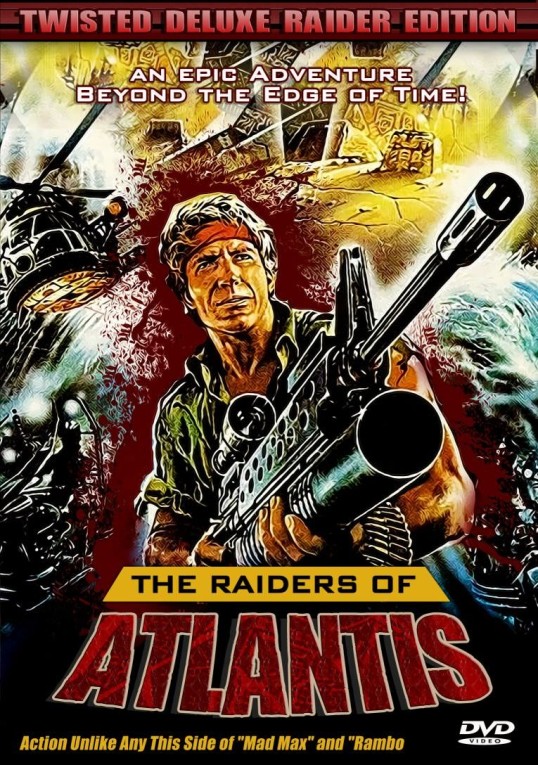
The Daily Grindhouse: The Raiders of Atlantis (dir by Ruggero Deodato)


ROA

It’s been a while since I’ve done an entry in the Daily Grindhouse here at the Shattered Lens.  (And please, no snarky comments about the definition of the word “daily.”  I’ve been doing such a good job of controlling my temper lately…)  So, I figured I’d correct that oversight by taking a few moments to tell you about The Raiders of Atlantis, an Italian film from 1983.

(If you’re a regular reader, you know how much I love Italian exploitation films.)

On many a Saturday night, I have gotten together with my fellow members of the Late Night Movie Crew (including TSL’s own Patrick Smith) and we’ve watched movies with titles like Samson Vs. The Vampire Women, Cruel Jawsand Space Raiders.  Whenever it’s my night to pick the movie, I’ve always been tempted to select The Raiders of Atlantis.  In many ways, it’s the perfect film to watch with a group of snarky and outspoken friends.  The film is action packed, it features a lot of over-the-top melodrama, the pace is relentless, and the film is so defiant in its refusal to follow any narrative logic that you can’t help but respect its defiant soul.

(If Raiders of Atlantis could talk, it would say, “I do what I want!” before giving the finger to anyone complaining about not being able to follow the plot.)

I’ve come very close to picking it on a few occasions but then I always remember just how violent this film can be.  By the standards of Italian exploitation, The Raiders of Atlantis is actually rather tame but it still features a lot of people dying in a lot of disturbingly graphic ways.  People are set on fire.  People are graphically shot in the face.  One unfortunate woman gets a dart fired into her neck.  Heads roll, literally.

The Raiders of Atlantis tells the story of what happens when a bunch of scientists on an oil rig accidentally cause the lost continent of Atlantis to rise up out of the ocean.  A Caribbean island is conquered by an army of heavily made up, motorcycle-riding, mohawk-sporting “interceptors,” who claim to be the descendants of the original inhabitants of Atlantis.  Led by the evil Crystal Skull (Bruce Baron), the Interceptors are determined to kill everyone who does not possess Atlantean blood.  When they’re not randomly killing, they’re searching for an artifact that will … well, to be honest, I’m not sure why they wanted that artifact but they certainly were determined to find it.

Who can stop the Interceptors?  Well, how about Mike (Christopher Connelly) and Washington (Tony King)?  They’re two mercenaries who just happened to be nearby when the continent of Atlantis rose out of the ocean.  Along with a group of scientists, an escaped convict, and a random bald guy in tuxedo, it’s up to Mike and Washington to save the world!

(Washington, incidentally, has just converted to Islam and spends most of the movie demanding that Mike call him by his new name, Mohammad.  I imagine this is one of those subplots that would be abandoned if the film were remade today.)*

So, as I said before, The Raiders of Atlantis makes absolutely no sense but that’s actually a huge part of the film’s charm.  This is one of those relentless action films that truly does seem to be making it up as it goes along.  There’s something very enjoyable about seeing how many movies The Raiders of Atlantis can rip-off in just 98 minutes and you soon find yourself thankful that the film didn’t waste any time trying to justify itself.  The film may not be traditionally “good” but it is flamboyantly bad and, in many ways, that’s even better.  Maybe you have to be a fan of Italian exploitation cinema to truly understand.

Speaking of which, if you have any experience at all with Italian exploitation, you will immediately recognize half the cast of The Raiders of Atlantis.  You may not know they’re names, because these actors frequently changed their Americanized screen names from film to film.  But you’ll definitely recognize the faces and one of the more enjoyable aspects of The Raiders of Atlantis is that you get to see all of these familiar faces together in one movie.

For instance, Christopher Connelly is best known for starring in Lucio Fulci’s ill-fated Manhattan Baby.  Tony King gave memorable performances in both The Last Hunter and Cannibal Apocalypse.  The cast also features giallo and spaghetti western mainstays George Hilton and Ivan Rassimov, along with Filipino Z-movie veteran Mike Monty.  Stefano Mingardo, who appeared in a handful of violent actions films, shows up as an escaped convict and livens up every scene in which he appears.  Even Michele Soavi, years before he would direct the brilliant Dellamorte Dellamore, appears in a small role.  Unfortunately, George Eastman is nowhere to be found but still, The Raiders of Atlantis is worth seeing for the cast alone.

The Raiders of Atlantis was directed by Ruggero Deodato, who is best known for directing such controversial films as Cannibal Holocaust and The House At The Edge of the Park.  Raiders of Atlantis is nowhere close to being as extreme as either one of those films.  If anything, it feels like a more violent than usual SyFy movie.

The Raiders of Atlantis has apparently slipped into the public domain and, as of this writing, it’s been uploaded to YouTube.  You can watch the trailer below.  This trailer not only captures the feel of the film but it also features the film’s enjoyably vapid theme music.

—–

*And why not remake it!?  Chris Pratt and Tyrese Gibson could play Mike and Washington.

Horror on TV: Night Gallery 3.5 “Spectre in Tap Shoes”


Spectre in Tap Shoes


Tonight’s horror on TV is an episode of Night Gallery that was originally broadcast on October 29th, 1972. It’s a ghost story that features dancing so, of course, I like it!


Enjoy Spectre in Tap Shoes!


6 Trailers To Go On The Road With


This weekend, I’m busy getting ready to go on a road trip with Jeff.  I’ll be away from home for two whole weeks!  However, fear not!  With the help of WordPress and my wonderful, beautiful older sister Erin, I will still be updating and posting even while we’re on the road.  I might even be able to convince my fellow Shattered Lens writer to spend the next two weeks watching the Lifetime Movie Channel and posting “What Lisa Would Have Watched Last Night.”  How about it, guys? *wink wink*

Anyway, while I deal with shopping and packing, why not enjoy the latest entry of Lisa Marie’s Favorite Grindhouse And Exploitation Trailers.

(And by the way, just because I’m going to be out of town next weekend won’t stop me from posting six more trailers next Saturday.  Why?  Because I love you, silly!)

1) The Klansman (1974)

In this infamous little film from the 1970s, Richard Burton, Lee Marvin, and O.J. Simpson fight the Ku Klux Klan in Alabama.  Believe it or not, I’ve actually seen this movie though the copy I saw was one of those public domain DVDs that I think was actually a copy of the edited-for-TV version of this movie.  (I say that because every time someone cursed, there was an awkward silence on the soundtrack.)  Even more odd is the fact that I’ve actually read the old novel that this movie is based on.  Anyway, this movie is pretty bad but the book is okay.  The film was directed by the same guy who directed the first James Bond films.

2) Beyond the Door (1975)

Okay, so this is pretty obviously an Exorcist rip-off but wow, this trailer freaks me out.  Needless to say this is an Italian film.  My favorite part of the trailer, to be honest, is the use of the Ryder truck.  It’s a moment that epitomizes Italian exploitation in that you can tell that the filmmakers really thought that displaying the one word — “Ryder” — would convince viewers that they were watching an American-made film.

3) 2020 Texas Gladiators (1985)

Speaking of Italian exploitation cinema, here we have another example.  I pretty much had to include this trailer because I live in Dallas and 2020 is just 9 years away.  That said, I’m not sure what part of Texas this film is supposed to be taking place in.  I’m guessing by all the shots of boots marching through grass that this is supposed to be up in North Texas but if you can find mountains like that around here then you’ve got far better eyesight than I do.  Add to that, the sudden indian attack seems more like an Oklahoma thing.  Not surprisingly, according to Amazon, this film was not only directed by Joe D’Amato but features both George Eastman and Al Cliver.

4) 1990: The Bronx Warriors (1982)

Apparently, it didn’t start in Texas.  This is also an Italian film.  It was directed by Enzo Castellari and, not surprisingly, George Eastman is in this one as well.

5) Empire of the Ants (1977)

The is the trailer that  dares to ask — who are you going to listen to?  Common sense or H.G. Wells?  I’ll tell you, nothing freaks me out more than when I see  one of those ant lines carrying a dead cricket back to the anthill.  Ants are one thing that I will not allow in the house.  However, I kinda admire them.  They’re so neat and organized.  Plus, males in ant society know their place.

6) Mr. Billion (1977)

“20th Century Fox presents Mr. Billion …. starring Terence Hill, the 5th biggest star in the  world…”  I haven’t seen very many Terence Hill films but I always enjoy seeing him in trailers.  I can’t really say whether he’s a good actor or not because every time I’ve seen him, he’s been dubbed.  But he definitely had a very likable presence.  You wanted him to be a good actor whether he was or wasn’t.  That said, even if I had been alive at the height of Mr. Hill’s fame, it never would have worked out for us as I’m Southern Italian and Hill is quite clearly from the north.  That’s just the way it is.  Anyway, back to Mr. Billion — I’m including two trailers for this one.  The first is the “Prestige” trailer.  The second one is much shorter and features one of those odd little songs that gets stuck in your head.