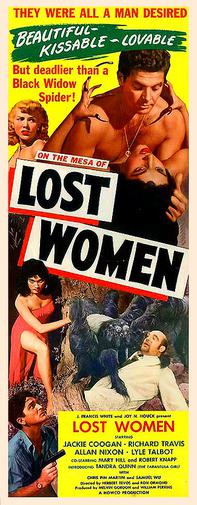
Horror Film Review: Mesa of Lost Women (dir by Herbert Tevos and Ron Ormond)


“Have you ever been kissed by a girl like this?” a disembodied voice asks at the start of 1953’s Mesa For Lost Women as a pair hands with claw-like fingernails caresses the face of someone who is later identified as being “Doc” Tucker (Allan Nixon).

Things get stranger from there.  A couple is found lost and dehydrated in the Mexican desert.  Grant Phillips (Robert Knapp) rambles about “super bugs” out in the desert and how they have to be destroyed.  American land surveyor Frank (John Martin) assumes that Grant must be delirious but Frank’s assistant, Pepe (Chris Pin Martin), knows differently.  We know that Pepe knows differently because the narrator tells us that Pepe had heard all about the monsters in the desert but Pepe keeps that information to himself….

Who is this narrator and why is he so condescending?  (For the record, he’s actor Lyle Talbot, who split his career between major, Oscar-winning productions and stuff like this.)  Have you ever noticed that a narrator usually just leaves you feeling even more confused by what you just watched?  There’s a trailer playing right now for a film called Ella McCay that opens with Julie Kavner saying, “Hi, I’m the narrator!” and whenever I hear that line, I’m just like, “Oh, this film is going to be so bad!”

I think it’s because most narrators are added after the fact, in an attempt to give some sort of uniformity to a badly constructed movie.  The narrator is there to tell us stuff that a good movie would be able to show us.  For instance, in the trailer for Ella McCay, Julie Kavner tells us that “I’m nuts about her,” as a way to assure us that Ella McCay is someone worth making a movie about.  Now, ideally, you wouldn’t have to have someone tell you that.  You would just watch the movie and say, “Hey, Ella McCay!  She deserves all the happiness in the world!”  But when your trailer is a bunch of scenes of Ella McCay acting a bit immature for someone who is destined to become “governor of the state you were born and raised in,” you need that narrator to say, “No, she’s likable, I promise!”

By that same logic, Mesa of Lost Women was apparently a mash-up of several different films, none of which had a complete script.  Narrator Lyle Talbot is here to tell us that, despite what we’re seeing, Mesa of Lost Women is an actual movie with an actual story as opposed to just a bunch of random scenes that were haphazardly crammed together.  We get a flashback of a scientist named Masterson (Harmon Stevens) traveling to the laboratory of Dr. Aranya (Jackie Coogan) and discovering that Aranya is creating giant tarantulas and transforming human women into mind-controlled slaves with the instincts of a spider.  Masterson doesn’t think that’s ethical so Aranya’s assistant, Tarantella (Tandra Quinn), gives him an injection that turns him into a simpleton.  Masterson ends up in a mental hospital, though he later escapes.  Meanwhile, an American businessman and his girlfriend (Mary Hill) come to Mexico and witness Tarantella dancing in a bar.  Masterson shows up and shoots Tarantella and then takes everyone hostage so that he can force Grant, who we now discover is a pilot, to fly him to the mesa of lost women …. or something.

Despite the best efforts of the narrator, the film is impossible to follow.  A big problem is that Dr. Aarnya’s plan never makes much sense.  How is creating a giant spider and a bunch of women who think that they’re spiders going to help him conquer the world?  The other problem is that the film had two directors, one of whom was an enigmatic German named Herbert Tevos who got the job by claiming to have directed Josef von Sternberg’s The Blue Angel.  Tevos’s footage of Dr. Aranya, the giant tarantula, and the “lost women” was not enough to secure the film distribution so a second director, Ron Ormond, was brought in to shoot a bunch of new footage to make the film more commercial.  Tevos’s film became an extended flashback in the middle of Ormond’s film and the whole thing is a big mess.

In fact, the film is such a mess that some people insist Ed Wood must have been involved.  It is true that narrator Lyle Talbot also appeared in Plan 9 From Outer Space and Glen or GlendaPlan 9‘s Mona McKinnon appears as a spider woman.  So does Dolores Fuller, who was Wood’s girlfriend at the time.  Wood later “borrowed” Mesa of Lost Women‘s score for Jail BaitMesa of Lost Women was definitely Wood-adjacent but, by all accounts, Wood didn’t actually do any work on the film.  This mess of a film belongs to Tevos and Ormond.

And it is a mess.  It’s a watchable mess, in much the same way that a nuclear meltdown would probably be watchable.  But, nonetheless, it’s still a mess and the incoherence of the plot really does get on one’s nerves, despite the best efforts of Lyle Talbot.  Talbot can’t sell the viewer on Mesa of Lost Women.  Maybe he would have had better luck with Ella McCay.
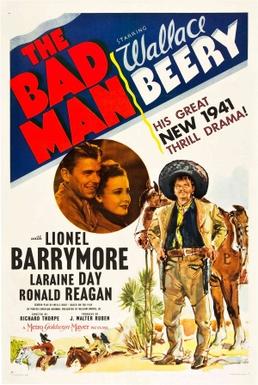
The Bad Man (1941, directed by Richard Thorpe)


Gil Jones (Ronald Reagan) lives on a ranch with his cantankerous uncle, Henry (Lionel Barrymore).  After their cattle are stolen by the notorious bandit Pancho Lopez (Wallace Beery), Gil and Henry are faced with the prospect of losing their ranch.  Banker Jasper Hardy (Henry Travers) wants to foreclose on Henry and take over the ranch but a businessman named Morgan Pell (Tom Conway) shows up and offers to pay the then-huge sum of $20,000 for the land.  Accompanying Morgan is his wife, Lucia (Laraine Day).  Lucia was Gil’s childhood love and Morgan fears that Lucia still loves Gil more than him.  Also in the mix is Gil’s comic relief best friend (Chill Wills), who has a crush on Hardy’s daughter (Nydia Westman).  Negotiations are interrupted when the flamboyant Lopez and his men return to the ranch and take everyone, but Gil, hostage.

This sepia-toned film is based on a stage play, one that had already been filmed twice.  It was Ronald Reagan’s first film for MGM and, when Reagan was running for President, he quipped that if he could survive acting opposite Wallace Beery and Lionel Barrymore than he could survive negotiating with Leonid Brezhnev.  The role of Gil is a typical Ronald Reagan role.  He’s good-natured and dependable and a little boring.  Because he once saved Lopez’s life, Lopez is willing to help him out with his problems.  Reagan is not bad in the role but he is overshadowed by Barrymore and Beery, two veteran actors who chew the scenery with gusto here.  Berry speaks in an exaggerated and not at all convincing Mexican accent while Barrymore bellows all of his lines.  Gil has so many different people yelling at him that it’s impossible not to feel sorry for him.  Morgan has ulterior motives for offering to buy the land and Tom Conway is a convincing villain.  Lopez helps out Gil and her uncle, saving not only their land but also plotting to bring Gil and Lucia back together.  It’s a stage bound mix of drama and comedy that doesn’t really work, though Beery and Barrymore are amusing and Ronald Reagan shows why he was cast in so many best friend roles.

Whether you’ll enjoy it will probably depend on how you feel about the cast because they’re really the only reason to watch.  If you’re a fan of Barrymore, Beery, or Reagan the film might work for you.  If you’re not, this stagey 70-minute western is probably not for you.

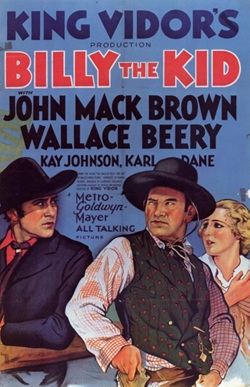
Billy The Kid (1930, directed by King Vidor)


In a frontier town, land baron William P. Donavon (James A. Marcus) finds his control challenged by the arrival of a English cattleman named John W. Tunston (Wyndham Standing).  Donavon orders his henchmen to gun down Tunston on the same day that Tunston was to marry the lovely Claire (Kay Johnson).  Tunston’s employee, an earnest young man named Billy The Kid (Johnny Mack Brown), sets out to avenge Tunston’s murder.  When Billy starts killing Donavon’s henchmen, it falls to Deputy Sheriff Pat Garrett (Wallace Beery) to arrest him.  When Billy escape from jail and rides off to be with Claire, Garrett pursues him.  Garrett is a friend of Billy’s and he knows that Billy’s killings were justified.  But he’s also a man of the law.  Will he be able to arrest or, if he has to be, even kill Billy?  Or will Garrett let his friend escape?

There were two silent biopics made about Billy the Kid but neither of them are around anymore.  This sound movie, directed by King Vidor, appears to the earliest surviving Billy the Kid film.  It’s a loose retelling of Billy’s life and his friendship with Pat Garrett and it doesn’t bother with sticking close to the established facts but that’s to be expected.  It’s an early sound film and, seen today, the action and some of the acting feels creaky.  Wallace Beery was miscast as Pat Garrett but I did like Johnny Mack Brown’s performance as the callow Billy.  The movie goes out of its way to justify Billy’s murders and it helps that Billy is played by the fresh-faced Brown.  King Vidor shows a good eye for western landscapes, a skill that would come in handy when he directed Duel In The Sun seventeen years later.

There are better westerns but, for fans of the genre, this film is important as the earliest surviving film  about one of the most iconic outlaws not named Jesse James.  It’s interesting to see Brown, usually cast as the clean-cut hero, playing a killer here.  The film’s ending is pure fantasy but I bet audiences loved it.

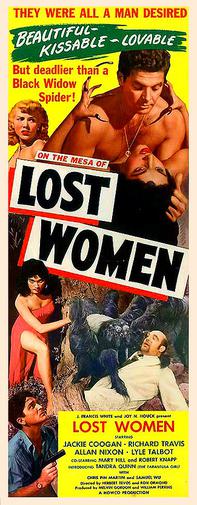
Horror on the Lens: Mesa of Lost Women (dir by Herbert Tevos and Ron Ormond)


Today’s Horror on the Lens is the infamous 1953 film, Mesa of Lost Women.  Off in the middle of the desert, Dr. Aranya (Jackie Coogan) is conducting dangerous experiments that are resulting not only in giant spiders but also a master race of superwomen who Aranya is planning to use to conquer the world or something.

Mesa of Lost Women is a bit of a disjointed film.  It was originally filmed by a German director named Herbert Tevos, who claimed to be an associate of Erich Von Stroheim’s and a former collaborator of Marlene Dietrich’s.  However, despite his claims of being well-connected, no one was particularly impressed with Tevos’s first cut of the film so Ron Ormond was brought in to film additional scenes, the majority of them featuring Jackie Coogan as the insane Dr. Aranya.  Jackie Coogan was, at the time, still best-known for playing The Kid in the Charlie Chaplin film of the same name.  After Mesa, he would go on to play Uncle Fester on the original Addams Family.

Anyway, Mesa of Lost Women is one of those B-movies that simply has to be seen and heard to be believed.  (Lyle Talbot provides the narration, which is judgmental even by the standards of the 1950s.)  Enjoy Mesa of Lost Women!