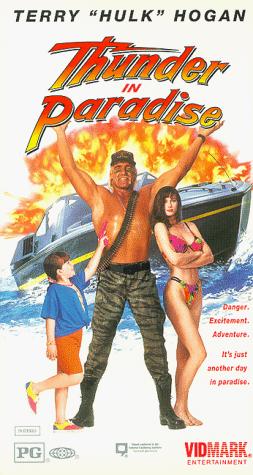
Thunder In Paradise (1993, directed by Douglas Schwartz)


R.J. “Hurricane” Spencer (Hulk Hogan) is a former Navy SEAL who now lives in Florida and makes his living with his superboat, Thunder.  Spencer’s best friend, Bru (Chris Lemmon), is also his business partner.  There’s nothing that Spencer and Bru can’t do.  This movie starts with Spencer taking the boat down to Cuba so he can rescue the family of a dissident and bring them back to Florida.  It ends with his using his boat to save the lives of his wife (Felicity Waterman) and his stepdaughter (Robin Weisman) from some treasure hunters who have made the mistake of kidnapping them.  Spencer’s marriage is one of convenience.  His wife needed a husband to get her fortune and he needed a rich wife to keep his business going.  His father-in-law (Patrick MacNee) doesn’t trust him but Spencer’s a top-notch American hero.

Though it was initially released direct-to-video, Thunder in Paradise was actually a pilot for a syndicated television show that started a few months later.  Both the film and the show were from the producers of Baywatch and it shows with the emphasis on the beach, the bikinis, the corny humor, and the cartoonish villains (led, in this case, by Flash Gordon himself, Sam Jones).  Of course, it’s a Hulk Hogan movie so none of that is really a negative.  Hogan might be playing Hurricane Spencer but he’s really playing himself and there’s enough self-aware humor to make Thunder In Paradise entertaining in a way that No Holds Barred definitely was not.  (I liked that, during a fight on another boat, there just happened to be a wooden chair sitting on the deck that Hogan could break across his opponent’s back.)  Chris Lemmon and Hulk Hogan are a surprisingly good team (Lemmon’s brain provide a needed  contrast to Hogan’s bawn) and Carol Alt is on-hand as the owner of a beach bar.  Naturally, a handful of Hogan’s fellow wrestlers shows up as well, Brutus Beefcake, Jim “The Anvil” Neidhardt, Giant Gonzalez, Jimmy Hart, and others.  As a fan of The Avengers, I was happy to see Patrick MacNee, even if his character was just a typical distrustful father-in-law.

Corny, silly, dumb, and more fun than it probably should be, Thunder In Paradise is an entertaining product of its time.
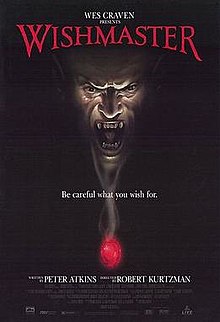
Horror Film Review: Wishmaster (dir by Robert Kurtzman)


Do you all remember Wishmaster?

Played by Andrew Divoff, the Wishmaster was a genie (or a djinn) who made his film debut in the 1997 film of the same name. The Djinn’s schtick is to randomly approach people and say something like, “Would you like to be rich?” or “Would you like all of your enemies to suffer?” He grants wishes but he does so in ironic ways. So, if you say want to be rich, you might very well turn into someone named Rich who is on the verge of getting hit by a bus. If you say that you want to escape from your mundane life, you might end up in a straight-jacket under water, struggling to perform one of Harry Houdini’s signature escapes.

I rewatched Wishmaster a few months ago and what I immediately discovered was the the Djinn wasn’t really that good at his job. He pretended to be clever in the way that he would fool humans but, honestly, it often seemed less like he was tricking people and more like he really wasn’t playing fair. Take the security guard who made the mistake of wishing for an escape. As I just mentioned, The Djinn immediately put him underwater in a straight-jacket. But the guard’s wish was not to have to escape. The guard’s wish was to simply escape. So, putting him in a life-and-death situation and telling him to figure it out for himself wasn’t fulfilling the guard’s wish. It just seemed like the Djinn wanted to drown someone and he decided to use his wish-granting job as an excuse.

The guard, by the way, was played by Tony Todd, one of the many horror icons who appeared in small roles in Wishmaster. (Today, Tony Todd is best known for the Final Destination films but, when Wishmaster came out, he was known for playing the Candyman.) Among the other cameos:

From Phantasm, Angus Scrimm provided the narration while Reggie Bannister played an unlucky pharmacist.

From Friday the 13th, Kane Hodder played a security guard who made the mistake of saying that he wished he could see the Djinn try to walk straight through him.

Day of the Dead’s Joseph Pilato played a crane operator.

John Carpenter vet George “Buck” Flower played an angry homeless man.

Sam Raimi’s brother, Ted Raimi, showed up long enough to get crushed by a crate.

And finally, Robert Englund played the somewhat pretentious professor who was responsible for bringing the Djinn to America in the first place.

As you can probably guess by looking at all of the cameos, Wishmaster is not a film that’s meant to be taken seriously. It’s often deliberately campy. Wes Craven may have produced it and was undoubtedly responsible for recruiting many of the actors who appeared in it but the film’s direction was handled by special effects maestro, Robert Kurtzman and he puts more emphasis on the visual effects than on any sort of serious exploration of the somewhat random series of events that make up the film’s storyline. Of course, when seen today, the film’s special effects look a bit cheap but, for many viewers (like me!), that’s actually a part of the film’s grisly charm.

Wishmaster does have a plot but it’s not particularly important. The Djinn tries to make Alexandra (Tammy Lauren) make three wishes so that he can unleash the forces of Hell. Why he spends all of his time granting wishes to other people instead of just concentrating on Alex is never really explained. It may be an often dumb movie but it’s also undeniably entertaining when taken on its own terms. Andrew Divoff is enjoyably sinister as the Djinn, playing the character with a sarcastic wit to go along with his evil schemes. It’s a fun movie to watch, even if it does feel like it was basically slapped together in a handful of days.

You should always be careful what you wish for but Wishmaster is still an entertaining piece of 90s horror.

(Author’s Note: Wow, this is embarrassing.  Right after I posted this review, I discovered that I previously reviewed Wishmaster in 2018!  Whoops!  Well, it’s nice to see that my thoughts on the film have remained consistent. — LMB)

Horror Film Review: Wishmaster (dir by Robert Kurtzman)


Remember the Wishmaster films?

There were four of them and they all deal with this ancient Djinn (Andrew Divoff) who, during each film, would escape from his magical prison and then wander around granting people their wishes.  Of course, since the Djinn was evil, there was always a catch.  He would either interpret the wish very literally or he would manipulate people into asking for the wish in the wrong way.  As a result, people would always get their wish but they’d get in a way that would make them suffer.

For instance, a typical Wishmaster conversation would go something like this:

“I wish I was a better actor.”

“Am I to understand that you wish you were John Wilkes Booth?”

“Wait …. what?”

“As you wish.”

Sic semper tyrannis!”

The first Wishmaster was released in 1997 while the fourth (and, to date, last) installment was released in 2002.  They’ve never gotten as much attention as some of the other horror franchises from that period, largely because there was really only so much that you could do with a character like the Djinn.  Part of the problem was that almost every scene depended on someone not understanding the importance of being clear when making a wish.  There’s only so many times that you can watch the Djinn trick people into saying, “I wish I never get old,” before the whole novelty of it all wears off.

That said, the Wishmaster films did have one thing going for them and that was Andrew Divoff.  A veteran character actor (and one who you might recognize from Lost, where he played a member of the Others who was both Russian and who had only one eye), Divoff was always creepy as fug in the role of the Djinn.  Whenever someone made the mistake of making a wish, this little smile would appear on Divoff’s face and you knew that someone was about to learn an important lesson about being careful what you wish for.  Divoff was seriously frightening of the Djinn, so much so that you regretted that the films themselves could never quite keep up with his performance.

Last night, I watched the first Wishmaster film for the first time in six years and it was actually a little bit better than I remembered.  The plot itself is typical Wishmaster stuff.  The Djinn is trapped inside of a gem that eventually makes it way to the United States.  An idiot lab worker attempts to experiment on it, which leads to the gem exploding, the Djinn getting free, and an epidemic of mass wish granting.  Nobody seems to have learned the lesson that the first thing you wish for is more wishes.

Wishmaster is stupid but fun.  The first film was produced by Wes Craven and perhaps that explains why the film is full of cameos from everyone who was anyone in low-budget 90s horror.  As a result, you’ve got Kane Hodder saying that he would “love it if” the djinn “tries to go right through him,” and Robert Englund playing a businessman and Tony Todd showing up as a doorman.  It’s nice to see them all, though ultimately the main reason to watch the film is for Andrew Divoff’s wonderfully smirky turn as the Djinn.  It’s hard not to wish that he had another horror franchise to dominate.

Be care what you wish for!

(Sorry, had to do it….)