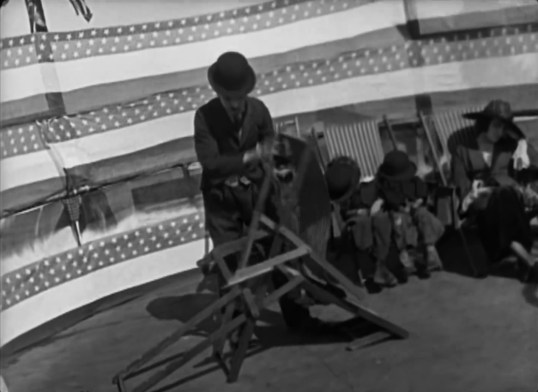
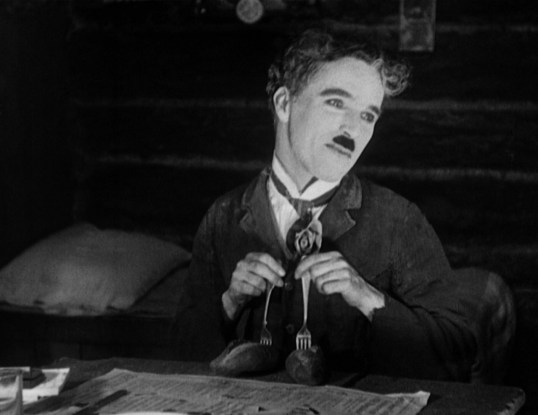
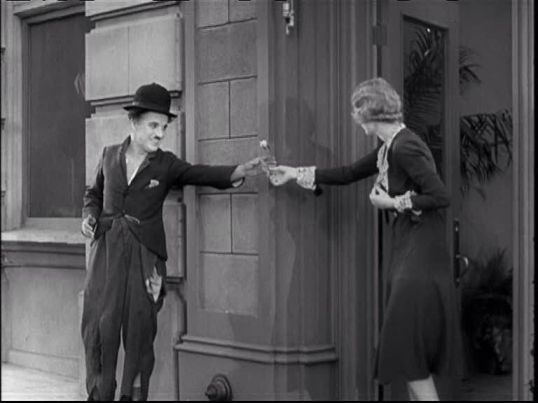
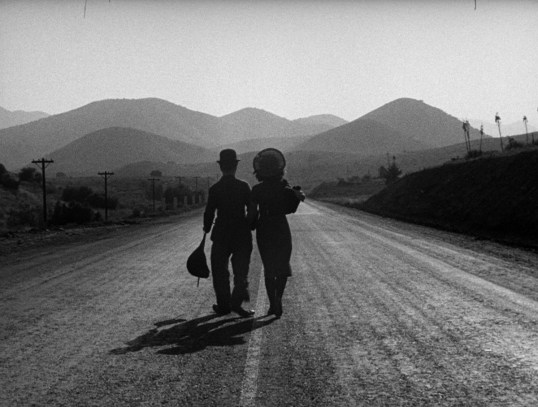
4 Or More Shots From 4 Or More Films is just what it says it is, 4 shots from 4 of our favorite films. As opposed to the reviews and recaps that we usually post, 4 Shots From 4 Films lets the visuals do the talking!
136 years ago today, film and comedy pioneer Charlie Chaplin was born. It’s time for….
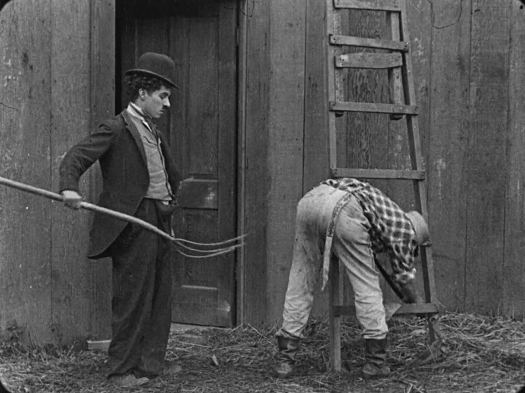
Today we celebrate the birthday of the immortal Charlie Chaplin , born on this date 130 years ago. Chaplin made his film debut 105 years ago this year, and the world hasn’t stopped laughing since! His silent comedies featuring the endurable character “The Little Tramp” (or as Chaplin called him, “The Little Fellow”) have stood the test of time, and his mix of humor and pathos elevated slapstick comedy to high art. The compilation film CHAPLIN’S ART OF COMEDY highlights Chaplin’s early efforts at Essanay Studios from 1914-15, and contains some of his best work.
The success of Robert Youngson’s 1959 film THE GOLDEN AGE OF COMEDY (spotlighting silent luminaries like Laurel & Hardy, Ben Turpin, and others) had spawned a whole host of imitators over the next decade utilizing low-to-no cost silent footage and repackaging it into a new feature film. Some were good, others lackadaisically put together, most…
So, guess what I did this morning? That’s right — I put on a blindfold, a stumbled over to my ever-growing Blu-ray, DVD, and even VHS collection and I randomly selected 12 films!
Why did I do this?
I did it so you, the beloved readers of Through the Shattered Lens, could once again have a chance to tell me what to do. At the end of this post, you’ll find a poll. Hopefully, between now and next Monday (that’s March 24th), a few of you will take the time to vote for which of these 12 films I should watch and review. I will then watch the winner on Tuesday and post my review on Wednesday night. In short, I’m putting the power to dominate in your hands. Just remember: with great power comes great … well, you know how it goes.
Here are the 12 films that I randomly selected this morning:
The Baader Meinhof Complex (2008) — This German film was nominated for Best Foreign Language Film. It tells the true life story of the left-wing German terrorist group, The RAF.
The Cat’s Meow(2001) — From director Peter Bogdonavich, this film speculates about the events that led to the shooting of silent film director Thomas H. Ince. Starring Kirsten Dunst as Marion Davies, Edward Herrmann as William Randolph Hearst, and Eddie Izzard as Charlie Chaplin.
Heavenly Creatures (1994) — The close relationship between two teenage girls (Melanie Lynesky and Kate Winslet) leads to both a vibrant fantasy world and real-life murder. Directed by Peter Jackson.
In A Lonely Place(1950) — In this film noir from director Nicholas Ray, Humphrey Bogart plays a screenwriter who may (or may not) be a murderer.
Liquid Sky(1983) — In this low-budget, independent science fiction film, an alien lands in New York and soon several members of the city’s underground art scene are vaporized. Not surprisingly, it all has to do with heroin.
Made in Britain (1983) — A very young Tim Roth makes his debut in this British film. Roth plays Trevor, a Neo-Nazi who — despite being intelligent and charismatic — also seems to be intent on destroying himself and everything that he sees.
Much Ado About Nothing(2013) — In between The Avengers and Agents of SHIELD, Joss Whedon found the time to direct this adaptation of Shakespeare’s play.
Peyton Place(1957) — In this Oscar-nominated film, the sordid secrets of an outwardly idyllic New England town are exposed.
Pretty Poison (1968) — Having just been released from a mental institution, Dennis (Anthony Perkins) finds himself involved with teenager Sue Anne (Tuesday Weld), who — despite her wholesome appearance — is actually psychotic.
Troll 2(1990) — A family moves to Nilbog, a small town that is populated by vegetarian goblins. This movie is widely considered to be one of the worst ever made.
Walkabout (1971) — In this visually stunning Nicolas Roeg film, a teenage girl and her younger brother find themselves stranded and left for dead in the Australian outback. They try to survive with the help of an Aborigine.
Zabriskie Point(1970) — In this 1970 film, the great Italian director Michelangelo Antonioni takes a look at the 60s counter-culture. Airplanes are stolen, buildings explode, and orgies magically materialize in the middle of the desert.
I recently discovered that Uverse has select films from the Criterion Collection available OnDemand. Last night, I took advantage of this service and watched 1940’s The Great Dictator. Along with being Charlie Chaplin’s first all-sound film, the Great Dictator was also a best picture nominee. (It lost to Alfred Hitchcock’s Rebecca.)
The Great Dictator is a broad comedy that, ultimately, has a very serious message. Made at a time when the second world war was looking more and more inevitable, The Great Dictator features Charlie Chaplin in two roles. As the film opens at end of World War I, Chaplin plays a meek but well-meaning Jewish barber who has found himself serving in the army of Tomania. Though the barber manages to survive the war, he also loses his memory and ends up spending the next 20 years in a mental hospital. When his memory finally does return, the barber returns to his barber shop and quickly discovers that things have changed. His shop has been boarded up and the word “JEW” has been painted over the windows. Thugs wearing military uniforms now patrol the streets and continually threaten to send people to concentration camps. Tomania is now ruled by a dictator named Adenoid Hynkel.
Hynkel, who happens to look just like the barber (and who is, of course, also played by Chaplin) is quickly established as being a crazy and rather simple-minded buffoon. As played by Chaplin, Hynkel gives long speeches in a harsh gibberish language that is designed to sound German without actually being German (fortunately, Hynkel has a translator on hand to tell us, after he has just spent two minutes harshly ranting, “Hynkel just explained his position on the Jews.”) and he continually runs throughout his palace in an attempt to prove that he’s capable of doing a hundred more things than the average person. In his private time, he does a child-like dance with a big inflatable globe, speculates on how glorious it will be to be the “brunette dictator of the Aryan people,” and tries to maintain a shaky alliance with his fellow dictator Benzino Napaloni (Jack Oakie). Playing a character that was the polar opposite of his usual persona, Chaplin’s performance manages to be both comedic and disturbing. You laugh at Hynkel’s buffoonish behavior but you never forget that he’s a very dangerous man. (Admittedly, I say that with a hindsight that was not possessed by either Chaplin or the audiences of 1940.)
The film proceeds to follow these two characters in two separate storylines that finally come together at the end of the movie with (SPOILER) Chaplin giving a nearly 5-minute plea for world peace. While Hynkel schemes to conquer the world one country at a time, the barber attempts to adjust to his new life while sweetly romancing the outspoken Hanna (Paulette Goddard), While the film is probably best known for Chaplin’s performance as Hynkel, I found the barber and Hannah’s relationship to be sweetly poignant. Their relationship gives this film a heart to go along with its biting satire.
For me (and admittedly, I’m a secret history nerd), it’s interesting to watch The Great Dictator today and try to imagine how audiences first reacted to it in 1940. According to Wikipedia, the Great Dictator was Chaplin’s most financially succesful film and Chaplin was even invited to the White House to recite the film’s climatic speech for President Roosevelt. And, of course, The Great Dictator also scored Oscar nominations for best picture, actor (Chaplin), supporting actor (Jack Oakie), screenplay, and original score. Chaplin also said, in his later years, that if he had known what was truly being done by Hitler and the Nazis, he would never have made a comedy like The Great Dictator.
I think that would have been a mistake on his part because if The Great Dictator proves anything, it proves that satire and humor is often the most powerful weapon against the forces of evil. Though Chaplin makes no secret of the fact that Hynkel is meant to be Hitler and Oakie is meant to be playing Mussolini, they could also serve as stand-ins for just about any dictator who has seized power through exploiting prejudice and hatred. The sight of Hynkel dancing with that globe is actually a far more effective anti-totalitarian statement than the heartfelt and undeniably sincere speech that ends the film.

 Through the Shattered Lens