Holidays On The Lens: Beyond Tomorrow (dir by A. Edward Sutherland)


After three eccentric businessman arrange for a young couple to get together right before the holidays, a plane crash kills the three men.  However, their ghosts remain on Earth to watch over the couple and to take care of some unexpected holiday business.  The film is a holiday film and a comedy and a romance and a musical and a ghost story and a melodrama and finally an oddly sincere meditation on life and death.

From 1940, here’s Beyond Tomorrow!

Holiday Spirit: Beyond Tomorrow (dir by A. Edward Sutherland)


After three eccentric businessman arrange for a young couple to get together right before the holidays, a plane crash kills the three men.  However, their ghosts remain on Earth to watch over the couple and to take care of some unexpected holiday business.  The film is a holiday film and a comedy and a romance and a musical and a ghost story and a melodrama and finally an oddly sincere meditation on life and death.

From 1940, here’s Beyond Tomorrow!

Holiday Film Review: Beyond Tomorrow (dir by A. Edward Sutherland)


I’m standing at the edge of tomorrow
And its all up to me how far I go
I’m standing at the edge of tomorrow

I’ve never seen such a view before
A new world before my eyes
So much for me to explore
It’s where my future lies

Today I’m standing at the edge of tomorrow
From here the future looks bright for me
And it’s all up to me how far I go
It’s my time to break away
I’m standing at the edge of tomorrow
Today

Beyond Tomorrow is a strange film from 1940.  Technically, it is a holiday film.  It takes place during the Christmas season and there’s a lot of very peppy scenes featuring people celebrating the holidays.  I watched the movie with my friends in the Late Night Movie Gang.  We’re a pretty sentimental group but even we felt that some of the characters went a bit overboard with the holiday cheer.  The film is also comedy and a romance and a musical and a ghost story and a melodrama and finally an oddly sincere meditation on life and death.  That’s a lot of weight for one film to carry and there were more than a few times that Beyond Tomorrow seemed like it might collapse in a heap of Christmas ambition.  Fortunately, the film always righted itself and, in the end, it actually managed to be …. well, definitely more interesting than what any of us were expecting!

The film opens with three businessmen (Harry Carey, C. Aubrey Smith, and Charles Winninger) living in a mansion with their Russian housekeeper (played by Maria Ouspenskaya, who was also the old gypsy lady in The Wolf Man).  As almost something of a lark, the three men arrange for James (Richard Carlson) to meet Jean (Jean Parker).  Jean is a teacher.  James is a singing cowboy from Texas.  Together, with the encouragement of the three businessmen, Jean and James get together.  Awwwww!

Unfortunately, the three businessmen are then all killed in a plane crash.  However, their ghosts remain on Earth and watch over the growing love between James and Jean.  Unfortunately, James become a singing sensation on the radio and soon, he’s being tempted to cheat.  Meanwhile, Jean’s ex-husband is running around with murder in his heart and a gun in his hand!  This romantic comedy has suddenly taken a very dark turn!

While the three ghosts look after James and Jean, they consider why they’re still on Earth and not in the afterlife.  One ghost is eventually greeted by his son, who died during the Great War.  Another one of the businessmen is haunted by vaguely defined sins and, even in death, he refuses to repent because he feels that he doesn’t deserve to go to Heaven.  Instead, he continually walks off into the darkness.  The last businessman continually tries to push James and Jean on the right path but it turns out that it’s not easy for the dead to talk sense to the living.

You can probably give yourself whiplash trying to keep up with the film’s tonal changes.  It starts out with romance and comedy and then suddenly, it’s turns into an existential rumination of love, forgiveness, and guilt.  Once the three businessmen die, it becomes a totally different story.  Suddenly, soldiers are returning from the dead and the gates of Hell are beckoning.  And, on top of that, James keeps breaking out into song every few minutes!

It’s a very strange film.  Unfortunately, from the start, the pacing feels off.  By today’s standards, Beyond Tomorrow gets bogged down in all of the songs and the scenes of holiday mirth-making.  That may not have been as much of a problem for audiences in 1940 but I have to say that, speaking as someone trying to watch this film in 2020, Beyond Tomorrow made my ADD go crazy.  If not for my friends and their patient willingness to inform me what was going on in the film, I probably wouldn’t have been able to follow the film’s storyline.

That said, the film was fairly well-acted and the final scenes, with the heavenly gates in the sky, are undeniably effective.  Speaking as a history nerd, I found it interesting to see how the shadow of World War I still hung over a film that was made 21 years after that war ended.  As the scenes in which one of the ghosts is a reunited with son showed, America was still dealing with trauma and horror of the first modern war.  (One year after the release of Beyond Tomorrow, Japan would bomb Pearl Harbor and America entered World War II, a conflict that many hoped to avoid precisely because they remembered the all of the men who didn’t make it home during the previous war in Europe.)  Messy though the film may be, Beyond Tomorrow functions well as both a historical document and a bit of sentimental wish fulfillment.

Compared to holiday classics like the original Miracle on 34th Street and It’s A Wonderful Life, Beyond Tomorrow is relatively unknown.  Certainly, it’s no classic.  But, for fans of both Christmas and old movies, it’s still an interesting trip into the past.
Cleaning out the DVR: Night Nurse (dir by William A. Wellman)


(Lisa is once again cleaning out her DVR!  She recorded the 1931 film Night Nurse off of TCM on May 3rd.)

Night Nurse follows the sordid nights and quiet days of Lora Hart (Barbara Stanwyck), a high school dropout who dreams of becoming a nurse.  Fortunately, she manages to get hired on as a trainee nurse at a big city hospital.  Along the way, she gets a new BFF (Joan Blondell), a potential new boyfriend named Mortie (Ben Lyon), who is not only handsome and nice but a bootlegger too, and valuable life lessons on how to defend herself against smirky male doctors.  Yay!

Unfortunately, even if you manage to survive the rigorous training program, the life of a night nurse is never easy.  For instance, Lora gets hired to help look after the Ritchie children.  The Ritchies may be rich but they’ve got so much drama going on that maybe it would be better if they were poor.  The kids, for instance, are always sick and their doctor (Ralf Harolde) is apparently hooked on morphine.  The mother (Charlotte Merriam) is always passed out drunk.  Meanwhile, the family’s chauffeur, Nick (Clark Gable!), is a total brute who appears to have dangerous plans of his own.

Made in 1931, Night Nurse is a pre-code film, which is to say that it was made before the production code mandated what was and was not acceptable in the movies.  Occasionally, among film fans like myself, there’s a tendency to assume that any pre-code film is actually going to be some sort of subversive, over-the-top masterpiece.  We always think about the epic orgies that Cecil B. DeMille would slip into his silent films or maybe Douglas Fairbanks playing a constantly sniffing detective named Coke Ennyday in The Mystery of the Leaping Fish or the old stories about anonymous stagehands accidentally getting gunned down during the filming of Little Caesar or The Public Enemy.  However, just as often, the pre-code label just means that a film is going to feature a few winky double entendres, a bootlegger hero, and at last one scene of the film’s heroine getting undressed.  If you want to become an expert on 1930s lingerie, just spend a weekend watching pre-code films.

That’s certainly the case with Night Nurse, which only takes 7 minute to reach its first scene of nurses changing out of street clothes and into uniform.  As for the bootlegger hero, that’s taken care of as soon as Mortie shows up and flashes his charming smile despite having a bullet in his hand.  As played by Ben Lyon, Mortie is not exactly the most convincing gangster to ever show up in a pre-code film but no matter!  He’s got charm and not every gangster can be Edward G. Robinson…

If it sound like I’m being critical of Night Nurse, I’m not.  I watch Night Nurse every time that it shows up on TCM and I actually love the film.  It’s a cheerfully silly melodrama, the type of innocently risqué film that could only be made during the pre-code era.  Stanwyck and Blondell are a perfect team and whenever I listened to them trade sarcastic quips or watched them as they try to get away with breaking curfew, I couldn’t help but think of my own friends.  Seriously, everyone should be as lucky as to have a BFF like Joan Blondell.  And finally, you get Clark Gable as the bad guy.  Gable is really mean and hateful in this movie and it takes a while to get used to seeing him without his mustache.  To be honest, he’s not as handsome without the facial hair.  But still — he’s Clark freaking Gable and, even in this early role, he had so much charisma and screen presence that it’s impossible not to watch him.

I was going to start this review by saying that Night Nurse sounded like a good title for an MCU film.  However, my boyfriend informed me that apparently, there actually was a Marvel comic book called Night Nurse.  Apparently, it had nothing to do with this movie.  That’s a shame but hopefully, someone at Lifetime will read this review and decide to remake Night Nurse with an all Canadian cast.  I’m keeping my fingers crossed on this one!

Anyway, Night Nurse shows up on TCM constantly.  Keep an eye out for it!

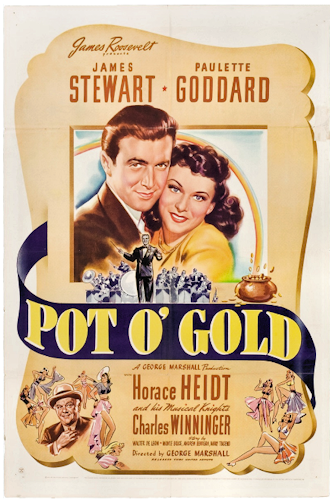
The Fabulous Forties #48: Pot O’ Gold (dir by George Marshall)


Pot_o_Gold-_1941-_Poster

The 48th film in Mill Creek’s Fabulous Forties box set was 1941’s Pot O’ Gold.  At first, I was really excited about watching Pot O’ Gold because it starred James Stewart, one of my favorite of the Golden Age stars.  “Wow,” I thought, “James Stewart never made a bad movie!  This is going to be great!”  However, before watching the film, I looked Pot O’ Gold up on Wikipedia and I discovered that apparently, James Stewart considered Pot O’ Gold to be the worst film that he ever made.

After having watched the film, I think that Jimmy may very well have been correct in his assessment.

Pot O’ Gold is a musical comedy.  Stewart plays Jimmy Haskell, the owner of a music store.  Jimmy loves music but he’s a terrible businessman.  Despite the fact that his store always seems to be full of quirky characters playing musical instruments, it still goes out of business.  Jimmy is forced to go to work for his uncle, C.J. Haskell (Charles Winninger).  C.J. not only owns a health food company but he also produces a radio show.

And, on top of all that, C.J. hates music!

Unfortunately, considering how much C.J. hates music, he lives right next door to the McCorkles, a family of Irish musicians.  The McCorkles are constantly practicing in front of C.J.’s store and, as a result, C.J. is constantly forced to call the cops to make them go away.

When Jimmy first arrives at the store, he befriends the McCorkles.  He even falls in love with Molly McCorkle (Paulette Goddard).  Unfortunately, none of the McCorkles know that he is C.J.’s nephew and C.J. doesn’t know that his nephew secretly continues to love music.  Meanwhile, C.J. is trying to catch the mysterious person who threw a tomato at him.  What he doesn’t realize is that the tomato was thrown by … JIMMY!

And it just keeps going on and on from there.  C.J. conspires to get rid of the McCorkles.  Jimmy tries to bring peace between the two sided without the Molly discovering that he’s related to C.J. and without C.J. realizing that Jimmy threw that tomato.  Jimmy eventually goes on C.J.’s radio show and soon, he’s using the show as a way to give away money to the needy.  Meanwhile, he struggles to forge peace between the McCorkles and C.J. without Molly discovering his true identity and without C.J. finding out he threw that tomato.  Will C.J. ever learn to love music and will it ever occur to anyone that this whole mess could easily be resolved by everyone making an effort not to randomly break out into song every time C.J. happens to be walking down the street?

Pot O’ Gold is an amazingly silly movie and I don’t mean silly in a good way.  This is one of those films where every issue could be resolved if people just showed a little intelligence.  It’s also a movie where everyone breaks into song every few minutes.  The key to a successful musical is that the songs have to feel like the grow organically out of the action.  The songs in Pot O’ Gold feel like they’re just there to be there.

Personally, I think James Stewart is one of those actors who can make any movie worth seeing.  He is his normal, likable self in this film but Pot O’ Gold never seems worthy of his famous persona.

Incidentally, Pot O’ Gold’s credited producer was James Roosevelt, FDR’s wastrel son.  I don’t know how much he had to do with the actual production but I’ve always wanted an excuse to use the word “wastrel” in a review.