Horror Film Review: The Revenge of Frankenstein (dir by Terence Fisher)


revengetitle

Last year, Gary reviewed the first of the Hammer Frankenstein films, The Curse of Frankenstein.  For today’s horror film review, I’m going to take a look at the second movie in Hammer’s Frankenstein series, 1958’s The Revenge of Frankenstein!

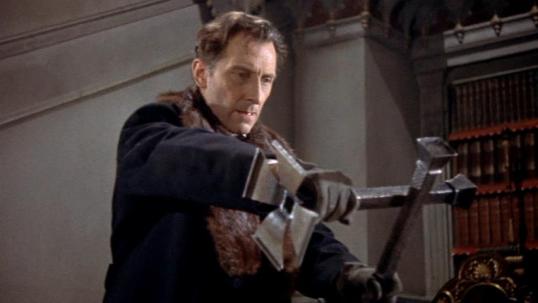
The Revenge of Frankenstein opens where The Curse of Frankenstein ended.  The monster (played by Christopher Lee in the first film) has been destroyed and Baron Frankenstein (Peter Cushing) has been sentenced to be executed for the monster’s crimes.  However, the Baron escapes the guillotine.  Instead, he arranges for a priest to be beheaded in his place.  Working under the name Dr. Stein, the Baron escapes to another village and, after several years, re-establishes himself as a wealthy and respected doctor.  While most of his patients are rich, Dr. Stein also helps the poor and the disabled.  By all accounts, he’s doing wonderful work but he’s also deliberately enigmatic, refusing to join the local doctors council.

Right from the beginning, we’re reminded of just how different Hammer’s Baron Frankenstein was from Universal’s version of the good doctor.  In the Universal films, Dr. Frankenstein — regardless of whether the doctor in question was Henry, Wolf, or Ludwig — was always portrayed as being misguided but ultimately noble.  If any of the Universal Frankensteins had been sentenced to death, it’s probable that they would have put on a stoic face, walked to the guillotine, and allow their head to roll.  In fact, they would have felt so responsible for the actions of the Monster that they probably would feel it was their moral duty to allow themselves to be executed.

That’s not the case when it comes to Hammer’s Baron Frankenstein.  Baron Frankenstein feels no guilt over what the Monster has done.  Go the guillotine?  No way!  Baron Frankenstein is determined to create life and if creating life means that other, lesser mortals end up dead … well, so be it.  As opposed to the Universal Frankensteins, who all developed god complexes after the success of their experiment, Baron Frankenstein has his god complex from the beginning.  And if Baron Frankenstein is a god, why shouldn’t a priest be sacrificed for the good of the Baron’s work?

Anyway, Dr. FrankenStein and his assistant, Dr. Kleve (Francis Matthews) are determined to once again bring the dead back to life.  This time, the plan involves transplanting the brain of hunchback Karl (Oscar Quitak) into a physically strong body (played by Michael Gwynn).  Dr. Kleve is worried that a brain transplant could lead to unforseen complications.  For instance, one of Dr. Stein’s chimpanzees reacts to being given an orangutan’s brain by turning into a cannibal.  However, Stein tells Dr. Kleve not to worry about it.  After all, what could go wrong?

Well, a lot goes wrong.  It’s a Frankenstein movie, after all.

I have to admit that, while I love Hammer’s Dracula films, I’ve never been a huge fan of their take on Frankenstein.  While Peter Cushing always makes for a wonderfully compelling and often chillingly evil Baron Frankenstein, the majority of the Hammer Frankenstein films always seem to move way too slowly.  Whenever I watch one of them, I always find myself growing rather impatient with the endless scenes of grave robbery and body stitching.  “HURRY UP AND BRING THAT DAMN THING TO LIFE!” I’ll find myself shouting.

However, I was actually pleasantly surprised by how well The Revenge of Frankenstein holds up.  That Cushing would give an excellent performance as Baron Frankenstein is to be expected.  But really, the entire film is well-acted and both Oscar Quitak and Michael Gwynn give poignant performances as Frankenstein’s latest experiment.  It’s a visually vibrant and nicely paced horror film, one that never drags like some of the later Hammer Frankenstein films.

The Curse of Frankenstein and The Revenge of Frankenstein make for a great double feature, especially in October!
Horror Film Review Repost: The Horror of Dracula (dir by Terrence Fisher)


(As some of our longtime readers might remember, I originally posted this review on October 11th, 2013.  I’m going to be posting reviews of all of the Hammer Dracula films today so I figured I would start things off by reposting my thoughts on the very first of them, 1958’s Horror of Dracula.  Add to that, I happen to really like this review!)

horrorofdracula

Of all the monsters who have appeared in horror cinema, Count Dracula is perhaps the most iconic.  Reportedly, Dracula first appeared on film in 1920, in a silent Russian film that is now considered to be lost.  In 1921, he would appear in a Hungarian film called Dracula’s Death and in 1922, he would be renamed Count Orlok for the German masterpiece Nosferatu.  Indeed, by the time Bela Lugosi gave his famous performance in Tod Browning’s Dracula, the count had been appearing in films for at least 11 years.  In nearly 100 years of filmmaking, a countless number of actors have brought Dracula to life.

We could spend hours debating who was the best Dracula and certainly, there are some worthy contenders.  Bela Lugosi brought a continental sophistication to the role, while John Carradine was properly intimidating and theatrical.  Udo Kier, Gary Oldman, Thomas Kretschmann, Leslie Neilsen, Zandor Vorkov, and Frank Langella have all played the prince of darkness, to varying degrees of success.

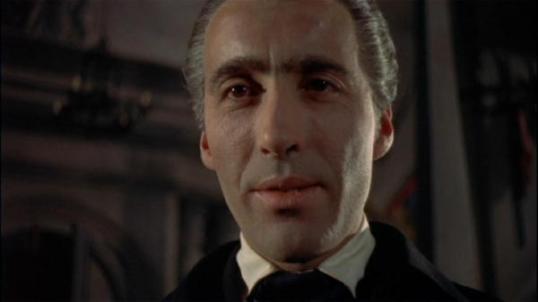
Yet for me, as worthy as any of those actors may be, there is only one true Dracula and he was played by Christopher Lee.

Lee famously played Dracula in seven movies for Hammer Films and, though he has often complained about the quality of these films (especially the later ones, which tended to mix Dracula with hippies), they were largely responsible for making Christopher Lee into the iconic figure that he remains today.  It’s also largely due to Lee’s performance that horror fans like me continue to discover and appreciate the films of Hammer today.

As played by Christopher Lee, Dracula was pure evil.  Lee’s Dracula had no use for self-pity and one can only imagine what his reaction would have been if he had ever run into the self-torturing vampires of Twilight.  Lee’s Dracula had no use for doubt or regret.  Instead, he was a determined animal who was driven by a singular lust for blood.

And yet, at the same time, Lee brought an intelligence to the role that was often lacking in previous performances.  Lee’s Dracula may have been an animal but he was a cunning animal.  Whereas it’s easy for me to imagine escaping from the clutches of Bela Lugosi, I know that if Lee’s Dracula wanted me then he would have me.  There’s no escape from Lee’s Dracula.  He’s too quick, determined, and intelligent.

Christopher Lee Is Dracula

His animal nature made Lee’s Dracula frightening but it was his cunning and determination that made him dangerous and, ultimately, even sexy.  (While I’ve read that audiences in 1931 swooned over Bela Lugosi, whatever sex  appeal he may have had is lost on modern viewers like me.)  It has often been argued that Bram Stoker meant for Dracula to be a symbol of all the desires that were repressed by Victorian society.   That’s certainly true when it comes to Christopher Lee’s carnal and viscous portrayal of the character.

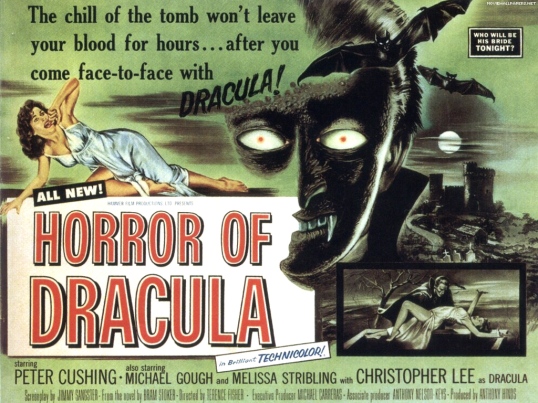
Of the seven Dracula films that Christopher Lee made for Hammer Films, the first remains the best.  Released in 1958 and known as Dracula in the UK and the Horror of Dracula in the US,  it revitalized the horror genre and helped to make stars of both Christopher Lee and Peter Cushing.  Especially when compared to some of the sequels that Hammer subsequently produced, it remains one of the best Dracula films ever made.

Horror of Dracula

The film is a very loose adaptation of Stoker’s original novel.  Jonathan Harker comes to Dracula’s castle in Romania.  Though posing as a librarian, Harker has actually come to the castle to drive a stake through the heart of both Dracula and his vampire bride.  However, no sooner has Harker staked the bride than he’s overpowered and bitten by Dracula.  Significantly, all of this occurs within the first 10 minutes of the film.  As opposed to certain other Dracula films, Horror of Dracula gets straight to the point.  And why shouldn’t it?  After all, anyone watching the film already knows that Dracula’s a vampire so why waste time trying to convince us otherwise?  We don’t watch Dracula for the familiar story as much as we watch to discover how different filmmakers will choose to tell that story.

When Harker’s colleague, Prof. Van Helsing (played with the perfect amount of intensity by Peter Cushing) shows up at the castle, he discovers that Harker is now a vampire and that Dracula is nowhere to be found.

Dracula, needless to say, is out for revenge.  He stalks Harker’s fiancee Lucy, as well as Lucy’s brother Arthur Holmwood (Michael Gough) and his wife Mina (Melissa Stribling).  Much as in Stoker’s original novel, Lucy is eventually turned into a vampire and it’s up to Van Helsing and Arthur to stop both her and her new master.

(Of course, in Stoker’s original novel, Harker is not turned into a vampire and instead marries Mina while the aristocratic Arthur is one of Lucy’s three suitors.  However, I have to say that I always thought the literary Harker was a bit on the dull side and that Arthur was always my favorite character so I’m happy that he gets to be the hero here.)

If I had to pick one film to epitomize everything that I love about the Hammer brand of horror, it would be Horror of Dracula.  As directed by Terrence Fisher, the film moves at an exciting, non-stop pace while the traditionally lush cinematography is almost bombastically colorful.  Cushing and Lee, who were the best of friends off screen, make for formidable opponents, with Cushing embodying good just as effective as Lee embodied evil.  Though it’s been over 50 years since Horror of Dracula was originally released, the film remains effective and, not coincidentally, a lot of fun.

Peter Cushing as Dr. Van Helsing

Quite simply put, this is a film that, for so many reasons, remains a true pleasure to watch.

One final note — I often find myself lamenting that I was born several decades too late and I realize just how true that is whenever I watch a film like Horror of Dracula.  Seriously, I would have loved to have been a Hammer girl, showing off my cleavage and getting hypnotized by Christopher Lee.

Seriously, what more could you want?

Back to School #7: if… (dir by Lindsay Anderson)


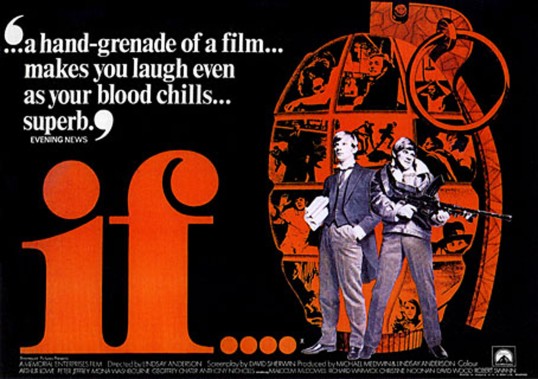
For today’s final entry in our series of Back to School reviews, let’s close out the 60s by taking a look at a 1968 British film.  Directed by Lindsay Anderson, if… not only won the Grand Prix du Festival International du Film (now known as the Palme d’Or) at the 1969 Cannes Film Festival but it also featured the film debut of future icon Malcolm McDowell.

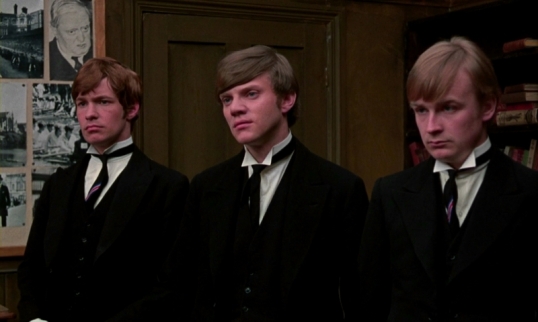
if… takes place at a British public school (or, as we would call it here in the States, a private school) that is mired in a long tradition of conformity and oppression.  For roughly the first half of the film, we see how the school works.  The teachers are stern and out-of-touch.  The headmaster (Peter Jeffrey) considers himself to be something of a reformer and is clueless as to just how little respect the students have for him.  Discipline is maintained by the Whips,sadistic upperclassmen who revel in their power and who spend most of their time speculating about which one of them will claim 13 year-old Bobby Phillips (Rupert Webster) as his own.  Three students — Mick Travis (Malcolm McDowell), Johnny (David Wood), and Wallace (Richard Warwick) — are considered to be nonconformists and soon find themselves being targeted by both the school’s faculty and the Whips.  During this first half, the film plays out as harsh but relatively realistic.

And then something happens.

If2

About 45 minutes into the film, if… starts to grow increasingly more and more surreal.  In a scene that plays out in languid, sensual slow motion, the otherwise dim-witted Wallace gracefully exercises on a high bar while an entranced Bobby Phillips watches.  When Rowntree and his fellow whips decide to punish Mick, Johnny, and Wallace with a particularly brutal caning, the disturbing sound of it echoes throughout the entire school.  During a war game, Mick fires an automatic rifle full of blanks at the chaplain and is subsequently forced to apologize while the chaplain sits up in a drawer kept in the headmaster’s office.  Mrs. Kemp, the wife of the housemaster, wanders naked through the dormitory.  Perhaps most famously, the film goes from randomly being in color to black-and-white and then back again, all adding to the movie’s dreamlike feel.

Perhaps most importantly, Johnny and Mick manage to sneak off campus and spend a day roaming around the city.  After they steal a motorcycle from a showroom, they stop at a cafe where they are served coffee by a character known only as the Girl (Christine Noonan).  The Girl tells Mick that sometimes she’s a tiger and soon, they are wrestling naked on the floor while Johnny sits in a corner booth and drinks his coffee.  Later, when Mick returns to the school, he looks through a telescope and sees the Girl staring back at him and waving.

Johnny, the Girl, and Mick

And finally, the Girl shows up while Mick, Johnny, Wallace, and Bobby are cleaning out a storeroom as a part of their punishment for scaring the chaplain.  Among the dusty shelves, they find not only a jar containing a fetus but a cache of weapons as well.  This leads to the film’s famous conclusion, a shocking act of violence that, in the 60s, was probably viewed as a show of solidarity with rebellious youth everywhere but, when seen in this time and age, draws disturbing parallels with the American tradition of school shootings.

Seen today, if… remains a surprisingly potent celebration of rebellion and a harsh condemnation of conformist society.  Occasionally pretentious in that wonderful way that only a British film made in 1968 could be, if… is also a surprisingly stinging satire that doesn’t leave anyone — even the film’s heroes — untouched.  Perhaps best of all, if… is also the film debut of Malcolm McDowell and he gives a strong performance here.  It’s easy to understand why, after seeing if…, Stanley Kubrick cast McDowell in A Clockwork Orange.  Interestingly enough, despite if’s apocalyptic ending, McDowell would play Mick Travis twice more, in Anderson’s O Lucky Man, a film that is even more surreal than if…, and in Britannia Hospital.

Tomorrow, we’ll continue our journey back to school by taking a trip to the 70s!

If