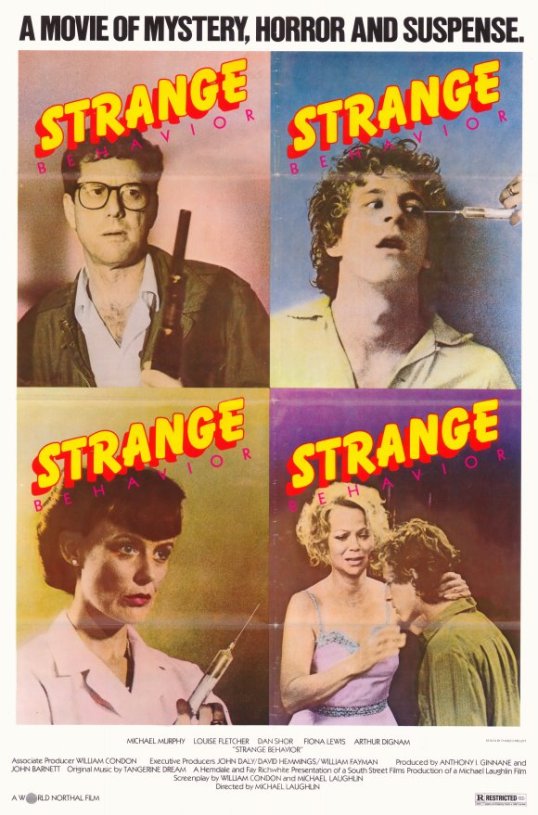
Horror Film Review: Strange Behavior (a.k.a. Dead Kids) (dir by Michael Laughlin)


I want to tell you about one of my favorite horror films.  It’s a strange one and I think you might like it.

It’s a movie from 1981.  It was filmed in New Zealand, even though it takes place in a small town in the American midwest.  It was directed by Michael Laughlin and the screenplay was written by Bill Condon, who has since become a director of some note.  This was Condon’s first screenplay.  In Australia and Europe, this movie is known as Dead Kids.  In America, the title was changed to Strange Behavior.

Here, watch the trailer:

It’s a pretty good trailer, actually.  That said, as good as the trailer may be, it doesn’t even come close to revealing just what an odd film Strange Behavior actually is.  If David Lynch had followed up The Elephant Man by directing a slasher movie, chances are the end result would have looked something like Strange Behavior.

Here’s another scene that I want you watch.  It’s kind of a long scene, clocking in at 7 minutes.  But I want you to watch it because, in many ways, this scene is the epitome of Strange Behavior:

http://www.youtube.com/watch?v=F0eAlUD93K4

Strange Behavior is perhaps the only 80s slasher film to feature a totally random and totally choreographed dance number.  It comes out of nowhere but, in the world that this film creates, it somehow feels totally appropriate.  Of course, the nun is going to announce that she’s not wearing any underwear and then pretend to stab a guy in the back.  Of course, the cowboy’s going to throw up and then want to go out to his car with his date.  And of course, a bunch of people in costume are going to end up dancing to Lightnin’ Strikes.  In Strange Behavior, the strangest behavior is the only behavior that makes sense.

As for the film itself, it’s a mix of small town melodrama, slasher horror, and gentle satire.  Teenagers are being murdered by other teenagers and no one is sure why.  The chief of police, John Brady (played by character actor Michael Murphy, who gives a quietly authoritative performance that counters some of the weirdness of the rest of the movie), is trying to solve the crimes while trying to cope with the mysterious death of his wife.  His son, Pete (Dan Shor), is going to the local college, where classes are taught by a professor (Arthur Dignam) who died years ago but who filmed a few lectures before passing.  To make extra money, Pete does what many of the local teenagers do — he volunteers for medical experiments.  Researcher Gwen Parkinson (Fiona Lewis) oversees the experiments, handing out pills and occasionally administering a hypodermic needle to the eyes of a test subject.  Gwen is always cool, calm, and collected.  When one irate father draws a gun on her, Gwen quips, “I can’t stop you.  I don’t have a gun.”

But there’s more to this movie than just medical experiments and murder.  Strange Behavior is full of wonderfully eccentric supporting characters.  Other than John, there’s really nobody normal to be found in either the town or the movie.  Pete’s best friend, Oliver (Marc McClure), is cute and dorky.   Barbara (Louise Fletcher) just wants to marry John and live in a town where dead bodies don’t turn up in the middle of corn fields, propped up like scarecrows.  John’s best friend and fellow cop, Donovan (Charles Lane), has been around forever and has a great, no-nonsense approach to even the strangest of things.  When it becomes obvious that John is not going to be able to solve the murders on his own, big city cop Shea (Scott Brady) shows up and wanders ineffectually through the movie, spitting out hard-boiled dialogue like a refugee from a 1930s gangster flick.  And finally, receptionist Caroline (Dey Young) sits at her desk in the clinic, gossiping about the patients and smoking cigarette after cigarette.  Caroline is probably the smartest person in the movie.  As an administrative assistant, I appreciated that.

It’s an odd little movie, which is why I love it.  Laughlin, Condon, and the entire cast created a world where everything is just a little off-center.  It makes for terrifically entertaining and weird movie, one that works as both satire and straight horror.

Strange Behavior is a film that deserves to much better known than it currently is so my advice is go watch it and then tell you friends to watch it too.

Lisa Reviews An Oscar Nominee: 42nd Street (dir by Lloyd Bacon and Busby Berkeley)


forty-second-street-1933

If you’re a regular reader of this site, it will not take you by surprise to learn that the 1933 Best Picture Nominee, 42nd Street, is one of my favorite films of all time.

I mean, how couldn’t it be?  Not only is it a pre-Code film (and we all know that pre-Code films were the best) and one the features both Ginger Rogers and Dick Powell in early roles but it’s also a film that depicts the backstage world of a stage musical with such a combination of love and snark that it will be familiar to everyone from community theater nerds to Broadway veterans.  42nd Street is a classic musical, though I have to admit that I think the majority of the songs are a bit overrated.  Even more importantly, 42nd Street is the ultimate dance film.  The film’s big production number, choreographed and filmed in the brilliant and flamboyant Busby Berkeley style, is such an iconic moment that it’s still being imitated and lovingly parodied to this day.

Every dance movie owes a debt to 42nd Street but few have come close to matching it.  Remember how much we all hated Smash?  There were a lot of reasons to hate Smash but the main reason was because it tried to be 42nd Street and it failed.  There can only be one 42nd Street.

It’s hard to estimate the number of show business clichés that currently exist as a result of 42nd Street.  Then again, it can be argued that they were clichés before they showed up in 42nd Street but 42nd Street handled them in such an expert fashion that they were transformed from being urban legends to immortal mythology.

42nd Street takes place in the backstage world, following the production of a Broadway musical through casting to rehearsals to opening night.  It’s an ensemble piece, one populated by all the usual suspects.  Julian Marsh (Warner Baxter) is the down-on-his-luck producer who desperately needs a hit.  Dorothy Brock (Bebe Daniels) is the celebrated star who is dating a rich, older man (Guy Kibbee, who made quite the career out playing rich, older men) while secretly seeing her ex, a down-on-his-luck Vaudevillian (George Brent).  From the minute that we first see Dorothy, we know that she’s eventually going to end up with a boken ankle.  It’s just a question of which chorus girl will be promoted to take her place.  Will it be “Anytime” Annie (Ginger Rogers) or will it be the naive and wholesome Peggy (Ruby Keeler)?  You already know the answer but it’s still fun to watch.

If you had any doubts that this was a pre-code film, the fact that Ginger Rogers is playing a character named “Anytime” Annie should answer them.  42nd Street is often described as being a light-hearted camp spectacle but there’s a cynicism to the film, a cynicism that could only be expressed during the pre-code era.  The dialogue is full of lines that, just a few years later, would never have gotten past the censors.

(This is the film where it’s said that Anytime Annie “only said no once and then she didn’t hear the question!”  This is also the film where Guy Kibbee cheerfully tells Annie that what he does for her will depend on what she does for him.  Just try to get away with openly acknowleding the casting couch in 1936!)

The menacing shadow of the Great Depression looms over every glossy production number.  Julian needs a hit because he lost all of his money when the Stock Market crashed and if the show is not a hit, everyone involved in the production will be out on the streets.  The chorus isn’t just dancing because it’s their job.  They’re dancing because it’s an escape from the grim reality of the Great Depression and, for the audience watching, the production numbers provided a similar escape.  42nd Street said, “Yes, life is tough.  But sometimes life is fun.  Sometimes life is sexy.  Sometimes, life is worth the trouble.”  Someday, 42nd Street promises, all the misery will be worth it.

Ultimately, 42nd Street is all about that iconic, 20-minute production number:

42nd Street was nominated for best picture but it lost to the nearly forgotten Cavalcade.

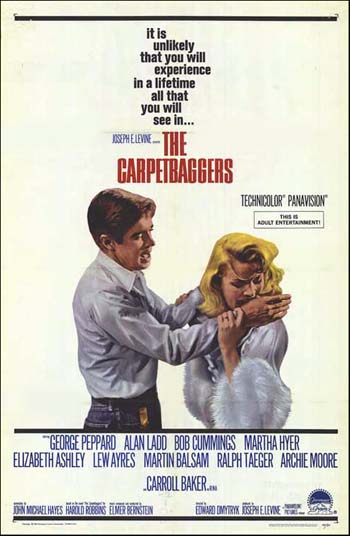
Embracing the Melodrama Part II #28: The Carpetbaggers (dir by Edward Dmytryk)


The_Carpetbaggers_1964_poster

The 1960s was apparently a bad time for talented old school Hollywood filmmakers getting sucked into making big budget, excessively lengthy films.  Joseph L. Mankiewicz spent most of his career making movies like All About Eve and then, in 1963, he ended up directing Cleopatra.  Elia Kazan went from A Face In The Crowd to The Arrangement.  John Huston went from Treasure of the Sierra Madre and The African Queen to directing not only The Bible but Reflections in a Golden Eye as well.

And then there’s Edward Dmytryk.  Dmytryk may not be as highly regarded by modern critics as Mankiewicz and Huston but he still directed some of the best film noirs of the 1940s.  His 1947 film Crossfire was nominated for best picture and probably should have won.  In 1952, he directed one of the first true crime procedural films, The Sniper.  His 1954 best picture nominee, The Caine Mutiny, featured one of Humphrey Bogart’s best and most unusual performances.

And yet, in 1964, he somehow found himself directing The Carpetbaggers.

The Carpetbaggers tells the story of Jonas Cord (George Peppard).  Jonas is the son of the fabulously wealthy Jonas Cord, Sr. (Leif Erickson).  At the start of the film, father and son do not get along.  Senior resents that Junior is more interested in piloting airplanes than in learning the family business.  Junior is angry that Senior has married Jonas’s ex-girlfriend, actress Rina Marlowe (Carroll Baker).  In fact, as far as Jonas, Jr. is concerned, Nevada Smith (Alan Ladd) is more of a father to him than his actual father.

Nevada Smith is Jonas, Sr.’s best friend and occasional business partner.  He’s a former cowboy who, we are told in a lengthy bit of exposition, is legendary for tracking down and killing the three men who killed his parents.  (As we listen to Jonas, Jr. tell the entire lengthy story, we find ourselves thinking, “Okay, so why not make a movie out of that story?”  Well, they did.  Two years after the release of The Carpetbaggers, Steve McQueen starred in Nevada Smith.)  Nevada’s also a film star whose career is in deep decline.

Speaking of deep decline, Jonas, Sr. ends up having a heart attack and dramatically dropping dead before he can get a chance to disinherit his son.  Jonas, Jr. inherits the Cord fortune and the Cord business and proceed to spend the next two and a half hours abusing everyone who gets close to him.  He even mistreats his loving and neurotic wife, Monica (Elizabeth Ashley, giving the only really memorable performance in the entire film).

Yes, there’s really no reason to have any sympathy at all for Jonas Cord, Jr. but the film insists that we should because he’s the main character and he’s played by the top-billed star.  We’re also told that he’s a brilliant aviation engineer and I guess we’re supposed to admire him for being good at what does.  We also discover that Jonas believes that his mother was insane and that she passed down her insanity to him.  He fears that he’ll pass the crazy gene to any of children that he might have so that’s why he pushes everyone away.  Just in case we don’t understand how big a deal this is to him, the camera zooms in for a closeup whenever Jonas is reminded of his mother.

(In the 60s, all mental instability was represented via zoom lens.)

However, Jonas isn’t just into airplanes!  He also buys a movie studio, specifically because Rina Marlowe is under contract.  Soon, Jonas is directing movies his way.  Jonas also finds himself falling in love with another actress (Martha Hyer) so, of course, he starts treating her badly in an effort to push her away.

What can be done to save the tortured soul of Jonas Cord?  Maybe he just need to get beaten up by Nevada Smith…

The Carpetbaggers was based on a novel by Harold Robbins.  The novel was apparently quite a scandal when it was originally published.  People read it and they wondered, “Who was based on who?”  Well, if you’ve ever seen The Aviator, it’s not that difficult to figure out.  Jonas Cord, eccentric movie mogul and obsessive pilot, was obviously meant to be Howard Hughes.  Rina Marlowe was meant to be Jean Harlow, a fact that can be guessed just by looking at the last names.  And I’m guessing that Nevada Smith was probably based on former President Warren G. Harding because … well, why not?

I suppose that, by the standards of 1964, the film version of The Carpetbaggers would have been considered risqué.  For a modern audience, the main appeal of something like The Carpetbaggers is to see what was once considered to be shocking.  The film is overlong, George Peppard doesn’t exactly figure out how to make Jonas into the compelling  rogue that he needs to be, the clothes and the sets are a lot more interesting than any of the dialogue (but not interesting enough to carry a nearly 3 hour movie), and the film’s pacing is so off that some scenes seem to go on forever while others are way too short.  But, as a cultural and historical artifact, The Carpetbaggers does hold some interest.

The Carpetbaggers was made at a time when Hollywood felt it was under attack from both television and European cinema.  With a film like The Carpetbaggers, the studios were saying, “See!?  Television will never be able to make a film this long and big!  And those Europeans aren’t the only ones who can make a movie about sex!”  Of course, as so often happened during this time, the studios failed to take into account that size and length don’t always equal quality (and ain’t that the truth?).  As for the sex — well, we hear a lot more than we actually see.  The Carpetbaggers is one of those films where everyone talks about sex, largely because showing sex wasn’t really an option.  (And it should be noted that most of the sex talk is delivered in the language of euphemism.)  As a result, The Carpetbaggers feels incredibly tame by today’s standards.  As a result, your main reaction to The Carpetbaggers will probably be to marvel at what was considered daring and shocking 50 years ago.

(And before we get too cocky and quick to dismiss those who came before us, let’s consider how our current films will look to movie audiences five decades from now…)

As far as biopics of Howard Hughes are concerned, The Carpetbaggers in no Aviator.  However, it is an occasionally interesting historical artifact.

Shattered Politics #4: Mr. Smith Goes To Washington (dir by Frank Capra)


mr-smith-goes-to-washington

So, when you read that I was going to be reviewing 94 political films here at the Shattered Lens, you probably knew that one of them would have to be the 1939 best picture nominee, Mr. Smith Goes To Washington.

So, we all know that story right?  The senator from an unnamed state dies.  The weak-willed Governor (Guy Kibbee) has to appoint a new senator.  Political boss Jim Taylor (Edward Arnold) demands that the governor appoint one of his cronies.  The state’s reformers demand that the Governor appoint a never-seen crusader named Henry Hill (who, whenever I hear his name, makes me think of Ray Liotta snorting cocaine in Goodfellas).  The Governor’s children demand that he appoint Jefferson Smith (James Stewart, of course!), who is the head of something called the Boy Rangers.  The Governor flips a coin.  The coin lands on its edge but it also lands next to a newspaper story about Jeff Smith.

So, of course, Mr. Smith goes to Washington.

Now, as the movie quickly makes clear, Jeff Smith is immediately out-of-place in Washington.  For one thing, he’s actually excited to be there.  He’s convinced that he’s there to make America a better place.  When a bunch of drunken reporters (led by the great Thomas Mitchell) make Smith look foolish, Smith responds by running around Washington and punching them out.  (That whole sequence probably serves as wish fulfilment for a lot of politicians.)  When his cynical legislative aide Saunders (Jean Arthur) tells him that he’s too naive to survive in Washington, he wins her over with the purity of his idealism.  When his mentor, Senator Paine (Claude Rains), is revealed to be a part of Washington’s corrupt culture, Smith is stunned.  When Taylor tries to destroy his political career, Smith responds by giving the filibuster to end all filibusters.  He’s one man standing up against a culture of corruption and…

And there’s a reason why, 76 years later, aspiring political candidates still attempt to portray themselves as being a real-life, modern Jefferson Smith.

This is one of those films that everyone seems to agree is great and, of course, there’s many reasons to love Mr. Smith Goes To Washington.  There’s the lead performance of Jimmy Stewart, of course.  While this may not be his best performance (I prefer the more layered characterization that he brought to It’s A Wonderful Life and Anatomy of a Murder), it is Stewart at his most likable and, most importantly, he makes you feel Jeff Smith’s pain as he discovers that Washington is not the great place that he originally assumed it to be.  Claude Rains was always great when it came to playing good men gone wrong and he’s perfect as Sen. Paine.  Thomas Mitchell and Jean Arthur are perfectly cast and I always enjoy seeing the bemused smile on the face of Vice President Harry Carey as Smith conducts his filibuster.

But I think the best thing about Mr. Smith Goes To Washington is that it actually makes you believe that there are Jeff Smiths out there who actually could make a difference.  And, until Judd Apatow gets around to remaking the film with Adam Sandler, audiences will continue to believe.

http://www.youtube.com/watch?v=sm9qaEJ3MBc