Lisa Reviews An Oscar Nominee: Great Expectations (dir by David Lean)


“My Christian name was Philip Pirrip, which I pronounced Pip….”

SHUT UP, PIP!

Seriously, there’s a lot of good things that can be said about Charles Dickens’s Great Expectations but most readers simply can’t get past the fact that the narrator insists on being called Pip.  I don’t necessarily blame them, as Pip might be a good nickname for a child but, by the time you’re 16, you should be demanding that everyone call you Phil.  That said, I’ve always liked Great Expectations.  Despite the fact that Charles Dickens could be a terribly pedantic writer, the plot of Great Expectations is genuinely interesting and the book is full of interesting characters, the majority of whom don’t demand to be known by their childhood nicknames.  Plus, I’ve always related to Estella.

The 1946 film adaptation of Great Expectations was at least the third movie to be made from the novel and it would be followed by many more.  (In 1998, there was a modernized version where Pip was wisely renamed Finn.)  Still, the 1946 adaptation is the best.  As directed by David Lean (and based on a stage version that was put together by none other than Alec Guinness), Great Expectations remains true to the source material while, at the same time, cutting away a lot of extraneous material.  As a result, Lean’s film version of the story maintains a clear narrative momentum, which is something that eluded Dickens in his sprawling original.

John Mills plays Pip, an orphan who is being raised by his wicked aunt and her husband, the simple but kind-hearted blacksmith, Joe Gargery (Bernard Miles).  One night, Pip helps out an escaped convict named Magwitch (Finlay Currie) and, though Magwitch is eventually recaptured, that one act of kindness will determine the rest of Pip’s life.

Pip is invited to visit the mansion of a recluse named Miss Havisham (Martita Hunt) and it’s there that he first meets and falls in love with the beautiful but rather cold-hearted Estella (Jean Simmons and then, after Estella grows up, Valerie Hobson).  Of course, what Pip doesn’t realize is that Miss Havisham has specifically raised Estella to destroy the hopes and dreams of every man that she meets.

Eventually, Pip grows up and discovers that he has a mysterious benefactor who feels that Pip should be transformed into a gentlemen so that he might be able to meet the “great expectations” that the benefactor has for him.  Pip, of course, assumes that it’s Miss Havisham but even those who haven’t read the book will probably suspect that there’s more to it than just that.  Pip moves to London, where he stays with Herbert Pocket (Alec Guinness), a pale young man (for that’s how Dickens described him) who teaches Pip that a gentleman does not use his knife as a fork.  Herbert was always my favorite character in the book and he’s my favorite character in the film, largely because he’s played by the totally charming Alec Guinness.

Anyway, Pip becomes a bit of a snob but eventually, he discovers the truth about his benefactor and the last few years of his life.  It causes him to not only rip down a lot of curtains but also to reconsider what it truly means to be a a gentleman.

It’s all very well-done, largely because David Lean doesn’t allow the fact that he’s making a film out of a great novel get in the way of telling a good story.  The film is well-acted by a wonderful cast of British thespians, all of whom manage to make even the most artificial of scenes and lines seem naturalistic and believable.  Even though Pip is a bit of a jerk, John Mills manage to turn him into a sympathetic character.  (Mills plays Pip as if he himself cannot stand the fact that he’s turned into such a snob.)  Both Jean Simmons and Valerie Hobson do a wonderful job of bringing the potentially problematic character of Estella to life and Bernard Miles is wonderfully empathetic in the role of the Joe Gargery.  The scene where a nervous Gargery first meets Pip after Pip has become a gentleman is a true example of great acting.

Not surprisingly, Lean also does a great job of bringing 19th century England to life.  Watching this film is a bit like stepping into a time machine and going back to the Dickensian era.  As filmed by Lean, London is as bright and vibrant as Pip’s childhood home is dark and constraining.  When Pip finds Magwitch on the beach, Lean directs the scene as if it were from a film noir.  When Pip enters the darkened home of Miss Havisham and meets the beautiful but destructive Estella, the film flirts with becoming a Rebecca-style gothic romance.  And when it’s just Pip and Herbert Pocket talking, it becomes a comedy of manners.  Not surprisingly, Great Expectations won Oscars for both its art design and its gorgeous black-and-white cinematography.

Great Expectations was also nominated for Best Picture.  However, it lost to Gentleman’s Agreement.

Film Review: The Loves of Edgar Allan Poe (dir by Harry Lachman)


I have to admit that the 1942 film, The Loves of Edgar Allan Poe, turned out to be far different from what I was expecting.

Just based on the title, I was expecting it would be a highly fictionalized, borderline silly film about Edgar Allan Poe defeating his romantic rivals and winning the hand of the woman he loved while still finding time to write The Raven.  I figured that there would be at least a few gentlemanly fisticuffs, with Poe portrayed as a combination of Rhett Butler and Cary Grant.  Looking at the title, it was easy for me to imagine the film closing with Poe kissing his future wife and then looking straight at the camera.  “Quoth the Raven!” he would say and wink while romantic music swelled in the background…

But no.  The Loves of Edgar Allan Poe is actually a very conventional biopic.  With a running time of only 67 minutes, the movie often feels rather rushed but it still manages to include most of the better known details of Edgar Allan Poe’s short but eventful life.  (An ever-present narrator is always ready to fill us in on every thing that happens off-screen.)  The film doesn’t spend much time on what initially inspired Poe’s macabre imagination.  There’s a scene of Poe, as a child, standing on a desolate hill and looking at a raven perched in a dead tree.  With the exception of an extended section that deals with Annabel Lee, that’s about as deep as the movie is willing to get as far as Poe’s art is concerned.

When Poe grows up, he’s played by actor Sheppard Strudwick, who has a good mustache but never exactly comes across as being the type of tortured genius who would eventually end up both revolutionizing literature and drinking himself to death.  The majority of the film deals with Poe’s advocacy for copyright reform, which is an important issue but not exactly the most cinematic of concerns.  Poe survives college.  Poe tries to sell The Raven for $25.  Eventually, Poe marries Virginia Clemm (Linda Darnell) and her subsequent sickness and death leads to not only Poe’s greatest work but also his own tragic end.

Along the way, Poe meets both Thomas Jefferson and Charles Dickens.  Jefferson shows up long enough to tell a young Poe that he’s a good writer and that he needs to stop gambling.  Dickens meets Poe and encourages him to continue to advocate for better copyright laws.

It is known that Poe and Dickens actually did meet but did Poe also meet Thomas Jefferson?  Legend says that he did but no one knows for sure.   Here’s what we do know:

Poe attended the University of Virginia in 1826.  The University’s founder, former President Thomas Jefferson, was still alive in 1826 and would often invite promising students to Monticello.  Whether Jefferson was still doing that when Poe enrolled at the University of Virginia is questionable.  Jefferson died five months after Poe started his studies.

As for Dickens, Charles Dickens and Edgar Allan Poe admired each other’s writing and they met in Philadelphia during Dickens’s 1842 tour of North America.  No record has been kept of what they discussed, though some think that Dickens told Poe about his pet raven and perhaps inspired Poe’s best-remembered poem.  In the movie, they discuss copyright laws, which is nowhere near as much fun.

(When it comes to Poe’s meetings with both Jefferson and Dickens, it is perhaps best to remember the lesson of The Man Who Shot Liberty Valance and print the legend.)

The Loves of Edgar Allan Poe is a very short film and an obviously low-budget one as well.  When the presence of that somewhat pedantic narrator, The Loves of Edgar Allan Poe feels more like an educational special than a real movie.  It’s an okay introduction to Poe’s life but, ultimately, the best way to get to know Edgar Allan Poe is to sit down and start reading.

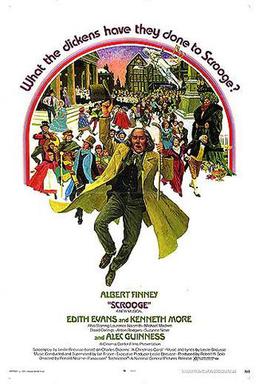
A Christmas Film Review: Scrooge (dir by Ronald Neame)


There have been many good film versions of the Charles Dickens novella, A Christmas Carol.  Several of them could even be called classics.  Everyone from Bill Murray to James Earl Jones to Tori Spelling to Fredric March has taken a turn at playing a version of the famous miser who, after being visited by three ghosts on Christmas Eve, changes his ways and becomes the most generous man in London.  This holiday season, I watched quite a few old TV shows and I was somewhat surprised to discover just how many sitcoms have featured an episode where one of the characters has A Christmas Carol-like experience.

Though actually, I shouldn’t have been surprised.  A Christmas Carol is a universal tale and it’s one that continues to be appealing 174 years after it was originally written.  You don’t have to be rich, British, greedy, or even a man to relate to what Ebenezer Scrooge goes through.  We’ve all be haunted by the past.  We’ve all wondered what we’re missing out on in the present.  And we all fear how we’ll be remembered in the future.  In fact, I would say that A Christmas Carol is probably as close to perfect you can get.  The only problem is that Bob Cratchit’s son is named Tiny Tim and any work of fiction that features a character named Tiny has to be docked a few points.

With all that said, my favorite film version of A Christmas Carol is the 1970 musical, Scrooge.

http://www.youtube.com/watch?v=g7xb1uSDxZ4

Scrooge sticks to the original details of the story.  Ebenezer Scrooge is played by Albert Finney.  (Finney was only 34 when he made Scrooge but was made up so that he looked closer to 120.)  The men, women, and spirits in Scrooge’s life are all played by a collection of distinguished British thespians.  Edith Evans is the stately Ghost of Christmas Past.  Kenneth More is the Ghost of Christmas Present, a decadent figure who drinks wine and travels around with two frightening-looking children.  Alec Guinness is a heavily chained Jacob Marley and he plays the role with just the right combination of sarcasm and concern.  (“No one else wanted to come,” Marley says when he greets Scrooge at the entrance of Hell.)  An actor named Paddy Stone is credited as playing the silent and shrouded Ghost of Christmas Future.  Let me just say that the Ghost of Christmas Future always scares me to death whenever I watch Scrooge.  I imagine little children in the 70s were traumatized by his skeletal visage.

What sets Scrooge apart is that it has singing and dancing!  That’s right, this is a musical version of A Christmas Carol, featuring songs composed by Leslie Bricusse.  Now, the overall quality of the songs is open to debate.  There’s 11 of them and really, only three of the songs are particularly memorable.  (Those songs are: I Like Life, I Hate People, and the Oscar-nominated Thank You Very Much.)  But, honestly, who cares?  The cast performs them with so much energy and enthusiasm that it’s impossible not to get swept up in it all.

(Admittedly, Albert Finney doesn’t really sing.  He just kinda growls the lyrics.  But that’s appropriate for the character of Scrooge.)

Scrooge is an outstanding production of a timeless tale.  It came on TV at least four different times this holiday season and I watched each time.  And I’ll do the same next year!

And as Tiny Tim, who did not die, said, “A Merry Christmas to all!  God Bless us, everyone!”

Listen to A Christmas Carol!


Now that you’ve had a chance to listen to radio productions of both It’s A Wonderful Life and Miracle on 34th Street, how about A Christmas Carol?

This version was produced by the BBC and it features Sir Ralph Richardson in the roles of both Scrooge and the storyteller!

From 1965, here is A Christmas Carol!


Merry Christmas from Vincent Price (A CHRISTMAS CAROL 1949)


gary loggins's avatarcracked rear viewer

What’s Christmas without Dickens’ classic A CHRISTMAS CAROL, and who better to narrate than jolly old Vincent Price! Enjoy this TV treat from 1949 before you eat your Christmas goose, and “God bless us, every one!”.

http://www.youtube.com/watch?v=wxgU_J366JI

View original post

Getting In The Holiday Spirit #2: Scrooge (or Marley’s Ghost) (dir by Walter Booth)


Yesterday, in order to help some of our readers get into the holiday spirit, I shared a film from 1905.  Well, tonight’s film was made four years before The Night Before Christmas!  Produced by R.W. Paul and directed by Walter Booth, Scrooge (or Marley’s Ghost) was produced in 1901 and it is apparently the oldest known cinematic adaptation of Charles Dickens’s A Christmas Carol.

Of course, when watching, it’s important to remember that this movie was made during the infancy of film.  If it seems primitive, that’s because it is.  However, it’s also a true piece of history and you know how much I love history!

(Also keep in mind that, while this 6-minute film looks surprisingly good for its age, it’s reportedly incomplete.  It also greatly condenses the original story.  Let’s just say that Marley ends up doing a lot more in this film than he does in others.)

From 1901, we present to you Scrooge (Or Maley’s Ghost)!

http://www.youtube.com/watch?v=ILDHYYsC-g0

(Also, a big thank you to the Xmas Flix YouTube channel for featuring so many classic holiday films!)