Horror Film Review: The Picture of Dorian Gray (dir by Albert Lewin)


picture-of-dorian-gray-32

Hello and welcome to the start of TSL’s annual October horrorthon!  All through the month of October, our focus will be on horror.  We will be sharing reviews and thoughts on some of the best (and worst) horror films ever made!  I have to admit that this is my favorite time of the year.  I love horror … like all good people!

I want to start things off by taking a look at a film from 1945.  The Picture of Dorian Gray is based on the famous novel by Oscar Wilde (a novel that some people think was inspired by the Jack the Ripper murders).  Dorian Gray (played by Hurd Hatfield) is a young and handsome aristocrat who lives in 19th century London.  When we first meet him, Dorian is intelligent, kind and virtuous.  He’s also more than a little boring.  He is the bland face of the establishment, a man destined to be celebrated for his position in society and largely forgotten after his death.

Dorian is posing for a painting that’s being done by his friend, an artist named Basil Hallward (Lowell Gilmore).  One day, Lord Henry Wotton (George Sanders) stops by the studio while Basil is painting Dorian.  Lord Henry is everything that Dorian Gray is not.  He’s a worldly and cynical man and he is very proud to live a life devoted to complete and total hedonistic pleasure.  He immediately sets out to corrupt Dorian and it turns out to be a lot easier than he was expecting.  Henry convinces Dorian that he can have everything that he wants as long as he’s young and handsome.  Dorian announces that he wishes the painting could age instead of him…

Now, here’s where the film takes a huge departure from Wilde’s novel.  In the novel, the painting ages while Dorian stay young.  No specific reason is given.  Instead, it’s just something that happens.  In the film, it turns out that Basil owns an ancient Egyptian statue and that the statue has mystical powers.  Dorian makes his wish in front of the statue and that’s why the painting starts to age.  Personally, I think the bit with the Egyptian statue is unnecessary and a little bit silly.  To me, the story is a lot more effective if the painting starts to age without an explanation.  The filmmakers obviously disagreed.

But no matter!  In the end, the Egyptian statue isn’t that important.  What is important that, freed from getting old or physically suffering for his actions, Dorian transforms into a different person.  Soon, he’s even more hedonistic than Lord Henry.  When he breaks the heart of a tragic singer named Sybil Vane (Angela Lansbury, in a poignant and Oscar-nominated performance), Dorian sees that the painting is now cruelly smirking while his own face remains innocent and untouched.  When Dorian eventually commits a murder to keep his secret from getting out, the blood appears on the painting’s hands while his own remain clean.

And the years pass.  Dorian finds himself both being hunted by Sybil’s brother (Richard Fraser) and falling in love with the niece (Donna Reed) of a man that he earlier murdered.  Dorian never ages but his portrait becomes more and more twisted.  What’s particularly interesting is that we see little of Dorian’s evil actions.  Instead, we watch and listen as other characters whisper about the horrific things that he’s done.  Physically, Dorian remains an innocent and young aristocrat.  But all we have to do is look at the picture and we can see what a monster Dorian has become…

The Picture of Dorian Gray is an absolutely gorgeous film, one that is full of elaborate sets that are often cast in shadow.  (It’s interesting to note that the more corrupt Dorian becomes, the darker and more shadowy his estate becomes.)  The film is in black-and-white, with the exception of three scenes in which the portrait is revealed in all of its Technicolor glory.  If that sounds like a gimmick … well, it is.  But it’s an amazingly effective gimmick.

The Picture of Dorian Gray is a classic exercise in psychological horror.  See it the next chance you get!

portrait-de-dorian-gray-1945-01-g

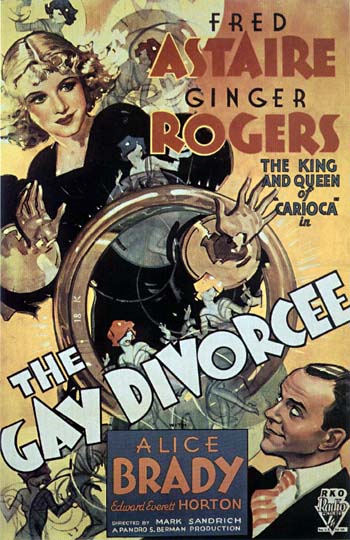
Cleaning Out The DVR, Again #31: The Gay Divorcee (dir by Mark Sandrich)


(Lisa is currently in the process of trying to clean out her DVR by watching and reviewing all 40 of the movies that she recorded from the start of March to the end of June.  She’s trying to get it all done by the end of July 11th!  Will she make it!?  Keep visiting the site to find out!)

The_Gay_Divorcee_movie_poster

The 31st film on my DVR was the 1934 musical, The Gay Divorcee, which I recorded on June 7th when it aired on TCM.

The Gay Divorcee is a Fred Astaire/Ginger Rogers musical, which means that the plot is less important than the dancing, the singing, and the charm.  The charm is especially important.  Don’t get me wrong — The Gay Divorcee includes some wonderful music, including Night and Day and The Continental, which went on to be the first song to win an Oscar for Best Original Song.  The dancing is incredible, as you would expect from any film featuring Astaire and Rogers.

But it’s the charm that makes The Gay Divorcee especially memorable.  Full of sophisticated dialogue delivered by a cast of wonderful 1930s character actors, The Gay Divorcee offered up an escape to a country that was still reeling from the Great Depression.  Some audiences went to a Warner Bros. gangster film and some audiences went to an Astaire/Rogers musical but what they all had in common was that the movies provided them a break from the harsh realities and hopelessness of everyday life.

As for the plot — well, it’s about rich people doing silly things.  Mimi Glossop (Ginger Rogers) wants to get a divorce from her husband, a gynecologist named Cyril (William Austin).  Apparently, Cyril doesn’t want to give her a divorce so Mimi, her aunt (Alice Brady), and her lawyer (Edward Everett Horton) come up with a plan that could only work in an Astaire/Rogers musical.  Mimi will visit England and, while staying at a properly luxurious hotel, she will pretend to have an affair with Rodolfo Tonetti (Erik Rohodes), a professional gigolo.

However, upon arriving at the hotel, Mimi runs into Guy Holden (Fred Astaire).  Guy is a friend of Rodolfo’s and he also happens to be in love with Mimi.  Mimi, meanwhile, mistakes Guy for the gigolo and they proceed to dance the night away…

Listen, the plot doesn’t matter!  What matters is that The Gay Divorcee features Fred Astaire and Ginger Rogers at their best!  This, after all, is the film that features Fred Astaire singing Cole Porter’s Night and Day

And, of course, there’s The Continental

The Gay Divorcee was one of the ten films nominated for best picture of 1934.  However, it lost to an equally charming film of the 1930s, It Happened One Night.

The Gay Divorcee was a fun and needed escape for viewers in the 30s and you know what?  We still need an escape today.


The Fabulous Forties #14: The Stork Club (dir by Hal Walker)


40s

For the past two weeks, I have been reviewing all fifty of the films to be found in Mill Creek’s Fabulous Forties DVD box set!  It’s been four days since I reviewed the 13th film in the set, Scared Stiffwhich is probably the longest bloggng break that I’ve ever taken in my life.  However, I am proud to say that I am back and ready to review the 37 remaining films!

Yay! Lisa’s back!

Now, I know what you’re asking.  Why, if I am about to review a film from the 1940s, am I sneaking a random Degrassi GIF into this review?  Well, unfortunately, the movie that I’m about to review isn’t that interesting and there’s not a whole lot to be said about it.  I’ve found some enjoyable and interesting films in the box set — The Black Book, Trapped, the original Jungle Book — but I’ve also found a few that are pretty forgettable.  So, why not liven things up with a shout-out to my favorite show?

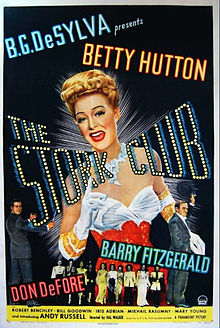
Anyway, the 14th film from The Fabulous Forties Box Set was 1945’s The Stork Club.

220px-Stork_Club_poster

When I saw that this film was called The Stork Club, my first thought was that it would be a comedy about pregnancy.  But it turns out that I was totally wrong.  Apparently, The Stork Club was a very popular New York nightclub in the 1940s and this film was meant to take advantage of that popularity.  (That said, according to the imdb, The Stork Club was not filmed at the actual Stork Club but instead on a Hollywood soundstage.)

As for the film’s story — well, this isn’t going to make much sense but here’s what happens.  A millionaire named J.B. (charming, Irish-accented Barry Fitzgerald) falls into a pond and nearly drowns.  Fortunately, his life is saved by Judy (Betty Hutton).

J.B. wants to reward Judy but, for some reason, he doesn’t want her to know that he’s rich.  So, with the help of his lawyer (Robert Benchley), he anonymously arranges for Judy to get both a new apartment and an unlimited credit line at all of New York’s best stores!

But J.B. also wants to keep an eye on Judy and make sure that she’s happy.  But he still doesn’t want her to know that he’s a millionaire or that he’s her benefactor.  After he finds out that she’s a hatcheck girl at the Stork Club, he arranges to get hired on as a busboy.  However, he gets fired after just one night and, believing him to be poor and homeless, Judy invites him to stay at her new apartment.

J.B. agrees and, in the film’s best, non-musical moment, he watches as Judy recklessly spends his money on new clothes.  It turns out that Judy thinks that the apartment and the credit line are all gifts from the owner of the Stork Club and she’s offended because she thinks the owner is trying to steal her away from her boyfriend, Danny Wilson (Don DeFore).

Danny is a bandleader but he’s been serving in the U.S. Army.  When Danny finally returns home, Judy is excited about arranging for him to get an audition to play at the Stork Club.  However, Danny is more concerned about the fact that Judy has a mysterious benefactor and that she’s now living in a luxury apartment with a mysterious old man.

Could Judy be a kept woman!?  Both Judy and J.B. insist that she is not but Danny refuses to believe them because Danny is kind of a jerk.  Of course, Danny isn’t meant to be a jerk but, by today’s standards, he’s definitely a jerk.  Judy could do so much better!

Anyway, the plot’s not really that important.  It’s mostly just an excuse for Betty Hutton to sing a few songs and that’s when the movie is at its best.  Check out some of Betty’s performances below:

Anyway, The Stork Club was pleasant but not particularly memorable.  When it works, it’s largely due to the endless charm of Betty Hutton and Barry Fitzgerald.  It may not seem like much today but I’m sure that, for audiences dealing with the contemporary horrors of World War II, The Stork Club presented a nice diversion.