30 Days of Noir #1: Lady Gangster (dir by Robert Florey)


Welcome to Noirvember!

Yeah, yeah, I know.  That sounds kinda silly, doesn’t it?  However, November is traditionally the month that classic film bloggers tend to concentrate on writing about film noir.  It provides a bit of grit and cynicism in between the horror fun of October and the holiday schmaltz of December.

I have to admit that I’m a little bit torn when it comes to taking part in Noirvember.  On the one hand, I love a good film noir and there’s quite a few obscure and underrated ones available on YouTube right now.  On the other hand, as a natural-born contrarian, I don’t like the idea of hopping on any bandwagons.

In the end, my love of film noir won out.  So, welcome to my first entry in 30 Days of Noir.


The 1942 film, Lady Gangster, opens with Dot Burton (Faye Emerson) walking up to a bank.  She’s carrying a small white dog with her.  Though the bank isn’t due to open for another 30 minutes, she explains to the bank guard that she’s got a train to catch and she simply has to deposit a check.  The guard unlocks the door and lets both her and her dog inside.

While filling out her deposit slip, Dot puts the dog down on the floor.  The dogs runs off, distracting the guard just long enough for three men with guns to slip into the bank and rob the place.  Though the police quickly arrive, the men manage to escape, taking $400,000 with them.

The police are immediately suspicious of Dot, especially when she struggles to keep her story straight as to why she’s at the bank.  The lead detective thinks that Dot was in on it.  Dot says that she was merely out for a stroll with her dog.  Dot says that her dog is named Tiny.  The dog, which looks exactly like one that was recently reported missing, is wearing a collar that reads “Boots.”

The district attorney announces that Dot will be prosecuted to the full extent of the law.  However, a crusading radio broadcaster named Ken Phillips (Frank Wilcox) is convinced that Dot is being railroaded.  Once he realizes that he went to high school with her, Ken is even more determined to help Dot.  Using the power of the airwaves, he forces the district attorney to release Dot into his custody.  Once free, Dot promptly confesses to Ken that she was a part of the robbery and that she’s hidden the money.  An indignant Ken turns her into the police.

So now, Dot’s in prison and no one’s sure where the money is.  One of the bank robbers even dresses up like a woman so that he can see Dot on visiting day but she refuses to tell him anything.  Dot isn’t going to reveal where the money is unless it means she can also get parole.  She needs to get released soon because she’s already got two psychotic snitches targeting her.

Fortunately, Ken has had a change of heart and is lobbying for her release.  Unfortunately, Dot has been tricked into believing that Ken has once again betrayed her so, naturally enough, she sets him up to be murdered.  When Dot discovers that she’s been fooled, can she find a way to warn Ken before it’s too late?

Believe it or not, all of this happens over the course of 62 minutes.  With that many betrayals, twists, and crimes packed into that short of a running time, there’s never a dull moment in Lady Gangster.  Though the film itself is full of huge plot holes and Frank Wilcox is a bit of a stiff as Ken, the film is totally worth seeing for Faye Emerson’s ferocious performance as Dot Burton.  Dot is a force of nature.  When the robbers try to steal her money, Dot instead steals from them.  When Dot believes that Ken has betrayed her, she sets him up to be murdered with a moment of hesitation.  When Dot discovers that Ken didn’t betray her, she immediately starts scheming to prevent the murder that she arranged.  Even when Dot confesses to being a part of the robbery, she does it on her own terms.  Nobody tells Dot what to do and, in that way, she represents the best of America.  As Dot herself explains it, “I’ll play ball with anyone but Hitler.”

The film has a rather odd ending, one that makes you wonder just how forgiving people generally were back in 1942.  But no matter!  Lady Gangster is a quickly paced movie that’s just melodramatic enough to be enjoyable.  It’s in the public domain and on YouTube.  Watch it for Faye Emerson’s performance.
The Fabulous Forties #47: Broadway Limited (dir by Gordon Douglas)


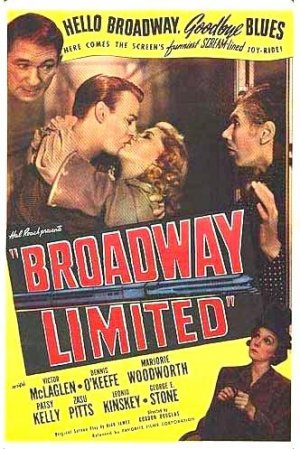
Broadway_Limited_FilmPoster

The 47th film in Mill Creek’s Fabulous Forties box set was a 1941 comedy named Broadway Limited.

Broadway Limited tells the story of several increasingly desperate characters and a baby.  April Tremaine (Marjorie Woodworth) is a film star whose career is in danger of stagnating.  Her frequent director, the eccentric Ivan Ivanski (Leonid Litinsky), comes up with a plan to increase April’s popularity.  He starts a rumor that she has adopted a baby.  The only problem is that April has to be seen with the baby for the rumor to be believable.

Fortunately, April is going to be traveling from Chicago to New York via a train known as the Broadway Limited.  Ivan decides that April needs to be seen with the baby on the train.  April’s assistant, Patsy (Patsy Kelly), is dating the train’s engineer, Mike (Victor McLaglen).  When Patsy tells Mike about the scheme, Mike decides to help out.  He spots a mysterious man with a baby.  Mike asks if he can borrow the baby for a few minutes.  The man agrees and hands over the baby and then Mike gives the baby to April.  Everyone sees April with the baby but the mysterious man has vanished.  What Mike does not initially know but quickly comes to suspect is that the baby might be the Pierson Baby, whose kidnapping has become national news.

(As confusing as it may sound when you read about it, it’s even more confusing when you actually watch it.)

The rest of the film basically follows Patsy, Mike, Ivan, and April as they all try to get the baby to safety without running the risk of being implicated in the kidnapping.  The four of them keep trying to leave the baby in different parts of the train, where she can be discovered by someone, just to inevitably have the baby somehow end up back in their compartment.

But that’s not all!  The high-strung president of the April Tremaine fan club (played by ZaSu Pitts) is also on the train and she keeps getting in everyone’s way.  And then there’s Dr. Harvey North (Dennis O’Keefe).  Harvey was April’s childhood crush and they just happen to be on the same train!  However, Dr. North believes that, since April has a baby, she must also have a lover…

If Broadway Limited sounds like an extremely busy film … well, it is.  The film attempts to do the screwball thing, with increasingly frantic characters running from compartment to compartment and behaving in increasingly ludicrous ways.  How well it works depends on which character is appearing in which scene.  O’Keefe plays his role too seriously, Litinsky is too broad, and Woodward is never believable as a movie star (which, needless to say, is problem when you’re the star of a movie).  However, Patsy Kelly and Victor McLaglen are both hilarious as Patsy and Mike and have a lot of chemistry.  As long as the film concentrates on Patsy and Mike, it’s entertaining.

Plus, the baby’s super cute!

Broadway Limited is hardly a classic but it works well enough.


Cleaning Out The DVR #38: It Happened One Night (dir by Frank Capra)


For those following at home, Lisa is attempting to clean out her DVR by watching and reviewing 38 films by the end of today!!!!!  Will she make it?  Well, it depends on whether or not she can finish the review below!)

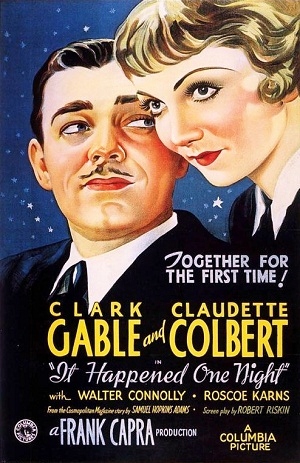
Gable_ithapponepm_poster

Before I talk too much about the 1934 film It Happened One Night, I want to tell a story about legs.

I’ve always been insecure about having a slightly large nose and once, when I was 17 years old, I was giving my mom a hard time about the fact that I had basically inherited it from her.  I was going on and on and being fairly obnoxious about it.  (Yes, believe it or not, I can occasionally be obnoxious…)

Finally, my mom held up her hand and said, “Yes, you got your nose from me but you also got my legs so stop crying!”

And you know what?  I glanced down at my legs and I realized that she was right and that made me feel a lot better.  Ever since then, I’ve taken a lot of pride in having a good pair of legs.

Now, you may be asking yourself what that has to do with It Happened One Night.  Well, It Happened One Night is one of the ultimate “good legs” movies.  That’s because It Happened One Night features the famous scene in which Claudette Colbert teaches Clark Gable the proper way to hitchhike.  (If I ever take up hitchhiking, I’m planning on using the same technique.)

That’s the scene that It Happened One Night is justifiably famous for.  However, It Happened One Night is more than just a film about hitchhiking.

It’s also a romance, one that features Claudette Colbert at her wackiest and Clark Gable at his sexiest.  Reportedly, the sell of undershirts plummeted after Clark Gable took off his shirt and revealed that he wasn’t wearing one.

It was one of the first road movies and it was such a success that it remains influential to this very day.  Any time you watch a movie that features two seemingly different characters getting to know each other on a road trip, you’re watching a movie that exists because of It Happened One Night.  (And yes, that includes Tom Hardy and Charlize Theron in Mad Max: Fury Road.)  

Frank Capra won his first Oscar for directing this film and It Happened One Night remains one of his most likable and least preachy films.  Just compare the unpretentious, down-to-Earth style of It Happened One Night to Meet John Doe.

Perhaps most importantly, It Happened One Night was the first comedy to win the Oscar for best picture.  It Happened One Night is a film that announces that a film doesn’t have to be a self-serious, pretentious epic to be great. Before the victory of It Happened One Night, the top prize was exclusively reserved for films like Cimarron and Calvalcade.  (Seriously, just try watching some of those early winners today.)  It Happened One Night‘s Oscar victory was a victory for the future of entertainment.

(By the way, as I sit here typing up this review, I keep accidentally typing It’s A Wonderful Life instead of It Happened One Night.  That’s the power of Frank Capra.)

It Happened One Night tells the story of  Pete Warne (Clark Gable).  Pete is an out-of-work reporter.  Though he may be down on his luck, he’s still confident and lovably cocky in that way that only Clark Gable could be.  While riding on a bus from Florida to New York, Pete recognizes one of his fellow passengers as Ellie Andrews (Claudette Colbert), an heiress who has recently eloped with a buffoonish big game hunter named King Westley (Jameson Thomas).  Ellie’s father wants to get the marriage annulled and has people all over the country searching for his daughter.  Pete agrees not to call Ellie’s father if Ellie will agree to give him an exclusive story when she meets up with Westley in New York.

For the rest of the film, we follow Pete and Ellie as they cross the United States, spending awkward nights in motel rooms, getting kicked off of buses, and hitchhiking.  Ellie gives lessons on how to get a car to stop.  Pete delivers a long monologue on the proper way to undress before going to bed.  Along the way, Pete and Ellie fall in love.  It also becomes obvious that Ellie’s father is right about Westley only marrying her for her money.

They also meet a large cast of increasingly eccentric characters.  Whether they’re dealing with the passengers on the bus or the cranky people staying at a rest stop or a motorist who won’t stop singing, Pete and Ellie do noy meet anyone who doesn’t have at least one odd quirk.  Like many classic screwball comedies, It Happened One Night takes place in a world where everyone — from a bus driver to a desk clerk to a group of women waiting to use a shower at a rest stop — has something to say about everything.  Some of the film’s funniest moments come from watching the normally smooth Pete have to deal with the increasingly crazy world in which he’s found himself.

(For her part, Ellie is at her happiest when things are at their strangest.  Ellie’s the best.)

The other great moments come from simply watching Gable and Colbert interact.  They have an amazing chemistry and it comes through in their performances.  It’d odd to read that apparently neither Gable nor Colbert were happy to be cast in It Happened One Night because their performances are so much fun to watch.  A love story only works if you love the characters and the love story in It Happened One Night definitely works.

As I stated above, It Happened One Night was the first comedy to win Best Picture.  Beyond that, it was also the first movie to win all of the top 5 Oscars: Picture, Director, Actor, Actress, and Adapted Screenplay.  (Those were also the only 5 nominations that It Happened One Night received.)  For once, the Academy got it right.  It Happened One Night remains a delightful film.

http://www.youtube.com/watch?v=ALmnUBqbhuo

(Oh my God, y’all, I did it!  That’s 38 films reviewed in 10 days and my DVR now has space to record all sorts of things!  And making it all the better is that I finished this project by reviewing a truly wonderful comedy like It Happened One Night!)

Shattered Politics #3: Hold That Co-Ed (dir by George Marshall)


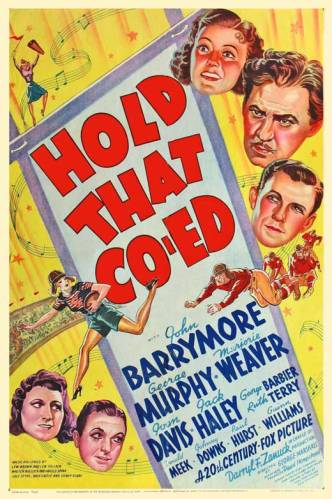
hold-that-co-ed-movie-poster-1938-1020685724

“Americans will put up with bad government but they won’t stand for bad sportsmanship!” — A political consultant in Hold That Co-Ed (1938)

Rusty Stevens (George Murphy) is the new head football coach at State University.  (Which state?  We never learn for sure, though the implication is that it’s somewhere near Louisiana.)  From the minute that he arrives, Rusty discovers why State’s football program is so unheralded.  Not only are the majority of the students lazy and unmotivated but the college can’t even afford to buy the players uniforms.  The perpetually nervous Dean Thatcher (Donald Meek) is of no help when it comes to getting the university what it needs.  Even worse, the state’s Governor, Gabby Harrigan (John Barrymore), is running for the senate and he has sworn that he’s going to solve the state’s budget crisis by cutting the football program!

(Cue dramatic music.  Actually, not really.  There’s not a single dramatic moment to be found in Hold that Co-Ed.)

Well, what can Rusty be expected to do, other than lead all the students on a march down to the capitol building where they demand to see Gov. Harrigan.  However, Harrigan is busy giving an interview and he refuses to meet with the students.  Instead, he tells a fawning reporter how he is going to introduce a bill in the U.S. Senate that will guarantee all retired people, “Not one, not two, not three, but a sum of 400 dollars every month!”

After the reporter leaves, his cynical (Is there any other type?) secretary Marjorie (Marjorie Weaver) asks Harrigan how the government will ever be able to afford his plan.  Harrigan says that the government can’t but “isn’t it nice for” retired people “to have something to look forward to?”

(Gov. Harrigan sounds like he could be elected President in 2016.)

Meanwhile, the college students get rowdy in the front office and end up picking up the Governor’s aide, Wilbur (Jack Haley, who a year later would play The Tin Man in The Wizard Of Oz), and passing him around over their heads.  Naturally, this gets the attention of the press and suddenly, the fate of State’s football program is a campaign issue.

Upon discovering that most voters like football, Harrigan declares himself to be State’s biggest supporter and soon starts to play a very prominent role in the football program.  Not only does he arrange for Lizzie Olsen (Joan Davis) to become the only female to play on a college football team (When informed that Lizzie playing is against the rules, Harrigan replies, “I’ll change them!”) but he also pays players to come to State.  (When informed that paying players is against the law, Harrigan replies, “I’ll change the law!”)

It all eventually leads to Rusty romancing Marjorie and a bet between Harrigan and his opponent in the Senate race in which the outcome of the big game will determine who withdraws from the race.

Because of course it does.

First released in 1938, Hold That Co-Ed is one of those strange films that seems like it could only have come out in the 1930s.  Obviously, it’s primarily a college comedy.  Yet, at the same time, it’s also a musical which features Rusty randomly breaking out into song and dancing.  And then, on top of that, it’s a political satire.  (Reportedly, Harrigan was based on Huey Long, who also served as the basis for a far more sinister character in All The King’s Men.)

And, in its way, Hold That Co-Ed is a fun, little time capsule.  If anything, the film’s political satire feels just as relevant today as it probably did when it was first released.  As playing in grand theatrical fashion by John Barrymore, Gabby Harrigan could be any number of pompous, say-whatever-you-have-to-say demagogues.

What makes this film particularly interesting is just how much it’s on Harrigan’s side.  Whereas most political films always feel the need to at least pretend to be on the side of “good” government, Hold that Co-Ed cheerfully celebrates Harrigan’s casual corruption.  In this shrill day and age, there’s something refreshing about seeing a film that passes no judgment.

And speaking of politics, John Barrymore was never elected to political office.  However, the film’s other star, George Murphy, was.  He served in the U.S. Senate from 1965 to 1971.

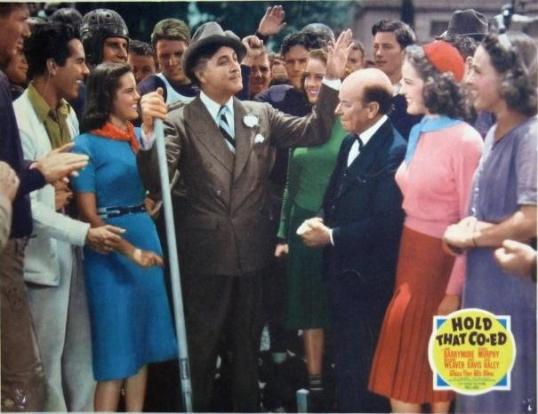
HoldthatCoed

Governor Gabby Harrigan (John Barrymore) in Hold That Co-Ed