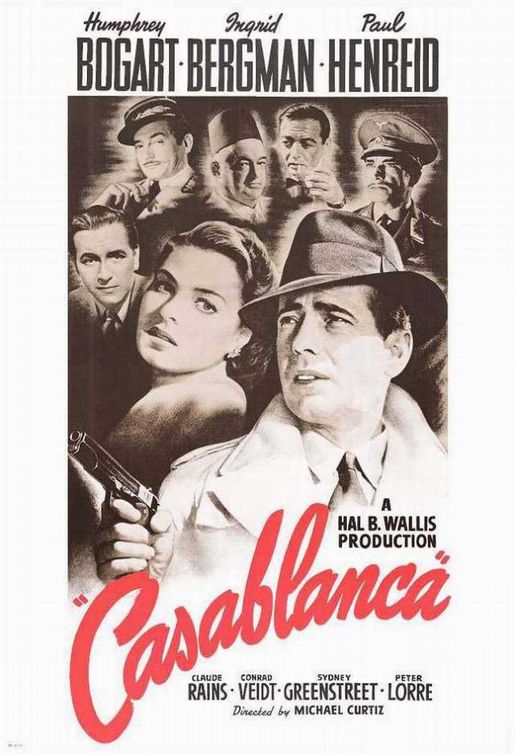
(This review contains spoilers but seriously, you should know all of this already.)
Is there anything left to be said about Casablanca?
Probably not.
As a film reviewer, I’m not supposed to admit that. I’m supposed to come up with some sort of new, out-of-nowhere, batshit crazy way to look at Casablanca. I’m supposed to argue that Rick was actually meant to be a survivor of abuse or that Victor Laszlo was some sort of precursor to President Obama or something. Or, if that doesn’t work, I’m supposed to intentionally troll everyone by writing something like, “10 reasons why Casablanca is overrated” or “I hate Casablanca and I don’t care who knows it!”
But I’m not going to do that.
The fact of the matter is that Casablanca is as good a film as everyone says it is. It is a film that everyone should see. It is a film that quite rightfully was named best picture of 1943. It deserves to be celebrated. It deserves to be seen. In fact, stop reading this review right now and go watch it. Don’t let me waste another second of your time.
The thing with Casablanca is that it’s such an iconic film that everyone knows what happens, regardless of whether they’ve actually watched the entire film or not. They know that the film takes place in Casablanca during World War II. They know that Casablanca is full of refugees, spies, and people who are hiding from their past. They know that Casablanca is policed by the charmingly corrupt Capt. Louis Renault (Claude Rains). They know that Major Strasser (Conrad Veidt) is the Nazi in charge. (I nearly said that Strasser was the “evil Nazi in charge” but when you identify someone as a Nazi, is it really necessary to add that they’re evil?) They know that Rick (Humphrey Bogart) is the American expatriate who owns Rick’s Cafe Americain and that everyone comes to Rick’s. They know that Rick’s slogan is that he doesn’t stick his neck out for anyone but they also know that his cynicism hides the fact that he’s still in love with Ilsa (Ingrid Bergman). They know that when Ilsa shows up at Rick’s and needs him to help her husband, Victor Laszlo (Paul Henreid), escape from Occupied Europe, Rick is forced to decide whether or not to get involved in the resistance.
And, whether you’ve seen the film or not, you know that it all ends on a foggy airstrip. Ilsa wants to stay in Casablanca with Rick but Rick tells her that she has to get on the plane with Laszlo because, if she doesn’t, she’ll regret it. Ilsa goes with Laszlo, leaving Rick behind.
And it may have been the right thing to do but how many viewers would have done the same if they had been in Ilsa’s high heels? Throughout the entire movie, we hear about how wonderful Laszlo is but, whenever he actually shows up on screen, it’s always a little bit surprising to discover just how boring a character Victor Laszlo really is. Unlike the troubled and deceptively cynical Rick, there’s not much going on underneath the surface with Laszlo. Just as Rick overshadows Laszlo, Bogart’s performance overshadows Paul Henreid’s. Bogart and Bergman have all the chemistry and the charisma. Henreid, on the other hand, comes across as stiff and a little dull. But, as the film suggests, World War II was not a time for self-doubt and self-interest. World War II was a time when the world needed straight-forward, determined men like Victor Laszlo.
And, if the world needed Laszlo and Laszlo needed Ilsa, then that meant Ilsa had to get on that plane.
That said, I’ve always liked to think that Ilsa ended up leaving Laszlo in 1945 and immediately made her way back to Morocco. Rick and Ilsa belonged together.
But until Ilsa comes back, Rick has his friendship with Renault. “Louis,” he says, “I think this is the beginning of a beautiful friendship.” Did Bogart realize, when he delivered that line, that literally thousands of people would be repeating it decades later? Bogart’s performance is probably one of the most imitated performances of all time. Anyone who sees Casablanca thinks that they can talk about gin joints and hills of beans in Bogart’s trademark style. Of course, they can’t and it’s a testament to the power of Bogart’s performance that it remains effective even after being endlessly imitated.
On Valentine’s Day of 2014, I saw Casablanca at the Alamo Drafthouse in Austin. It was an amazing and romantic experience. See Casablanca on the big screen. It’ll make you love life and bring life to your love.
Needless to say, Casablanca is an intimidating film to review. So, I’ll just say this: Casablanca is even better than you think it is. If you haven’t seen it, go watch it. If you have seen it, go watch it again.
Just resist the temptation to say, “Play it again, Sam,” in your best Bogart-like voice.
Because, seriously, Rick never actually says that line.

 Through the Shattered Lens