The great Cary Grant was born 122 years ago today.
In honor of Cary Grant’s legendary career and screen charm, today’s scene that I love comes from one of my favorite Cary Grant/Ingrid Bergman/Claude Rains/Alfred Hitchcock movies! From 1946’s Notorious, here is a scene that I love.
Have y’all been to Mt. Rushmore? My wife and I stopped by in 2023 on the way home from Yellowstone. It was pretty cool stuff!
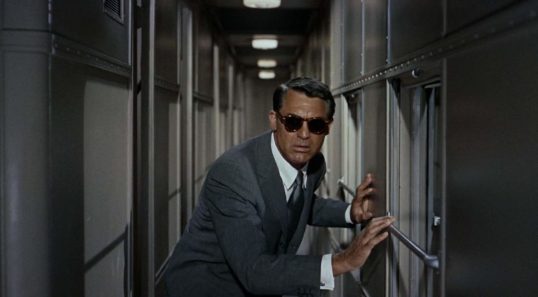
I remember as I was driving up to Mt. Rushmore, I saw a sign that mentioned the Alfred Hitchcock movie NORTH BY NORTHWEST (1959) being filmed there. I hadn’t seen the movie in many years, so I decided to watch it again when I got home to celebrate the trip. I enjoyed seeing Cary Grant and Eva Marie Saint hanging out near the giant rock faces of some of America’s great presidents. In celebration of Hitchcock’s 126th birthday in cinema heaven, I thought I would share that scene with all of you!
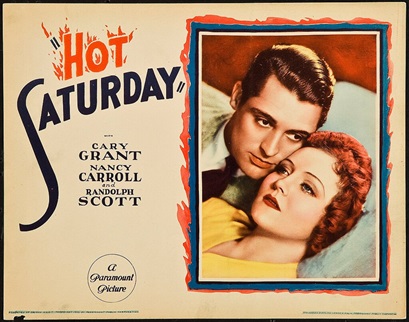
First released in 1932 and featuring Cary Grant in his first leading role, Hot Saturday is a film about gossip and love.
Ruth Brock (Nancy Carroll) is a young bank teller living in a small town. It’s the type of town where everyone knows everyone else. For instance, everyone knows that every man in town wants to date Ruth but that Ruth, for her part, is not in any hurry to settle down and get married. She’s having too much fun going to dances, drinking with her friends, and enjoying life. Everyone knows that playboy Romer Sheffield (Cary Grant) is interested in Ruth but then again, Romer appears to be interested in everyone. Romer has scandalized the town by allowing a woman named Camille (Rita LaRoy) to live at his mansion.
Ruth has a date with one of her coworkers, Conny Billop (Edward Woods), but, when Conny refuses to take no for an answer, she gets away from him and ends up at Romer’s estate. Ruth and Romer spend the night together, just talking. Still, thanks to Conny and Eva (Lillian Bond), the daughter of Ruth’s boss, the whole town is soon convinced that Ruth is Romer’s lover. The town is so scandalized that Ruth even loses her job.
Fortunately, Bill Fadden (Randolph Scott) has returned to town. Bill is a geologist. He grew up in town, with Ruth. He’s spent the last seven years on a surveying expedition but now he’s back and he wants to marry Ruth. How lucky is Ruth? She not only has two good men in love with her but one of them looks like Cary Grant and the other one looks like Randolph Scott! However, when Bill hears the rumors, will he continue to love her or will he be yet another person who gives in to the curse of small town gossip?
Hot Saturday is a film that truly took me by surprise. It’s a pre-code film and it’s one that has all of the usual tropes that one usually associates with the pre-code era. Everyone’s obsessed with sex. There’s a lot of kissing. There’s a lot of drinking. There’s an emphasis on legs and lingerie. There’s even a scene where Ruth gets into a wrestling match with her younger sister when she discovers that her sister has taken her new panties. I’m one of four sisters so I could certainly relate but it’s still not the sort of thing that one necessarily expects to find in a film from the 1930s. But that’s one reason why I love the Pre-Code era. Allowed to police itself, pre-code Hollywood made films that were more realistic and open about their subject matter than the films made under the production code but which also still had their own unique innocence to them. Hot Saturday has an ending that would have never been allowed during the Code era, one that is, dare I say it, rather empowering.
But, beyond all that, Hot Saturday is an intelligently written film that strikes a good balance between drama and character-driven comedy. Nancy Carroll is beautiful and likable in the lead role. Cary Grant and Randolph Scott are both as handsome and charming as can be. Hot Saturday is both a look at the reality and dangers of small town gossip and a touching love story. I enjoyed it.
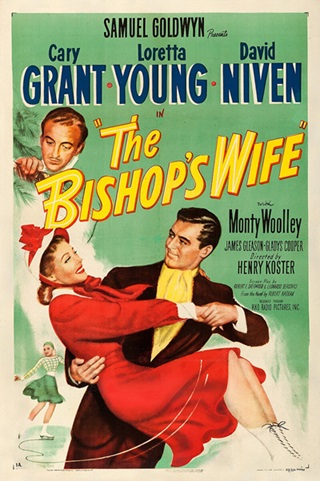
In 1947’s The Bishop’s Wife, Cary Grant stars as Dudley.
We first see Dudley walking down the snow-covered streets of a city that is preparing for Christmas. He watches Julia Broughman (Loretta Young), the wife of the local Anglican bishop. He stops to talk to Prof. Wutheridge (Monty Woolly), a secular humanist who is close to Julia and her husband, despite being irreligious himself. Dudley seems to know all about the professor, even though the professor is not sure who he is. The professor mentions that he was fired from a university because he was considered to be a “radical,” even though he has no interest in politics. The professor says that the town’s church has seen better days, especially since the Bishop is more interested in raising money from the rich to build a grand new cathedral than actually meeting with the poor who need help.
The last person that Dudley visits is Bishop Henry Broughman (David Niven). Dudley reveals to Henry that he’s angel and that he’s come in response to Henry’s prayers. Henry has been frustrated in his attempts to raise money for a new cathedral. Dudley has come to provide guidance.
With only the Bishop knowing the truth about Dudley, Dudley becomes a houseguest of the Broughmans. The Bishop has become so obsessed with his new cathedral that he’s not only been neglecting his diocese but also his family. While Dudley tries to show Henry what’s really important, he also helps Julia and her daughter Debby (Karolyn Grimes) to fit in with the neighborhood. (Bobby Anderson, who played the young George Bailey in It’s A Wonderful Life, makes an appearance as a boy having a snowball fight who says that Debby can’t play because no one wants to risk hitting a bishop’s daughter with a snowball.) The Bishop becomes jealous of Dudley and perhaps he should be as Dudley finds himself falling in love with Julia and considering not moving on to his next assignment.
(And now we know where Highway to Heaven got the inspiration for 75% of its episodes….)
The Bishop’s Wife is an enjoyable film, one that is full of not just Christmas imagery but also the Christmas spirit as well. The Bishop finally realizes that his planned cathedral is more of a gift to his ego than to the men and women who look to him for guidance and comfort in difficult times. David Niven is, as always, likable even when his character is acting like a jerk. That said, this is pretty much Cary Grant’s show from the start. Suave, charming, and gently humorous, Grant joins Claude Rains and Henry Travers in the ranks of great cinematic angels. Never mind that Grant’s character is a bit pushy and has his own crisis of faith. From the minute that Grant appears, we know that he’ll know exactly the right way to answer Henry’s prayers.
Cary Grant was not nominated for Best Actor for his performance here. Undoubtedly, this was another case of Grant making it all look so easy that the Academy failed to realize just how good of a performance he gave. Interestingly enough, The Bishop’s Wife was one of two Christmas films nominated for Best Picture that year, along with Miracle on 34th Street. Both films lost to Gentleman’s Agreement.
Today is the 121st birthday of one of the great actors of Hollywood’s Golden Age, the one and only Cary Grant. For those of us who love to watch older films, Grant is usually the epitome of old-fashioned movie star charisma. He was an actor who could do it all, from screwball comedy to tear-jerking melodrama to exciting thrillers. What one usually hears about Cary Grant is that he was an actor who was taken for granted because he made everything seem so effortless.
And yet, there was a darkness to Grant’s best performances. Like Jimmy Stewart, he was an actor whose affable screen presence often hinted at inner turmoil. And, much as in the case of Stewart, Alfred Hitchcock was a director who immediately understood that. He cast Grant in some of his best films, usually playing a character with a secret or two to hide. One of my favorite “darker” Grant performances and films is 1946’s Notorious.
Directed by Alfred Hitchcock, Notorious opens with T.R. Devlin (Cary Grant) meeting and, it is implied, seducing Alicia Huberman (Ingrid Bergman). Alicia, at the time, was attempting to drink away her sorrow over her father being convicted of treason for his pro-Nazi activities during World War II. As the daughter of an American Nazi with a reputation for drinking too much and being promiscuous, Alicia is indeed notorious. That’s something that Devlin uses to his advantage the next morning when he informs that hangover Alicia that he is an American intelligence agent and that he is investigating the activities of a group of Nazi sympathizers who fled to South America at the end of the war. He wants Alicia, as the daughter of a known sympathizer, to infiltrate their operations.
Reluctantly, Alicia agrees and, while they wait for to learn the exact details of her assignment, they fall in love. Devlin is not happy when his superiors inform him that they want Alicia to approach and seduce Alex Sebastian (Claude Rains), a friend of her father’s who now lives in Brazil with his domineering mother (Leopoldine Konstantin). Alicia is even less happy when Devlin tells her of the assignment, especially as she knows that the weak-willed Sebastian has always been in love with her. She assumes that Devlin only pretended to love her.
After Devlin arranges for Alicia to be at the local riding club at the same time as Alex, Alex meets her and immediately brings her to the mansion that he shares with his mother. Alex is an interesting character. When we first meet him, he hardly seems like a Nazi sympathizer. His happiness when he sees Alicia and the apparent sincerity of his love for her stands in contrast to the often cold, manipulative, and harsh Devlin. Sebastian invites Alicia to move into his mansion and soon, Alicia tells Devlin that he can add Sebastian to “my list of playmates.” When Sebastian asks Alicia to marry him, Devlin tells Alicia to do what she wants. Alicia married Sebastian though she loves Devlin but she soon discovers just how for Sebastian and his mother will go to protect themselves and their Nazi conspirators.
Notorious is famous for its 2 and a half kissing scene between Devlin and Alicia, filmed at a time when the production code specifically stated that kisses could only last for three seconds. Hitchcock handled this by interrupting the kiss every three seconds and then having his two stars get back to it. Both Cary Grant and Ingrid Bergman said the scene was awkward to shoot, specifically because they had to keep finding reasons to split apart without splitting too far apart but the effect onscreen is amazingly romantic and probably about as erotic as 1940s studio production could be. In that scene, you have no doubt that Devlin and Alicia share a passion that Alex, even though he is in love with Alicia, could never understand. Grant and Bergman have an amazing chemistry in this scene and really the entire film.
As played by Cary Grant, Devlin is not always likable in Notorious. He can be cold and manipulative and judgmental but, in the end, we never doubt his love for Alicia. Alex also loves Alicia but he ultimately puts himself (and his mother) first. As for Alicia, she is someone who has been unfairly branded by both the activities of her father and her past reputation and anyone who has ever come to work or gone to school on a Monday morning and heard the snickering that goes along with the rumors about what she did during the weekend will immediately relate to Alicia. Alicia is told that the mission is a way to redeem herself but the film suggests that no redemption is necessary. If anything, it’s Devlin who needs to redeem himself for the way he previously manipulated and judged her. Devlin and his superiors are trying to stop a group of Nazi sympathizers from graining power in South America and their mission is an important one. (That sentiment would be even more true from audience watching in 1946, just a year after the end of World War II). But the important of their mission doesn’t change the fact that the people involved are human beings with very real and very fragile emotions.
Notorious features some of Hitchcock’s best set pieces, from the famous kissing scene to another scene involving the key to a wine cellar. Grant, Bergman, and Rains give three of their best performances in this intelligent thriller. (Watching, one can see why Ian Fleming suggested Cary Grant as a possible James Bond.) I first saw Notorious in a film class in college. At first, the class was a bit hesitant about a black-and-white movie from 1946 but, by the end, there were cheers as Devlin rushed to save Alicia. Notorious is a timeless classic.
Notorious (1946, dir by Alfred Hitchcock, DP: Ted Tetzlaff)
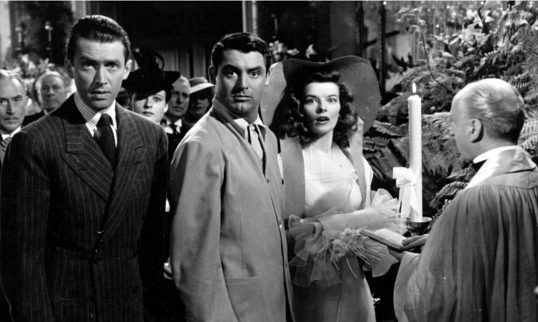
Today’s scene that I love comes from the 1940 film, The Philadelphia Story, and it features my favorite Golden Age actor, James Stewart, carrying Katharine Hepburn and singing a song that might sound a bit familiar to our readers.
This is the performance, by the way, that won Stewart an Oscar. Stewart himself often said that he felt the Academy rewarded him to make up for not giving him the Oscar for Mr. Smith Goes To Washington. That’s probably true but still, this film features Jimmy Stewart at his most charming. Teaming Stewart up with not just Katharine Hepburn but also Cary Grant makes The Philadelphia Story one of the best romantic comedies to come out of Hollywood’s pre-war era.
(Before the war, Stewart was Jimmy. After he served bravely in World War II and returned to America, he was definitely James.)
The great Cary Grant was born 120 years ago today.
In honor of Cary Grant’s legendary career and screen charm, today’s scene that I love comes from one of my favorite Cary Grant movies. This is also one of my favorite Ingrid Bergman films and one of my favorite Alfred Hitchock films and even one of my favorite Claude Rains films. 1946’s Notorious is a favorite all-around!
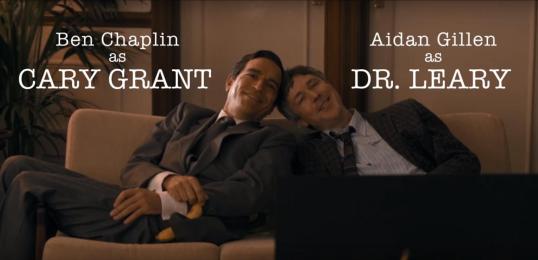
The year in 1959 and Cary Grant (Ben Chaplin) is filming North by Northwest. From what we see of him, he’s the Cary Grant that we’ve all read about — the handsome, charming, witty, but very guarded movie star who never seems to truly trust anyone.
On set, Grant is visited by a pushy Harvard professor named Timothy Leary (Aidan Gillen). Leary explains that he’s recently read an interview in which Grant discussed using a new drug called LSD for therapeutic purposes. Leary believes that the drug could possible be used to help humanity evolve into something better. He says that he wants to take LSD and he wants Grant to guide him through his trip. Grant rather stiffly explains that LSD should only be taken under medical supervision. Leary, however, doesn’t have time for that.
Eventually, Leary and Grant do end up dropping acid together and, as you might have guessed, that’s where things start to get strange. First off, Leary and Grant find themselves sharing the same trip. While Grant tries to escape from Leary, they travel through Grant’s poverty-stricken childhood and they even find themselves being chased by the famous North By Northwest cropduster. They also take a trip to Leary’s future, where he will someday be just as famous as Grant. Leary proclaims that LSD will be the start of the counter culture while the far more conservative Grant grumbles that Leary is a charlatan and that most people won’t be able to handle the drug. Along the way, we go through the usual innuendos about both men. Even under the influence of LSD, Grant remains guarded about his sexuality while Leary struggles to convince Grant that he actually is prophet and not just a con artist looking to get rich through revolution.
Clocking in at just 20 minutes, When Cary Grant Introduced Timothy Leary to LSD is an enjoyably weird little film that makes sense once you realize that Chaplin and Gillen are not actually meant to be playing the real-life Grant and Leary but instead are playing fictionalized versions who both understand that, along with being historical figures, they’re also characters in a film. By the end of the film, they’re less concerned with dealing with each other and more concerned with convincing those of us in the audience that one of them is right and the other one is wrong. Ben Chaplin may not look like Cary Grant but he has the right brooding quality to be convincing as a troubled man who often feels trapped by his own persona. Aiden Gillen, meanwhile, is far more cheerful as Timothy Leary, who he plays as being a bit of a trouble-making sprite.
Interestingly enough, the film is loosely based on fact. Cary Grant did take LSD for therapeutic reasons and Timothy Leary did later go on to become a public figure as a result of his pro-acid advocacy. It has been rumored that Leary and Grant actually did meet, though not necessarily during the filming of North by Northwest. In the end, When Cary Grant Introduced Timothy Leary to LSD is an enjoyably weird short film that shows up occasionally on Showtime so keep an eye out for it.
4 Shots From 4 Films is just what it says it is, 4 shots from 4 of our favorite films. As opposed to the reviews and recaps that we usually post, 4 Shots From 4 Films lets the visuals do the talking!
Today is the 116th anniversary of one of the greatest stars of Hollywood’s Golden Age, Cary Grant! And that means that it’s time for….
4 Shots From 4 Cary Grant Films
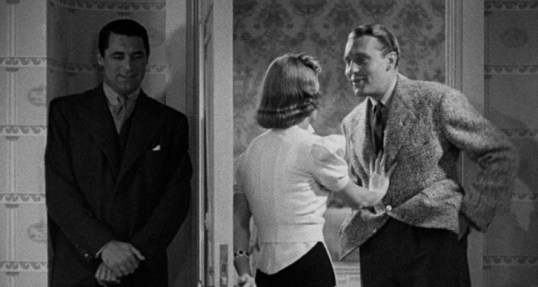
The Awful Truth (1937, dir by Leo McCarey)
The Philadelphia Story (1940, dir by George Cukor)
North by Northwest (1959, dir by Alfred Hitchcock)
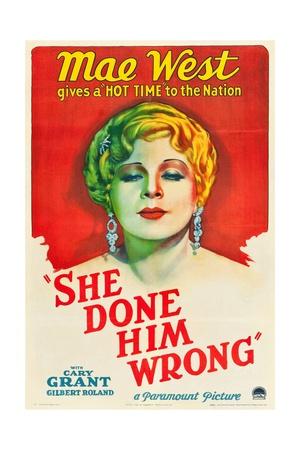
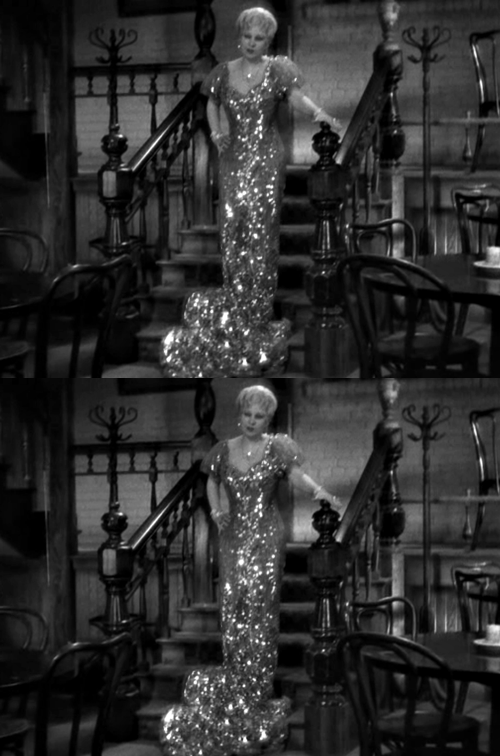
Bawdy Mae West had scandalized Broadway with her risque humor, and struggling Paramount Pictures snapped her to a movie deal. Her first was a supporting part in 1932’s NIGHT AFTER NIGHT, where she was allowed to rewrite her own dialog, and stole the show by purring sexually charged lines like “Goodness had nothing to do with it, dearie”. Mae’s presence helped refill Paramount’s coffers, and raised the hackles of censorship boards across America. It wasn’t long until the Production Code became strictly enforced, thanks in large part to Mae, but before then, she was given the spotlight in 1933’s SHE DONE HIM WRONG, based somewhat on her stage success DIAMOND LIL.
Like the play, SHE DONE HIM WRONG is set in The Bowery during the 1890’s, but here Diamond Lil is called Lady Lou, because the censors wanted to whitewash all vestiges of the ribald play. Diamond Lil or Lady…




 Through the Shattered Lens