The 1983 film Scalps answers the following question:
What happens when these grad students…

…dig up a sacred Native American burial ground and consider stealing some of the artifacts for themselves?
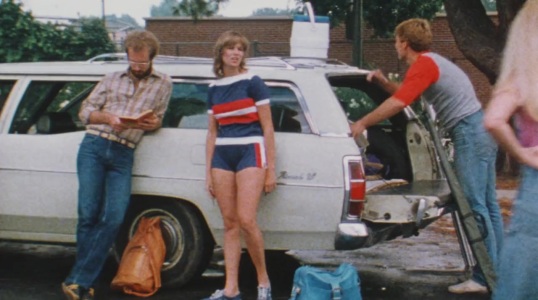
These grad students right here!
Well, they upset this lion…

…and this woman…

…and this guy, as well!

Needless to say, things don’t end well for anyone involved.
As for why those students were out digging for artifacts in the first place, the blame rests with Prof. Machen. At first, Machen didn’t go with the students. He had to take care of stuff back at the university. When he finally did show up, it was a little bit too late. Prof. Machen is played by an actor named Kirk Alyn, who was the first actor to play Superman back in the 1940s.
In the picture below, you can tell Prof. Machen is an explorer because of the pith helmet that he’s carrying:

Scalps is about 80 minutes long. Most fans of low-budget horror will not be shocked to learn that Scalps is about 60 minutes of filler and 20 minutes of actual action. Seriously, it takes forever for those grad students to actually reach the site of the dig and then, once they start digging, it seems to take even longer for anything to actually happen. Occasionally, we get a quick flash forward of someone getting scalped or an insert of either the lion, the witch, or the warrior looking upset.
The grad students themselves are pretty much interchangeable. As far as the men go, two of them have beards and another likes to drink beer. As far as the women are concerned, two of them are blonde and one of them is slightly less blonde. D.J. (Jo-Ann Robinson) is kind of a hippie and she has a bad feeling about everything.
(Stupid hippies! Bleh!)
What’s odd is that, in the end, the film’s glacial pace actually works to its advantage. Combined with an 80s synthesizer-of-doom score and some ragged but still effectively desolate shots of the desert, the slow pace actually gives Scalps something of a dream-like feel. Like a filmed nightmare, the film is suffused with a feeling of impending doom. Once the killings start, Scalps also makes good use of the slo-mo of doom. Even the most rudimentary of scenes can be scary when they’re filmed in slow motion.
Scalps has been described as being one of the most censored films in cinematic history. If you listen to Fred Olen Ray’s director’s commentary (more on that below), you’ll learn that it was largely censored due to the behavior of an unethical producer. That said, it is a remarkably gory little film. It may take a while for the blood to start flowing but once it starts, it doesn’t stop. Admittedly, some of the gore effects worked better than others. The arrow to the eye didn’t seem authentic. The scalping, on the other hand, seemed far too authentic. As for the decapitation …. well, I’d put that somewhere in the middle.
Scalps is something of a historical oddity, because it was one of the first films to be directed by the incredibly prolific Fred Olen Ray. If you’re lucky enough to find the out-of-print Retromedia DVD, you can listen to a commentary track from Fred. He’s remarkably honest about the film’s flaws and also discusses how he feels that the film’s producers ruined the film by adding random insert shots and flash forwards. (“That’s not us doing that!” Fred says during one insert of the lion.) Fred also points out that he made the mistake of actually shooting some of the night scenes at night. It’s always interesting listening to a veteran director talk about his first film. Since they have nothing to lose by openly discussing the mistakes that they made, their commentaries become a sort of a mini-film school.
Scalps is not a lost masterpiece but it is oddly watchable. Somehow, it manages to be both silly and surprisingly effective at the same time.

 Through the Shattered Lens