Horror Film Review: Tales From Parts Unknown (dir by Cameron McCasland)


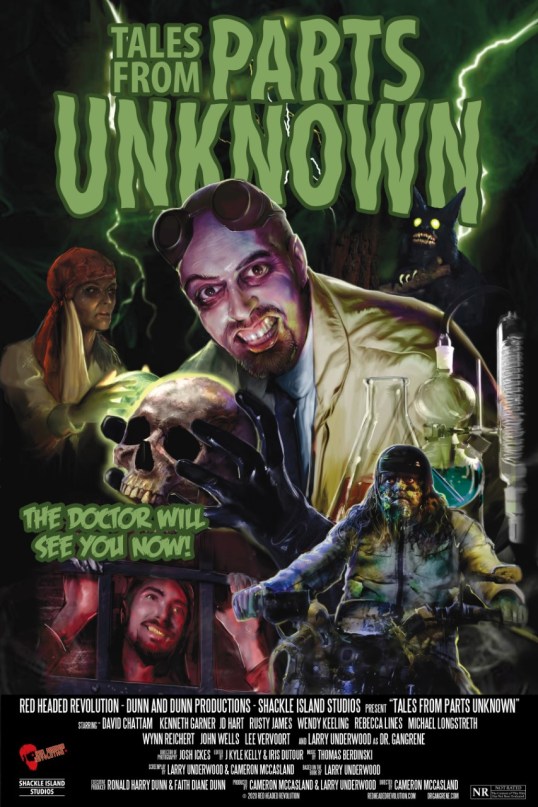
On Shackle Island, there’s a somewhat dilapidated-looking mansion.  And inside that mansion, there’s a friendly and talkative scientist by the name of Dr. Gangrene (played by Larry Underwood).  If you need shelter from the rain, Dr. Gangrene will be more than happy to accommodate you.  Of course, if you do accept Dr. Gangrene’s hospitality, you’ll have to visit the lab and take a look at the doctor’s truly impressive collection of brains.  For every brain, there’s a different story.  In the new horror anthology film, Tales From Parts Unknown, Dr. Gangrene introduces four of those stories.

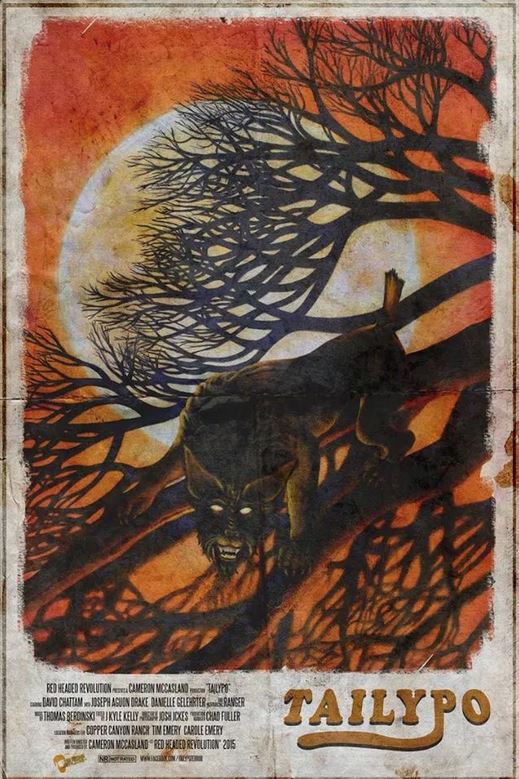
The first brain, Tailypo, tells the story of a hunter and his dog and what happens when their prey escapes from them but loses its tail in the process.  Let’s just say that some creatures don’t take well to losing their tails and that, if you ever do happen to come across a tail out in the middle of the wilderness, it’s probably best to just leave it where you found it.  I originally reviewed Tailypo back in 2015 and it was interesting to get a chance to rewatch it.  (From my review: Tailypo is the first in a series of short films that McCasland is planning to put together for an anthology film that I hope I will someday get a chance to review.)  Tailypo holds up well to a second viewing.  Not only does David Chattam give a good and sympathetic performance as the Hunter but Tailypo really does capture the feel of being the type of story that someone would tell while sitting in front of a campfire.

The second story was Retrieval Service, which told the tale of two gravediggers who eventually make the mistake of trying to rob the dead.  Retrieval Service had a nice Southern gothic feel to it.  It was set (and filmed) in Tennessee and it really captured the unique feel of the region.  The two grave diggers (played by Kenneth Garner and J.D. Hart) got some good lines and had some enjoyably surreal nightmares on their way to digging up graves in search of treasure.  Don’t disturb the dead, the story tells us, no matter how much jewelry they’re wearing.

For The Prisoner of Perdition, we take a trip back to the old west.  In the small town of Perdition, an outlaw named Thorne (John Wells) waits in jail.  An angry mob wants to play jury and executioner but Marshal Tom Clanton (Rusty James) is determined to keep him safe.  However, Thorne has plans of his own and, as becomes apparent throughout the night, he’s also very good at manipulating people.  In fact, he’s a little too good at it.  It’s almost as if he’s not quite human….

The Prisoner of Perdition may not be the most historically accurate western ever made but that’s actually accounts for a good deal of the segment’s charm.  It’s not taking place in the real old west as much as it’s take place in the public’s popular imagination of what the old west was like.  As a result, you’ve got panicky townspeople, women posing on the saloon’s balcony, a tough-talking marshal, and a coldly manipulative prisoner.  The Prisoner of Perdition looks like it was an enjoyable segment to film, which makes it an enjoyable segment to watch.  John Wells does a good job as the charming but evil Thorne.

The Prisoner of Perdition is followed by my favorite story, The Rider.  The Rider is about a greedy writer (Wendy Keeling), her henpecked husband (Wynn Reichert), and the Biker (Lee Vervoort) that the writer accidentally runs over while she’s trying to drive and yell at her husband at the same time.  In its way, The Rider provides a nice tail-end to Tailypo, though the greedy writer is a far less sympathetic character than the unfortunate hunter.  Like Tailypo, The Rider has a lot of atmosphere and an appropriately dark conclusion.

Tales From Parts Unknown is a horror anthology that has an enjoyably retro feel to it.  Larry Underwood (a.k.a. Dr Gangrene) is a veteran horror host and he’s a lot of fun to watch as he holds up each brain to the camera and as he explains why the viewer can’t leave the laboratory just yet.  Tales From Parts Unknown is an entertaining film, perfect for the Halloween season.
A Short Film Review: Tailypo (dir by Cameron McCasland)


Tailypo (1)

Who doesn’t love a good folk tale?

Every section of this country has their own separate folk tales, their own stories about mysterious monsters and unsolved mysteries.  New Jersey has the Jersey Devil.  Bigfoot is rumored to live near Seattle.  If you stop by Fouke, Arkansas, be sure to ask about the Boggy Creek Monster and, if you’re ever in Colorado, be sure to keep an eye out for the jackalopes.  They say that Chupacabras live in South Texas and there’s a goatman who lives near Ft. Worth.  I was born in the southwest and I grew up hearing stories and having nightmares about La Llorona, the weeping woman who cried for the children she had drowned.

I have to admit that, even with my love of folk tales and urban legends, I wasn’t really familiar with the legend of Tailypo.  Or, at least, I wasn’t until I saw Tailypo, the latest short film from Cameron McCasland, the director of The Lashman.

Taking place in Appalachia, Tailypo opens with Levon (David Chattam) and his dog Jasper (played by Ranger) out hunting.  When Levon hears something rustling in the nearby bushes, he opens fire.  Though the creature runs off, it leaves something behind.  Specifically, it leaves behind its tail, which Levon proceeds to pick up and take home with him.  Later that night, as Levon relaxes at his isolated cabin, he starts to hear a voice hissing in the darkness.  The creature is back and it wants its tail…

Tailypo is an effective 14 minutes exercise in claustrophobic horror, one that pays homage to the type of scary stories that people used to tell while sitting around in the dark or in front of campire.  Even the sound of the creature hissing brought to mind a particularly creative storyteller using every technique at her disposal to lure her listeners into the world of her story.  As such, it’s a scary film but it’s also a really fun film, with David Chattam bringing a sly humor to his role.  If you’ve ever spent any time in the country, you’ve met someone like Levon and Chattam is authentic and likable.

McCasland makes good use of the film’s Appalachian setting, emphasizing the isolation of both Levon and the creature from the outside world.  Both of them live a life outside of “normal” society and, when their paths cross, it’s a reminder that there are still mysteries lurking in the shadows.  Interestingly enough, while Levon was hunting and also when I got my first glimpse of his cabin home, I found myself thinking about Winter’s Bone.  Both films take place in a part of America that many would consider to be “the backwoods” and both of them use that setting to remind complacent viewers that, virtually next door, there’s an entire world that most know little about.

Tailypo is the first in a series of short films that McCasland is planning to put together for an anthology film that I hope I will someday get a chance to review.  Along with playing at various film festivals, Tailypo can currently be viewed for free at both redheadedrevolution.com and on youtube.

So, go watch it!

Tailypo

The Daily Grindhouse: The Lashman (dir by Cameron McCasland)


339542_242684609106121_126435694064347_676919_7608822_o

It’s been a while since I’ve down a Daily Grindhouse review here on the Shattered Lens and shame on me for that!  Fortunately, I recently saw a film called The Lashman, a film that may have been released in 2014 but which serves as a tribute to the low-budget, wilderness slasher spectaculars that played at so many grindhouse and drive-in theaters in the 70s and 80s.  After watching the film, I knew that I had seen the perfect film with which to relaunch this feature.

The Lashman was directed by Cameron McCasland and filmed in Kentucky.  As I’ve said many times in the past, I love local horror films.  These are films that are made on location, outside of Hollywood and which often utilize local talent, both behind and in front of the camera.  Along with reminding us that no one location has a monopoly on American filmmaking talent, these locally made horror films also feel a lot more authentic than the slick, “mainstream” films coming out of Hollywood.  This is horror taking place in the real world, as opposed to on a sound stage.  “Authenticity,” that belief that what you’re watching could happen just as easily to you as it could to the people onscreen, is one of the keys of effective horror cinema.  If you can’t relate to the fear of the characters or believe that the film’s threat — no matter how outlandish — might just happen to be waiting for you in the shadows, then the film is not going to work.  Grindhouse horror films, with their rough edges and their cast of often unfamiliar faces, worked precisely because they felt authentic.

I think this especially true for slasher films.  As unfairly critically reviled as they may be, the slasher film is based on a horror that we can all relate to.  We all know that there are disturbed people out there.  We all secretly suspect that we’re more vulnerable, both mentally and physically, than we like to pretend we are.  And, as much as we like to shout back at the screen and complain about how slasher movie victims are always doing something stupid, we all know that we have no idea how we would react if we ever found ourselves in the same situation.  Most of us secretly know that we’d never survive a slasher film.  I know I wouldn’t.  I’d be the girl wandering around outside in her underwear, saying, “This isn’t funny!,” and then spraining my ankle as soon as I tried to run away.

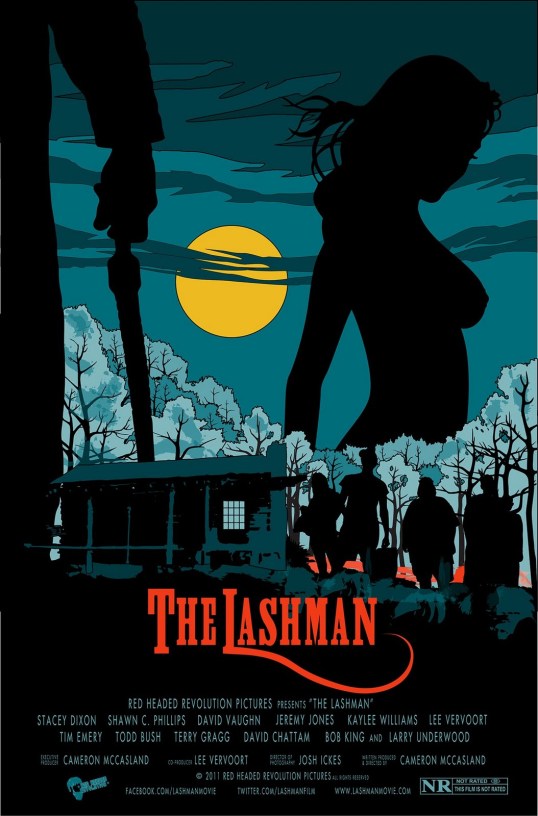
The Lashman is a throwback to those old grindhouse slasher films, a loving homage to films that may have never been critically embraced but which remain undeniably effective.  The film’s story is simple.  Five students spend the weekend at a cabin in the woods.  Lashman, who is rumored to be the malevolent spirit of a man killed over 100 years before, shows up.  People die.

Our five students are all traditional slasher movie victims.  In fact, they share the same basic relationships as the five victims from the original Texas Chainsaw Massacre.  There’s two couples, Stacy (Stacy Dixon) and Billy (David Vaughn) and Daniel (Jeremy Jones) and Jan (Kaylee Williams) and then there’s Stacy’s awkward misfit of a brother, Bobby (Shawn C. Phillips).  (Much like poor wheelchair-bound Franklin from Texas Chainsaw, Bobby spends a lot of time complaining.)

Out of the cast, Shawn Phillips is the one who I immediately recognized because he’s appeared in several low-budget and undeniably fun horror films, with Ghost Shark being a personal favorite.  However, all five of the main cast members do a good job.  I’m jealous of the screaming abilities of Stacy Dixon and Kaylee Williams and David Vaughn made for a good “nice guy” hero.  However, special mention has to be made of Jeremy Jones.  One of the unwritten rules of the slasher genre is that one of your main victims has to be a totally obnoxious jerk and Jeremy Jones deserves a lot of credit for the total commitment that he shows to that role.

The Lashman is a film that will best be appreciated by those who know their horror movies and who can appreciate that McCasland has essentially crafted this film to be a valentine to the entire genre.  Everything about the film — from the beautifully shot opening where two anonymous teens fall victim while the moon beautifully glows down on a lake to the final chase through the woods between the Lashman and his suddenly partially undressed final prey — feels like a tribute to the classic grindhouse horror films of the past.

Finally, as I wrap up this review, allow me to share just a few more thoughts:

This film was produced by Red Headed Revolution Pictures.  As a redhead, I appreciated that.  It was also co-produced by Lee Vervoort, who was one of the directors on Volumes of Blood.

The token crazy old man character (every slasher film has one and nobody ever listens to him when he attempts to warn them) is played by an actor named Larry Underwood, who is a horror host (under the name Dr. Gangrene) and a Rondo-winning horror blogger.  (That said, I should admit that the main reason that I initially smiled when I saw his name in the credits is because I just started reading Stephen King’s The Stand.)

Director Cameron McCasland has a cameo appearance in the film and is credited as playing Handsome Bartender.

The end credits declare, “A good cast is worth repeating!”  If you’ve seen any the great Universal films from the 30s and 40s, you will immediately recognize the phrase.  When I was a kid and I would watch any of the old monster movies, I always loved seeing that “a good cast is worth repeating!”  In a weird way, it always made me feel happy for the cast.