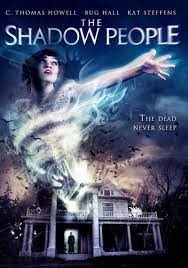
On a rainy night and after nearly crashing their car into a ditch, Andrew (Bug Hall) and Megan (Kat Steffens) arrive at their new country home. Andrew is a writer. Megan is a painter. At first, their new home seems like the perfect place for both of them to practice their art and work on starting a family but then Megan starts to see strange people standing around the house. She fears that they could be the Shadow People, evil spirits that her grandfather told her about. After Megan realizes that she’s lost her necklace, her visions start to get more extreme and violent.
The Shadow People starts out as a really good haunted house film with a good performance from Kat Steffens and a lot of effective jump scares. It works up until a scene where Megan suddenly speaks in a demonic voice, as if she’s been possessed. Later, some of the spirits speak in the same voice and it sounds so much like autotune that it takes you right out of the movie. The spirits are much more effective before they start talking but the movie still has a good twist ending and Kat Steffens’s performance is never less than great so The Shadow People is still worth it.
Top-billed on The Shadow People‘s poster is C. Thomas Howell. Howell actually only has a few minutes of screen time, playing a mysterious minster whose role in the story only become apparent in the film’s final moments.
2012’s Atlas Shrugged: Part II picks up where Part I left off.
The time is still the near future. (Part I specifically set the story as taking place five years into the future. Part II declines to use a specific date but it does feature some news personalities playing themselves so it’s still clearly only meant to be a few years from 2012.) The economy has gotten even worse. The poor are only getting poorer while the rich are getting richer. Under the direction of Head of State Thompson (Ray Wise) and his main economic advisor, Wesley Mouch (Paul McCrane), the government has nationalized nearly every business. Halfway through the film, Thompson declares a national emergency and uses the Fair Share Law to invoke Directive 10-289. All inventors, businessmen, and other creative people are required to sign their patents over to the government and to stop trying to develop now techniques. Wages are frozen. No one can be fired and no one can be hired. Creative thinking is discouraged. Asking questions or expressing doubt is forbidden. People are encouraged to snitch on anyone not following the Directive. Thompson and Mouch insist that it’s for the “good of the people,” and anyone who disagrees runs the risk of being dragged into court and sent to prison for ten years. Meanwhile, gas now costs $42.00 a gallon. One of the funnier moments of the film features someone paying $865.72 to fill up a truck.
Dagny Taggart (Samantha Mathis), the Vice President of Taggart Transcontinental Railways, is still trying to discover who invented an experimental motor that she found hidden away in a mine. The motor could potentially change the way that goods are transported but it appears to be missing one component. Unfortunately, all of the great scientists and inventors have been vanishing, with many of them leaving behind notes that ask, “Who is John Galt?” Meanwhile, Dagny’s lover, Hank Rearden (Jason Beghe), fights to protect Rearden Metal from being taken over by the government and Dagny’s brother, James (Patrick Fabian), sells out to Wesley Mouch with the end result being that there’s no one left at Taggart Transcontinental with the intelligence or the experience necessary to keep two trains from colliding in a tunnel.
Given that Ayn Rand herself was an atheist who wrote very critically of religion, it’s interesting how much of Atlas Shrugged: Part II feels like one of those evangelical films where the Rapture comes and the entire world falls apart because all of the believers have suddenly vanished. In the case of Atlas Shrugged, the world falls apart because all of the creatives and all of the leaders of industry and all of the innovative thinkers have abandoned it so that they can create a new community with John Galt. (They’ve “stopped the motor of the world.”) In many ways, this is the ultimate in wish fulfillment, a way of declaring, “They’ll miss me when I’m gone!” Indeed, the majority of people who keep a copy of Rand’s novel displayed on their bookcase do so because they believe that they would be one of the lucky ones who was approached by Galt. No one expects that they’ll be the person left behind to try to run the railroad. It’s a bit like how like the most strident Marxist activists always assume they’ll be the ones organizing the workers as opposed to being a worker themselves.
Not surprisingly, the same critics who attacked Part I didn’t care much for Atlas Shrugged Part II. When I first saw it, I thought the film was a bit too long and I was annoyed that, with the exception of a few minutes at the end, the film didn’t really seem to move the story forward. At the same time, just as with the first film, I appreciated the fact that the second film was proudly contrarian in its portrayal of the government as being inherently incompetent. After all, this was 2012, back in the “good government” era, when a lot of people still reflexively assumed that the government was staffed only by hyper-competent policy wonks who knew what they were doing and who were only concerned with making sure that “the trains ran on time,” to borrow an old expression.
Rewatching the film this weekend, I have to say that I actually appreciated Atlas Shrugged Part II a bit more than the first time I watched it. Yes, Part II was still a bit too long and the domestic drama between Hank and his wife fell flat but Part II is still a marked improvement on the first film. Some of that is because Part II had a higher budget than Part I and, as a result, it didn’t look as cheap as the first film. The corporate offices looked like actual corporate offices and the factories looked like real factories. Secondly, the second film had an entirely different cast from the first film. Samantha Mathis, Jason Beghe, and especially Patrick Fabian were clear improvements on the actors who previously played their roles. That’s especially important when it comes to Mathis and Beghe because, as opposed to the first film, Part II convinces the viewer that Dagny and Hank actually are as important as they think they are. When the trains collide in the tunnel, the viewer never doubts that Mathis’s Dagny could have prevented the disaster if not for the government’s attempts to force her out of her own company. As well, the viewer never doubts that Beghe’s Hank would fight to the end to protect his business, even if it means prison. One wouldn’t have necessarily believed that while watching the first film.
Finally, having lived through the COVID era, the film’s portrait of government overreach and incompetence feels a lot more plausible when watched today. One doesn’t have to be a fan of Rand’s philosophy or agree with her solutions to see the parallels between Directive 10-289 and the policies that led to children being kept out of schools and numerous small business having to shut their doors. In an era when most people’s faith in governmental institutions has been broken to such an extent that it might never be fixed in our lifetime, Atlas Shrugged Part II resonates. Whereas the film once felt subversive, now it feels downright prophetic.
If you grew up in the “Monster Kid” generation like me… well, you’re old! That is, old enough to remember THE MUNSTERS, the silly 60’s sitcom about a family of monsters adjusting to life in suburbia. The show ran two seasons and inspired a feature film, 1966’s MUNSTER, GO HOME!, with Fred Gwynne (Herman, the Frankenstein’s Monster surrogate), Yvonne DeCarlo (Lily, a vampire resembling Carroll Borland in MARK OF THE VAMPIRE), Al Lewis (Grandpa, aka Count Dracula himself!), and Butch Patrick (Eddie, a wolf-boy) reprising their roles. The Munsters returned in a 1981 TV Movie THE MUNSTERS’ REVENGE with Gwynne, DeCarlo, and Lewis, then as a 1988-91 syndicated sitcom THE MUNSTERS TODAY, this time starring John Schuck (Herman), Lee Meriweather (Lily) and Howard Morton (Grandpa).
The fright family have proved durable, and were trotted out yet again for a 1996 holiday TV Movie, THE MUNSTERS SCARY LITTLE CHRISTMAS. I’m usually…
Last night, I watched yet another “original” movie on the SyFy network. This one was called Arachnoquake.
Why Was I Watching It?
First off, how do you not watch something called Arachnoquake? The title itself is just pure genius in that it not only tells you that the film is about spiders and earthquakes but it also lets you know ahead of time that this is a movie to have fun with.
Also, I was watching because I still have good memories of watching Jersey Shore Shark Attackearlier this month.
What’s It About?
So basically, there’s an earthquake in New Orleans and a bunch of gigantic, extremely venomous albino spiders are released out into the city and the bayou. However, these aren’t just your typical giant albino spiders. No, these are giant albino spiders that can breathe fire and walk on water. It’s kinda like Treme, just with more spiders and less Steve Zahn.
In fact, there’s no Steve Zahn in this film at all! However, there is Edward Furlong, playing a greasy-haired guy who is stuck driving a school bus with a bunch of female softball players on it. Meanwhile, Furlong’s asthmatic wife (Tracey Gold) is stuck on a trolley that’s being driven by a guy played by Bug Hall. And, best of all, there’s also a really badly tempered old guy named Gramps on the trolley as well. Gramps, sad to say, doesn’t stick around for too long but for the first 30 minutes of the film, he was all that we could talk about on twitter…
What Worked?
Listen, if you’re going to bitch and whine about narrative logic, cheap special effects, and silly dialogue while watching a movie like Arachnoquake, you’re kinda missing the whole point of the film. This is a movie that was made to inspire people to talk back to the TV. Arachnoquake doesn’t take itself all that seriously and neither should you. I mean, yes, the spiders looked faintly ludicrous when they showed up in the bayou, chasing after a motorboat. But I suspect that was kind of the point.
Arachnoquake is a film that was made to be viewed as part of a communal experience. I understand that they actually had viewing parties down in New Orleans and I would have loved to have been at one of them! (And I think I could have gotten all sorts of beads tossed at me as well…) However, I settled for live tweeting the film on twitter and that was so much fun! I got to talk to other people who were watching and enjoying the film and even better, the film’s director and some of the performers (especially Megan Adelle) joined in on the live tweet and actually responded to those of us who were talking about their film. Not all of the comments were positive (at one point, director Griff Furst responded to one online critic with, “Blow me.”) but it was still a lot of fun and, if anything, it showed that the filmmakers knew and appreciated their audience. Both the film and the whole communal viewing experience were a lot of fun!
Finally, I think just about everyone on twitter agreed that the highlight of the film was the character of Gramps (played by Grant James). SyFy films are full of cantankerous old men but few are quite as cantankerous as Gramps. We were all a little bit sad to see Gramps die about 30 minutes into the film. Personally, I’m hoping that he returns in a sequel and gets to utter the line, “When you get to Hell, tell ’em Gramps sent you…”
I also hope that the sequel is set during Mardi Gras.
What Did Not Work?
(Spoiler Alert. Seriously, no joke — massive spoiler ahead)
The character played by Tracy Gold spend almost the entire film having an asthma attack and, finally, during the final 15 minutes of the film, she dies as a result. I have to admit that bothered me a lot, both because I actually have asthma but also, and more importantly, because it just felt jarringly out-of-place in what had been, up to that point, a really fun B-movie.
Don’t get me wrong — it wouldn’t have bothered me if Gold had been killed as the result of being wrapped up in a spider web or something. That would have worked well with the tone of the rest of the film. But having her die as a result of not having her inhaler — it just hit too close to home for me and it was just so different in tone from the rest of the film that it briefly made it difficult for me to get back into the right B-movie mindset that’s necessary to truly enjoy a film like Arachnoquake.
“OH MY GOD! Just like me!” Moments
Well, obviously, I related to poor Tracey Gold and her asthma attack. But, beyond that, I could also relate to all the characters in the film because I hate the thought of being in an earthquake and I don’t care much for spider. Especially gigantic albino ones that breathe fire…
Lessons Learned
I will always double-check to make sure I have my inhaler before I leave the house. Also, if I ever find myself stranded in the country with a gigantic albino spider coming towards me, I hope some greasy-haired guy is there to beat it to death with a softball bat while screaming, “Now that’s how you make jambalaya!”
 On a rainy night and after nearly crashing their car into a ditch, Andrew (Bug Hall) and Megan (Kat Steffens) arrive at their new country home. Andrew is a writer. Megan is a painter. At first, their new home seems like the perfect place for both of them to practice their art and work on starting a family but then Megan starts to see strange people standing around the house. She fears that they could be the Shadow People, evil spirits that her grandfather told her about. After Megan realizes that she’s lost her necklace, her visions start to get more extreme and violent.


 Through the Shattered Lens