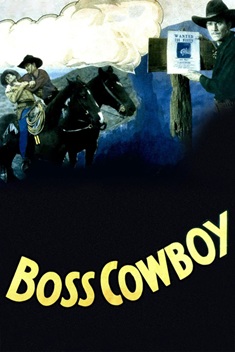
 Boss Cowboy takes place in the 30s but it’s very much a western. One car shows up and telephone poles dot the countryside but almost everyone in the movie rides a horse. The Nolans and the Rosses are two ranching families. Both families are losing cattle. Nolan foreman Dick Taylor (Buddy Roosevelt) suspects that the culprit is the Ross foreman, Jack Kearns (George Cheseboro) and he’s right. Kearns is ripping off both families. Complicating Taylor’s effort to stop Kearns are his romantic feelings towards Mary Ross (Frances Morris), who is visiting from “back east.” Sally Nolan (Fay McKenzie) is also visiting and running joke is her handing off her small dog to a ranch hand named Slim (Alan Holbrook).
No apparent relation to either Teddy or FDR, Buddy Roosevelt was a respected stunt man who tried his hand at starring in a few westerns, Unfortunately, Buddy Roosevelt wasn’t much of an actor, which is painfully apparent while watching him in Boss Cowboy. He’s fine when he’s riding a horse and pulling a gun but when he has to speak, it’s difficult to watch. As bad as Buddy Roosevelt’s acting was, he was not the worst actor in Boss Cowboy. That honor was split between Frances Morris and Fay McKenzie. Boss Cowboy is pretty dull. Every scene drags and there are plenty of awkward silences while the cast tries to remember their lines.
Though he wasn’t much of an actor, Buddy Roosevelt remained in a demand as a stunt man throughout the 40s. In the 50s and 60s, he was kept busy playing townsmen in shows like The Life and Legend of Wyatt Earp. In 1962, he made his final film appearance in The Man Who Shot Liberty Valance. He then retired to Colorado, where he did at age of 75 in 1973. In all, his Hollywood career spanned 46 years, from 1916 to 1962.
 Through the Shattered Lens