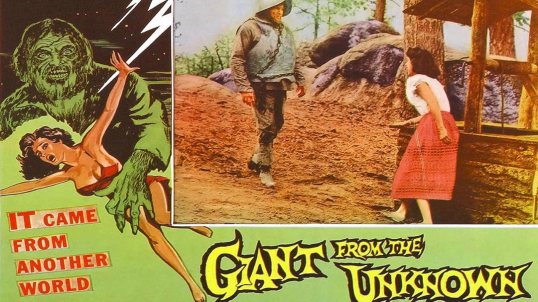
Horror Film Review: Giant From The Unknown (dir by Richard E. Cunha)


In 1958’s Giant From The Unknown, something strange is happening in a California mountain town.  Animals are being killed.  Property is being destroyed.  People are being murdered.

Sheriff Parker (Bob Steele) suspects that the murderer might be Dr. Frederick Cleveland (Morris Ankrum), mostly because Dr. Cleveland spends a lot of time in the mountains looking at fossils with his daughter, Janet (Sally Fraser).  When a younger scientist named Wayne (Ed Kemmer) shows up to help Dr. Cleveland out with his research, Sheriff Parker is even more suspicious.  Meanwhile, the local citizenry suspects that it might be a member of the local Native American community.

It turns out that everyone’s wrong!

The murderer is a formerly dead conquistador (Buddy Baer), who was brought back to life by a bolt of lightning and who is now wandering around the mountains and killing people.  The conquistador walks around in his full conquistador uniform, which is in pretty good shape when you consider the fact that he’s been dead for over two hundred years, maybe longer.

The odd thing about the conquistador is that he’s regularly described as being a giant, even though he’s clearly not.  I mean, he’s tall.  He appears like he might be 6’5.  That makes him taller than the average person but shorter than the average professional basketball player.  The filmmakers regularly attempt to shoot him from a lower angle in order to make him look taller but there’s nothing that can be done to disguise the fact that he’s just a 6’5 guy wearing what appears to be a fake beard and mustache.  If anything, he looks like the frozen-faced Burger KIng mascot.  Maybe he would stop killing people if the sheriff would just order a cheeseburger and fries.  I mean, seriously, his whole rampage could have been avoided.

The title is also incorrect about the giant being from the unknown.  He’s very obviously from Spain.  All one has to do is look at his uniform.  I think the unknown element of this film is how the conquistador has spent centuries underground without losing any skin.  For someone who has been dead for as long as this conquistador was, his hair is very clean and well-groomed.  Watching this film, it’s hard not to feel that Dr. Cleveland should have spent some time researching conquistador embalming techniques because whoever preserved the “giant” did a very good job!  Everyone should be so lucky to look that good for being dead for that long.

Giant From The Unknown attempts to do the usual thing where the monster falls for the only woman in the entire film.  (Indeed, it was hard not to notice that town’s population seemed to be 99% male.)  Unfortunately, the giant was a pretty silly monster so it was difficult to get wrapped up in his emotional journey.  There are some monsters that you feel sorry for and there are other monsters that you just wish would go away.  The giant is a monster who probably had a lot of good haircare tips and who could have probably helped out the entire town …. if only they had been willing to listen!

Lisa Reviews An Oscar Nominee: Quo Vadis (dir by Mervyn LeRoy)


The 1951 best picture nominee, Quo Vadis, is actually two movies in one.

The first movie is a rather stolid historical epic about life in ancient Rome.  The handsome but kind of dull Robert Taylor plays Marcus Vinincius, a Roman military officer who, after serving in Germany and Britain, returns to Rome and promptly falls in love with the virtuous Lygia (Deborah Kerr).  Complicating Marcus and Lygia’s relationship is the fact that Lygia is a devout Christian and a friend to Peter (Finlay Currie) and Paul (Abraham Sofaer).

Marcus’s uncle, meanwhile, is Petronius (Leo Genn), a government official who has a reputation for being a bon vivant.  In real-life, Petronius is believed to have been the author of the notoriously raunchy Satyricon.  You would never guess that from the way that Petronius is portrayed in Quo Vadis.  We’re continually told that Petronius is a notorious libertine but we don’t see much evidence of that, beyond the fact that he lives in a big palace and he has several slaves.  In fact, Petronius even falls in love with one of his slaves, Eunice (Marina Berti).

The second movie, which feels like it’s taking in a totally different cinematic universe from the adventures of Marcus and Lygia, deals with all of the intrigue in Nero’s court.  Nero (Peter Ustinov) is a giggling madman who dreams of rebuilding Rome in his image and who responds to almost every development by singing a terrible song about it.  Nero surrounds himself with sycophants who continually tell him that his every idea is brilliant but not even they can resist the temptation to roll their eyes whenever Nero grabs his lyre and starts to recite a terrible poem.  Nero is married to the beautiful but evil Poppaea (Patricia Laffan) and there’s nothing that they love more than going to the arena and watching people get eaten by lions.  It disturbs Nero when people sing before being eaten.  “They’re singing,” he says, his voice filled with shock an awe.

It’s difficult to describe just how different Ustinov’s performance is from everyone else’s in the film.  Whereas Taylor and even the usually dependable Deborah Kerr are stuck playing thin characters and often seem to be intimidated by playing such devout characters, Ustinov joyfully chews on every piece of scenery that he can get his hands on.  Nero may be the film’s villain but Ustinov gives a performance that feels more like it belongs in a silent comedy than a biblical epic.  Ustinov bulges his eyes.  He runs around the palace like he forgot to take his Adderall.  While Rome burns, Nero grins like a child who has finally figured out a way to outsmart his parents.  “You won’t give me more money?  I’ll just burn down the city!”

And the thing is — it all works.  The contrast between Ustinov and the rest of the characters should doom this film but, instead, it works brilliantly.  Whenever Ustinov’s performance gets to be too much, Robert Taylor and Leo Genn pop up and ground things.  Whenever things start to get too grounded, Ustinov throws everything back up in the air.  The conflict between the early Christians and the Roman Empire is perfectly epitomized in the contrast between Robert Taylor and Peter Ustinov.  It makes for a film that is entertaining almost despite itself.

Quo Vadis was nominated for best picture but lost to An American In Paris.