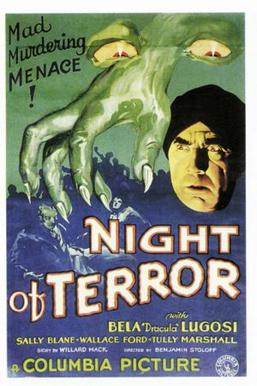
1933’s Night of Terror opens with a character known simple as The Maniac (Edwin Maxwell) attacking random people with a knife. The Maniac is on a murder spree. He leaves taunting newspaper articles on the bodies. (Don’t look at me, I didn’t write the script,) Wisecracking newspaper reporter Tom Hartley (Wallace Ford ) would love to track the Maniac down.
Meanwhile, the richest man in town has been murdered. Was he killed by the Maniac? No one is sure. What is known is that he divided his large fortune amongst not only his heirs but also his servants. Of course, if an heir or a servant should die, that just means more money for everyone else! Meanwhile, the man’s nephew — scientist Arthur Hornsby (George Meeker) — is busy trying to talk his family into burying him alive so that he can test his new suspended animation serum. Arthur swears that he’s figured out a way for people to live without oxygen for a period of time!
Okay, Arthur, that’s great. Anyway….
This sixty-one minute horror film features Bela Lugosi as Degar, the butler. Degar and his wife, Sika (Mary Frey), are regularly referred to as being “heathens” by some of the other members of the family. And yet, when the family needs someone to hold a seance so that they can figure out who is trying to kill all of them, who do they ask to conduct it? Degar’s not happy about it but Sika agrees to do so. Needless to say, things don’t go well.
It’s a bit of silly film and the final twist doesn’t make much sense. One gets the feeling that the script was written over the course of one night and no one really spent that much time worrying about whether or not it all came together to tell a coherent story. Moments of humor are mixed in with moments of would-be terror. The family chauffeur is easily scared. The members of the family all toss out insults at each other. When the police show up, they speak in the rat-a-tat fashion of 1930s police officers. No one in the film yells, “Scram!” and yet it seems like they should have. It’s that type of movie. My favorite scene featured a handcuffed Lugosi offering a police officer a cigarette from “Asia.” Needless to say, the cigarette caused the cop to pass out. Its 1930s stoner humor.
Bela Lugosi got top-billing but his role is actually pretty small. Still, Lugosi gives a good performance and delivers his lines with a straight face. He gets the honor of explaining the mystery to all of the police officers and family members. That said, the film is stolen by Edwin Maxwell as the Maniac. Maxwell gets to break the fourth wall at the end of the film and he probably sent many young audience members home with nightmares. The Maniac tells the audience not to reveal how the film ended, lest they want to be haunted by him. Hitchcock would have been proud.
 Through the Shattered Lens