4 Or More Shots From 4 Or More Films is just what it says it is, 4 shots from 4 of our favorite films. As opposed to the reviews and recaps that we usually post, 4 Shots From 4 Films lets the visuals do the talking!
Earlier, today, it was announced that Sidney Poitier had passed away at the age of 94.
Poitier was, of course, the first black actor to win the Oscar for Best Actor. He won that award for 1962’s Lillies of the Field. He would go on to star in the Oscar-winning In The Heat of the Night, where he delivered the famous line, “They call me Mr. Tibbs!” Poitier was one of the first black actors to be acknowledged as a movie star. In the 70s and the 80s, he chafed at the limited selection of roles that he was being offered in mainstream productions and he started to produce and direct his own films. He also served as a diplomat, serving as the Bahamian ambassador to both Japan and UNESCO.
In honor of Poitier’s life and legacy, here are….
4 Shots From 4 Sidney Poitier Films
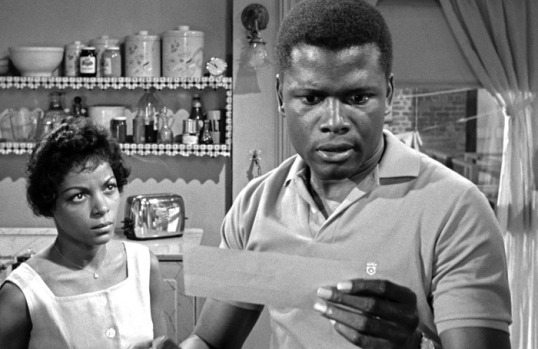
A Raisin in the Sun (1961, dir by Daniel Petrie, DP: Charles Lawton Jr.)
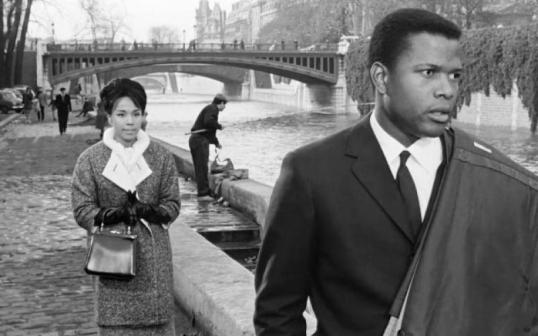
Paris Blues (1961, dir by Martin Ritt, DP: Christian Matras)
In The Heat of the Night (1967, dir by Norman Jewison, DP: Haskell Wexler)
Brother John (1971, dir by James Goldstone, DP: Gerald Perry Finnerman)
Yesterday, while I was out running, I tripped over an invisible rock (at least I think it was an invisible rock) and I twisted my ankle. My first impulse was to check to see if I was being chased by zombies since I’ve learned from movies that anytime a woman sprains her ankle, there has to be either zombies or a masked killer somewhere nearby. Fortunately, movies are not real life. Anyway, I’m staying home from work today, trying to rest and stay off my ankle — which means going against every naturally hyper instinct in my body.
Fortunately, I’ve got thousands of movies, a lot of books, and a TV to help comfort me as I spend the day on the couch. (I also have the sound of my landlord’s son mowing the lawn outside.) Earlier this morning, as I was exploring everything that television has to offer, I came across a channel called Bounce TV and a movie called Brother John.
Up until I randomly came across it on Bounce TV, I had never heard of Brother John. A quick google search hinted that I probably wasn’t alone in that. Brother John appears to be a rather obscure film.
And that’s a shame because, as I quickly discovered, Brother John is actually a pretty interesting film.
Released in 1971, Brother John takes place in a small town in Alabama. The majority of the town’s black citizens work at the local factory, where they are exploited by the white owners and kept in check by the white sheriff (who, as played by Ramon Bieri, is the epitome of the nightmarish Southern law enforcer). When the workers, under the leadership of the charismatic Charlie Gray (Lincoln Kilkpatrick), threaten to unionize, the town finds itself on the verge of exploding into racial violence.
Into all of this comes John Kane (Sidney Poitier). Wearing a dark suit and viewing the world through weary eyes, John grew up in the town. The local doctor and town drunk Doc Thomas (Will Geer) can still remember delivering John. However, John mysteriously vanished when he was a teenager. As Doc Thomas points out, John only returns after someone dies. In this case, it was the funeral of John’s sister that led to him returning to town.
This time, however, John doesn’t leave immediately after the funeral. Instead, he spends a few days in the town and dates a school teacher (Beverly Todd). The authorities — led by Doc Thomas’s politically ambitious son, Lloyd (Bradford Dillman) — are convinced that John is a labor agitator who has come to town to start trouble. Meanwhile, the factory workers (including Todd’s ex-boyfriend, played by Paul Winfield) are angered by John’s reticent nature.
After having John arrested, Lloyd discovers, from looking at John’s passport, that John has been all over the world, even to communist countries that should be closed to American citizens. He discovers that John carries a journal that’s full of empty pages. When he asks John how he managed to learn a dozen different languages, John replies, “I listened.” Lloyd thinks John is a communist. Doc Thomas, meanwhile, is convinced that John is something more than just a human being…
Who is Brother John? That’s the question that everyone’s asking in this film. It’s a question that the film never answers. Instead, it’s up to the audience to consider the enigmatic clues offered up in this film and come to their own conclusions.
And that is why I enjoyed Brother John. It’s a film that encourages the audience to think for itself. Featuring an excellent performance from a perfectly cast Sidney Poitier and plenty of moody Southern atmosphere, Brother John is a great discovery waiting to be found.


 Through the Shattered Lens