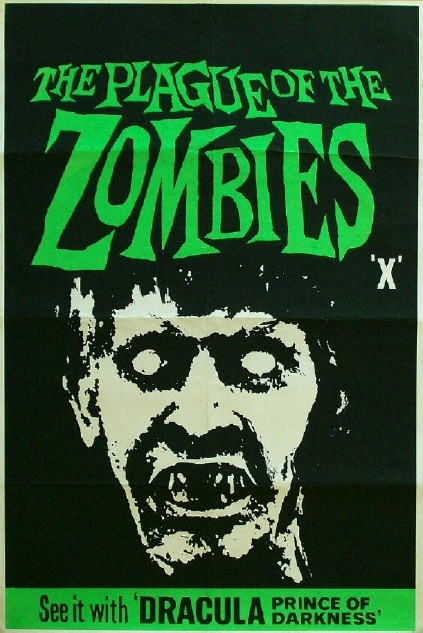
Horror Film Review: The Plague of the Zombies (dir by John Gilling)


One of the best (and scariest) zombie films of all time came to us from Hammer Studios.

The 1966 film, The Plague of the Zombies, takes place in a small, fog-filled English village.  The village has been hit by a plague, one that is wiping out all of the inhabitants.  Unable to combat or even diagnose the mysterious illness, Dr. Peter Tomlinson (Brook Williams) calls in his friend, Sir James Forbes (Andre Morrill) for help.  Sir James arrives with his daughter, Sylvia (Diane Clare) and suggests that the graves of the recently deceased should be dug up so that he can examine the bodies himself.

Sounds like a reasonable idea, right?  There’s only one problem.  ALL OF THE COFFINS ARE EMPTY!  Now, before anyone asks, they weren’t empty when they went into the ground.  There were dead bodies in them when they were originally buried.  But now the coffins are empty, the bodies are missing, and that can mean only one thing — ZOMBIES!

And since this is a Hammer film, that also means that a squire is to blame!  Seriously, if there’s anything that I’ve learned from watching British horror films, it is to never trust a squire.  Squires always seem to end up practicing some sort of black magic.  In this case, Squire Clive Hamilton (Jack Carson) has just returned from Haiti, where he apparently spent some time researching the art of zombie creation.  Squire Hamilton has a tin mine to manage and undead workers are apparently far less demanding than living workers.

(Of course, today, Squire Hamilton could have just automated the mine and brought in robot workers, who would probably be even less demanding than zombie workers.  In fact, with the march of progress, there may soon be no need for zombie workers at all.)

This is a Hammer film so, needless to say, Sylvia eventually gets kidnapped and it’s up to Dr. Tomlinson and Sir James to put an end to the Squire’s evil plans before Sylvia is transformed into a zombie herself.  That’s not going to be as easy as it seems, because there’s zombies everywhere!

The Plague of the Zombies is one of Hammer’s best films and it’s also one of the few that, even to a modern viewer, remains frightening.  The village is a wonderfully atmospheric location, mixing all of the usual gothic tropes that we’ve come to expect with Hammer films with a very real feeling of decay.  Even before the whole zombie plague started, one gets the feeling that the village was already dying a slow, economic death.  The tin mine may be the only way to keep the village alive but, at the same time, killing the village is also the only way to keep the tin mine open.  The Plague of the Zombies is a moody and rather sad film, one that has a bit more on its mind than just supplying the usual Hammer combination of cleavage and blood.

Speaking of blood, Plague of the Zombies has one of the scariest zombie scenes of all time, in which one of our heroes finds himself wandering through a mist-covered cemetery while the dead rise around him.  At one point, he literally steps over a pool of blood.  Of course, the scene itself turns out to be a dream but it’s still effectively frightening.  Also frightening are the zombies themselves, with their pasty, decaying flesh and their blankly hostile faces.  It has been suggested that Plague of the Zombies was an influence on Romero’s Night of the Living Dead and you can definitely see that in its portrayal of the zombies as being a threat not because they’re fast but because they’re so relentless and pitiless.

The Plague of the Zombies is one of the best Hammer films out there so watch it this Halloween!

A Movie A Day #5: ffolkes (1979, directed by Andrew V. McLaglen)


A group of terrorists, led by Lou Kramer (Anthony Perkins, at his bitchiest) and Harold Schulman (Michael Parks), have hijacked Esther, a supply ship that services two North Sea oil rigs, Ruth and Jennifer.  Kramer demands that the British government pay him 25 millions pounds.  If he’s not paid, he’ll blow up the two oil rigs, destroying the British economy and causing a catastrophic environmental disaster.  Kramer has also rigged the Esther with explosives.  If anyone tries to board the boat, he will blow both the ship and himself up, taking the crew with him.

The British Prime Minister (Faith Brook, playing Margaret Thatcher) could pay the ransom or she could call in counter terrorism expert, Rufus Excalibur ffolkes (Roger Moore).

(Though the name undoubtedly looked odd to American audiences, ffolkes is a common Welsh surname and is often spelled with both fs lowercase.)

Made in between The Spy Who Loved Me and Moonraker, ffolkes was Roger Moore’s attempt to defy the typecasting that had defined his career.  Other than his loyalty to Queen and country, ffolkes has very little in common with James Bond.  James Bond was a suave smoker who bedded several women per film, lived in a hip London flat, drank Martinis, and was always ready with a quip.  ffolkes is humorless, drinks Scotch, hates cigarette smoke, and lives in an isolated castle.  The biggest difference between Bond and ffolkes?  Embittered by one bad marriage, ffolkes has no interest in women and refuses to work with them.  Instead, ffolkes loves cats.

ffolkes had always been overshadowed by Moore’s work as James Bond but it holds up well as a good, old-fashioned adventure film.  In many ways, Anthony Perkins’s Kramer feels like a predecessor to Die Hard‘s Hans Gruber and, if ffolkes had been released ten years later, it probably would have been referred to as being “Die Hard at sea.”  If you can get used to him playing someone other than James Bond, Roger Moore does a good job as the eccentric ffolkes and James Mason provides welcome support as ffolkes’s only friend.

Though ffolkes was a box office disappointment, it retains a cult following and it used to show up regularly on British television.  (I saw it at least once every summer that I went to the UK.)  When it was originally released in the U.K., it was called North Sea Hijack.   When it was released in the U.S., presumably under the assumption that American audiences wouldn’t be able to find the North Sea on a map, the title was changed to ffolkes, which probably left audiences more confused than the North Sea ever would have.  When the movie was first broadcast on American television, the title was changed yet again, this time to Assault Force.

To quote Roger Moore: “The film has so many title changes that I’ve lost count.  But everyone seems to like the character I played.”

For tomorrow’s movie a day, it’s another film where Roger Moore did not play James Bond, The Cannonball Run.

roger-moore-is-ffolkes

Cleaning Out The DVR, Again #8: Anne of the Thousand Days (dir by Charles Jarrott)


Anne

After I finished writing my review of Rolling Thunder, I continued the process of cleaning out my DVR by watching the 1969 film, Anne of the Thousand Days.  How does a film like Anne of the Thousand Days compare to a film like Rolling Thunder?

They might as well have been conceived, written, directed, and released on different planets.

I recorded Anne of The Thousand Days off of TCM on March 26th.  The main reason that I set the DVR to record it was because Anne was a best picture nominee.  It may seem strange to think that this rather conventional film was nominated the same year as Butch Cassidy and the Sundance Kid, Z, and Midnight Cowboy.  It gets even stranger when you consider what wasn’t nominated that year: Medium Cool, If…, Last Summer, They Shoot Horses, Don’t They?, Alice’s Restaurant, The Wild Bunch, Once Upon A Time In The West, and a long list of other films.  In fact, if I wanted to, I could probably spend this entire review listing all of the 1969 films that feel like a more appropriate best picture nominee than Anne of the Thousand Days.

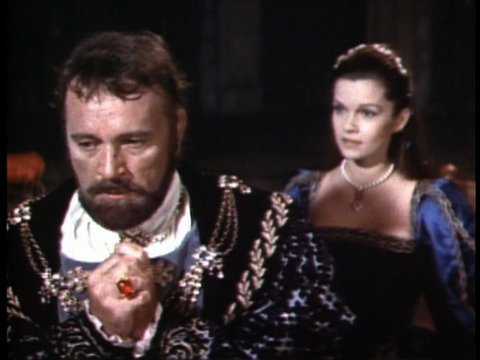
And yet, Anne was nominated for best picture.  In fact, it received a total of 10 Oscar nominations, the most of any film that year.  Tellingly most of the nominations were in the technical categories and the only Oscar that it won was for its costumes.  Genevieve Bujold received a nomination for playing the title character and Richard Burton became the third actor to receive a nomination for playing King Henry VIII.

As for the film, Anne of the Thousand Days tells the oft-told story of King Henry VIII and his marriage to Anne Boleyn.  Told in flashback as both Henry and Anne wait for her to be executed on charges of adultery, the film shows us how middle-aged Henry VIII first met and fell in love with 18 year-old Anne Boleyn.  Standing in the way of Henry’s pursuit of Anne was the fact that 1) Anne intensely disliked him, 2) Anne was already engaged, 3) Anne’s sister was already Henry’s mistress, and 4) Henry was already married to Catherine of Aragon (Irene Papas).

Fortunately, Henry happens to be king and being king comes with its perks.

For instance, as king, he can order Anne and her fiancée to break up.  As king, he can casually dismiss his former mistress.  And, as king, Henry has the power that Anne finds to be the ultimate aphrodisiac.  At first, Anne merely loves the fact that Henry is obsessed with her.  But slowly, she comes to love Henry as a man as well…

The only problem is that Henry is still married and Catherine is still popular with the people.  Even after Henry divorces her and marries Anne, the common people refuse to accept Anne as their queen.  When Sir Thomas More (William Squire) refuses to recognize Anne as queen, Anne demands that More be executed.  When Henry initially shows reluctance, Anne announces that she will not sleep with him until More is dead.

Needless to say, Thomas More is quickly executed.

However, Henry’s attention has already moved on to Jane Seymour (Lesley Paterson) and, desperate to get Anne out of his life, he arranges for Cardinal Cromwell (John Colicos) to frame Anne on charges of adultery and incest.  With Anne facing a humiliating trial and the possibility of execution, Henry makes her an offer.  If she agrees to an annulment, he’ll free her.  However, their daughter — Elizabeth — will lose her claim to the throne…

It’s telling that Charles Jarrott did not receive an Oscar nomination for his work as Anne of the Thousand Day‘s director.  There are a lot of technically good things about Anne of the Thousand Days but, despite all of the melodrama and sex and historical detail to be found in Anne, it never comes to life as a movie.  The costumes are to die for, the sets are impressive, and the cast is full of talented British character actors but the whole movie just feels oddly flat.  Try as it may, it can never convince us that either Henry VIII or Anne Boleyn is worth all the trouble.

Anne of the Thousand Days was obviously a big production, which probably explains all the Oscar nominations.  But otherwise, it’s one of the more forgettable best picture nominees.