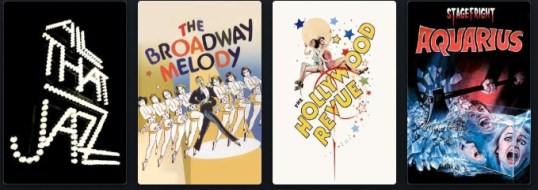
4 Films For The Weekend (6/6/25)


On Sunday, the Tonys will be handed out on  and, if you want to watch the ceremony, it’ll be televised on CBS.  However, if you’d just rather watch some movies about backstage life, I’ve got a few suggestions.

The Broadway Melody (1929) is a historically important film, in that it was the first sound film and the first musical to win the Oscar for Best Picture.  The story is nothing special.  Two sisters (Anita Page and Bessie Love) attempt to make the transition for Vaudeville to Broadway.  One sister becomes a success and almost loses herself in the process.  The other sister remains determined to become a star.  Watching the film today, it’s obvious that the cast and the crew were still figuring out how to work with sound.  That said, it’s a historical oddity and an interesting look at the film industry making the transition into the sound era.  If you’re into that sort of thing — and I certainly am! — the film is now available on Tubi. 

Far more entertaining is the same year’s Hollywood Revue of 1929 (1929).  Produced by MGM, Hollywood Revue features all of the MGM featured players showing off what they could do.  It’s a plotless parade of variety acts, hosted by the suave Conrad Nagel and featuring everyone from Joan Crawford to Marion Davies to Buster Keaton, Laurel & Hardy, Lionel Barrymore, John Gilbert, and Jack Benny!  The goal here was to not only show off MGM’s roster of stars but also to show audiences that MGM knew how make sound pictures.  It’s actually a really fun little movie.  The cast appears to be having fun and there’s something really enjoyable about seeing so many talented people all in one movie.  It also features a song called Singin’ In The RainThe film can be viewed on YouTube.

Bob Fosse’s All That Jazz (1979) is a masterpiece, following choreographer Joe Gideon (Roy Scheider) as he directs both a film and a musical at the same time while popping pills, having heart attacks, and flirting with the Angel of Death (Jessica Lange).  The scene where Gideon watches as his daughter and his girlfriend perform a dance routine that they’ve prepared for him is one of the most heartfelt moments that I’ve ever seen in a movie.  The film’s surreal ending manages to be satirical, heart-breaking, oddly funny, and sad.  Fosse based Gideon on himself and sadly, they both shared the same fate.  It can be viewed on Tubi.

Finally, Michele Soavi’s Stage Fright (1987) is one of the best horror films to ever be set in a theater.  Have you ever wondered why the victims in slasher films don’t just leave the house or the theater?  Have you ever said, “Don’t split up, you idiots!”  Well, in this one, everyone sticks together and everyone tries to leave and it doesn’t do a bit of good.  (Unfortunately, their director has a cocaine problem.)  This film has an absolutely brilliant opening sequence.  I always laugh when the Marilyn Monroe look-alike starts playing the saxophone.  The much-missed Giovanni Lombardo Radice has a small role.  Director Soavi appears as a cop who asks, “Do you think I look like James Dean?”  The film is on Tubi.

(Check out last week’s Weekend Films here!)

The Lost Best Picture Nominee: The Patriot (dir. by Ernst Lubitsch)


So, in case you hadn’t noticed, I’ve got a love for film trivia in general and Oscar trivia in particular.  I also love to make lists.  Last night, these twin loves led to me staying up way too late making a list of every single film ever nominated for best picture.  As I looked down at that list, I thought to myself, “That’s not even a 1,000 movies.  Why it would only take a few years for me to see and then review every single film ever nominated.”  So, I am now a woman on a mission.  Well, actually, I’m on several missions but this is definitely one of them.

Unfortunately, there is one nominee that its doubtful that I — or anyone else will ever see — and that is 1928’s The Patriot.  Not only was it the last silent film to be nominated for best picture but it’s also the only nominee to subsequently become a “lost” film.  With the exception of a few publicity stills and the film’s trailer, all trace of The Patriot has vanished.  Maybe there’s a copy of it sitting in the corner of someone’s attic.  It has happened in the past, after all.  More likely though, the Patriot is simply gone. 

Here’s the trailer:

The Patriot was based on the 1801 assassination of Tsar Paul I of Russia.  Paul was played by Emil Jannings who, the previous year, had won the very first Academy Award for Best Actor for his performance in The Last Command.  Paul’s assassin — the patriot of the title — was played by character actor Lewis Stone who later played almost everyone’s father in the 1930s.  Director Lubitsch was, like Jannings, a relatively recent arrival from Germany.

The Patriot was an expensive, “prestige” presentation that was pretty much doomed the moment that Al Jolson spoke in The Jazz Singer.  With audiences now obsessed with “talking pictures,” the silent Patriot was a box office bomb.  Paramount hastily withdrew the film from circulation, added a few sound effects (though no dialogue because of Jannings’s thick German accent), and then re-released the film with the little success.  The Patriot — the last silent film nominated — lost to the first sound film to win Best Picture, Broadway Melody.

The box office failure of The Patriot pretty much drove the last nail into the coffin of the silent film era.  Jannings reacted to the coming of sound by returning to his native Germany and continuing his film career there.  He co-starred with Marlene Dietrich in Josef von Sternberg’s The Blue Angel.   As Germany’s most distinguished actor, Jannings was a supporter of Adolf Hitler and he appeared in several Nazi propaganda films during World War II.  In 1945, following the fall of the Third Reich, Jannings reportedly carried his Oscar with him as he walked through the streets of Berlin.  He died in Austria in 1950 at the age of 65. 

Lewis Stone, meanwhile, prospered in sound films and was a busy character actor until he died of a heart attack in 1953.  Reportedly, he dropped dead while chasing some neighborhood children who had been throwing rocks at his garage.

Ernest Lubitsch also had a very succesful career in Hollywood and specialized in sophisticated romantic comedies and musicals.  While Jannings was making propaganda films for Hitler, Lubitsch was directing the anti-Nazi comedy, To Be Or Not To Be.  He died of a heart attack in 1947, reportedly while having sex with a starlet who was auditioning for a role in his latest film.

The Patriot remains lost.