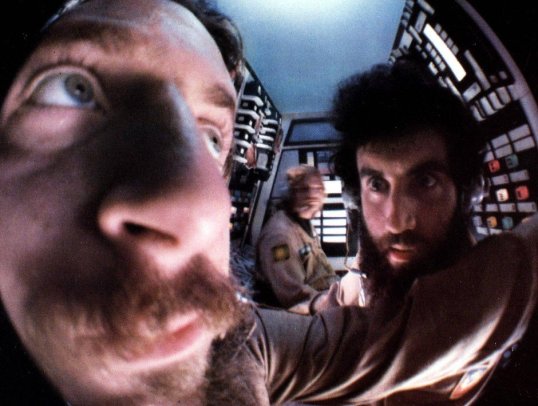
Dark Star (1974, dir by John Carpenter, DP: Douglas Knapp)
What’s it like to live in outer space?
That’s the question posed by 1974’s Dark Star and the answer seems to be that it’s boring as Hell. Lt. Doolittle (Brian Narelle), Sgt. Pinback (future director and screenwriter Dan O’Bannon), Boiler (Cal Kuniholm), and Talby (Andreijah “Dre” Pahich) have been floating in their spaceship for over twenty years. (Because of the vagaries of the space-time continuum, they’ve only aged three years in all that time.) The leader of their mission, Commander Powell (Joe Saunders) was killed when he was accidentally electrocuted at the start of the mission. The crew put his body in suspended animation so that they could still ask him question despite the fact that he’s not quite alive. (When they do talk to Powell, Powell is very resentful about the whole situation.) Doolittle, a former surfer, has taken over as commander of the ship though no one seems to be quite sure what their mission is.
The men struggle to find ways to pass the time as they float endlessly through space. Some of them watch the asteroids in the distance. Doolittle fantasizes about surfing. Pinback plays jokes on people and claims to be an imposter who killed the real Pinback before the start of the mission. The spaceship is a cluttered mess and the crew looks more like a collection of long-haired hippies than a group of rigorously trained astronauts. They spend their time getting on each other’s nerves.
They do have a few things that they have to deal with over the course of the film. The men aren’t particularly smart and whatever discipline they had was abandoned long ago. As a result, their ship constantly seems to be on the verge of literally falling apart. A dangerous alien that looks like a beach ball gets loose on the ship. Even worse, one of the ship’s talking bomb is having an existential crisis. It’s been over 20 years and it has yet to be used to blow anything up. What, the bomb wonders, is the purpose of being a bomb if you can’t blow anything up? Then again, what is the purpose of being in space if there’s nothing left to explore or to discover?
Dark Star is a film that requires a bit of patience. It moves at its own deliberate pace and a lot of the humor comes from the contrast between the shabbiness of the film’s crew and Stanley Kubrick’s far sleeker vision of space travel in 2001: A Space Odyssey. Both Dark Star and 2001 are existential films about man’s search for meaning in the stars. In 2001, Dave Bowman finds that meaning, even if he doesn’t realize it. The crew of the Dark Star however have to deal with very real possibility that there is no meaning. Dark Star‘s comedy comes from poking fun at the concept that going into space would make people any less frustrated than they already are on Earth.
Essentially a stoner comedy set in space, Dark Star was John Carpenter’s feature debut. It started out as a student film but Carpenter and Dan O’Bannon were able to raise an extra $10,ooo to extend it to feature length. Largely overlooked when it was first released, it was re-released in 1979. By that point, Carpenter had directed Halloween and O’Bannon had written Alien, a film that had more than a little in common with Dark Star’s shabby future and its dangerous alien. While Dark Star definitely shows its origins as a student film, I’ve always enjoyed it. It’s hard not appreciate the film’s ambition. And, in its way, it’s probably one of the most realistic vision of life in space ever captured on film. Humans, the film says, will always be humans. They’ll always screw things up but occasionally, if they’re lucky, they’ll also get to surf amongst the stars.
 Through the Shattered Lens