Film Review: The Caine Mutiny Court-Martial (dir by Robert Altman)


In the 1980s, director Robert Altman found himself even more outside of the Hollywood system than usual.  A series of films that confused critics and repelled audiences had led to Altman becoming something of a pariah.  As no studio was willing to give Altman a chance to make the type of quirky feature films that he made his name with in the 70s, Altman instead directed a series of low-budget theatrical adaptations.  These films may not have gotten the attention of his earlier films but they allowed Altman to show off his talents, especially when it came to working with actors.

1988’s The Caine Mutiny Court-Martial was one of those films.  Made for television and based on the play by Herman Wouk, The Caine Mutiny Court-Martial was a courtroom drama that Altman brought to life with his usual flair.  Anyone who has read either the play or Herman Wouk’s original novel (or who has seen the 1953 film version, The Caine Mutiny) will know the story.  In the final days of World War II, Lt. Steven Maryk (Jeff Daniels) has been court-martialed for mutiny.  During a particularly violent storm, Maryk took command of the USS Caine away from Lt. Commander Queeg (Brad Davis).  Maryk and his fellow officers, including aspiring novelist Lt. Thomas Keefer (Kevin J. O’Connor), claim that, after several incidents that indicated he was mentally unstable, Queeg froze up on the bridge and had to be relieved of command.  Queeg claims that everything he did was to enforce discipline on the ship and that he never froze.  Prosecuting Maryk is Lt. Commander John Challee (Peter Gallagher).  Defending him is Lt. Barney Greenwald (Eric Bogosian), who is determined to win the case even though he doesn’t necessarily agree with Maryk’s actions.

The Caine Mutiny Court-Martial is very much a filmed play.  Almost all of the action takes place in one location, a gymnasium that has been converted into a court of military law.  We don’t actually see what happened on the Caine when Maryk took control.  Instead, we just hear the testimony of those involved.  Queeg defends himself, ably at first but soon he starts to show signs of the pressure of being in command.  Maryk explains his actions and we want to believe him because he’s played by fresh-faced Jeff Daniels but, at the same time, there’s something a little bit too smug about his declaration that Queeg was not fit for command.  The other officers on the Caine testify.  Under Greenwald’s skillful cross-examination, Queeg is continually portrayed as being a flawed officer.  But only Greenwald understand that Queeg was isolated not only by the loneliness of being in charge but also by members so his own crew, like Keefer, who hated the Navy and didn’t want to take their part in the war effort seriously.  As a Jew who is very much aware of what’s at stake in the war, Greenwald has mixed feelings about the way that Queeg was treated.  It ends with a party, where a drunk Greenwald calls out the true architect of The Caine Mutiny.  As opposed to the way the scene was portrayed in the 1953 film or in Willam Friedkin’s recent adaptation), Altman focuses not so much on Greenwald but on the party occurring around him.  If the other versions of this story ended on a note of triumph for Greenwald, this one ends on a note of sadness with Greenwald’s words being almost unheard by the officers of the Caine.

Altman gets excellent performances from the entire cast and, even more importantly, he avoids the downfall of so many other theatrical adaptations.  The Caine Mutiny Court-Martial may be a talky film and it may largely take place in only one location but it’s never boring.  Altman’s camera is continually prowling around the makeshift courtroom, reflecting the tension of the case in every movement.  The end result is one of Altman’s best theatrical adaptations.
Retro Television Reviews: Poochinski 1.1 “Pilot”


Welcome to Retro Television Reviews, a feature where we review some of our favorite and least favorite shows of the past!  On Thursdays, I will be reviewing Poochinski, which aired on NBC in 1990.  The entire show is currently streaming on YouTube!

This week, we take a look at another one-episode wonder, Poochinski!

Episode 1.1 “Pilot”

(Dir by Will Mackenzie, originally aired on July 9th, 1990)

Detective Stanley Poochinski (Peter Boyle) is a veteran of the mean streets of Chicago.  He’s rude and crude but he’s also a good cop, one who is mentioned as having once caught a mad bomber.  I mean, I guess you have to be good at your job to capture someone who not only knows how to make bombs but who is also mad about it.

Poochinski shows his softer side when he comes across a bunch of teenagers taunting a stray English bulldog.  Poochinski pulls his gun and threatens to kill a 12 year-old.  That may sound extreme but it works!  (The 12 year-old, I should mention, was also holding a switchblade.)  Poochinski adopts the dog and starts to bring it to work with him, much to the consternation of Poochinski’s uptight and ambitious partner, Detective Robert McKay (George Newbern, a talented actor who somehow always seemed to turn up in stuff like this).  McKay dislikes the fact that the dog is flatulent and so is Poochinski.

However, Detective Poochinski is run down by two thieves during a pursuit.  As Poochinski dies, the dog runs over to him.  They stare into each other’s eyes.

Cut to Poochinski’s funeral.  Detective McKay attends with the dog.  After everyone else leaves, the dog starts to talk to McKay in Poochinski’s voice!

That’s right …. Poochinski has been reincarnated as a dog!  Except, of course, the dog was already alive when Poochinski died so I guess it’s not reincarnation.  I guess Poochinski’s soul just entered the dog’s body.  But what about the dog’s soul?  These are the unanswered questions that haunt me.

Probably because this was only a 21-minute episode and didn’t really have much time to spare, McKay quickly accepts that his partner is inhabiting the body of a dog.  McKay adopts the dog and names it Poochinski.  While McKay helps Poochinski come to terms with the fact that he’s now a dog, Poochinski gives McKay advice on how to flirt with the neighbor (Amy Yasbeck).  Working together, they also set out to catch the criminals responsible for Poochinski’s “death.”

Probably the creepiest thing about Poochisnki is that, half the time, the dog is played by a real dog.  But whenever Poochisnki starts talking, the real dog is replace by a terrifying rubber puppet that doesn’t even look like the original dog.  Watching the rubber dog talk, I couldn’t help but be reminded of that scene in Spike Lee’s Summer of Sam when the neighbor’s dog enters David Berkowitz’s house and orders him to “KILL!” while happily wagging its tail.

There was only one episode of Poochinski.  The pilot was not picked up for a series but it was still aired on NBC during the dog days of summer.  It’s easy to see why the pilot did not lead to more shows.  Poochinski says that he only wants to do two things: catch a criminal and lick himself.  He does both in the pilot so there really wasn’t much left for this devil dog to do, other than turn evil and taunt McKay into transforming into the Son of Poochinski.

(That said, I did smile at the fact that the police sergeant’s name was Sgt. Shriver.  But that’s just because I’m a history nerd who has spent way too much time reading about the Kennedy family.)

Some TV shows only need one episode and Poochinski was definitely one of them.

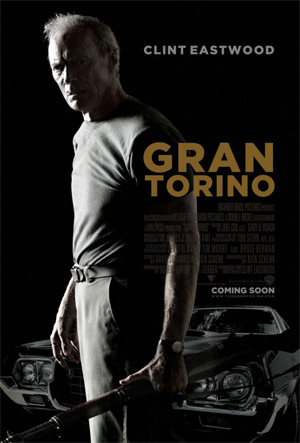
Embracing the Melodrama Part II #113: Gran Torino (dir by Clint Eastwood)


Gran_Torino_posterWalt Kowalski (Clint Eastwood) is a grumpy man.  And by that, I mean that he’s extremely grumpy.  Remember how grumpy Bill Murray was in St. Vincent?  He’s got nothing on Walt Kowalski.

Walt served in the Korean War and, five decades later, his experiences still haunt him.  After the war, he lived in Detroit and he worked on an assembly line.  He’s since retired but he still loves his old Ford Gran Torino, a car that he could very well have helped to build.  His wife has recently passed away and his children are eager to move him into a nursing home.  Walt is slowly smoking himself to death and the only person who visits him regularly is an earnest young priest (Christopher Carley, playing the ideal priest).

Just as Walt’s life has changed as he’s gotten older, so has his neighborhood.  The neighborhood is now dominated by Hmong immigrants.  When Walt catches Thao Vang Lor, a 16 year-old Hmong, attempting to steal his car, it leads to an unlikely friendship between Walt, Thao, and Thao’s sister, Sue.  When the same local gang that put Thao up to stealing Walt’s car subsequently attacks Sue, Thao wants revenge but Walt says that if Thao kills a man, it’s something that he’ll never recover from.  After locking Thao in his house, Walt goes off to confront the gang on his own…

And, since Walt is played by Clint Eastwood, you’d be justified in thinking that Walt’s confrontation would amount to a lot of quips and violence.  But actually, it’s the exact opposite.  Gran Torino does not find Eastwood in the mood to celebrate violence.  Instead, the film is a meditation on both the cost of violence and the impossibility of escaping one’s own mortality.

Whenever people talk about the 2008 Oscar race, the focus always seems to be on the snubbing of  The Dark Knight.  However, I would say that Gran Torino (among other films) was snubbed even more than The Dark Knight.  After all, The Dark Knight may have missed out on best picture but it still received 8 nominations and won an Oscar for Heath Ledger.  Gran Torino, on the other hand, received not a single nomination.

Don’t get me wrong.  I’m not arguing that Gran Torino deserved a best picture nomination.  It’s a fairly predictable film and some of the symbolism, particularly during Walt’s final confrontation with the gang, gets a bit too heavy-handed.  (Any time a character spontaneously strikes a crucifixion pose in a movie, you know that things are starting to get out of hand.)  But I would argue that Clint Eastwood definitely deserved a nomination for best actor.  In many ways, Walt is a typical Eastwood character but, right at the moment when we’re expecting him to behave like every other Eastwood character that we’ve ever seen, Walt surprises us by doing something completely different.  As a director, Eastwood subverts our expectations of Clint Eastwood as both an actor and a character.  As a result, the audience is taken by surprise by Walt, if not by the film’s plot.

I remember, at the time the film was released, there was some speculation that Gran Torino would be the last time we ever saw Clint Eastwood onscreen.  That proved to be false, as he subsequently starred in Trouble With The Curve.  However, even if it wasn’t his final acting role, Gran Torino still serves as the perfect monument to Eastwood’s unique screen presence.