The Things You Find On Netflix: Sergio (dir by Greg Barker)


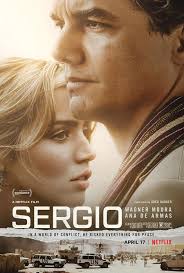
Sergio, which dropped on Netflix last Friday, is a biopic of the Brazilian diplomat, Sérgio Vieira de Mello.  Sergio spent 34 years as a diplomat with the United Nations, going to some of the most dangerous places in the world and trying to negotiate with people who were determined to kill one another.  Sergio was so respected within the UN that he was seen as a likely candidate for Secretary-General.  Instead, in 2003, Sergio was killed in a terrorist attack while he was in Baghdad, observing the American occupation of Iraq.

Starring Wagner Moura in the title role, Sergio opens with Sergio arriving in Baghdad.  For the majority of the film, he’s buried in the rubble of his blown-up office, thinking about his past life while an American soldier (played, with quiet authority, by Garret Dillahunt) tries to dig him and his assistant, Gil (Brian F. O’Byrne) out.  Through the use of flashbacks, we watch as Sergio negotiates peace in East Timor and argues against the occupation of the Iraq.  We also watch as he meets and falls in love with Carolina (Ana de Armas), pursuing a passionate affair with her despite being married.

Sergio is a rather staid biopic.  If you’re expecting to see an Adam McKay-style screed about international diplomacy and American war crimes, that is not what this film is and we should be happy for that because, seriously, have you tried to watch The Big Short or Vice lately?  Instead, Sergio is more like a Jay Roach film without the attempts at humor.  It’s a blandly liberal biopic that is conventionally structured and a bit too convinced that the audience is going to automatically agree with its points.  Indeed, one of the film’s most glaring flaws is that it assumes that we’re all as enamored with the UN as it is.  Instead of making a case for why the UN should be taken seriously, Sergio just assumes that it is.

The other big problem with the film is that it’s just boring.  There’s nothing interesting about the film’s structure and, as portrayed in the rather bland script, both Sergio and Carolina come across as being ciphers.  We’re constantly told that Sergio is charismatic and controversial but we really don’t see much evidence of it.  The film itself doesn’t seem to know what made Sergio tick but what’s even worse is that it doesn’t seem to be particularly interested in finding out.  There’s not much interest in digging into Sergio’s mind or his motives,  The film forgets that you can portray someone as a hero and celebrate their accomplishments without necessarily idealizing them.  With the exception of one or two scenes (and there is an effective moment where one of Sergio’s assistants does call him out for putting everyone’s life in danger by refusing to accept protection from the U.S. army), Sergio is portrayed in such an idealized that he comes across as being a bit dull.  Wagner Moura is an appealing actor but there’s no depth to his performance.  Meanwhile, Ana de Armas is reduced to playing the stock girlfriend with a social conscience role.

All that said, I almost feel guilty about not liking Sergio.  The film was made with good intentions but good intentions don’t necessarily translate to compelling storytelling.

 

Embracing the Melodrama Part II #105: Million Dollar Baby (dir by Clint Eastwood)


Million_Dollar_Baby_poster

(This review and the Spanish trailer below are dedicated to mi madre, who saw Million Dollar Baby when it was first released and told me that, even though the film had been nominated for lots of Oscars, I shouldn’t watch it until I was in a better and more stable place emotionally.  She was right.)

Two months ago, I started Embracing the Melodrama Part II.  At the time, I announced that I would be reviewing 126 cinematic melodramas and I would get it all done in 3 weeks time!  Well, here we are 8 weeks into it and we are just now approaching the finish line.  That’s okay, though.  Even if it’s taken me longer than I thought it would, I’ve still been having fun writing and sharing these reviews.

I’ve been posting these reviews in chronological order.  Though it may be hard to remember, we started with a 1927 silent classic called Sunrise.  From Sunrise, we’ve worked our way through history and we’ve taken a look at films that are both famous and obscure.  And now, 104 reviews later, we finally reach the 2004 best picture winner, Million Dollar Baby.

When I first saw Million Dollar Baby, I had two reactions.  On the one hand, I thought it was a great film.  I thought it was a film that featured great performances and which gave me a chance to experience a world that I did not know much about.  I thought to myself, “This is a film that future directors will cite as an influence.  This is a film that proves that, even if he does sometimes make movies like Hereafter or Jersey Boys, Clint Eastwood still deserves to be known as a great American filmmaker.”  On the other hand, I thought to myself, “This film is so damn depressing that there’s no way I’m ever going to watch it again.”

And really, it is an amazingly sad film.  When the film starts, of course, you don’t think it’s going to be sad.  You think it’s going to be your standard sports film, the one where the underdog beats the odds and becomes a champion.  For one thing, the film is narrated by Morgan Freeman and Morgan’s got that voice that makes you believe that there is some justice to the universe.  Secondly, Hillary Swank is so appealing in the role of Maggie, a waitress who wants to become a boxer, that you just know she deserves a happy ending.  At first, veteran trainer Frankie (Clint Eastwood) refuses to work with her but her determination wins him over.  And soon, Frankie — who, in typical Clint movie fashion, has a strained relationship with his daughter — becomes a father figure for Maggie.

And as you watch Maggie find success as a boxer, you’re so happy for her.  I certainly was, despite the fact that I know next to nothing about boxing beyond the fact that it’s something that I would never want to do.  And when Clint starts to soften up to her, you’re not surprised.  After all, he’s craggly old Clint Eastwood.  He’s scary but we all know he has a heart of gold.  Add to that, Morgan Freeman’s still telling the story and surely the voice of God would not allow anything bad to happen…

And then … tragedy.  By the time that I finally saw Million Dollar Baby, I already knew the story’s big twist.  I knew that, as a result of a brutal fight, Maggie would be left paralyzed.  I knew that she would beg Frankie to euthanize her.  But seriously, imagine what a shock it must have been for audiences when this film first came out.

I mean, everything’s going perfectly and then suddenly, it’s not.

To a certain extent, I was jealous of those who got to see Million Dollar Baby without any advanced knowledge of the tragedy that defines the final third of the film.  When I watched the film, I found myself dreading the thought of enjoying any of Maggie’s triumphs because I knew what was going to happen.  Those who watched the film with know knowledge may have been shocked but at least they got to believe, for a few scenes, that Maggie could find that perfect sports film ending.

Then again, Million Dollar Baby is a great film because it refuses the temptation to give us the ending that we all want and expect.  Instead, it’s a movie that celebrates the people who will be there for you even when thing’s suddenly aren’t perfect.

That’s why Million Dollar Baby works as well as it does.  Unfortunately, it’s also why it’s a film that I could only watch once.

http://www.youtube.com/watch?v=Sva4p3E6p4o