In the late 1960s, television coverage of football is dull and boring. The games are played during the day and the announcers have no personality. An executive at ABC named Roone Arledge (John Heard) changes all of that by convincing the NFL to start scheduling games for Monday night. Arledge launches Monday NightFootball, a broadcast that puts the viewers at home in the stadium. Arledge explains that he wants cameras everywhere. He wants the sidelines and the stands to be mic’d up. And he wants announcers who will make the game interesting. He picks an experienced radio announcer named Keith Jackson (Shuler Hensley), former Dallas quarterback Don Meredith (Brad Beyer), and finally an egocentric, loquacious, and opinionated sports reporter named Howard Cosell (John Turturro). The straight-laced Jackson only lasts a season and finds himself overshadowed by Meredith’s good ol’ boy charisma and Cosell’s eccentricities. Arledge brings in Frank Gifford (Kevin Anderson) as a replacement and changes both sports and television forever. Monday night football becomes huge but so do the egos of the men involved.
Based on a non-fiction book by Bill Carter, MondayNightMayhem is a look at the early days of Monday Night Football, with most of the attention being given to the mercurial Howard Cosell. As a work of history, it’s pretty shallow. There’s a lot of montages set to familiar 70s tunes and there’s plenty of familiar stock footage. Beyer and Anderson do adequate impersonations of Meredith and Gifford without really digging for much under the surface. MondayNightMayhem is dominated by John Turturro’s performance as Howard Cosell. Turturro doesn’t look like Cosell and he really doesn’t sound that much like Cosell but he does capture the mix of arrogance and bitterness that made Howard Cosell such a memorable and controversial announcer. In its breezy manner, the film hits all the well-know points of Cosell’s life and career, from defending Mohammad Ali to considering a run for the Senate to trying to reinvent himself as a variety show host to the controversy when he was though to have uttered a racial slur during one of the games. I wish the film had a bit more depth but John Turturro’s committed but bizarre performance keeps it watchable.
The snow and ice finally melted today so, this afternoon, Jeff and I went down to the Alamo Drafthouse and we saw the just released Will Smith/Margot Robbie film, Focus.
You know how there’s some films that you see and you know that you had a good enough time while you were watching it and then, a few hours later, you realize that the movie itself is quickly fading from your memory? It’s not that you just saw a bad movie as much as you just watched one that was not exceptionally good. To a large extent, that sums up how I felt about Focus. I watched it. I was mildly entertained. And I have a feeling that, 6 months from now, I’m going to come across this review and say something like, “Oh yeah, I guess I did see that movie.” It gets the job done but it doesn’t do much else.
(I was actually tempted to start this review by saying that Focus was good for a “March movie” but then I remembered that last year, The Grand Budapest Hotel came out in March and proved that the date of release is no longer an excuse.)
In Focus, Will Smith plays Nicky Spurgeon. Nicky’s nickname is Mellow but he didn’t get that nickname for the reason that you probably think he did. (Though, rest assured, we do find out the exact reason why Nicky is called Mellow and yes, it does factor into the film’s final twist.) Nicky is anything but mellow. Instead, he’s a professional con artist who is always scheming, who always considers every detail, and who is always focused on getting what he wants.
The film is split into two parts and the first part is actually pretty good. An inexperienced con artist named Jess (Margot Robbie) attempts to rob Nicky and gets a lecture as a result. Nicky isn’t so much upset that Jess tried to con him as much as he, as a professional, is annoyed that Jess did such a bad job of it. This leads to Nicky eventually becoming Jess’s mentor. Nicky teaches Jess all the tools of the trade, introduces her to all the properly quirky members of his crew, and he even goes against his own advice (which is to never get close to anyone) when he and Jess become lovers.
The highlight of the first part of the film is a football game where Nicky and a compulsive gambler (B.D. Wong) end up making a series of increasingly ludicrous bets. B.D. Wong gives such a memorably unhinged performance that he briefly made the entire film seem more interesting than it actually was. In fact, as I look back over Focus, I find myself wishing that the entire film has just been about his character.
But, unfortunately, the film isn’t about B.D. Wong. Instead, it’s about Nicky and Jess. The second part of the film, which takes place three years after the first part, features Jess and Nicky as equals and it feels like almost an entirely different movie. Whereas Smith and Robbie had a nice chemistry as teacher and student, that chemistry vanishes after the time jump. Unfortunately, that’s not all that vanishes. The film’s pace and playful sense of fun disappears as well. If the first half of the film felt like an above average first episode of a quirky TV show, the second half felt like a long-running sitcom on which the show runner had been fired and suddenly replaced. It was similar to what had come before but, ultimately, it felt very different.
Focus does end with a big twist but, long before it was revealed, Jeff and I both guessed what it was. The problem is that we’ve seen so many movies about con artists that we know that all of them are destined to end with a big twist that reveals that there was another con going on that we didn’t know about. It’s impossible to be surprised by the eventual twist because we all know that it’s coming. For a “con movie” like Focus to work, it has to either be so cleverly written or so much fun to watch that we actually stop thinking about the inevitability of the upcoming twist. But, since Focus is never as clever as it thinks it is, we instead spend our whole time thinking about the twist and, seeing as how you’re a clever and experience filmgoer, you probably won’t have much trouble predicting it.
But here’s the thing: I think it’s possible to be too critical of a film like Focus. Focus may not be good but it does have it fun moments. Will Smith could play Nicky in his sleep. (And, to be honest, he occasionally seems to be doing just that.) Margot Robbie looks like she belongs in an old film noir. The settings are glamorous. The clothes are to die for. Ultimately, Focus is both moderately enjoyable and extremely forgettable. If you don’t see it in a theater, you won’t regret it. However, when it show up on cable in December, it’ll make for inoffensive background noise.
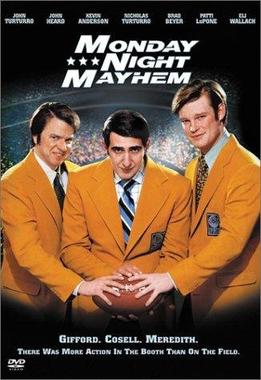 In the late 1960s, television coverage of football is dull and boring. The games are played during the day and the announcers have no personality. An executive at ABC named Roone Arledge (John Heard) changes all of that by convincing the NFL to start scheduling games for Monday night. Arledge launches Monday Night Football, a broadcast that puts the viewers at home in the stadium. Arledge explains that he wants cameras everywhere. He wants the sidelines and the stands to be mic’d up. And he wants announcers who will make the game interesting. He picks an experienced radio announcer named Keith Jackson (Shuler Hensley), former Dallas quarterback Don Meredith (Brad Beyer), and finally an egocentric, loquacious, and opinionated sports reporter named Howard Cosell (John Turturro). The straight-laced Jackson only lasts a season and finds himself overshadowed by Meredith’s good ol’ boy charisma and Cosell’s eccentricities. Arledge brings in Frank Gifford (Kevin Anderson) as a replacement and changes both sports and television forever. Monday night football becomes huge but so do the egos of the men involved.
 Through the Shattered Lens