You can probably just look at the title and guess what is going on with this 2009 faith-based film.
Sarah Collins (Rebecca St. James) is pregnant and she’s thinking about getting an abortion. She doesn’t feel that she’s ready to become a mother. Her quasi-boyfriend works in the same office that she does and, at first, he seems more interested in just hanging out with the boys than actually doing anything that would indicate he would be a good father. Sarah is up for a promotion at work and, as her best friend (Andrea Logan White) is quick to point out, the bosses aren’t going to promote a woman who might put her family before her job.
On the other hand, Sarah keeps having visions of herself in the future, married and with a daughter who loves her. Sarah’s sister-in-law (Staci Keanan) talks about how much she loves being a mother. A local minister (Dick Van Patten) gently suggests that God might be trying to tell Sarah something. Sarah realizes that her best friend is hardly an unbiased observer when it comes to Sarah’s choice. Plus, the film takes place during the Christmas season. There’s happiness and joy everywhere!
As you probably guessed, this is an anti-abortion movie. That said, as far as faith-based anti-abortion movies go, it’s actually a bit more fair-minded than one might expect. Sarah struggles with her decision and the film is at least willing to take Sarah’s concerns seriously, as opposed to just portraying her as being either selfish or immature (which is the usual path that most anti-abortion films take). One character expresses regret for her own past abortion but, again, the film treats the character fairly. It may not seem like much but compared to something like Allison’sChoice, which featured Jesus Christ showing up and then breaking into tears while standing in an abortion clinic, Sarah’sChoice is downright moderate in its storytelling.
The truth of the matter is that there really aren’t that many subtle films made about abortion, on either side of the debate. Yes, pro-life films tend to be heavy-handed and too quick to villainize those who feel differently. But the same can be said of most pro-abortion films as well. Abortion is one of those issues that tends to bring out the extremists on both sides. When you see a film like Sarah’sChoice — a film in which no one is accused of committing murder and no one attempts to bomb anyone else — it’s almost a relief, even if you don’t agree with the film’s overall message.
Rebecca St. James gives a sympathetic performance as Sarah and Andrea Logan White brings so much-needed nuance to the role of her best friend. Dick Van Patten, with his friendly manner and nonjudgmental attitude, is the ideal counselor. Sarah’sChoice is not a film that is going to win any converts and I imagine that people who are far more politically-minded than me will find a lot to get annoyed about with this movie. I think that, overall, it’s well-acted and well-made. It’s a movie not a manifesto.
In 2011’s Marriage Retreat, Jeff Fahey and Victoria Jackson play marriage counselors.
Seriously, that’s bring to mind some wonderful images, doesn’t it? I would pay money for a film where Jeff Fahey plays a Dr. Phil-type psychiatrist who has his own television show where he yells at his guests and tell them that they’re not worth his time. Fahey would totally knock that role out of the park. As for Victoria Jackson, her eccentric screen persona would seem to make her the perfect companion for Fahey. Fahey is known for intensity. Jackson is known for being in her own private world. They’re a good combination!
And Fahey and Jackson are the best things about MarriageRetreat. Admittedly, Victoria Jackson doesn’t really get to do too much but she has a few good scenes with Fahey. Fahey, for his part, dominates the entire film. MarriageRetreat may be a lightweight and ultimately rather light-headed comedy but Fahey doesn’t give a lightweight performance. Fahey delivers all of his lines with that hard-driving intensity of his and, when someone complains about being married, Fahey’s glare tells you all you need to know. If the film’s message was that being a bad husband results in dealing with the wrath of Fahey, many husbands would immediately shape up.
Unfortunately, the rest of the film doesn’t really live up to the performances of either Fahey and Jackson. The majority of the film deals with three boring couples who all go on a marriage retreat. They stay at what appears to be a summer camp and they discuss why their marriages are falling apart.
For instance, Mark (David A.R. White) says that he’s not ready to be a father and he’s come up with all sorts of financial excuses to justify not starting a family. Do you think Jeff Fahey’s going to let him get away with that? No way! Plus, Mark’s wife (Andrea Logan White) is already pregnant so Mark better stop whining and step up.
Bobby Castle (Tommy Blaze) was a successful businessman but then he blew all of his money in some unwise investments. Now, Bobby is addicted to gambling online and his wife (Caroline Choi) is thinking of leaving him. Bobby is such a degenerate gambler (to quote Joe Pesci in Casino) that he even finds a way to get online at the camp so that he can continue to play poker on the Internet. The man needs help!
And finally, James Harlow (Matthew Florida) needs to grow up, especially since he’s about to become a father…. wait, a minute, I thought that was Mark’s problem. Well, no matter. Grow up, James!
The men are all immature and Jeff Fahey calls them out on it while Victoria Jackson tells the wives that they need to remember that God made them second and their job is to support their husbands …. wait, what? Oh, wait — this is another faith-based movie about marriage. The recurring theme in these films is that, no matter how much the husband screws up, it’s still ultimately the fault of the wife for not being understanding and supportive. Yeah, okay, then. There’s a difference between being supportive and being a doormat.
Anyway, the problem with this film is that I didn’t really care about the married couples. But I did enjoy watching Jeff Fahey do his thing.
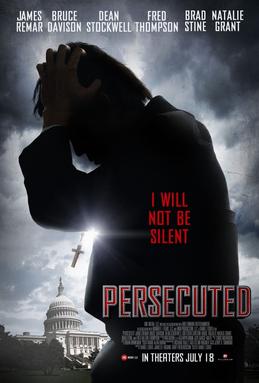
It may seem strange that I would choose to end my series of reviews of films that feature politics and politicians by reviewing Persecuted, an obscure film from 2014. After all, Shattered Politics started out with D.W. Griffith’s Abraham Lincoln. Over the past three weeks, I’ve reviewed everything from Mr. Smith Goes To Washington to The Phenix City Storyto Dr. Strangelove to The Godfather to Nashville to Once Upon A Time In America to The Aviator. I have been lucky enough to review some of the greatest films ever made. And now, at the end of this series, I find myself reviewing Persecuted, a film that has a score of 0% over on Rotten Tomatoes.
Consider that for a moment.
As I sit here typing out this sentence, not a single critic has given Persecuted a good review. And I will admit right now that I’m not going to be the first. Persecuted is cheap-looking, heavy-handed, melodramatic, histrionic, foolish, silly, preachy, predictable, strident, and just about every other possible criticism that comes to mind. If the film is redeemed by anything, it’s that it is full of good actors who do the best that they can with characters that are either seriously underwritten or ludicrously overwritten.
Persecuted takes place in the near future. Sen. Donald Harrison (Bruce Davison) has written something called the Faith and Fairness Act, which would basically require churches to provide equal time to other religions and would make it illegal to suggest that only one religion has all the answers. How exactly that would work, I’m not sure. However, a big part of Harrison’s bill is that, in exchange for giving up any claim to having all the answers, churches will now get money from the federal government. As a result, a lot of church leaders have sold out and announced their support for the bill.
However, evangelist John Luther (James Remar) refuses to support the bill. As we’re told when Luther first appears, he’s a recovering alcoholic and drug addict who used to be a professional gambler. But then he found faith and he’s now the most popular man in the country. Or, at least, he is until he’s drugged by the government and framed for murdering a prostitute.
So now, Luther is on the run. He has to evade capture, prove his innocence, and reveal the truth about Harrison and his shadowy backers. Helping Luther out is his father, an Episcopalian priest who is played by former real-life Presidential candidate Fred Thompson. (Thompson, incidentally, is a very good actor and brings a lot of conviction and authority to his role.) Not helping Luther are the former leaders of his church, one of whom is played by character actor Dean Stockwell.
I’ll admit right now that, as familiar and talented as all four of them may be, James Remar, Bruce Davison, Fred Thompson, and Dean Stockwell are hardly big stars and you really can’t blame any of them for presumably taking a job strictly for the money. That said, it’s still odd to see such good actors appearing in a film like Persecuted and they all deserve at least a little bit of credit for doing their best with the material that they had to work with. However, my favorite performance came from Brad Stine, who plays glib preacher who betrays Luther. Stine is just so sleazy and hyperactive that he’s a lot of fun to watch.
Now, while Persecuted is obviously a faith-based film, it’s plot actually has more in common with the paranoia movies of the 70s than it does with Left Behind. John Luther is a guy who knows the truth and has been framed as a result and he spends nearly the entire film on the run. If anything, this is a film that will probably appeal more to conspiracy theorists than to Christians. But, judging from the film, the conspiracy that’s trying to destroy John Luther doesn’t appear to be very competent. How else do you explain that John Luther — the most famous man in the world — manages to easily evade capture despite the fact that he spends most of the film wandering around in broad daylight with dried blood on his face. At one point, he even calls his wife and has a conversation with her. “Ah!” I thought, “this is where we’ll discover that the conspiracy is listening in on the conversation!” But no, that didn’t happen. In fact, his wife talked to him while, in the background, two cops searched their house. “The police are looking for you,” the wife says but neither one of the police officers seems to hear her. Apparently, it didn’t seem to occur to any of them that John Luther might call his wife. For a paranoia film to work, you have to feel like the film’s hero is in constant danger and Persecuted never succeeded in doing that. How can anyone be scared of a conspiracy that can’t even handle the basics?
Persecuted is not a good film but, in its own unfortunate way, it is a relevant one. Much as how the first film I reviewed for Shattered Politics, D.W. Griffith’s Abraham Lincoln, told us a lot about America in the 1930s, Persecuted tells us a lot about how America is viewed by its citizens in the 21st Century. Persecuted is a film that insists that our leaders can’t be trusted, that your friends will betray you if ordered to do so by those in authority, and that everything bad will come disguised as something good. It’s not exactly an optimistic view of politics or America but then again, these are the times that we live in. It’s been a long time since Billy Jack went to Washington. It’s been even longer since Mr. Smith first showed up.
Now, instead, all we have is Bruce Davison telling us, “You thought you were bigger than the system and you’re not!”
And, on that note, Shattered Politics comes to an end! I’ve had a lot of fun writing this series of 94 reviews and I hope that you’ve enjoyed reading them! If there’s any conclusion that I think can be drawn from these 94 films, it’s that politicians will always betray you and politics will always depress you but movies will always be there to lift you back up.
If I had to choose between voting and watching a movie, I would pick a movie every time. Fortunately enough, I live in a country where I am allowed to do both.


 Through the Shattered Lens