Review: The Killer (dir. by David Fincher)


“Stick to your plan. Anticipate, don’t improvise. Trust no one. Never yield an advantage. Fight only the battle you’re paid to fight. Forbid empathy. Empathy is weakness. Weakness is vulnerability.” — The Killer

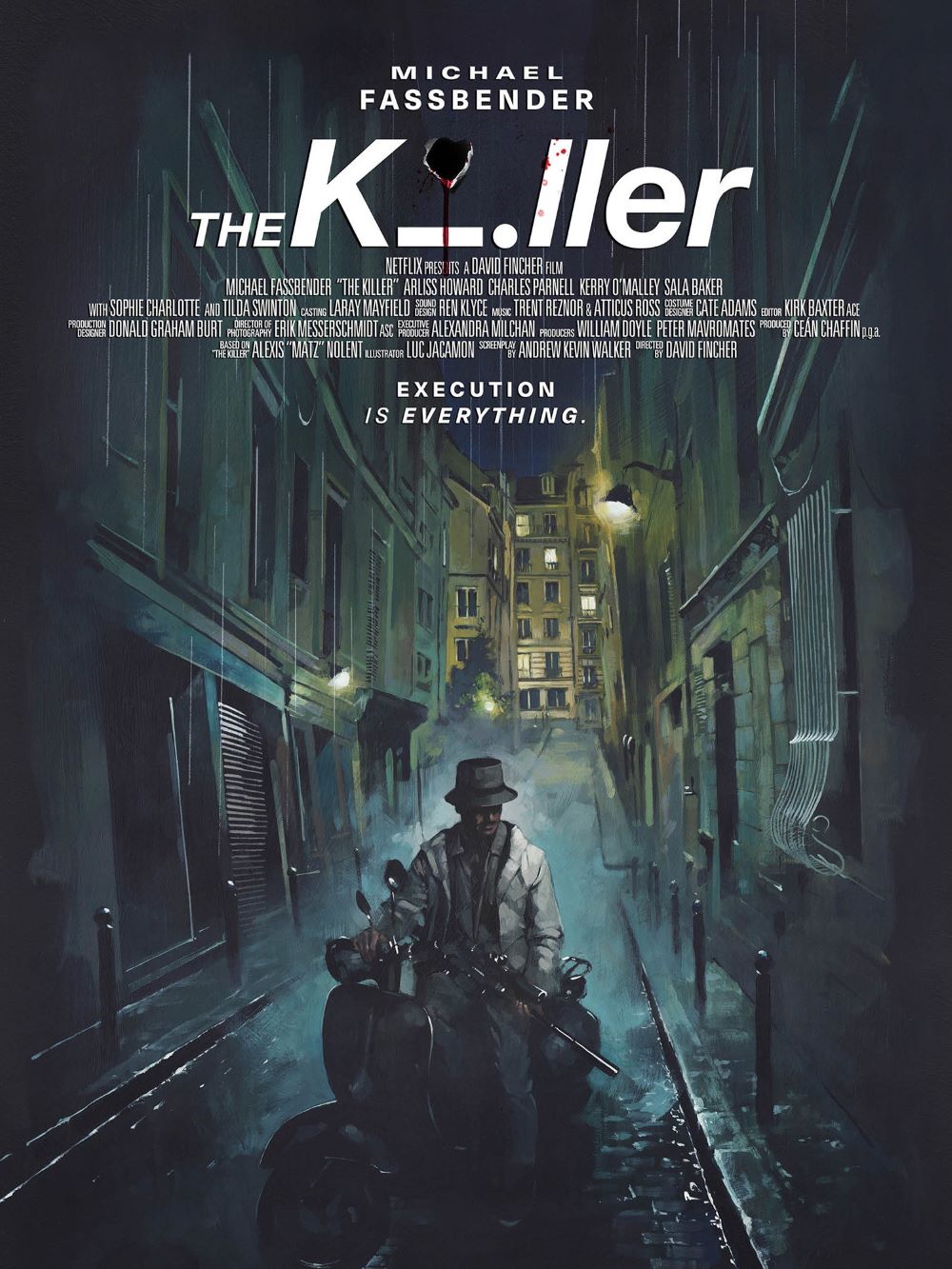
David Fincher’s The Killer lands like a perfectly aimed shot: clean, methodical, and laced with just enough twist to make you rethink the whole trajectory. At its core, the film follows an elite assassin—brilliantly played by Michael Fassbender—who suffers a rare professional failure during a high-stakes hit in Paris. After days of obsessive preparation in a WeWork cubicle, complete with hourly surveillance checks, yoga breaks, protein bar sustenance, and a nonstop loop of The Smiths, he pulls the trigger only to miss his target entirely.

This one slip shatters his world of ironclad redundancies and contingencies. Retaliation soon hits close to home, striking his secluded Dominican Republic hideout and drawing in his girlfriend. What begins as a routine job quickly escalates into a personal cleanup mission, spanning cities like New Orleans, Florida, New York, and Chicago. Fincher transforms these stops into taut, self-contained vignettes, layering precise bursts of violence over the protagonist’s gradual psychological fraying—all while keeping major reveals under wraps to maintain the film’s coiled tension.

The structure dovetails perfectly with Fassbender’s commanding performance. He embodies a man radiating icy zen on the surface, while a relentless machine churns underneath. His deadpan voiceover delivers self-imposed rules like a deranged productivity gospel—”forbid empathy,” “stick to your plan,” “anticipate, don’t improvise”—even as he slips seamlessly into civilian guises: faux-German tourist, unassuming janitor, casually ordering tactical gear from Amazon like it’s toothpaste.

The result is darkly hilarious, conjuring a corporate bro reborn as high-functioning sociopath, where bland covers clash absurdly with lethal intent. Yet as stakes mount, subtle cracks appear: split-second hesitations, flickers of unexpected mercy that betray buried humanity. Fassbender nails this evolution through sheer minimalism—piercing stares, economical gestures, weaponized silence—morphing the killer from untouchable elite into a flawed, expendable player in the gig economy’s brutal grind.

These nuances echo the film’s episodic blueprint, quintessential Fincher territory. On-screen city titles act as chapters in a shadowy assassin’s handbook, with tension simmering through drawn-out prep rituals: endless surveillance, gear assembly, contingency mapping that drags just enough to immerse you in the job’s soul-numbing tedium. The Paris mishap ignites the chase—he evades immediate pursuit, sheds evidence, and races home to fallout, then pursues leads through handlers, drivers, and rivals in a chain of escalating confrontations.

Fincher deploys action sparingly but with devastating impact. A standout brawl erupts in raw, prolonged chaos—captured in extended, crystal-clear shots with improvised weapons and no shaky-cam crutches—perfectly embodying the killer’s ethos even as it splinters around him. Each sequence builds without excess, from tense interrogations to standoffs that flip power dynamics, underscoring how the world’s rules bend unevenly.

This kinetic progression meshes flawlessly with Fincher’s visual command. Cinematographer Erik Messerschmidt crafts a hypnotic palette of cool desaturated blues, sterile symmetries, and digital hyper-reality, evoking unblinking surveillance feeds into an emotional void. Tactile details obsess: the rifle case’s satisfying zip, suppressed gunfire’s sharp snick, shadows creeping across WeWork pods, dingy motels, and gleaming penthouses—all mirroring the killer’s frantic grasp for order amid encroaching disarray.

Sound design heightens every layer, sharpening ambient clacks of keyboards, hallway breaths, and gravel footsteps to a razor’s edge. Integral to the immersion is the minimalist electronic score by Trent Reznor and Atticus Ross, Fincher’s trusted collaborators from The Social Network to Mank. Their eerie ambient drones and ominous rhythmic pulses bubble like a suppressed heartbeat—swelling subtly in stakeouts, throbbing through violence, threading haunting motifs into voiceovers. It mirrors the protagonist’s inner turmoil without overwhelming the chill precision, turning silences between notes into weapons as potent as any sniper round.

This sonic and visual restraint powers the film’s bone-dry irony, which methodically punctures the protagonist’s god-complex. He preaches elite status among the “few” lording over the “many sheep,” yet reality paints him as sleep-deprived, rule-bending, and perpetually improvising—empathy leaking through denials in quiet, humanizing beats. Fincher weaves these into his signature obsessions—unmasked control freaks, dissected toxic masculinity, exposed capitalist churn—but with playful lightness, sidestepping the heavier preachiness of Fight Club or Seven.

The killer’s neurotic Smiths fixation injects quirky isolation amid globetrotting nomadism; their melancholic lyrics (“How Soon Is Now?”) punctuate stakeouts and flights like wry commentary on his fraying detachment. It all resolves in a low-key homecoming: no grand redemption or downfall, just weary acknowledgment that even “perfect” plans crack under chaos’s weight.

This sleight-of-hand elevates The Killer beyond standard assassin tropes into a sharp study of elite evil’s banality. Supporting roles deliver pitch-perfect economy: Tilda Swinton’s poised, lethal rival in mind-game restaurant tension; Arliss Howard’s obliviously entitled elite; Charles Parnell’s wearily betrayed handler; Kerry O’Malley’s poignant bargainer; Sala Baker’s raw, physical menace. Under two hours, Fincher packs density without bloat—layered subtext, rewatchable craft everywhere.

Gripes about its procedural chill or emotional distance miss the sleight entirely: this is a revenge thriller masking profound dissection of a borderless mercenary world, where pros prove as disposable as their untouchable clients. Fans of methodical slow-burns like ZodiacThe Game, or Gone Girl will devour the razor wit, process immersion, and unflinching thematic bite.

Ultimately, The Killer crystallizes as a sly late-period Fincher gem, fusing pitch-black humor, visceral horror, and surprising humanism into precision-engineered sleekness. It dismantles mastery illusions in unforgiving reality, leaving Fassbender’s killer stubbornly human: loose ends mostly tied, slipping back to obscurity as a survivor adapting. In a flood of bombastic action sludge, it offers bracing cerebral air—proving restraint, dark laughs, and surgical insight remain the filmmaker’s deadliest tools. For obsessive breakdowns of the human machine at its breaking point, it’s Netflix essential.

Do Comics Publishers Need Readers Anymore? Part Two


If you look at the copyright indicia notices typically printed on the inside front covers of most nominally “independent” comics, you’ll find that the trademarks for the book in question — as well those for all its characters, their distinct likenesses, and what have you — are jointly held by the principal members of that comic’s so-called “creative team.” Generally that means the writer and the artist, unless the comic was made by a real CARTOONIST who does everything themselves, but I’ve seen select instances where the colorist and even the letterer are in on a piece of the action, as well. This is the good side of creator ownership, with everything working as it should. But there is, increasingly, a darker side that is seeing a lot of people getting screwed out of their fair share —

For instance, when you look at the copyright indicia in most comics published by Aftershock, Avatar, and Boom! Studios, what you’ll see about eight times out of ten is that the trademarks to the characters and concepts are jointly held by the WRITER and the PUBLISHER, with the artist left out in the cold despite spending more time working on the book than anybody else. That’s because Aftershock, Avatar, and Boom! — and even, increasingly, Dark Horse — take their so-called “pitches” directly from writers, and then hire out a jobbing penciller, inker, or penciller/inker to draw the series that they “green light” on a work-made-for-hire basis. In other words, these poor schmucks are getting the same raw deal they would be getting at Marvel or DC — only probably even worse, because the page rates at these second-and third-tier publishing houses are for shit.

Of course, economically speaking, these publishers have a built-in excuse as to why they don’t pay their talent a decent wage : none of their comics sell.  Curiously, though, that doesn’t seem to stop them from making more of them. Consider : Aftershock can’t be said to have published a legitimate “hit” series at any point in its near-ten-year history, and a quick glance at the monthly sales figures shows most of their product charting in the 5,000-6,000 copies sold range — if it even charts in the first place. Many of their titles don’t make the minimum threshold to be ranked at all. Ditto for Avatar, which hasn’t had a real hit outside Crossed and its Alan Moore-scripted series like Neonomicon and Providence. Or how about Boom!, which has somehow survived for well over a decade despite NEVER having a real sales success (not endorsed by Keanu Reeves, that is) until Something Is Killing The Children and its spin-off series, House Of Slaughter, turned up in the last year or two?

Speaking of, the copyrights on those two books are even MORE confusing : writer James Tynion IV and artist Werther Dell’Edera are BOTH credited as the series’ CREATORS, but the books are OWNED by Tynion and Boom!, with Dell’Edera stuck on the outside looking in of his own co-creation. Over at Aftershock, though, things are getting even more ridiculous : their recent series Nuclear Family, written by Stephanie Phillips and drawn by Tony Shasteen, isn’t the property of EITHER creator — it’s the property of the publisher and a Hollywood guy named Eric Bromberg, who “pitched” the project to Aftershock but apparently didn’t feel like actually WORKING on it himself. I was able to confirm that “business model” also applies to Aftershock comics Pestilence and Red Atlantis, and if I had a couple more hours to devote to legwork on this column, I’m sure that I could find more.

But we’re not finished with the absurdity yet, friends. Newer publishers TKO Studios and AWA/Upshot both showed up talking a big game about how “creator-friendly” they were, but ALL of their books are corporate-owned, and the two guys running the show at AWA, Bill Jemas and Axel Alonso. are former Marvel suits. If they wanted to keep sticking it to the talent like this, you have to wonder why they didn’t just stay at their old gigs — oh, that’s right, they were fired.

Both TKO and AWA are still patiently waiting for their fist popular series to come along, as well, but their overall publishing outputs are remaining fairly consistent — hell, AWA seems to be cranking out more and more titles every month. Yet NONE of them sell. How is it, then, that supposedly “indie” publishers find themselves getting more and more stingy in terms of offering REAL creator ownership, even as their books gather dust on the shelves?  I mean, why would a publisher even CARE about screwing over one or more of the creators of a series almost no one reads? Why would they accept proposals from Hollywood screenwriters for projects those guys don’t want to put any effort into themselves and that are more or less guaranteed to find their way into dollar bins within a few months?

The answer, of course, is pretty simple : these publishers aren’t looking to have a wide range of successful titles, they’re looking to stumble into a Willy Wonka-esque golden ticket. If just ONE of their comics gets optioned for development by a TV or movie studio, they figure that will make up for all the losses on all this other crap. And if one of those options makes it out of development hell and onto the big or small screen? They’re REALLY swimming in gravy then. These companies aren’t even “comic book publishers” per se — they’re in the business of publishing movie and TV treatments that have the added “plus” of being storyboarded entirely in advance.  I assure you I’m not at all exaggerating when I say that sooner rather than later at least one of these mid-level “independents” is going to drop all the pretense, forego distributing their product to comic shops, and just ship it to studio execs and producers off a mailing list.

To return to our original question, then, these comics publishers absolutely DON’T need readers — note the plural. What they need is just ONE random reader, with deep pockets and Tinseltown connections, to look at one of their comics and figure it has the makings of a hit in other media. That’s enough to keep the lights on in the short term. Ultimately, though, what they would REALLY like is the kind of deal Boom! recently got where 20th Century Fox bought a sizable stake in the company and moved their offices right onto the studio lot. Or the deal Dark Horse got, where they sold the company lock, stock, and barrel to a multinational video game giant.  The AWAs, Aftershocks, TKOs, and even the Avatars of the world keep plugging away, losses be damned, in hopes of that one MONSTER payday down the line.

******************************************************

Like everything else I’m running this week, this essay originally appeared on my Patreon site, where you get three similar helpings to thoughts straight from yours truly’s id every week. You can subscribe for as little as a dollar a month, and while I’m admittedly biased, I daresay that’s one of the better values going in the entire Patreon racket these days. So come on over, we’re friendly, I promise.

Oh, and I suppose a link would help. Here you go : https://www.patreon.com/fourcolorapocalypse

See How An “Evil Empire” Is Built


Evil_Empire_001_coverA

You won’t find a much more loaded term in the entire lexicon of political rhetoric than “evil empire.” The phrase was made (in)famous when Reagan used it to describe the Soviet Union back when he had a hard-on for the apocalypse, and while some folks thought he was just being melodramatic, the “joke” he made a couple years later when he thought his mic was off about how he’d “just signed legislation outlawing Russia forever — we begin bombing in five minutes,” went some way towards throwing into stark relief why hard-line anti-communists were every bit as much a threat, if not moreso, than the dreaded “pinkos” themselves.

Fast forward a few years from that and America is thumping its collective chest and patting itself undeservedly on the back for having supposedly “won” the Cold War — uhhhhhmm, sorry, but last I checked the Soviet empire collapsed from within under its own weight — and we find out that our purported “enemy” was a starving nation that couldn’t even put bread on its own collective table, much less invade the US and destroy our much-vaunted “way of life.” In short, folks, we got hustled — the US government spent hundreds of billions on weapons (particularly nuclear weapons) we didn’t need in order to “fight” a “foe” that couldn’t even keep its own house in order. much less come and forcibly annex our own.

The lesson to be learned here? All wars — even “cold” ones — are a racket, in the immortal words of Smedley Butler, and the only “winners” are the defense contractors who profit from them.

JAN140984-02

Still, Cold War anxiety gave rise to some remarkably salient takes on the whole “dystopian future” scenario, the most famous of them in the comics world being Alan Moore and David Lloyd’s seminal V For Vendetta, which eventually became a big-budget Hollywood blockbuster once it had been stripped of all its smartest elements (and anarchist politics),  and  the Guy Fawkes “V” mask has ended up being appropriated not only by groups that probably do, if you’ll pardon the term,”deserve” to wear it given that they understand the story’s socio-political implications — such as the Anonymous hacker collective and various factions of the loosely-defined “Occupy” movement — but also, sadly and ironically, by far-right extremist supporters of arch-conservative/homophobe/racist American politician Ron Paul, and his even less principled, and decidedly more eel-like, son, Rand, who’s not even much of a Libertarian given his opposition to same-sex marriage and civil unions, his oft-stated desire to outlaw all abortion, even in cases of rape and incest, and his flat-out insane idea to “modify” the 1964 Civil Rights Act so that businesses can go back to discriminating against black customers if they want.

This guy’s a “champion of freedom”? Don’t make me laugh. Still, given his propensity for taking credit for work done by others, it’ll probably only be a few years before the junior senator from Kentucky claims authorship of V For Vendetta himself.

All of which brings us, in an admittedly roundabout way, to the fact that it’s about time for a “dystopian future” comic for a new generation now that the last really good one has been hijacked, at least at the margins, by the very right-wing authoritarian forces it was (bravely, for its time, I might add) braying against. And while I don’t know if writer Max Bemis and artist Ransom Getty’s Evil Empire, the first issue of which has just seen the light of day via Boom! Studios, will prove to be that book, it’s certainly off to an intriguing, if wildly uneven, start.

Evil_Empire_001_PRESS-6

I freely admit to not being at all familiar with either of this title’s principal creators — the only name associated with the series so far that I recognize  being FBP (a book you absolutely need to be reading) artist Robbi Rodriguez, who provides one of the variant covers to this debut installment (the main one, reproduced at the top of this review, being the handiwork of Jay Shaw) — but that’s actually a good thing in my book, since there’s a shitload of up-and-coming talent in comics that deserves much wider exposure than it’s gotten so far. Hell, truth be told I’m not all that schooled on Boom! as a publisher, apart from the fact that they have the RoboCop comics license and  they put out Mike Carey and Elena Casagrande’s Suicide Risk, which is easily one of the three or four best series being published by anyone right now. A quick glance at Evil Empire‘s copyright indicia shows that it’s a company-owned, rather than creator-owned, work, and that’s not cool in my book, but oh well. Marvel and DC certainly have been been getting away with the work-for-hire hustle for decades now — it’s just depressing to see smaller publishing houses following suit, I guess.

In any case, this is at the very least a creator-driven project —it would just be nice it if were a creator-owned one, as well.

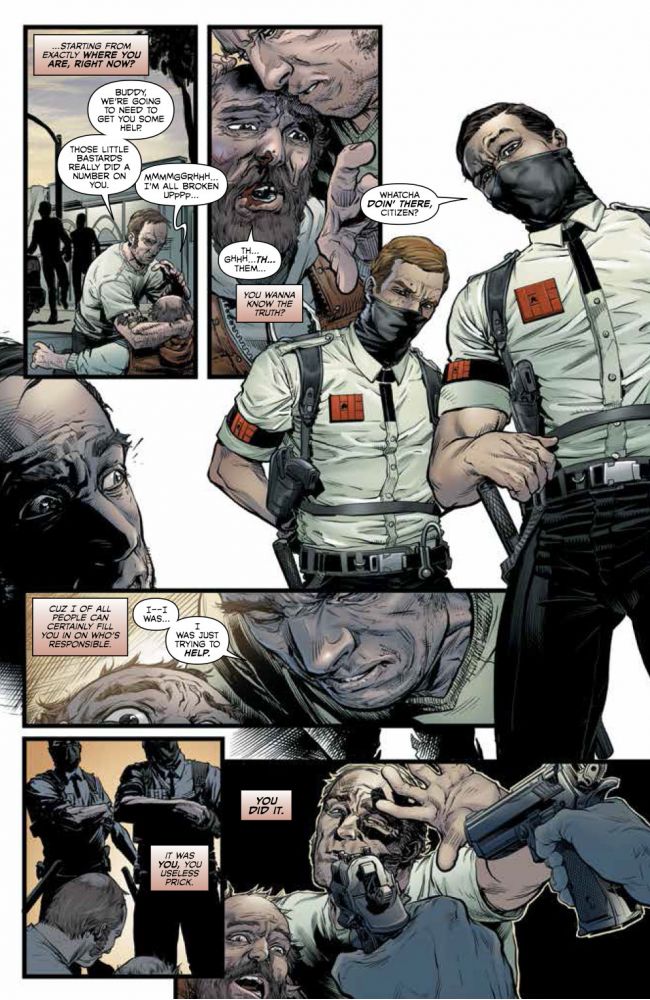
Anyway, to the story — the action starts off 25 years in the future, where things have gone to hell in the proverbial bucket. “Security” cameras monitor every citizen’s every move, armed George Zimmerman-types are given badges and prowl the streets looking for (oh, who are we kidding, creating) trouble, some unnamed corrupt dictatorial overlord runs the whole show, and various technological “bread and circuses” serve to disrupt the cowed and tired populace from the troublesome nature of reality itself.

All in all, then, not too big a reach.

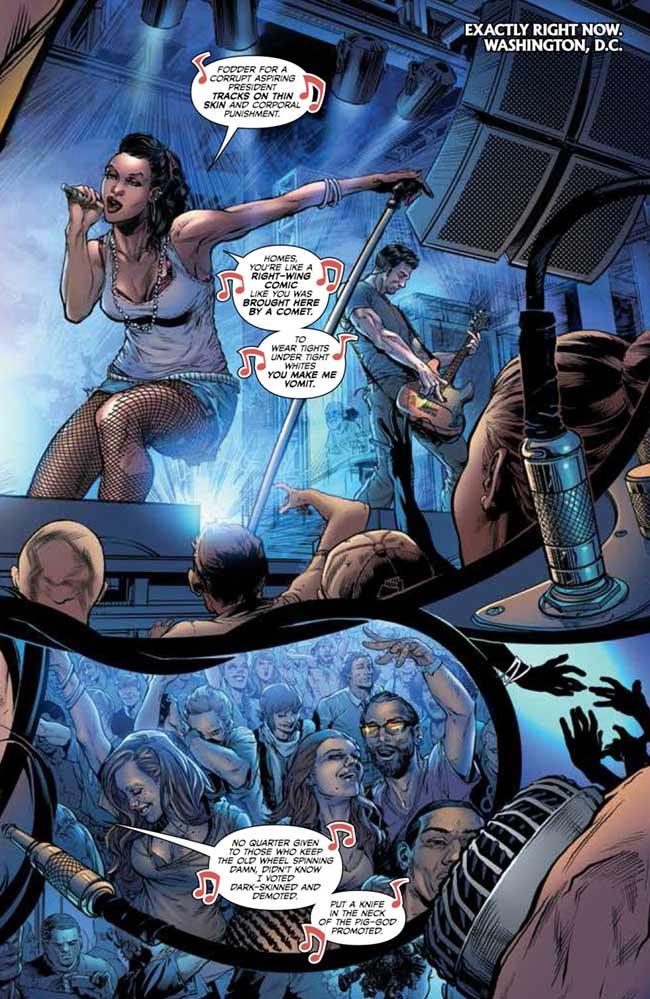
A few pages in, though, is when things start to get interesting, as Bemis and Getty begin the task of charting how we get from here to there. First up we meet politically-aware hip-hop artist Reese Greenwood, and while Bemis saddles her with some truly mind-bogglingly stupid lyrics, to his credit he also manages to establish her as a thoughtful, deeply aware character in fairly short order. She’s got no time for “the system,” as you’d expect, but she ‘s hardly the type of cardboard caricature so many “urban” African-American women in comics are these days. She seems like the sort of person you’d actually enjoy sitting down and having a conversation with, rather than a confrontational, “Invader From Mars” type.

Democratic presidential nominee Sam Duggins certainly seems to have taken a shine to her, as well. He pulls a few strings to meet her backstage after one of her shows, crashes an interview she does with MTV, surreptitiously passes his phone number to her — anything to get the young lady’s attention. Sam seems a decent-enough sort — more progressive than anybody the party would have the guts to nominate for national office in real life, to be sure (not to mention the fact that a single guy without kids wouldn’t stand a chance in a presidential election), but Reese isn’t buying his line entirely. She certainly seems to hope  he’s the real deal (hey, a lot of us hoped for the same from Obama once upon a time, before his “Bush-lite” tendencies fully came to the surface), but she’s  apparently seen one too many phony “leftists” turn out to be  nothing but “kinder, gentler” versions of the same old corporate stooges over the course of her life to fully get on board with either of the “Big Two” political parties, even the less overtly noxious one. I can certainly relate to that.

Evil_Empire_001_PRESS-7

Still, as  patently dishonest as Duggins may (or may not, who knows?) be, he’s a saint compared to pious, grandstanding, loathsome Republican nominee Kenneth Laramy, your typical “family values” right-wing blowhard. Unlike Reese and Sam, Laramy is, in fact, presented as nothing but a two-dimensional collection of tired stereotypes, which is kind of a shame, but with only 22 pages of story and art to work with something’s gotta give, and hey, it’s only the first issue — and there’s plenty of reason to suspect that there’s a  lot more going on with him than meets the eye.

Case in point — midway through through out opening installment, Laramy’s daughter finds her mother bleeding to death in their home with a knife in her back. This scene is handled incredibly clumsily, with hints at first being given that something’s happened to the daughter rather than the mother, and mom croaking (sorry) some incredibly wooden dialogue about something bad she did years ago as she expires (Getty also employs an admittedly unique, but frankly kinda stupid, artistic contrivance when he segues into this scenario via an attached panel-sized asterisk), but the point to take away here, plot-wise,  is that there is no assailant present, so the identity of Mrs. Laramy’s murderer remains a mystery.

At her wake, though, the shit really hits the fan. Duggins shows up with Reese as his date, and while you’d expect a media circus to ensue, that’s avoided when Laramy himself finally takes to the stage — or page, as the case may be — and leaves us with one of the better cliffhanger splash-pages that I can recall in quite some time. Sure, it’s not exactly realistic for a grieving widower to be interrupted in the middle of his eulogy by a reporter asking him a fucking question — even if said widower is running for president (actually, he announces that he’s withdrawing from the race during the speech, but that’s neither here nor there) — but while the set-up may be awkward, to put it kindly (as are little touches of dialogue throughout the book, like Reese referring to Laramy’s running mate as his “runner-up” and Duggins saying that Laramy is opposing him on the “ticket” rather than the ballot, “tickets” being, colloquially speaking, something that a presidential and vice-presidential candidate are, ya know, sharing  — but again, whatever) the payoff is big. Or might be. In any case, our “bad guy” candidate ends the first issue by dropping one heck of a bomb, and Bemis succeeds in leaving his readers damn hungry for answers.

Yeah, alright. Evil Empire has a long way to go before it can even be mentioned in the same breath as V For Vendetta. And Bemis’ story is more concerned with how a fascist government comes to be rather than how it’s toppled. But his set-up shows a lot of promise, and with a little bit of dialogue tightening and some deft editorial tinkering along the edges, this could really turn out to be a fun and thought-provoking ride. Sure, the story definitely has a left-leaning point of view, but at least it’s realistic in its portrayal of Democrats as “less-bad” guys rather than actual good guys, and its forward-thinking presentation of urban youth culture in general, and hip-hop culture specifically, is to be commended. Too often in comics these days people of color under the age of 30 are still portrayed as villains, and that’s certainly not the case here.

On the art side, Getty does a nice job making his characters look reasonably believable physically, and he’s pretty skilled at using facial expressions and other non-verbal cues to communicate thought and feeling. There’s no typical super-hero action — and very little action in general — for him to sink his teeth into and really show off his chops, but his panels mostly flow together pretty nicely and he keeps the reader engaged with his images throughout, which isn’t always easy in a “talky” book such as this one.

So, hey, what the heck — $3.99 is admittedly a lot to shell out for a 24-page package, especially when 2 of those 24 pages are taken up by “house ads” at the back of the book — but Evil Empire managed to hook me, warts and all, and given that its takes place in a self-contained world of its own making rather than a corporate “universe” with decades of backstory to catch up on, readers new to comics in general might find this a decent-enough introduction to the medium, particularly if they’re fans of  sci-fi, thriller, or other genre entertainment with a political twist. I can’t recommend it unreservedly, given that it still has much to prove, but I’m happy enough right now to keep shoveling four bucks a month over to Boom! to see where this ride Bemis and Getty are taking us on ends up going.