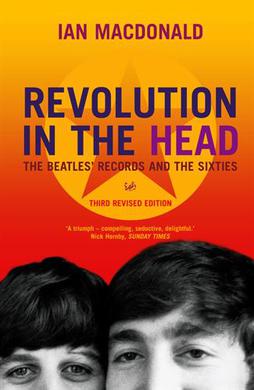
Book Review: Revolution In The Head by Ian MacDonald


Since today would have been the 84th birthday of John Lennon, I want to take a minute to recommend a book called Revolution In The Head.

First published in 1994 and subsequently revised two more times, Revolution In The Head is both a chronological history of the songs that the Beatles recorded and a cultural history of the 60s.  By examining the recording of each song, Ian MacDonald not only describes how each song reflects (or doesn’t reflect) what was happening in the group at the time but also how the Beatles’s changing sound reflected what was happening in the world at the time.  Author Ian MacDonald was clearly a Beatles fan but, more importantly, he was not an apologist and, in the book, he’s just as quick to criticize as he is to praise.  While he praises the majority of the band’s recordings, there’s more than a few that he totally dismisses.  It’s a well-researched and passionately argued book, one that makes interesting reading for both fans of the group and history nerds like myself.

As for the Beatles themselves, they come across as fully developed people.  MacDonald neither idealizes nor demonizes the group and instead focuses on the idea of them as working musicians who usually collaborated well together as a group but sometimes feared and resented that they were losing their individual identities.  Neither Lennon nor Paul McCartney are presented as being saints and MacDonald doesn’t shy away from showing how frayed their relationship had become by the time the group split up.  (They’re portrayed as developing a classic love/hate relationship with each other.)  But both are also presented as being talented artists who were capable of creating beautiful music that would survive the test of time.  For all the conflict and for all the times that Lennon complained about McCartney’s commercial sensibilities and for all the times that McCartney complained that Lennon was not committed to keeping the Beatles going, they were still capable of creating songs like Eleanor Rigby and A Day In The Life.

A lot of Beatles fans will probably disagree with MacDonald’s opinions.  He’s surprisingly dismissive of a lot of George Harrison’s songs, including the wonderful While My Guitar Gently Weeps.  But that’s okay!  There’s nothing wrong with having differing opinions.  It’s actually a good thing.
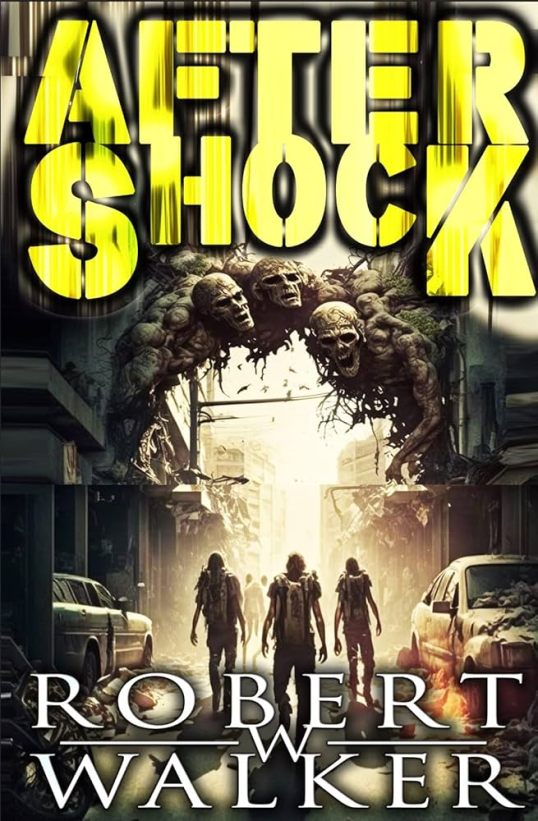
Horror Novel Review: Aftershock by Robert W. Walker


Dangerous work is being done at the Coppelmier Center For Disease Control.  In an underground lab that sits beneath a major American city, three scientists are working on creating the ultimate biological weapon.  That’s definitely not a good thing, especially when you consider that the city in question is Los Angeles and Los Angeles has a history of getting hit by earthquakes.  You would think that Dr. Leo G. Coppelmier would have understood that building his underground bio weapon lab in a place known to randomly and violently shake was a bad idea.  But Dr. Coppelmier is a wealthy genius and he wants to do things his way.

Of course, an earthquake does hit.  And, of course, a really dangerous plague is set free.  Soon, a horrifying creature with claws is killing people all over Los Angeles, removing their heads and their spinal columns and leaving the bodies in the sewers.  (Yuck!)  Could this be related to the earthquake and the mutated virus that was set free as a result?  Of course it does …. but good luck getting the powers-to-be to admit it!  The government would always rather cover up a problem than admit they played a role in creating it.

Reporter Bill Quinn is determined to discover and reveal the truth and he’s got two scientists and his best friend helping him out.  But will he be able to track down and stop the killer before the plague is spread even further?

Published in 1987, Aftershock is a quick and pulpy read, one that feels like a gory throwback to the B-movies of the 50s and 60s, the ones in which some scientist would make the mistake of trying to play God and end up getting transformed into a fly or a member of the Alligator People.  The subtext of those movies always seemed to be that it was dangerous to look for too many answers and that scientists should stop trying to change things just for the sake of changing them.  The subtext of Aftershock is not quite as reactionary, instead it just suggests that it’s dangerous to build a bioweapon lab on the San Andreas fault and I agree with that.  Aftershock is a violent and bloody tale that holds your attention and offers some genuinely frightening imagery.  Reading it today, it’s hard not think about the fact that COVID undoubtedly escaped from a lab as well.  After everything that we, as a society, have been through over the past four years, books about mad scientists and poorly-planned lab schemes hit a little bit differently nowadays.

Book Review: The Mall by Steve Kahn


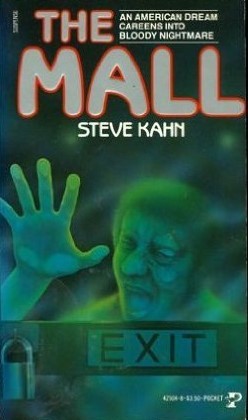
Just from the cover, you would think that The Mall, which was first published in 1983, was a horror novel about a bunch of shoppers getting trapped by a collection of angry spirits whose slumber was disturbed by the titular building being constructed on an ancient burial ground.

Or you might think that The Mall was a sci-fi story in the style of Jim Wynorski’s Chopping Mall, in which The Mall of the Future turned on shoppers and refused to let them escape while a bunch of robots struck a blow for machine rights everywhere.

That’s certainly what I thought when I came across this book and spent a few minutes starting at the cover at Half-Price Books a few months ago.  The cover seemed to show a man melting as he tried to open the doors of the mall!  I mean, seriously, who wouldn’t be intrigued by such a horrific image?  (If I did die at a mall, I would hope that I would at least die in an expensive store so people would be impressed when they heard.)  I bought the book because of the cover and the cover is why I waited until horrorthon to read it.

Unfortunately, it turns out that the cover is the best thing about the book.  It’s not really a horror novel, either.  Sure, it’s listed as being a part of the horror genre on every online listing that I’ve found for it but the book itself is more of a Die Hard rip-off.  (Yes, the book was published before Die Hard even went into production but that’s the power of Die Hard!  It was being ripped off before it even existed.)  The plot is that The Mall is a state-of-the-art playground for the upper and middle-classes.  It was built by Mel Goodman, an industrialist who built himself up from nothing.  On the same day that Mel is having his birthday party in the mall’s offices, his former employee, Jeffrey Prince, leads a group of criminals in an armed but surprisingly dull takeover of the mall.  Prince threatens to kill everyone unless his financial demands are met.  Unfortunately, no one can escape or enter the mall because the doors, I kid you not, have been superglued shut!

The frustrating thing about The Mall is that we are told that there are 40,000 people in the mall.  And yet none of them really try to do anything to thwart Prince’s plans.  Instead, they just wait patiently and some even continue to shop.  That might seem like a satirical commentary on American consumerism but this isn’t half as clever (or emotionally resonant) as Dawn of the Dead.   If anything, it’s the literary equivalent of one of those disaster films where a bunch of different people find themselves trapped in one location and they deal with their personal issues while waiting for the crisis to end.  I’m a little bit surprised this was never turned into a made-for-TV movie.

In the end, it’s not a very good book but the cover continues to haunt me.  Seriously, let that man out of the mall before he dissolves!

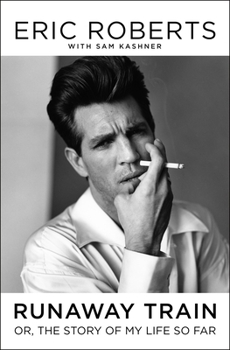
Book Review: Runaway Train Or, The Story Of My Life So Far by Eric Roberts with Sam Kasher


Hell yeah, Eric Roberts has written a book!

A friend of mine recently sent me Eric Roberts’s just published autobiography as a gift.  I was excited because, as any of our regular readers know, I am a huge fan of the insanely busy Eric Roberts.  That said, I wasn’t really expecting much from the book because most Hollywood autobiographies that I’ve read have had a tendency to be a bit dry.  Often times, the author (or their ghost writer, as the case may be) is either too concerned about not offending anyone or too bitter about the state of their career to really provide much honest insight into their life or their chosen profession.

Eric Roberts, however, is the exception to the rule.  Runaway Train is a fascinating read.  Roberts comes across as being very honest about his career, his demons, his family, and his compulsive need to always be working.  Roberts admits to being a workaholic but, as he explains it, it’s better to be addicted to acting than to be addicted to cocaine.  And I have to say that I think he has a point there.

Roberts writes about his dysfunctional childhood, his time as a star, and his more recent career as an actor who is willing to appear in just about everything.  He writes about his addictions and how they almost ruined his life.  He writes about his marriage to Eliza and fully takes responsibility for all the times that he’s screwed up.  (Roberts screwing up is a recurring theme throughout the book, almost to the extent that you just want to give the guy a hug and tell him to stop being so hard on himself.)  He writes about the time that he spent as a patient of Dr. Drew on Celebrity Rehab.  (In perhaps the book’s funniest moment, he realizes that he needs to be addicted to something if he’s going to go on Celebrity Rehab.  Eventually, he agrees to go on the show for help with his marijuana addiction, despite Roberts belief, which I agree with, that you can’t actually get addicted to marijuana.)  Roberts writes about some of his films, though he obviously can’t write about all 700 of them.  So, while there is no Top Gunner trivia, there are three pretty interesting chapters devoted to Star 80, The Pope of Greenwich Village, and Runaway Train.

Roberts does write about other celebrities, though he does so in a way that is neither petty nor obsequious.  He writes about his friendship with Robin Williams with an honesty that few other celebs would be willing to risk.  Danny Trejo, Eddie Bunker, Mickey Rourke, Christopher Walken, Sterling Hayden, Doug Kenney, Sharon Stone, Rod Steiger, and Sylvester Stallone all show up at one point or another.  And yes, Eric Roberts does write about his relationship with both his sister Julia and his daughter, Emma.  Eric is open about he and Julia having been occasionally estranged but he manages to do so in a way that protects everyone’s privacy.  One might never expect this from some of the roles that he’s played but Eric Roberts comes across as being a pretty classy, if somewhat eccentric, guy.

I loved this memoir.  I recommend it to all of you.

Horror Novel Review: The Spear by James Herbert


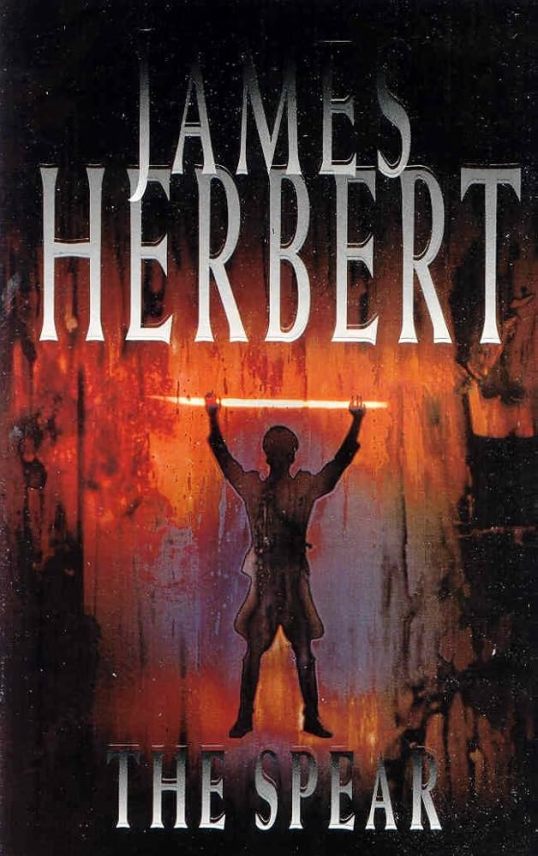
In the 1978 novel The Spear, Harry Steadman is an ex-Mossad agent who is now a private investigator.  Steadman is hired to investigate the disappearance of another Mossad agent and soon finds himself caught up in an international conspiracy of wealthy and high-rnking Neo-Nazis who are hoping to use the Spear of Longinus to resurrect the feared head of the SS Heinrich Himmler!

The Spear is a fast-moving mix of horror and action.  Imagine James Bond if Bond found himself battling ancient demons and you have an idea of what The Spear is like.  As often happened to James Bond, Harry Steadman is lucky to be dealing with a bunch of villains who just can’t stop themselves from stopping the action to lay out all of their plans.  That said, the book does a good job of creating an atmosphere of paranoia and unease as Steadman finds himself going up against an occult conspiracy that involves some of the most powerful people in the world.  Like all good paranoia thrillers, The Spear creates a world where literally no one can be trusted.  The action is frequently over-the-top and the horror is memorably gruesome.  A scene involving a crucifixion is particularly nightmarish.  Harry Steadman is a compelling hero, one who doesn’t love violence but who understands what’s at stake.  The Spear does not shy away from discussing the evil of the Nazis and, in today’s world where anti-Semitism is on the rise and where people are openly making excuses for Hitler and arguing that the Allies were somehow not the good guys in World War II, Herbert’s novel feels very relevant to the world today.

The Nazis search for ancient artifacts and Himmler’s belief that their power could be wielded for Germany also inspired Raiders of the Lost Ark and Indiana Jones and The Last Crusade.  A former chicken farmer and a committed Pagan, Himmler was reportedly a strong believer in the power of the occult and there is some speculation that, along with the Lost Ark of the Covenant, Noah’s boat, and the Holy Grail, the Spear of Longinus was one of the artifacts that Himmler instructed his agent to search for.  For all the time that they spent searching, the Nazis apparently never found any of the artifacts that they believed would deliver them to victory.  By the end of World War II, even Himmler was secretly negotiating with the Allies.  At the war’s end, Himmler committed suicide while in custody of the Allies.

Of course, the real Holy Lance was discovered in Antioch during the Crusades and currently sits in the Manoogian Museum in Vagharshapat, Armenia.


Horror Book Review: Bats Out Of Hell by Guy N. Smith


“You think those are bats?” someone said as we all stood out on the balcony of a hotel in the mountains of Switzerland.

I was 18 years old, a recent high school graduate who was spending my summer in Europe with my sisters.  We were in Switzerland and had just eaten dinner at our hotel.  I had stepped out onto hotel’s balcony, joining several other tourists who were looking up at the evening sky.  The sky was was full of shadowy, winged creatures that seemed to be circling the hotel.  As I stared up at the creatures and listened to the people around me wonder what they could be, I thought to myself that they very well could be bats.  That freaked me out a little.  Growing up in the Southwest, I had seen my share of bats.  I’ve seen bats get trapped in garages.  I’ve seen bats come flying out of tunnels.  I’ve never been attacked by a bat.  In fact, you have to be pretty obnoxious to attract the attention of a non-rabid bat.  But that doesn’t make the sight of them any less frightening or the thought of them sucking your blood any less alarming.

We all stood out on the balcony, staring up at the bats and wondering if we were about to be attacked.

“Those are definitely bats,” someone else said, “Is it safe to be out here?”

By this point, my sister Megan had come out onto the balcony in order to make sure that I hadn’t fallen off.

“What’s everyone looking at?” she asked.

“Those are bats!” an old woman exclaimed, pointing at the sky.

“Those are birds,” Megan replied.

The “bats” chirped in agreement.

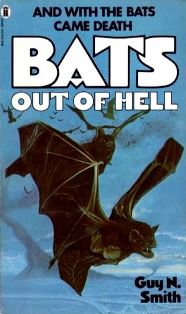
I found myself thinking about that Swiss evening as I read the 1978 horror paperback, Bats Out Of Hell.  This novel opens with Professor Brian Newman developing a new virus as part of an attempt to find a cure for Meningitis.  Unfortunately, he has tested his virus on a bunch of bats at the laboratory and now, they’ve all become increasingly aggressive.  Since the virus also appears to ultimately be fatal to the bats, Newman can’t help but feel guilty about what he’s putting the bats through.  Even though he’s told he just be happy that the bats are going to die eventually, he can’t stop thinking about their accusatory stare.  He knows that the bats blame him and well they should!

An argument with his girlfriend leads to Brian falling and accidentally setting free all of the infected bats.  The bats swarm across the British countryside, attacking everyone that they see and spreading the virus.  The government reacts by declaring martial law and trying to isolate the bats to one city.  Soon, rioters are taking to the streets and vigilantes are enforcing their own violent interpretation of the law.

That’ll teach humanity to try to cure Meningitis!

Bats Out Of Hell is a pulpy read, one that works because bats are scary and author Guy N. Smith keeps the action moving quickly.  The novel is at its best when envisioning a world where fear of disease has led to mass panic and a suspension of civil rights.  Hmmm …. why does that seem so familiar?  It’s amazing how science fiction can eventually become science fact.

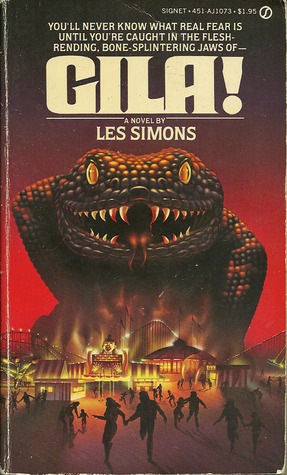
Horror Novel Review: Gila! by Kathryn Ptacek, writing as Les Simons


Watch out New Mexico!

Your long history of atomic testing is coming back to haunt you in the form of giant Gila Monsters!  Hiss, they say before they attack.  Hiss, they say as they look at the severed body parts that inevitably show up as a result of their rampages.  Hiss, they say as they make their way across the desert.  Hiss, hiss, hiss!

(Thanks a lot, Oppenheimer!)

Admirably, the 1981 novel Gila! is pretty straight-forward.  It’s about giant Gila monsters and it doesn’t pretend to be anything more than quick and rather pulpy read.  With the lizards cutting a path of destructing through New Mexico, Governor Bubba J. Roy wants something done and he wants it done now!

Heh heh — seriously, his name is Bubba J. Roy.  All of his dialogue is written phonetically, as if we might otherwise not guess that a character named Bubba J. Roy would have a fairly strong Southwestern accent.  That’s the type of novel this is.

It’s up to Dr. Kate Dwyer and her Native American lover, Chato Del KIinne, to figure out how to stop the mutated lizards.  It won’t be easy, both because the lizards are really big and, as always happens in this type of situation, there’s a bunch of ambitious bureaucrats who think they know better.  Before the humans can figure out a way to deal with the giant lizards, the monsters wipe out the patrons of a diner, the passengers on a school bus, and a huge amount of fairgoers, along with several soldiers and more than a few reporters.

(As I read the book, it occurred to me that perhaps the best solution would have been to build an electric fence around New Mexico and just let the Gila monsters have it.  Seriously, my family briefly lived in New Mexico and not one of us has ever had any great desire to go back.  I nearly stepped on a rattlesnake at one point.  Agck!  The state is dangerous enough even without all of the atomic monsters.)

Gila! is basically a throw-back to the classic giant monster movies of the 50s, though this book features a lot more sex than any of those films.  It’s relatively tame sex but still, there’s a surprisingly large amount for a relatively short novel about killer lizard.  Obviously, the writer knew what her readers were looking for and, to her credit, she gave it to them.

(It’s a bit of a shame that Gila! was apparently never turned into a movie.  Reading it, I kept thinking about how much this seemed like the type of story that just cried out to be the type of 70s movie that Leslie Nielsen made before he started doing comedies.  Ali MacGraw could have played Kate.  Burt Reynolds could have played Chato.  Bubba J. Roy?  Ned Beatty, of course!)

It’s a deeply silly book but entertaining and a quick read.  I picked up a beat-up paperback copy while visiting Snooper’s Book Barn in Fort Smith, Arkansas and I read the book the same day.

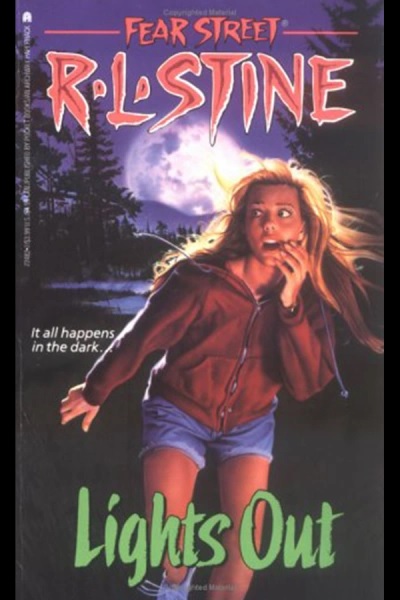
Horror Book Review: Lights Out by R.L. Stine


Never go camping!

Seriously, if there’s any lesson to be learned from the nearly 600 posts that showed up on the site through the month of October in 2023, do not go camping.  If you take nothing else away from Horrorthon, I hope you’ll take away a strong disdain for camping in general and summer camp in specific.  Seriously, the wilderness is full of monsters and summer camps seem to breed madmen.

Just consider R.L. Stine’s 1991 novel, Lights Out.

In Lights Out, Holly is spending the summer working as a counselor at her uncle’s summer camp and it absolutely sucks!  Not only does the summer camp have a long history of weird events and tragedy but no one seems to be happy about Holly being there.  Holly doesn’t like the outdoors and she doesn’t like bugs and she certainly doesn’t like snakes, even if they’re just made out of rubber.  The other counselors, rather than trying to help Holly out, spend the entire time bullying her and then threatening her to keep her quiet.  At one point, they even throw leeches at her!  Seriously, who does that!?  Who not only collects leeches but also throws them at someone!?

Why is everyone being so mean to Holly?  Well, a lot of it because the two resident mean girls think that Holly is going to steal the attention of the male counselors.  But Holly feels that there’s something even more sinister happening at the camp.  Someone appears to be vandalizing the camp and trying to force her uncle to shut the place down.  Eventually, one of the counselors dies when someone shoves her face against the pottery wheel.

Of course, the camp doesn’t shut down.  It takes more than just one murder to shut down a summer camp.  Things come to a head when, despite being terrified of the outside, Holly takes part in leading the camp’s nature hike.  Why is Holly even working as a camp counselor?  I know it’s because her mother demanded that she do something more than just hang out around the house during the summer but, seriously — there’s a lot to do in Shadyside!  There’s so much Holly could have done!

The main message of this book is that camping sucks and I could definitely agree with that.  If the girl on the book’s cover had red hair, she could have easily been me whenever I was up at my grandfather’s farm in Arkansas and I was trying to figure out if there was a snake in the nearby high grass or if all the hissing was just my imagination.  As for the plot, it was basically Friday the 13th with a much smaller body count.  (Christopher Pike would have killed off the whole camp.  R.L. Stine is a bit nicer.)  It’s a bit of a silly book but the message comes through loud and clear.

CAMPING SUCKS!

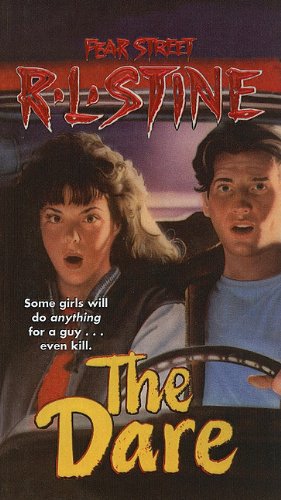
Horror Book Review: The Dare by R.L. Stine


If you were in high school and someone dared you to kill the school’s toughest teacher and then proceeded to tell the entire school that you were planning on killing the school’s toughest teacher, what would you do?

Me, I would probably pretend to be sick for a few days and stay home until everything blew over.  Or maybe I’d transfer to a different school or send an anonymous note to the police or maybe I’d even suggest to the teacher that he should take advantage of my state’s open carry laws.  What I’m saying is that I would do something other than consider the dare and agonize over whether or not I should actually kill the teacher.  I would like to think that killing the teacher would not even be an option for me.  You say to me, “Are you going to kill him?” and I reply, “No.”  What I don’t do is be like, “I don’t know, I guess.”

In 1994’s The Dare, Johanna has a slightly different response.  She knows that murder is wrong but the guy making the dare is Dennis Archer and Dennis is totally hot and rich and self-absorbed whereas Johanna is poor and kind of plain and a little bit insecure.  Dennis and his friends enjoy daring each other to do things.  All of their risk-taking actually does lead to one of Dennis’s friends accidentally getting shot.  That would be enough to convince me not to hang out with Dennis but Johanna is a bit more forgiving of accidental shootings.

Mr. Northwood is a total badass who teaches History, which was always my favorite class in high school.  Mr. Northwood doesn’t care whether or not Dennis and his family are planning on flying to the Bahamas for a week, he’s still not going to give Dennis a makeup midterm.  If Dennis misses the midterm, he’ll fail the course and he might not get to run track and eventually make his way to the Olympics.  But if Dennis stays for the midterm, he won’t get to go on a trip to the Bahamas that he could conceivably take any other time during the year.  As you can guess, it’s a difficult decision but Dennis ends up going to the Bahamas.  When Dennis discovers that Northwood was serious about not giving him a makeup midterm, Dennis starts flirting with Johanna and encouraging her to imagine all the different ways that they could kill Mr. Northwood….

YIKES!

As you can probably guess, the main problem here is that Johanna is kind of an idiot who can’t even find the strength to say, “No, I will not murder my neighbor and teacher, no matter how many times the hottest guy in school asks me too.”  Johanna actually does have other friends, none of whom have ever asked Johanna to kill anyone.  But Dennis is just so hot!

I guess it can be argued that this novel does capture the way that some students feel towards the tough teachers.  When I was in high school, I always assumed that any teacher who was tough on me was doing so because they had a crush on me or they were jealous of me and my naturally red hair.  I got mad at my teachers and I sometimes talked about how much I hoped they would quit or move away but I never made plans to kill them because I’m not psycho like that.

Anyway, The Dare is one of those R.L. Stine books where everyone was so consistently illogical, I assumed the entire thing was meant to be a dream.  Seriously, a hot guy is not worth going to jail over, Johanna!  This book suffered from a lack of likable characters and a lack of a believable plot.  Mr. Northwood was cool, though.  History teachers for the win!

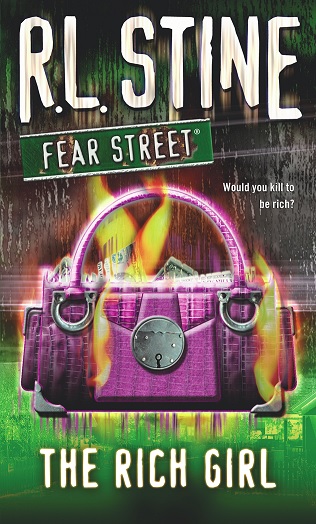
Horror Novel Review: The Rich Girl by R.L. Stine


The 1997 novel, The Rich Girl, tells the story of two teenage friends.

Emma is poor and worried about how her family is going to be able pay for her mother’s medical needs.  Sydney is rich and worried that Emma is going to stop being her friend just because she doesn’t like Sydney’s boyfriend, Jason.  As you can probably guess, one of these friends has much larger and far more serious concerns than the other but this book is called The Rich Girl and therefore, Sydney is our main character.  Sorry, Emma.  Only rich people get to star in Fear Street books.

Anyway, Sydney and Emma work at the local movie theater.  One night, they come across a duffel bag that someone has been left behind.  It’s full of money!  In fact, there’s more than enough money to help out Emma’s mother.  Sydney wants to turn the money in but Emma points out that her family needs the money and, even more importantly, Emma needs the money.  Emma wants to go to college and she wants to finally buy some pretty clothes and she wants her mother to be alive to see her do both.  Sydney and Emma decide not to turn in the money but to instead bury it out in Fear Woods.  They’ll leave it out there for two weeks and then, it’ll all belong to them!  Yay!

Sydney and Emma promise each other that they won’t tell anyone about the money but then Sydney tells Jason.  Jason demands a some of the money for himself, though if he could just shut up and be patient, Sydney would eventually have half of the money and everything about their toxic relationship suggests that she would give him however much he wanted.  Anyway, all of this all leads to violence and Jason’s apparent death.  Sydney and Emma hide Jason’s body but Emma can’t shake the feeling that someone is watching and following her.  Could Jason be back from the dead!?  Does Zombie Jason want revenge!?  Or could it be something else?

This book had a big twist at the end but it was pretty familiar twist and I saw it coming from miles away.  I appreciated the kind of dark ending but neither Sydney nor Emma were particularly compelling characters.  This one kind of felt like Stine an autopilot.