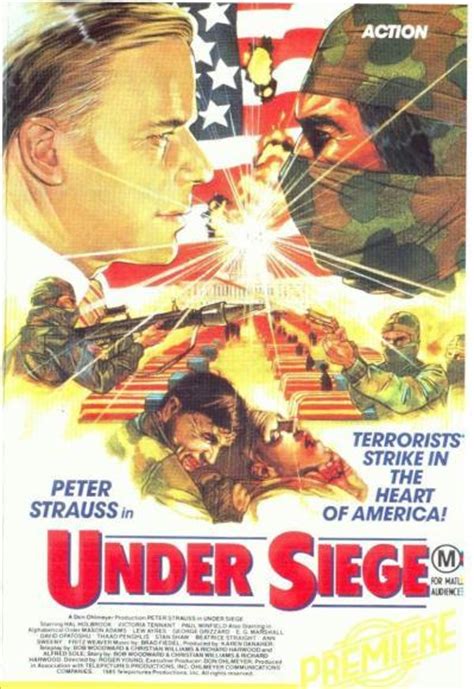
Let’s say that you are the governor of Arkansas and, once again, your state is running out of money and will soon not be able to afford to pay its bills. What do you do?
That was the problem facing Governor Bill Clinton in 1986. His solution was to allow a big Hollywood production to come down to Little Rock and film someone throwing explosive devices at the state capitol. The capitol building at Little Rock looks like a smaller version of the capitol building in Washington D.C. The producers of Under Siege needed to shoot a scene where terrorists attempt to blow up Congress. Even though the state capitol wasn’t actually blown up in the film, the dome did end up with extensive burn marks that were visible for years afterwards. Many people in Arkansas were not amused that they had to allow a film crew to set their capitol on fire just to pay the bills. Still, if Bill Clinton hadn’t agreed to blow up the state capitol building, Arkansas could have gone bankrupt and then he probably would have lost his reelection bid in 1986. If Bill Clinton wasn’t reelected, he never would have been elected to the presidency in 1992, Hillary Clinton would never have been elected to the Senate in 2000 and, in 2016, the Democrats wouldn’t have been stuck with the only possible nominee who could have actually lost to Donald Trump. When you look at it that way, Under Siege is one of the most significant films ever made.
As for the film, it’s a 3-hour, made-for-TV movie about what happens when Islamic extremism hits home. Notorious terrorist Abu Ladeen (Thaao Penghlis) has managed to sneak into the United States and is hiding out in Detroit. He directs a series of attacks on beloved American institutions. Not only is the Capitol Building bombed but a mall is also attacked. While President Maxwell Monroe (Hal Holbrook, who was born to play presidents) tries to keep America from falling apart, his hawkish advisers tell him that now is the time to launch a strike against Iran, despite Iran claiming to have nothing to do with the attacks. Only the director of the FBI, John Garry (Peter Strauss), and the Secretary of Defense, Andrew Simon (Paul Winfield), argue that the president should exercise caution. Garry is convinced that the attacks are the result of homegrown, domestic extremism and not an international conspiracy. Garry is a very hands-on FBI director. He’s the type of FBI director who will chase a terrorist down a street in Washington D.C. Let’s see James Comey do that shit.
Under Siege probably seemed outlandish in 1986 but it seems prophetic today. The film’s depiction of both terrorism and the government’s shady response to it turned out to be accurate. That doesn’t mean that it’s a very good movie. It was co-written by Bob Woodward of Watergate and Washington Post fame, so of course John Garry is righteous beyond belief and the solution to all of America’s problem begin with contacting a newspaper editor and blowing the whistle. America may be under siege but a strongly-worded editorial is here to save the day.
Under Siege used to regularly show up on late night television and the DVD was popular overseas. (In France, it was called Au Revoir, America.) Not surprisingly, after 9-11, it vanished from circulation. If you can find a copy, watch it and ask yourself, “Would I blow up my state capitol just to pay the bills?”
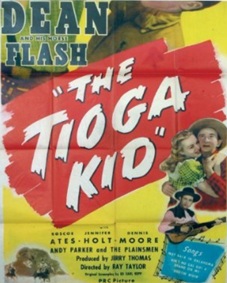 Singing Ranger Eddie Dean (played by the same-named Eddie Dean) and his sidekick, Soapy Jones (Roscoe Ates), are sent to track down the Tioga Kid, an outlaw who happens to look just like Eddie. Soapy suggests that The Tioga Kid could be a long lost twin brother. Eddie isn’t sure because his parents were killed in an Indian ambush when he was just a baby. This seemed to be the backstory for many of Poverty Row’s favorite western heroes.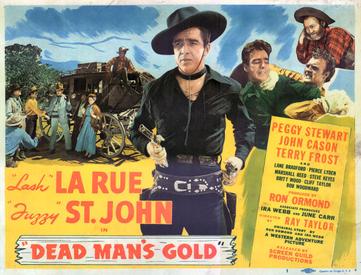
 Through the Shattered Lens