Film Review: Tobor The Great (dir by Lee Sholem)


Last week, along with my friends and fellow members of the Late Night Movie Gang, I watched the 1954 sci-fi film, Tobor The Great.

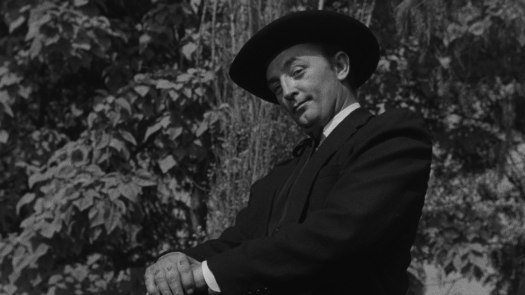
As you can probably tell by looking at the top of this review, Tobor came with a really great poster.  It’s a poster that promises all sorts of sci-fi thrills and chills.  It screams, “B-movie masterpiece!”  You look at that poster and you think to yourself, This film is probably extremely silly but I absolutely have to watch it!

Of course, if you know anything about the B-movie aesthetic of the 50s and 60s, you won’t be shocked to learn that the poster has next to nothing to do with the actual film.  True, there is a robot is featured in the film.  The poster is honest about that.  And Tobor actually looks just as good in the movie as he does on the poster.  And there is a subplot about space travel but, at no point, do we see Tobor walking across the surface of Neptune or Jupiter or wherever it is that Tobor is supposed to be in this poster.  Maybe he’s on one of the moons of Saturn.  Who knows?

Also, at no point, does Tobor carry around a woman.  In fact, Tobor is pretty much a film for kids.  The main character, other than Tobor, is an 11 year-old boy named Gadge (Billy Chapin).  I can only imagine how audiences reacted when they went into the film expecting to see the scene in the poster and instead, they were confronted with a movie about a little boy and his robot.

Tobor is one of those films that opens with several minutes of stock footage.  Rockets take off.  The stars shine in the sky.  Scientists and engineers do stuff.  It all looks pretty impressive but, of course, none of it was actually shot for this film.  In fact, the use of all that stock footage mostly serves to highlight how cheap the rest of the movie looks.

As for the film’s plot, it has apparently been determined that it’s too dangerous to send humans into space.  So, Professor Nordstrom (Taylor Holmes) and Dr. Harrison (Charles Drake) build a robot that is specifically designed to fly an interstellar craft.  They name their creation Tobor, because that’s robot spelled backwards.  (Tobor even points out that his name is robot spelled backwards.)  In order to help Tobor explore the universe, they design him to be able to simulate human emotions.  In fact, they’re so successful at it that Tobor ends up befriending Nordstrom’s grandson, the aforementioned Gadge.

The press and the military are all very impressed with Tobor.  Unfortunately, it’s the 1950s and that means that the communists are impressed by Tobor as well!  Can the scientists and their families keep Tobor from getting abducted by a bunch of Russian agents!?  Let’s hope so because there’s a lot of space that needs to be explored….

Anyway, Tobor The Great is silly but kind of fun.  It has its slow spots but it also has a really cool robot and it’s always fun to watch the commies get thwarted.  It’s a real time capsule film, one that not only reflects the decade in which it was made but which also has a somewhat charming innocence to it.  If nothing else, it’s nice to think that, in the days before CGI, the filmmakers actually had to make a Tobor of their own.  Apparently, Tobor is currently in a private collection and I hope whoever has him is treating him well.

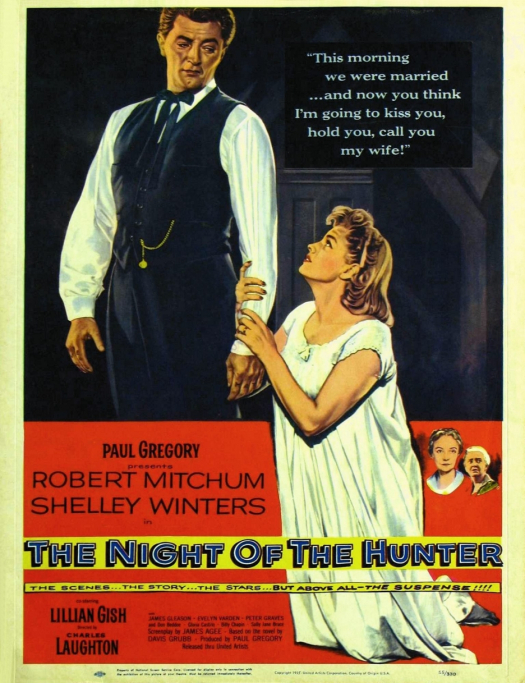
Happy 100th Birthday Robert Mitchum!: THE NIGHT OF THE HUNTER (United Artists 1955)


gary loggins's avatarcracked rear viewer

Regular readers know I’m a big fan of Big Bob Mitchum, having covered nine of his classic films. The self-effacing Mitchum always downplayed his talents in interviews, but his easy-going, naturalistic style and uncanny ear for dialect made him one of the screen’s most watchable stars. Whether a stoic film noir anti-hero, a rugged soldier fighting WWII, a romantic lead, or a malevolent villain, Mitchum always delivered the goods. Last night I watched THE NIGHT OF THE HUNTER for the first time, and his performance as the murderous ‘Reverend’ Harry Powell just zoomed to the top of my list of marvelous Mitchum performances.

Mitchum’s Powell is totally amoral and totally crazy, a sociopathic killer who talks to God about killing women, those “perfume smelling things, lacy things, things with curly hair” that The Lord hates, according to Harry. He’s sexually repressed to the point he must murder in the name of God to…

View original post 578 more words

Shattered Politics #10: A Man Called Peter (dir by Henry Koster)


A_Man_Called_Peter

Occasionally, I’ll see a film like Crime of Passion or Bigger Than Life and I’ll say, “Wow, that’s really subversive for a movie that came out in the 1950s!”

And it’s true.  We tend to think of the 1950s as being a time when conformity ruled all.  It was a time of innocence and chastity, when cinema heroes all wanted to have a house in the suburbs and loving couples slept in separate beds and nobody ever questioned anything.  Of course, the truth of the matter is that there were a lot of films released in the 50s that challenge that perception.

And then again, there were also films like 1955’s A Man Called Peter.

A Man Called Peter is a biopic about Peter Marshall (played by Richard Todd), a Scottish immigrant who came to the United States, became a Presbyterian minister, and then eventually became the Chaplain of the United States Senate.  (That means that he would open each session of the Senate with a prayer and occasionally provide spiritual counsel to the senators.)  I recently watched it on Netflix, specifically because I thought it might be appropriate for this series of political reviews.

And it is, but just barely.

It actually takes the film a while to get to the part where Peter Marshall becomes the Senate Chaplain.  First, we watch him as a boy in Scotland, trying to stow away on a boat heading for America.  Then, several years later, he’s out walking on a foggy night.  He trips over a tree root and, as he lies on the ground, he announces that God has told him to 1) pursue a career as a minister and 2) to do so in America.  (I have to admit that I was raised Catholic so I have no idea whether he was having a typical Presbyterian spiritual experience or not.  But the film certainly takes it seriously.)

Peter ends up in America where he ministers to a church in Atlanta, marries Catherine (Jean Peters), and then eventually ends up at a church in Washington, D.C.  When he eventually is asked to serve as Chaplain of the Senate, both he and the film go out of their way to avoid taking any definite position on any issue.  Instead, Peter gives prayers that encourage the senators to put partisan bickering aside and work together to make the United States the best country in the world.

Having now watched all 120 minutes of A Man Called Peter, I can safely that this is a film that epitomizes everything that we always assume to be true about the 1950s.  From the film’s view of marriage to religion to politics, A Man Called Peter is perhaps one of the most stereotypically 1950s  movies ever made.  This is such a 1950s movie that it’s even filmed in CinemaScope!

(And speaking of CinemaScope, A Man Called Peter looks great but it’s perhaps one of the least intimate biopics that I’ve ever seen.  You can see every inch of the surrounding landscape but the human beings get lost.)

For me, the film’s most 1955 moment comes when Catherine first discovers that her husband has been reassigned to Washington, D.C.  She and Peter are on their honeymoon when they get a telegram telling them that their new home in Washington is ready.  Catherine is shocked.  Peter says that he didn’t want to interrupt their honeymoon by telling her that they’re not going home to Atlanta.  Instead, they’re going to an entirely new city and an entirely new life.  (In other words, Peter has decided to say goodbye to Catherine’s family and friends.)

“Aren’t you pleased?” Peter asks her.

Cheerfully, Catherine replies, “Well, who wouldn’t be?”

Ah, the 50s.