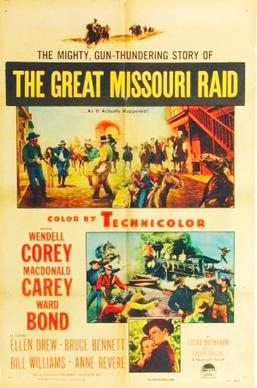
The Great Missouri Raid (1951, directed by Gordon Douglas)


During the Civil War, brothers Frank (Wendell Corey) and Jesse James (Macdonald Carey) leave the family farm and fight as Confederate guerillas under the leadership of the infamous William Quantrill.  When the war ends with the Confederacy’s defeat, Frank, Jesse, and their friend Cole Younger (Bruce Bennett) return home to Missouri and discover that their town is being ruled over the tyrannical Major Towbridge (Ward Bond).  With their farms in ruin and having little opportunity to make honest money, the James Brothers and the Younger Brothers soon resort to robbing banks and trains.  It’s their revenge against not only the soldier occupying their land but also the bankers and land barons who have been taking advantage of their friends and family members.  The James-Younger Gang become heroes to economically oppressed people everywhere.

From the minute that they arrive home, Towbridge is determined to imprison the James brothers.  Not only does he distrust them because of their past with Quantrill but he also blames them for the death of his own brother.  Towbridge becomes so obsessed that he even leaves the army so that he can pursue Frank and Jesse as a private detective.  Even as it appears that Jesse might be on the verge of settling down and abandoning his criminal life, he still has to deal with unexpected visitors like the Ford brothers.

The story of Frank and Jesse James inspired several films, some of which were better than others.  Directed with a good eye for detail by Gordon Douglas, The Great Missouri Raid tells the familiar story with enough skill to be watchable but it never reaches the classic status of Walter Hill’s The Long Riders. 

The main problem is that both Wendell Corey and Macdonald Carey come across as being almost too civilized as the James brothers.  The film is obviously sympathetic to the James brothers and, as westerns tended to do in the 50s, it ignores some of the less heroic details of their lives of outlaws.  (The film, for instance, doesn’t mention that the James brothers were probably already outlaws before the Civil War started and it’s doubtful that a modern film would be as sympathetic to two men who left home to fight for the Confederacy.)  Usually, though, even the most sympathetic film portrayals of the James brothers still portray them as being the type of people who you wouldn’t necessarily want to meet while riding the trail.  Wendell Corey and Macdonald Carey play Frank and Jesse as being so nice that it’s hard to believe that they could have even rode with Quantrill, let along the Younger brothers.  They’re the most reasonable outlaws this side of the Mississippi.  Bruce Bennett and Bill Williams are more believable as the rough and tough Cole and Jim Younger.

Not surprisingly, the film is stolen by Ward Bond.  Bond usually played reasonable authority figures for John Ford and Frank Capra.  As Major Towbridge, though, he’s cast as a martinet who allows his obsession with James brothers to turn him into a fanatic.  For those who are used to only seeing Bond cast as a fair cop or a tough-but-fair military officer, his performance in The Great Missouri Raid is a revelation.

The Long Riders is the best movie about the James Gang but, for western fans, The Great Missouri Raid should be entertaining if not definitive.
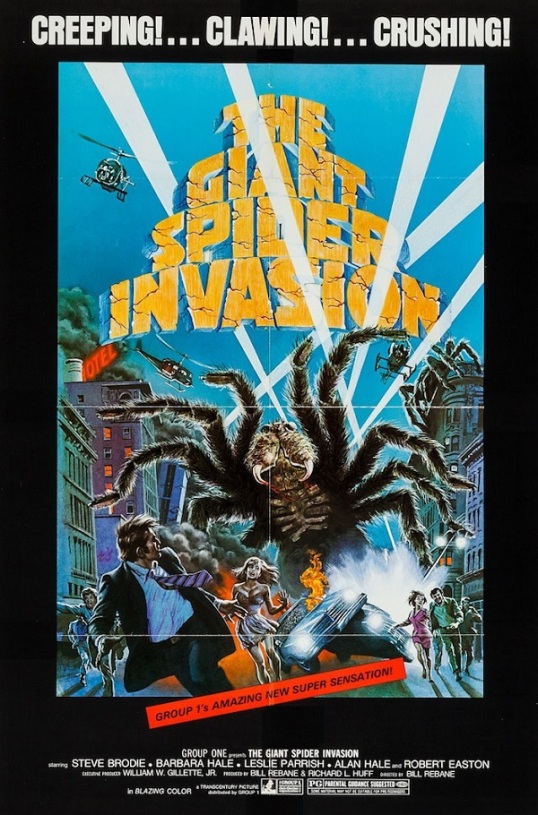
The TSL’s Horror Grindhouse: The Giant Spider Invasion (dir by Bill Rebane)


Welcome to rural Wisconsin, where everyone’s running around in their underwear and getting attacked by giant spiders!

That’s not meant to be a dig at the 1975 film, The Giant Spider Invasion, either.  I mean, let’s be honest.  If you’re going to be running around the trailer park in your underwear, the last thing that you want to do is walk straight into a giant spider web.  That happens a few times in The Giant Spider Invasion and I cringed every time because …. AGCK!  I mean, it’s a scary thought and The Giant Spider Invasion understands that.  Years ago, I was riding a horse and I rode head first into a spider web and oh my God!  I lost track of how many hours I spent washing my hair afterwards.  Of course, fortunately, I wasn’t in my underwear when I rode into that spider web.  So, it wasn’t as bad as it could have been.

Anyway, The Giant Spider Invasion opens with a meteorite crashing down to Earth.  As I previously mentioned, it lands in Wisconsin.  I can’t help but think that the alien spiders were a bit disappointed when they emerged out of their meteorite and discovered that they were in Wisconsin.  One would imagine that they were probably aiming for Washington D.C. and maybe they got off track.  Still, it works to the spiders’ advantage in that they’ve managed to land in a place so filthy and messy that no one is going to notice a few extra tarantulas crawling around.  Or, at least, they don’t notice until the tarantulas are gigantic and wandering through the fields.

(Go ask Alice …. when she’s ten feet tall…..)

We follow as various people deal with the giant spider invasion.  What we quickly discover is that, in 1975, America just wasn’t ready to make contact with alien spiders.  While Dr. Langer (Barbara Hale) and Dr. Vance (Steven Brodie) investigate the meteorite crash, the rest of the town is too busy with their own personal dramas to be of much help.  The Sheriff (Alan Hale, Jr.) is a buffoon who tries to coordinate a response from the safety of his office.  Dan (Robert Easton) and Ev (Leslie Parrish) obsess on whether or not the meteorites contain diamonds as well as spiders.  Dan has an affair with barmaid Helga (Christine Schmidtmer) while Ev’s younger sister, Terry (Dianne Lee Hart) dates Dave (Kevin Brodie), the son of the local newspaper editor.  Every 15 minutes or so, a crazed-looking preacher pops up and starts ranting about how the world’s going to end because of the sins of people like Dan, Eve, and Helga and, to be honest, the preacher seems to be the only person in town who understands just how much trouble they’re all in.

It’s all kind of silly but, because this is a Bill Rebane film, it all plays out with a certain unbridled enthusiasm that’s impossible to resist.  Rebane was never one to let a low-budget get in the way of his ambitions and the special effects in The Giant Spider Invasion may be cheap but they still have a charm all their own.  I mean, let’s face it.  Spiders are scary and any scene that features a giant one sneaking up on someone is going to be at least somewhat effective.  (I’ll even go on to say that a shot of a “giant” spider super-imposed over a field was actually rather effective and creepy.)  Add to that, The Giant Spider Invasion has only an 84-mintue running time so it doesn’t waste any time getting to the spiders.  This is a fun movie and a perfect one to watch in October.

The Stratton Story (1949, dir. by Sam Wood)


Monty Stratton was one of the greats.

He was a Texas farmboy who knew how to throw a baseball.  Recruited by the Chicago White Sox, he spent five years in the majors.  From 1934 through 1938, he compiled a 36–23 record with 196 strikeouts and a 3.71 ERA in 487.1 innings.  In 1937, he won 15 games with a 2.40 ERA and five shout-outs.  The next season, he won another 15 games and completed 17 of his 22 starts.  For those of you who might not speak baseball, that all means that he was a really good right-handed pitcher.

When Stratton wasn’t playing baseball, you could find him down on his farm in Greenville, Texas.  He lived there with his wife, Ethel.  On November 27th, 1938, Monty Stratton was hunting rabbits when he accidentally shot himself in his right leg.  While Stratton survived the shooting, his leg was amputated, bringing Stratton’s major league career to an end.

No longer able to play in the majors, Monty Stratton spent the next few years as a pitching coach and helping to start a semi-pro team in Greenville.  With the help and encouragement of his wife, he continued to practice his pitching and he eventually trained himself to the point where he could transfer his weight effectively onto his artificial leg so that he could effectively throw a baseball.  In 1947, Monty Stratton made a comeback, pitching in the minors and ending the season with an 18–8 record and a 4.17 earned run average.  Stratton spent the next six years pitching in the minors before retiring from the game.  He went on to start the Greenville Little League program.  If you go to Greenville, you can still find Monty Stratton Field near Greenville High School.

The Stratton Story was made in 1949, shortly after Stratton’s comeback and while he was still playing in the minors.  James Stewart plays Monty Stratton while June Allyson plays his wife.  The movie follows Stratton from his early days on the farm through his major league career, his accident, and his eventual comeback.  Though the real Monty Stratton served as a technical advisor to the film, I don’t know how historically accurate it was.  The movie, for instance, seemed to condense the timeline so that it seemed like Stratton went straight from losing his leg to practicing for his comeback when it actually took ten years for Stratton to eventually get signed to a minor league team.  Even if it does take some liberties from the facts, The Stratton Story is still a good movie.  The baseball scenes are great and Jimmy Stewart is convincing when he’s throwing the baseball.  He’s also convincing in the scenes where Stratton sinks into a dark depression after losing his leg.  Stewart was so good in the role that, when Stratton finally started to practice his pitching again, I wanted to jump up and cheer.

I liked The Stratton Story.  It probably helps that I love baseball but it’s also a good movie about an inspiring story.