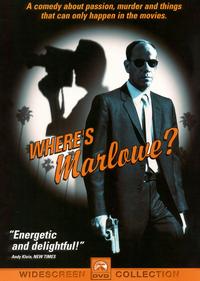
 Two documentarians (Mos Def and John Livingston) decided to make a film about two real-life private detectives, Joe Boone (Miguel Ferrer) and Kevin Murphy (John Slattery). At first, Boone is skeptical of the two filmmakers. He watched their last documentary, a three-hour epic about New York’s water supply, and was disappointed by the lack of sex. However, as the two filmmakers follow him around, he warms up to them and they discover that the tough and sarcastic Boone is actually a soft-hearted idealist who can barely pay the bills. When Boone discovers that Murphy is sleeping with the wife of one of their clients, their partnership dissolves. It looks like Boone is going to have to shut down his agency, unless the two filmmakers can help him solve his latest case.
Where’s Marlowe? starts out strong by focusing on Miguel Ferrer’s performance as Joe Boone. Ferrer did not get to play many leading roles but he was perfectly cast as Joe Boone. He is completely believable as an old-fashioned private investigator struggling to survive in the modern world. During the movie’s less interesting second half, the attention shifts to the filmmakers trying to help Boone. Mos Def and John Livingston are good in their roles but the film’s focus should have stayed on Ferrer. Unfortunately, the main mystery is never as interesting as Miguel Ferrer’s solid lead performance.
Where’s Marlowe? started out as a pilot and it is easy to see where it would have gone if it had become a television series. For all of its flaws, it is worth it just to see Miguel Ferrer in a rare leading role.
 Paul Harrington (John Lithgow) is a wealthy banking consultant who has just married a sexy, younger woman, Lauren (Madchen Amick). Paul thinks that Lauren is perfect but then her brother, Donald (Eric Roberts), shows up. What Paul does not know is that Donald is not actually Lauren’s brother. Instead, Donald is Reno, Lauren’s first husband who she never actually divorced. Reno has just escaped from prison where he was serving time for a crime for which he believes Lauren framed him. While Paul tries to save his father’s failing bank, Reno starts to plan a bank robbery and Lauren tries to balance her old life with Reno with her new life with Paul.
 Through the Shattered Lens