Celebrate Labor Day With These 14 Films!


I have no idea what this day is supposed to celebrate but I hope everyone has a good one.
There doesn’t seem to be any agreed upon way to celebrate Labor Day.  A few people have the day off and they’re the reason why I decided to hold off on going up to Lake Texoma until this upcoming, holiday-free weekend.  Personally, I think the best way to celebrate any holiday is with a film festival so here are my suggestions for your Labor Day viewing:
  1. Red Menace (1949) — In this wonderfully atmospheric film noir, a former GI named Bill Jones (Robert Rockwell) finds himself seduced by the Communist Party.  After he witnesses the head of the party murder a man who questions the wisdom of Marx, Jones and his lover go on the run.
  2. Big Jim McClain (1951) — John Wayne takes on the commies!  And you better believe that no one is more determined to keep America and its workers safe from communist influence than the Duke!  This film features some lovely Hawaiian scenery and enough over-the-top propaganda to make any American proud.
  3. I Was A Communist For The FBI (1951) — Based (I imagine very loosely) on a true story, I Was A Communist For The FBI is about an agent who spent nine years undercover as a communist.  As a result, he lost his friends and almost his family but he also serves his country.  Featuring a scene where a strike turns violent, there’s nothing subtle about this film but, as with Big Jim McClain, that’s a large part of what makes the movie so watchable.
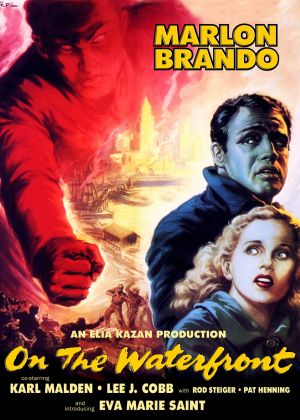
  4. On The Waterfront (1954) — Marlon Brando won his first Oscar for this film about union corruption.
  5. Dr. No (1962) — In his very first film outing, James Bond shows what a good job a true professional can do.
  6. The Godfather (1972) — “It’s strictly business.”
  7. Blue Collar (1978) — In this gritty film from Paul Schrader, three auto-workers (played by Yaphet Kotto, Harvey Keitel, and Richard Pryor) discover that their union is even more corrupt than management.  Consider this film to be an antidote to Norma Rae.
  8. F.I.S.T. (1978) — After the success of Rocky, Sylvester Stallone played a thinly-disguised version of Jimmy Hoffa in this epic historical film.  The film is poorly paced and doesn’t quite work but it’s interesting to see Stallone, post-Rocky, playing a character who isn’t necessarily all-that heroic.
  9. Convoy (1979) — The film celebrate the independent trucker, the hard-working driver who doesn’t want to be tied down by either the unions or the law.  Convoy is infamous for being an out-of-control production and yes, it is a bit self-indulgent.  But who cares?  When that convoy forms, you have to heartless not to cheer a little.
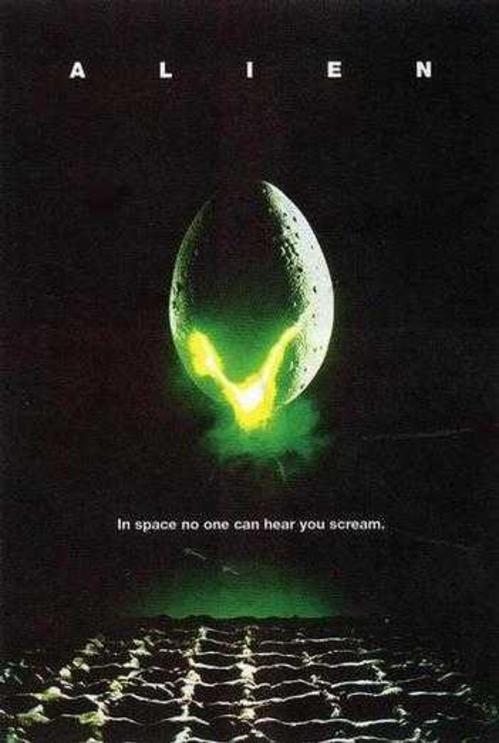
  10. Alien (1979) — One of the best films about how much it sucks to have to work for a living, Alien follows a group of blue-collar workers whose lives are deliberately put in danger by a big, faceless corporation.
  11. Last Exit to Brooklyn (1989) — A labor strike leaves a Brooklyn neighborhood reeling.  This film is not for the faint-hearted.
  12. Hoffa (1991) — Jack Nicholson stars as Jimmy Hoffa in this uneven but watchable film.  This movie is unabashedly pro-Hoffa and therefore, it provides an interesting contrast to films like F.I.S.T. and Blue Collar.
  13. Office Space (1999) — And don’t forget to sing along to the copier scene!
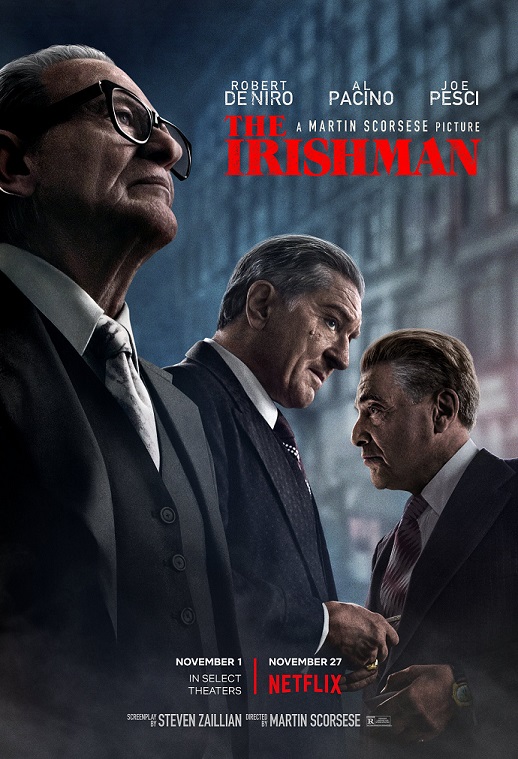
  14. The Irishman (2019) — Despite all the criticism that it received when it was first released, The Irishman is one of Martin Scorsese’s finest films.  It takes a while to get used to the de-aging but Al Pacino’s performance as Jimmy Hoffa was brilliant.  This film is one of the best looks at how the American labor movement lost its way.
A Quickie With Lisa Marie: Big Jim McLain (dir by Edward Ludwig)


During my sophomore year of college, I was acquainted with a bearded sociology major who would tell anyone that he met that he was a communist.  He also insisted that he was a revolutionary in the tradition of Che Guevara though, for the most part, he never seemed to do much more than hang out in the lobby of Bruce Hall and yell at the top of his lungs.   When he wasn’t attacking George W. Bush and Dick Cheney, he was busy quoting Karl Marx and telling people about how communism would fix all of America’s problems.  He would also get very upset if you called him a socialist.  “No,” he would say, “I’m a communist and I’m proud of it!”

I have to admit that I usually went out of my way to avoid him and I would cringe whenever I would hear him shouting my name and inviting me to come sit down next to him so he could attempt to give me my daily indoctrination while he stared at my breasts.  I could never summon up much enthusiasm for his ideology or his idolization of Hugo Chavez.  It all sounded rather dreary and boring to me.

I recently found myself thinking about those days in Bruce Hall lobby after I watched the 1952 anti-communist melodrama, Big Jim McLain.

Produced by and starring John Wayne, Big Jim McLain was made at the height of the red scare.  Produced in full cooperation with the infamous House Un-American Activities Committee, Big Jim McLain was meant to be an answer to all those weak-willed liberal types who claimed that the committee was going too far in its hunt for communist subversives.

Big Jim McLain starts out with a thunderstorm.  While stock footage of lightning illuminates the screen, a medley of patriotic songs play on the soundtrack and a somber-voiced narrator quotes The Devil Vs. Daniel Webster.  

Suddenly, the scene changes.  We’re in Washington D.C. and we’re watching a meeting of the House Un-American Activities Committee.  A shifty little man with a beard is being interrogated by the members of the committee.  They ask him if he’s ever been a communist.  He takes the fifth amendment.  He’s asked if he would ever take up arms against the United States.  Again, he pleads the fifth.

The camera pans back to reveal two remarkably tall men listening to the man’s testimony.  They both share the same look of disgust, a look that leaves no doubt how they feel about this sleazy little subversive and his constitutional rights.  They are Big Jim McLain (John Wayne) and his partner, Mal Baxter (James Arness) and they fight communists.

Suddenly, we hear the familiar sound of John Wayne’s determined drawl on the soundtrack and we realize that Big Jim McLain was using multiple voice-overs long before Terrence Malick even made his first film.

Wayne, speaking in character as Big Jim, explains that he and Mal have spent the last few months proving that the witness is a communist.  And now, they have no choice but to watch as he hides behind the constitution.  We’re told that this communist will be able to return to his position of teaching economics at an unnamed “north eastern college.”

That opening scene pretty much tells you everything that you need to know about the ideological outlook of Big Jim McLain.  The government is looking out for our best interests, outsiders are dangerous, and good men know the importance of following orders.

HUAC sends Big Jim and Mal to “the territory of Hawaii,” where they hand out a lot of subpoenas, conduct a smattering of illegal wiretaps, and try to figure out who is actually in charge of the local communist party.  Along the way, Big Jim meets and romances a naive secretary named Nancy (played by Nancy Olson).  Nancy just happens to work for a communist doctor but we know that she’s okay because she’s the widow of a serviceman.

Big Jim McLain is a real curiosity piece, a true product of its time.  Perhaps not surprisingly, the film really does feel like a time capsule.  Full of simplistic characters and nonstop speech-making from John Wayne, it’s easy to laugh at and dismiss a film like this.

Then again, the main idea behind Big Jim McLain seems to be that the government is justified in doing anything to fight its enemies and that anyone who openly questions or disagrees our leaders most be either evil or mentally incompetent.  Just how much has our culture changed since then?  How different is anti-communist crusader Big Jim McLain from those who today continually assure us that we have nothing to fear from the NSA?  One gets the feeling that if this film were made today, Big Jim would be hunting down Edward Snowden and directing drone strikes against America’s enemies.

Perhaps for obvious reasons, Big Jim McLain is a fairly obscure film.   I first found out about it from reading J. Hoberman’s Army of Phantoms.  Oddly enough, within a day or two of my reading about it, Big Jim McLain turned up on TCM.  It’s not a very good film but, in the best exploitation tradition, it is a document of its time and therefore, worth seeing as a piece of history.

As for the communist of Bruce Hall, he ended up dropping out at the end of the semester and, apparently, he later turned up in New York doing the whole Occupy Wall Street thing.  I’ve been told that he was recently spotted in Austin, still wearing his Che Guevara t-shirt.

One thing’s for sure.

Big Jim McLain would have taken him out with one solidly placed right hook.