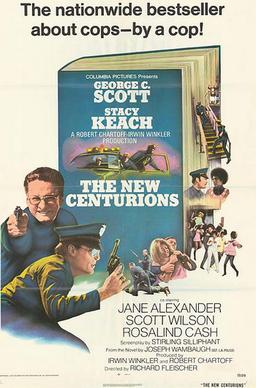
 Fresh from the police academy, three rookie cops are assigned to a precinct in East L.A. Gus (Scott Wilson) is a father of three who just wants to do a good job and support his family. Sergio (Erik Estrada) is a former gang member who saw the police academy as a way to get out of his old neighborhood, and Roy (Stacy Keach) is a new father who is going to law school at night. Most of the movie centers on Roy, who goes from being an idealistic rookie to being a hardened veteran and who comes to love the job so much that he abandons law school and eventually loses his family. Roy’s wife (Jane Alexander) comes to realize that Roy will never be able to relate to anyone other than his fellow cops. Roy’s mentor is Andy Kilvinski (George C. Scott), a tough but warm-hearted survivor who has never been shot once and whose mandatory retirement is approaching.
Based on an autobiographical novel by real-life policeman Joseph Wambaugh, The New Centurion’s episodic structure allows the film to touch on all the issues, good and bad, that come with police work. Gus is shaken after he accidentally shoots a civilian. Sergio feels the burden of patrolling the streets on which he grew up. Roy becomes a good cop but at the cost of everything else in his life and he deals with the stress by drinking. There are moments of humor and moments of seriousness and then a tragic ending. Just as Wambaugh’s book was acclaimed for its insight and its realistic portrayal of the pressures of being a policeman, the movie could have been one of the definitive portraits of being a street cop, except that it was directed in a workmanlike fashion by Richard Fleischer. Instead of being the ultimate cop movie, The New Centurions feels more like an especially good episode of Police Story or Hill Street Blues. (The New Centurions and Hill Street Blues both feature James B. Sikking as a pipe-smoking, martinet commander.)
George C. Scott, though. What a great actor! Scott only has a supporting role but he’s so good as Kilvinski that you miss him when he’s not around and, when he leaves, the movie gets a lot less interesting. Scott makes Kilvinski the ultimate beat cop and he delivers the closest thing that The New Centurions has to a cohesive message. A cop can leave the beat but the beat is never going to leave him.

 Through the Shattered Lens