I review COOGAN’S BLUFF (1968) – starring Clint Eastwood!


Here at The Shattered Lens, we’re looking forward to celebrating the birthday of Clint Eastwood on May 31st. In anticipation, I decided to revisit COOGAN’S BLUFF (1968). 

Clint Eastwood is Coogan, a tough as nails deputy sheriff from Arizona, who’s ordered by his boss, Sheriff McCrea (Tom Tully) to go to New York City and bring back the escaped killer James Ringerman (Don Stroud). When he gets to New York, he’s informed by Lieutenant McElroy (Lee J. Cobb) that Ringerman has overdosed on LSD while in the state’s custody, he’s now in the Bellevue Hospital, and he will not be released to Coogan until the state Supreme Court says so. Stuck in the Big Apple with nothing to do but flirt with probation officer Julie Roth (Susan Clark), Coogan decides to take matters into his own hands and get Ringerman out of the hospital early. He bluffs the attendants at the hospital into turning Ringerman over to him so he can catch the first plane back to Arizona. It seems like a good plan until he’s ambushed by Ringerman’s girlfriend Linny (Tisha Sterling) and his friend Pushie (David Doyle), he gets conked on the head, and he loses both his gun and his prisoner. Now, in trouble with Lieutenant McElroy and Sheriff McCrea, Coogan is ordered back home to Arizona. Determined to get Ringerman at any cost, Coogan stays in the city and leaves a trail of broken hearts and bruised bodies on his way to capturing his man! 

Made in 1968 after Eastwood’s string of excellent spaghetti westerns with Sergio Leone, COOGAN’S BLUFF may be set in contemporary times, but Coogan still seems to be a product of the old west. A big part of the fun is watching him interact with the people of New York City, where everyone is trying to take advantage of him, whether it be the cab driver, the hotel clerk, or the hooker down the hall. When he finally gets to the police station, he sees a building that’s completely overrun with criminals and crazies. He soon finds that Lieutenant McElroy follows the law down to the letter, while he treats the law as more of a set of suggestions on his way to getting the bad guys. This leads to endless frustration and almost gets Coogan arrested multiple times throughout the film as he doesn’t want to deal with all the red tape. One thing that doesn’t change whether Coogan is in Arizona or New York is his success with the ladies. They all swoon and he more than willingly obliges. The only problem for his prospect of true love is the fact that getting his guy always comes first, and he’ll use that sex appeal to get whatever information he needs. One of the main action scenes in this film, the bar fight, is set up ironically when the woman he’s “using” turns the tables and instead sets him up to be pummeled. 

COOGAN’S BLUFF is Eastwood’s first film with director Don Siegel, with whom he’d make DIRTY HARRY a few years later. You can definitely see the genesis of Harry Callahan in Walt Coogan, a man who does whatever it takes to stop criminals, is quick with a whip, and usually pisses off his superiors along the way. In some ways, you could say that Walt Coogan set the mold for the hero of cop films for the next couple of decades! It also has that sense of humor that would be a mark of Eastwood’s cop films. This one includes a funny thread that runs throughout where every person he meets assumes he’s from Texas because he wears a cowboy hat, and he always corrects them that he’s from Arizona. I get this as I always make sure people know that I’m from Arkansas! 

Overall, I really enjoy COOGAN’S BLUFF due mainly to Clint Eastwood’s excellent performance in the lead role. It was a great start to his “post Leone” career and would influence action movie heroes from that point forward. 
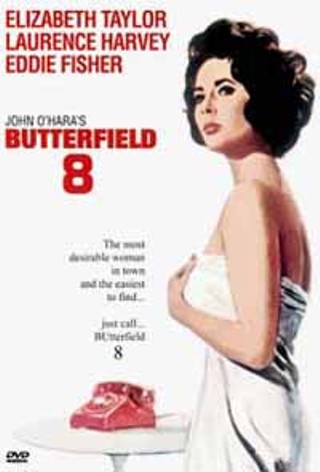
Cleaning Out The DVR: BUtterfield 8 (dir by Daniel Mann)


“Mama, face it,” Gloria Wandrous (Elizabeth Taylor) announces in the 1960 film, BUtterfield 8, “I was the slut of all time!”

Personally, I think Gloria is being a little bit too hard on herself. Certainly the film suggests, in its 1960 way, that she’s promiscuous and that she only sleeps with men for money but that doesn’t necessarily make her the slut of all time. For one thing, I would think that the slut of all time would have more options than just a wimpy pianist played by Eddie Fisher or a depressing, self-absorbed businessman played by Laurence Harvey.

“I still say it stinks,” Elizabeth Taylor said, almost immediately after winning her first Oscar for her performance in BUtterfield 8 and she’s kind of right. BUtterfield 8 is not a particularly good film, though not quite as bad as Taylor seemed to believe it to be.

Taylor won the Oscar after suffering a near fatal bout of pneumonia and having to undergo a tracheotomy. Along with saying that the film stunk, Taylor also often said that she only won her first Oscar because she nearly died. That may or may not be true but the thing is, Taylor’s the best thing in this overwritten and overheated mess of a movie. She certainly gives a better and more sympathetic performance than Laurence Harvey, who is cast as her married lover, Wilson Liggett. We’re meant to sympathize with Ligget but Harvey plays him as if he’s in a permanently sour mood and, after just a few minutes of listening to him bitch about every little thing, the viewer will get sick of him. It’s hard to really see what Gloria Wandrous sees in this whiny alcoholic.

Then again, the only other option that the film gives Gloria is Steve Carpenter, the pianist played by Eddie Fisher. Steve can’t decide if he’s in love with his boring girlfriend, Norma (Susan Oliver) or if he’s in love with Gloria. However, Steve has no problem letting Gloria borrow one of Norma’s dresses so that she can wear it when she goes home to visit her mother and I have to say that if I was Norma, Steve would be finding a new bed to sleep in after that. Gloria tells Steve that he needs to decide who he’s in love with but Steve jut can’t do it. Of course, in real life, Eddie Fisher left Debbie Reynolds so that he could marry Elizabeth Taylor. (A year or so later, Taylor left Fisher so that she could marry Richard Burton.)

BUtterfield 8 is one of those films that was undoubtedly considered to be daring when it was first released, seeing as how it acknowledged that people had sex without getting married first. (GASP!) Of course, though the film acknowledges that people have sex, it still makes sure to let us know that no one’s happy afterwards and that promiscuity eventually leads to death. (I mean, BUtterfield 8 may have taken risks but it still knew better than to defy the production code.) Seen today, the entire film is rather tame, talky, and slow but the star power of Elizabeth Taylor still comes through. The film opens with a lengthy sequence of Gloria getting ready for her day and, as you watch it and, more importantly, as you watch Elizabeth Taylor, you find yourself thinking that this is what a movie star is supposed to be. She dominates the film and she manages to credibly deliver even the most overheated pieces of dialogue. (Just try to imagine Jennifer Lawrence delivering the “slut of all time” line and you’ll immediately understand the difference between the movie stars of the past and the movie stars of the present. Of course, you could also say the same thing about trying to imagine a young Elizabeth Taylor in Silver Linings Playbook or The Hunger Games.) In fact, one could argue that Taylor’s performance is almost too good for the material. The film, in its 1960 way, suggests that Gloria would be better off if she just settled down but it’s impossible to imagine Taylor’s Gloria Wandrous settling for the stiffs played by Laurence Harvey and Eddie Fisher.

Though Elizabeth Taylor was correct about BUtterfield 8‘s overall quality, it’s still a good example of what star power can do for an otherwise mediocre film.

Cleaning Out The DVR: Picnic (dir by Joshua Logan)


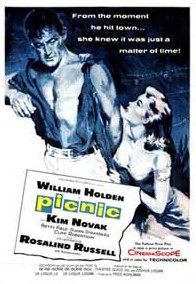
Original_movie_poster_for_the_film_Picnic

Tonight, I continued to clean out the DVR by watching the 1955 film Picnic.

Now, Picnic is kind of a strange film.  It’s one of those films from 50s that takes place in a small town where everyone is obsessed with sex but, since it’s the 1950s, nobody can just come out and say that they’re talking about sex.  So, instead, all of the dialogue is very discreet.  For instance, when Madge Owen (Kim Novak) talks to her mother, Flo (Betty Owens), about her date with her boyfriend, Alan (Cliff Robertson), Madge confesses that they spent the night kissing.  Flo asks if Madge if they have done anything more than kiss but, of course, she never comes straight out and says what “more” would be.  The audience knows what she’s talking about but it’s as if the world would actually end if anyone actually uttered the word.  “Oh mom!”  an embarrassed Madge says before confirming that she and Alan haven’t done anything more than kiss.

Flo desperately wants Madge to marry Alan because Alan is rich and his father owns the town’s grain elevator.  Marrying Alan would allow Flo to move up in the town’s strict social hierarchy.  However, Madge isn’t sure that she loves Alan.  Certainly, Alan seems to be a good man with a good future but he’s not a romantic.  Instead, he is someone who has his entire life already mapped out for him.

On Labor Day, a stranger comes to town.  His name is Hal Carter and he shows up riding on a freight train.  He’s come into town to see his old friend, Alan.  It turns out that Hal and Alan went to college together and were members of the same fraternity.  Hal was a star football player but he eventually flunked out of school and has spent the last few years drifting around the country.  However, Hal is now ready to settle down and he wonders if his old roommate Alan can get him a job at the grain elevator.

Now, here’s the strange part.  Hal is played by William Holden.  When he made Picnic, William Holden was 38 years old and looked closer to being 45.  (By contrast, Cliff Robertson, in the role of his former college roommate, was 32 and looked like he was 25.)  Hal spends a lot of time talking about his traumatic childhood and how he is finally ready to settle down and start acting like an adult.  In short, Hal talks like a 30 year-old but he looks like he’s nearly 50.  It’s odd to watch.  But even beyond the age issue, William Holden was an actor who always came across as being both confident and cynical.  Hal is a secret romantic with a deep streak of insecurity.  As great an actor as he may have been, William Holden is so thoroughly miscast here that it actually becomes fascinating to watch.  It brings a whole new subtext to the film as you find yourself wondering why no one is town finds it strange that a middle-aged man is still struggling to deal with his childhood.  When all the town’s young women ogle that shirtless Hal, it’s as if he’s wandered into a town populated only by teenagers with daddy issues.

(Paul Newman played the role of Hal in a Broadway production of Picnic.  And really, that’s who the ideal Hal would have been, a young Paul Newman.)

The majority of the film takes place at the town’s Labor Day picnic, where almost every woman in town is driven to distraction by the sight of Hal dancing.  Even the spinster teacher, Rosemary (Rosalind Russell), is so turned on by Hal’s masculinity that she makes a pass at him and accidentally rips his shirt.  Of course, some of Rosemary’s behavior is due to the fact that she’s drunk.  Her date, the befuddled Howard Bevans (Arthur O’Connell), made the mistake of being whiskey to the picnic.

Hal also dances with Madge’s 13 year-old sister, Millie (Susan Strasberg).  I have to admit that, even though I related strongly to Madge, Millie was my favorite character in the film.  Millie wears glasses and can recite Shakespeare from memory.  She knows that everyone around her is full of it and she’s willing to call them on it.  Of course, Millie herself ends up with a crush on Hal and it’s a dream for her when she finally gets to dance with him.

(Strasberg was 17 years old but is believable as a 13 year-old.  At the same time, since Hal appears to be nearly 50, his sudden closeness to Millie carries an icky, if unintentional, subtext.)

But then Madge suddenly appears, wearing a pink dress and literally emerging from the black night.  She starts to sway to the music.  As she slowly approaches Hal, he forgets about Millie and soon is dancing with Madge.  It’s actually a rather striking scene, one that so full of dream-like sensuality that it almost seems more like it was directed by surrealist David Lynch as opposed to the usually workmanlike Joshua Logan.

(In the video below, the scene freezes about 12 seconds in, before starting up again at the 16 second mark.  This is a glitch with the upload and is not present in the actual film.)

Needless to say, a drifter can’t just come into town and steal his ex-roommate’s girlfriend without drama following.  Picnic starts out as a slightly overheated examination of small town morality and then, after about an hour, it goes the full melodrama route, complete with police chases, stolen cars, a fist fight in an ornate mansion, and a lot of big speeches about the importance of love.  Needless to say, it’s all a lot of fun.

Picnic was nominated for best picture of the year.  However, it lost to the far more low-key Marty.

Embracing The Melodrama #13: Peyton Place (dir by Mark Robson)


Poster - Peyton Place_04

“Just remember: men can see much better than they can think. Believe me, a low-cut neckline does more for a girl’s future than the entire Britannica encyclopedia.” — Betty (Terry Moore), speaking the truth in Peyton Place (1957)

Sex!  Sin!  Secrets!  Scandal!  It’s just another day in the life of Peyton Place, the most sordid little town this side of Kings Row!  It’s also the setting of the 1957 best picture nominee, Peyton Place.

Peyton Place is a seemingly idyllic little village in New England.  The town is divided by railroad tracks and how your fellow townspeople views you literally depends on which side of the tracks you live on.  As the film itself shows us, the right side of tracks features pretty houses and primly dressed starlets.  The wrong side of the tracks features shacks and a bunch of people who look like the ancestors of the cast of Winter’s Bone.  The difference in appearance is not particularly subtle (but then again, the same thing could be said for the entire film) but, regardless of which side of the tracks live on, chances are that you’re keeping a few secrets from the rest of the town.

On the right side of the tracks, you can find Constance McKenzie (played by Lana Turner, who is just about as convincing as a New England matron as you would expect a glamorous Hollywood star to be), a dress shop owner who is so prim and proper that she literally flies into a rage when she comes across her daughter kissing a boy.  Could it be the Constance’s repression is the result of her once having been a rich man’s mistress?  And will the new high school principal, the progressive and rather dull Mr. Rossi (Lee Phillips), still love her despite her sordid past?

Constance’s daughter is Allison (Diane Varsi) and poor Allison just can not understand why her mother is so overprotective.  Will Allison ever find true love with the painfully shy Norman Page (Russ Tamblyn) or will she be forced to settle for someone like the rich and irresponsible Rodney Harrington (Barry Coe)?

Rodney, for his part, is in love with Betty (Terry Moore), a girl from the wrong sides of the tracks.  Rodney’s father (Leon Ames) is the richest man in town and makes it clear that he will not allow his son to marry someone with a “reputation.”  Will Rodney get a chance to redeem himself by going off to fight in World War II?

And what will happen when Rodney and Betty go skinny dipping and are spotted by a local town gossip who promptly mistakes them for Norman and Allison?  Reputations are at stake here!

Meanwhile, over on the bad side of the tracks, Lucas Cross (Arthur Kennedy) sits in his shack and drinks and thinks about how the world has failed him.  His long-suffering wife (Betty Field) works as housekeeper for the McKenzie family.  Meanwhile, his abused daughter Selena (Hope Lange, giving the film’s best performance) is Allison’s best friend.  When Lucas’s attempt to rape Selena leads to a violent death, the sins and hypocrisy of Peyton Place are revealed to everyone.

Peyton Place is a big, long  movie, full of overdramatic characters, overheated dialogue, and over-the-top plotting and, for that reason, I absolutely love it!  Apparently, the film was quite controversial in its day and the scenes where Arthur Kennedy attacks Hope Lange still have the power to disturb.  However, the main reason why I enjoy Petyon Place is because anything that could happen in Peyton Place does happen in Peyton Place.

Seriously, how can you not love a film this sordid and melodramatic?

Embracing the Melodrama #9: Kings Row (dir by Sam Wood)


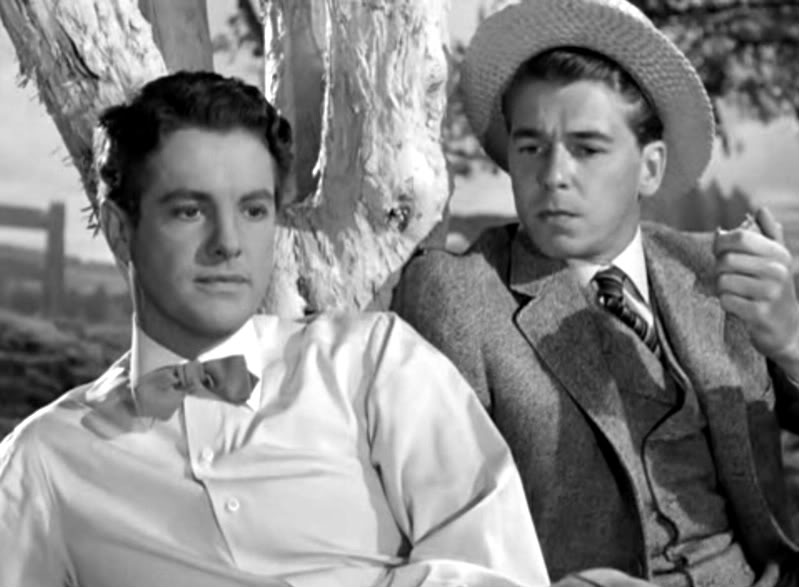
Kings Row“Where’s the rest of me!?” — Drake McHugh (Ronald Reagan), upon waking up to discover that his legs have been amputated, in Kings Row (1942)

It is with that line that the 1942 best picture nominee Kings Row earns its place in film history.  The formerly carefree and rich Drake had lost all of his money due to a crooked banker.  However, instead of feeling for himself, Drake got a job working for the railroad and finally started to show that he was capable of acting like a mature, responsible adult.  However, when Drake was injured in a boxcar accident, he had the misfortune to be taken to the sadistic Dr. Gordon (Charles Coburn).  Gordon felt that it was his duty to punish those who he considered to be wicked and that’s exactly how he felt about about Drake.  So, despite the fact that Drake had once been in love with Gordon’s daughter, Gordon proceeded to chop of Drake’s legs.

It’s just another day in Kings Row.

Of course, to an outsider, Kings Row looks like your typically calm and pleasant community.  But behind closed doors, this small town is full of sordid secrets.  Only those who have grown up in Kings Row understand the truth.  Only they can understand how Drake McHugh could end up losing his legs.

When they were both growing up at the turn of the century, Drake’s best friend was Parris Mitchell (Robert Cummings).  While Drake was pursuing Dr. Gordon’s daughter, and being loved from afar by Randy Monaghan (Ann Sheridan), Parris was studying to be a doctor under the tutelage of Kings Row’s other doctor, Dr. Alexander Tower (Claude Rains).  While Dr. Tower appeared to be a much nicer man than Dr. Gordon, he definitely had his eccentricities.  For instance, there was the wife who was reportedly confined somewhere in the house and never allowed to leave.  And then there was Dr. Tower’s daughter, Cassandra (Betty Field).  Dr. Tower was very protective of Cassandra, perhaps too protective.  How would Dr. Tower react when Parris, his best student, started to develop romantic feelings towards Cassandra?

Again, it’s just another day in Kings Row.

So, by now, it should be pretty obvious that Kings Row is one of those films that deals with big secrets in small towns.  That, of course, is a theme that was explored by films that were made long before Kings Row.  What made Kings Row unique is that it was perhaps the first film to actually portray that evil as specifically existing and thriving because of the repressive nature of a small town.  Whereas other films had featured outsiders bringing bad habits to an otherwise innocent and idyllic community (and be sure to watch Hitchcock’s Shadow of a Doubt if you want a perfect example of this), Kings Row suggested that the very nature of its setting is what led to all of the melodrama.  The film suggests that evil men like Dr. Gordon can specifically thrive in a town like Kings Row because his fellow townspeople aren’t willing to risk the placid surface of their existence by exposing him.  As such, Kings Row serves as a template for all of the sin-in-a-small-town films and TV shows that have followed.

Beyond the film’s historical importance, Kings Row holds us pretty well as entertainment.  As the film’s hero, Robert Cummings is a bit on the bland side but, fortunately, he’s surrounded by an excellent cast of character actors.  It’s a bit of a cliché to say that Claude Rains was perfectly cast because, seriously, when wasn’t Claude Rains perfectly cast?  But, in the role Dr. Tower, Claude Rains is perfectly cast.  Charles Coburn makes for a perfectly terrifying villain.  Ann Sheridan is likable and sympathetic as the woman who tries to help Drake recover after Dr. Gordon takes away his legs.  And finally, you’ve got future President Ronald Reagan in the role of Drake McHugh.  Reagan is usually dismissed a being a pretty boring actor (and I really haven’t seen enough of his films to say one way or the other) but he gave a great performance in Kings Row.

And that’s why, even beyond its historical significance, Kings Row is still a film that is more than worth watching.

KingsRowFRIENDS-1