4 Of My Favorite Fictional Oscar Winners!


For 9 decades, the Oscars have been an important part of American life.  As I’ve said on this site many times, Oscar Sunday is as much of an unofficial holiday as Super Bowl Sunday.  For many of us, the new year doesn’t even begin until the morning after the Oscars.

However, some of the most memorable Oscar winners didn’t even exist!  The Academy Awards have been used as a plot device in any number of movies.  Here are four of my favorite fictional Oscar winners:

  1. Johnny Fontane (Al Martino) in The Godfather (1972)

Oh, Johnny Fontane.  He had such a good singing career going until he started to lose his voice.  But, fortunately, there was a part for him in an upcoming picture.  As Johnny explained it, the part was a guy just like him.  “I wouldn’t even have to act.”  The only problem was that studio head Jack Woltz didn’t want to give him that role.

It’s a good thing that Johnny had a Godfather like Vito Corleone.  And it’s a good thing that the Godfather had a lawyer like Tom Hagen, a lawyer who didn’t mind arranging for a horse to be beheaded.  Khartoun may not have survived but Johnny Fontane got his part and his Oscar.

(Johnny’s adventures at the Oscars are detailed in all their loving glory in Mario Puzo’s novel.  Perhaps not wanting to harm its own Oscar chances, the film left out the majority of Johnny’s Hollywood adventures.)

2. Margaret Elliott (Bette Davis) in The Star (1953)

“C’mon, Oscar!  Let’s get drunk!”

Listen, you may think that winning an Oscar means that you’re set for life but often, the exact opposite is true.  Winning an Oscar has killed many a career.  They even have a name for it: The Oscar Curse.

Take Margaret Elliott for instance.  She won an Oscar.  And now, just a few years later, she’s broke, drunk, and deeply in denial.  Can her daughter (Natalie Wood) convince Margaret that it’s time to stop drinking and admit that fame is a hideous bitch goddess?  Or will Margaret continue to get drunk with her Oscar staring at her in judgment?

3. Vicki Lester (Judy Garland) in A Star is Born (1954)

Sadly, Vicki is better remembered for what happened during her acceptance speech than for the speech itself.  When her husband, notorious alcoholic Norman Maine (James Mason), took the stage and struck his wife while drunkenly motioning, it shocked Oscar watchers everywhere.  But Vicki never stopped loving him and, after his tragic death, she let the world know that, “This is Mrs. Norman Maine.”

4. Jerilee Randall (Pia Zadora) in The Lonely Lady (1983)

“I don’t suppose I’m the only one whose had to fuck her way to the top.”

Greatest fake Oscar acceptance speech ever!

Lisa Cleans Out Her DVR: 20,000 Years in Sing Sing (dir by Michael Curtiz)


(I am currently in the process of cleaning out my DVR.  I recorded the 1932 film, 20,000 Years In Sing Sing, off of TCM on January 31st.)

I was somewhat surprised to discover that I had this 1930s prison film on my DVR.  I’m not sure what led to me deciding to record it though, if I had to guess, I’d say that it was probably the title.  I probably assumed it was about a prisoner who served a 20,000 year sentence.  I mean, that sounds interesting, right?

It turns out I was wrong though.  The film starts with a shot of a line of prisoners walking into a prison, with their sentence superimposed over their heads.  One guy is in for 7 years.  Someone else has a 50 year sentence.  Another person has a 33 year sentence.  I’m guessing that if you added all of the sentence up, you would end up with 20,000 years.

That’s a lot of angry men, all trapped in one location.  Fortunately, Sing Sing Prison has a compassionate warden.  Paul Long (Arthur Byron) is a good man, a criminal justice reformer who believe that prison should be about more than punishment.  He is tough but fair and he runs his prison on the honor system.  Break the rules and you’ll be tossed into solitary.  Respect the rules and the Warden might even let you leave the prison for a day or two.  The press and the bureaucrats may think that Warden Long is naive but prison guards love him.  “We’re behind you,” the head guard says when it appears that Long might be about to lose his job.  And the prisoners respect him, even if few of them are willing to admit it.

Tommy Connors (Spencer Tracy) is the newest prisoner.  He’s been sentenced to 5 to 30 years for robbery and assault with a deadly weapon.  Tommy’s a tough guy, the type who speaks in the rat-a-tat manner that will be familiar to anyone who has ever watched a 30s gangster film.  He’s a tough guy so he ends every sentence with “see?,” as in, “No prison is going to break me, see?” Tommy’s the type of guy who brags that, even if they send him to solitary, he can do his time standing on his head.  When he gets called into the Warden’s office, he tosses a lit cigarette on the floor.  Can the Warden reform even as rough a customer as Tommy Connors!?

It doesn’t help, of course, that Tommy has a friend named Joe Finn (Louis Calhern) and, even though Joe is on the outside, he’s constantly encouraging Tommy to break the rules.  Joe has an ulterior motive for wanting to keep Tommy in prison for as long as possible.  That motive is his desire for Fay (Bette Davis), Tommy’s loyal girlfriend.  When Fay is injured in an accident, the Warden agrees to let Tommy visit her on the condition that Tommy return in 24 hours.  However, when Tommy’s visit leads to murder, the Warden is blamed.  It gets even worse when the Warden announces that he is sure that, despite the charges against him, Tommy will honor his word and return to the prison.

Will Tommy do the right thing?  Or will he flee and destroy the Warden’s career?

20,000 Years in Sing Sing was produced by Warner Bros and it features the studio’s typical pre-code combination of a B-movie action and progressive politics.  Seen today, it’s a watchable but minor film, one that often seems dated in its view of criminal behavior.  (Even I, a huge believer in the need for criminal justice reform, thought the warden was being incredibly naive when he put the convicts on the honor system.)  That said, it’s always interesting to see Bette Davis in the days before she became the Bette Davis and was just another ingenue trying to make an impression while surviving the studio system.  As well, since Spencer Tracy eventually became best known for portraying wise, plainspoken men, it’s interesting to see him playing the cocky and disrespectful Tommy.

Still, I think there is a place for a movie about someone spending 20,000 Years in Sing Sing.

(I imagine that, after the first 10,000 years, it gets easier.)


Scenes That I Love: “Come on, Oscar! Let’s get drunk!” from The Star!


In this scene, from the 1952 showbiz melodrama The Star, Bette Davis plays a faded film actress who has found the perfect drinking companion.

Interestingly enough, Bette Davis was nominated for an Oscar for getting drunk with Oscar.


Cleaning Out the DVR Pt 10: Halloween Leftovers


gary loggins's avatarcracked rear viewer

hl1

Halloween has come and gone, though most people have plenty of leftovers on hand, including your Cracked Rear Viewer. Here are some treats (and a few tricks) that didn’t quite make the cut this year:

hl2

ISLE OF THE DEAD (RKO 1945, D: Mark Robson)

Typically atmospheric Val Lewton production stars Boris Karloff as a Greek general trapped on a plague-ridden island along with a young girl (Ellen Drew) who may or may not be a vorvolaka (vampire-like spirit). This film features one of Lewton’s patented tropes, as Drew wanders through the woods alone, with the howling wind and ominous sounds of the creatures of the night. Very creepy, with another excellent Karloff performance and strong support from Lewton regulars Alan Napier, Jason Robards Sr, and Skelton Knaggs. Fun Fact: Like BEDLAM , this was inspired by a painting, Arnold Bocklin’s “Isle of the Dead”.

hl3

THE BOWERY BOYS MEET THE MONSTERS (Allied Artists 1954, D: Edward…

View original post 506 more words

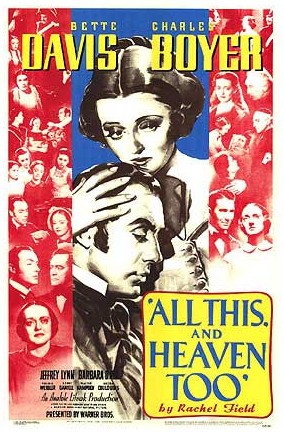
Cleaning Out The DVR, Again #37: All This And Heaven Too (dir by Anatole Litvak)


(Lisa is currently in the process of trying to clean out her DVR by watching and reviewing all 40 of the movies that she recorded from the start of March to the end of June.  She’s trying to get it all done by the end of July 11th!  Will she make it!?  Keep visiting the site to find out!)

All_this_heaven_movieposter

The 37th film on my DVR was the 1940 film, All This, And Heaven Too.  It originally aired on June 21st on TCM.

All This, and Heaven Too is one of the many melodramatic historical romances in which Bette Davis appeared in the late 30s and early 40s.  These films usually featured Bette as a strong-willed woman who was often condemned for not conforming to the rules of society.  Typically, she would end up falling in love with a man who society said she could not have.  Bette almost always seemed to end up alone, which I guess was the way women who thought for themselves were punished back then.

In this one, Bette plays Henriette Deluzy, a French woman who ends up in America in the 1850s.  When she shows up to start teaching at a private, all-girls school, her students immediately start gossiping about her.  It seems that Henriette was at the center of some sort of European scandal and everyone is speculating about what happened.  Finally, at the start of class, Henriette tells her students that she’s going to tell them the true story of what happened back in France.

It turns out that Henriette was a governess.  She took care of the four children of the Duc de Praslin (Charles Boyer) and his wife, the Duchesse (Barbara O’Neil).  The Duchesse was mentally unstable and soon came to suspect that her husband had fallen in love with Henriette.  Though she may have been insane, it turned out that the Duchesse was correct.  When the Duchesse fired Henriette and then lied to her husband about it, the Duc flew into a rage and murdered his wife.

Under the laws of the time, the Duc could only be judged by his fellow noblemen.  He was told that if he simply confessed and said that Henriette was the one who drove him to commit the murder, he would be set free.  (As opposed to the characters that Bette Davis played in The Letter and The Little Foxes, Henriette was totally innocent.)  Would the Duc confess and allow Henriette to be blamed or would he deny his love for her and sacrifice his life as a result?

All This, And Heaven Too is a rather slow movie and it’s hard not to be disappointed that Henriette is such a boring character.  She’s so innocent and victimized that the role almost seems like a waste of Bette Davis’s talents.  A big production that featured lavish (though black-and-white) recreations of 19th Century France, All This, And Heaven Too was probably a big deal for contemporary audiences and, if you’re a Bette Davis or Charles Boyer completist, you might enjoy it.  But otherwise, it’s really nothing special.

All This, And Heaven Too was among the 10 films nominated for Best Picture of 1940.  However, it lost to Rebecca.

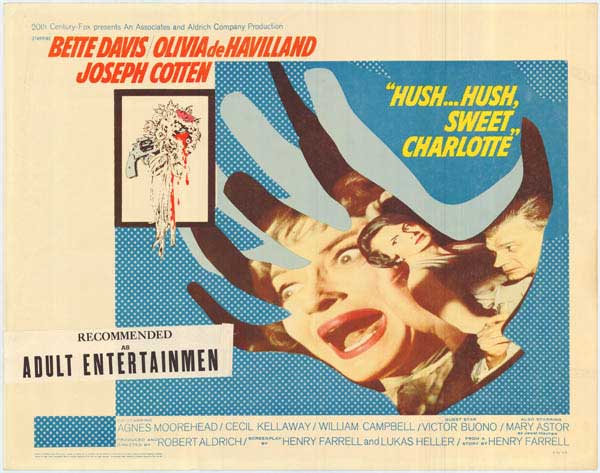
Happy 100th Birthday Olivia de Havilland!: HUSH… HUSH, SWEET CHARLOTTE (20th Century Fox 1964)


gary loggins's avatarcracked rear viewer

char1

Today marks the 100th birthday of one of the last true Golden Age greats, Olivia de Havilland. Film fans across the globe are celebrating the life and career of this fine actress, who fought the Hollywood system and won. Olivia is the last surviving cast member of GONE WITH THE WIND (Melanie Wilkes), won two Academy Awards (TO EACH HIS OWN, THE HEIRESS), headlined classics like THE SNAKE PIT and THE DARK MIRROR, and costarred with dashing Errol Flynn in eight exciting films, including CAPTAIN BLOOD , THE ADVENTURES OF ROBIN HOOD, SANTA FE TRAIL, and THEY DIED WITH THEIR BOOTS ON.

Olivia moved to Paris with her husband in the 1950’s and was semi-retired, acting in a handful of films. In 1962 director Robert Aldrich  scored a huge hit, a psychological horror thriller called WHATEVER HAPPENED TO BABY JANE?, starring screen veterans Bette Davis and Joan Crawford. A new genre was…

View original post 835 more words

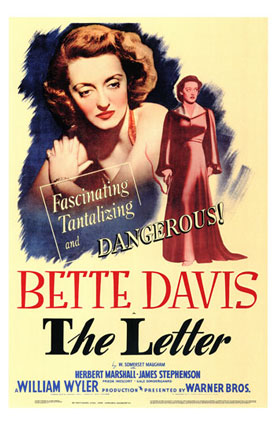
Cleaning Out The DVR #14: The Letter (dir by William Wyler)


The_Letter_poster

After watching Break-Up Nightmare, I watched one more film that was sitting on my DVR.  That film was 1940’s The Letter.  I had recorded it off of TCM and, up until last night, I had never seen it before.  I’m happy to say that I’ve seen it now because it’s a great movie, featuring a fascinating mystery, feverish atmosphere, excellent supporting performances, and a ferociously brilliant performance from the great Bette Davis.

Filmed in a dream-like noir style by William Wyler, The Letter opens on a rubber plantation in Malaysia.  It’s night and the camera pans over the native workers all trying to sleep through the hot night.  Eventually, the camera reaches the big house, where the plantation’s wealthy and, of course, white manager lives.  (The contrast between the wealthy Europeans interlopers and the natives who work for them is a reoccurring theme throughout The Letter.)  A gunshot rings out.  A man stumbles out of the house.  Following after him is Leslie Crosbie (Bette Davis).  She is carrying a gun and, as we watch, she shoots the man a few more times.  She shoots him until she’s sure that he’s dead.

Leslie is the wife of Robert Crosbie (Herbert Marshall, who also played Davis’s husband in The Little Foxes) and the man that she just killed is Geoff Hammond, a respected member of Malaysia’s European community.  When the police arrive, Leslie explains that Hammond “tried to make love to me” and that she was forced to kill him in self-defense.  Leslie is arrested for the crime and will have to face trial but everyone knows that she will be acquitted.  After all, Leslie and her husband are members are well-connected members of the upper, European class.

However, Leslie’s lawyer, Herbert Joyce (James Stephenson), has doubts about Leslie’s story.  He points out that she sounds just a little too rehearsed.  His suspicions are confirmed when his clerk, Ong Chi Seng (Sen Yung), tells him about the existence of a letter that Leslie wrote on the day that Hammond was killed.  In the letter, Leslie orders Hammond to come see her and threatens to reveal the details of their relationship if he doesn’t.  Ong explains that he only has a copy of the letter.  The original is in the hands of Hammond’s widow (Gale Sondergaard) and she’s willing to sell the letter for a substantial price.

Not surprisingly The Letter is dominated by Bette Davis but, for me, the most memorable character is the outwardly obsequies but inwardly calculating Ong Chi Seng.  Sen Yung plays him with such a polite manner and a gentle voice that it’s actually incredibly shocking when he reveals his true nature.  And yet, even after he’s been exposed as a potential blackmailer, his manner never changes.  Meanwhile, Gale Sondergaard only appears in a handful of scenes but she steals every one of them with her steely glare.

In order to get the letter away from Ong and Mrs. Hammond, Leslie and Joyce have to convince Robert to give them the money without allowing him to learn the letter’s content.  But, what neither one of them realizes, is that Mrs. Hammond has plans that go beyond mere blackmail.

The Letter is an atmospheric melodrama that plays out almost like a fever dream and it also features one of Davis’s best performances.  It was nominated for best picture but it lost to another atmospheric melodrama, Alfred Hitchcock’s Rebecca.

Cleaning Out The DVR #6: Watch On The Rhine (dir by Herman Shumlin)


After I finished watching Around The World In 80 Days, I decided to watch the 1943 film, Watch on the Rhine.  Though both films are immortalized in the record books as a multiple Oscar nominee, Watch on The Rhine might as well have taken place in a totally different universe from Around The World In 80 Days.  Based on a play by the always politically outspoken Lillian Hellman, Watch On The Rhine is as serious a film as Around The World In 80 Days is frivolous.

It’s also somewhat infamous for being the film for which Paul Lukas won an Oscar for best actor.  When Lukas won his Oscar, he defeated Humphrey Bogart, who was nominated for his iconic performance in Casablanca.  This is justifiably considered to be one of the biggest mistakes in Oscar history and, as a result, there are people who will tell you that Watch On The Rhine is a totally undeserving nominee, despite having never actually seen the film and not being totally sure who Paul Lukas was.

Up until I watched the film yesterday, you could have included me among those people.

What’s interesting is that Watch On The Rhine almost feels like a companion piece to Casablanca.  Both films were resolutely anti-fascist, both of them dealt with a member of the Resistance trying to escape from a German agent, and both films climaxed with a gunshot.  The part played by Paul Lukas, a German engineer named Kurt Muller, feels like he could be an older version of Casablanca‘s Victor Laszlo.  Finally, whereas Casablanca centered around “letters of transit,” Watch On The Rhine centers around money.  Kurt is smuggling money to the Resistance.  Teck de Brancovis (George Coulouris), a dissolute Romanian count, demands money in exchange for not informing the Germans of where Kurt’s location.

(Of course, both Casablanca’s letters and Watch on the Rhine’s money are an example of what Hitchcock called the MacGuffin.  The letters and the money are not important.  What’s important is that both films use the thriller format to inspire viewers to support the war effort.)

The film takes place in 1940, when America was still officially neutral.  Kurt and his American wife, Sara (Bette Davis), have secretly entered the United States through Mexico.  Officially, they are only visiting Sara’s brother (Donald Woods) and mother (Lucille Watson) in Washignton, D.C.  Unofficially, they are looking for political sanctuary.  However, Kurt still finds himself drawn back to Germany, especially after he finds out that one of his friends in the Resistance has been arrested by the Gestapo.

Not surprisingly, considering its theatrical origins, Watch On The Rhine is a very talky and a very stage-bound film.  Almost all of the action takes place in one location and a good deal of the film’s running time is devoted to Kurt giving speeches.  Don’t get me wrong, that’s not a complaint.  Though the film may have been released at the height of the war, the play was written at a time when America was still officially neutral and many elected officials were adamant that, even if it meant Hitler taking over the entire continent, America should never get involved in the affairs of Europe.  Watch On The Rhine was Hellman’s attempt to both expose what was happening in Germany and to rally them to the anti-fascist cause.  Watch On The Rhine may be propaganda but its anti-Nazi propaganda and who can’t appreciate the importance of that?

When it was originally released, Watch On The Rhine was sold as a Bette Davis vehicle.  To be honest, Davis doesn’t really do much in the film.  She supports her husband and she has a few sharp words for Teck but, otherwise, her role is definitely secondary to Paul Lukas.  Davis took the role because she believed in the film’s message.  It’s a good message and, for that matter, Watch On The Rhine is a pretty good film.  It’s well-acted, intelligently written, and perfectly paced.

But what about Paul Lukas’s Oscar?  Well, let’s state the obvious.  Humphrey Bogart should have won the award for Casablanca.  That doesn’t mean that Paul Lukas doesn’t give a worthy performance.  He originated the role on stage and he does a good job of bringing the character to life on film, bringing a sincere intensity to even the most stagey of Kurt’s monologues.  Whenever Lukas speaks, he’s explaining to the filmgoers why the U.S. must take a stand against Hitler and his followers.  Considering that Watch On The Rhine was released at the height of World War II, I imagine that this, more than anything, led to Lukas winning his Oscar.

Watch On The Rhine was also nominated for Best Picture.  It was deserved nomination but, in this case, the Academy made the right decision and gave the Oscar to Casablanca.

Lisa Watches An Oscar Nominee: The Little Foxes (dir by William Wyler)


Little_foxesThat Bette Davis was an amazingly talented actress is something that we all already know.

However, she has become such an iconic figure that I think that it’s easy to forget just how versatile she could be.  She was ferocious in Of Human Bondage.  She was poignant in Dark Victory.  She was majestic in All About Eve.  Even when she eventually ended up appearing in stuff like Burnt Offerings, she still managed to command the screen.  Of course, nobody played evil with quite the style and power as Bette Davis at her prime.  And if you ever have any doubt about that fact, I would suggest watching the 1941 Best Picture nominee, The Little Foxes.

Based on a play by Lillian Hellman, The Little Foxes is a dark Southern melodrama that takes place in 1900.  The once mighty Hubbard Family has fallen on hard times.  Brothers Benjamin (Charles Dingle) and Oscar (Carl Benton Reid) have inherited their father’s money and Oscar has made himself even more wealthy by marrying the poignant alcoholic Birdie (Patricia Collinge).  However, when Oscar and Benjamin decide that they want to build a cotton mill, they discover that, even with their own fortunes, they are still $75,000 short.

They turn to their sister, Regina (Bette Davis).  As quickly becomes obvious, Regina is a hundred times more intelligent and clever than either one of her brothers.  However, because she’s a woman, Regina was not considered to be a legal heir to their father’s fortune.  As a result, after his death, she was left penniless.  In order to survive, Regina had to marry the wealthy but sickly Horace (Herbert Marshall).  When Regina asks Horace for the $75,000, Horace refuses.  He wants nothing to do with either one of her brothers.

With the reluctant help of Oscar’s son, Leo (Dan Duryea), the brothers steal the money straight from Horace’s bank account.  Regina, however, finds out about the theft and schemes to blackmail her two brothers….

For the majority of the film, you are totally on Regina’s side.  Despite the fact that Regina is ruthless and obviously taking advantage of Horace’s weakened state, you find yourself making excuses for her.  Her brothers are both so sleazy and greedy and Regina is so much smarter than her idiotic siblings that the film occasionally feels like a dark comedy.  It’s fun watching her get the better of them and you find yourself assuming (and hoping) that Regina will somehow be redeemed by the end of the movie.

And then it happens.

Aware of both Regina’s scheme and the fact that she never loved him, Horace announces that he’s going to change his will and he’s going to leave his entire fortune to their daughter, Alexandra (Teresa Wright, in her Oscar-nominated film debut).  He also tells Reginia that he’s going to say that he lent Leo the money, which would make it impossible for her blackmail scheme to work.

It’s while they’re arguing that Horace suddenly suffers a heart attack.  And as Horace struggles to climb up a staircase so that he can get his medicine, Regina calmly sits in a chair and shows not a hint of emotion as he dies.  It’s such an unexpected and effective moment, largely because Bette Davis’s performance was so good that it kept both the viewer and Horace from realizing just how monstrous Regina truly was.

It’s hard to think of any contemporary actress who could so totally and believably embody a character of Regina Gibbons.  It takes courage to commit so fully to playing such an evil and hateful character.  Bette Davis had that courage and her performance alone makes The Little Foxes worth watching.

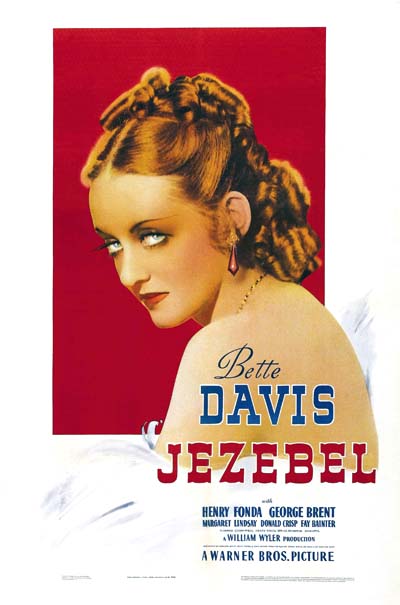
Embracing the Melodrama Part II #12: Jezebel (dir by William Wyler)


Jesebel_movieposterWe started out this day by taking a look at Bette Davis in Of Human Bondage so it seems only appropriate that today’s final entry in Embracing the Melodrama should be another film in which Bette Davis plays a potentially unlikable character who is redeemed by being the most interesting person in the film.

The 1938 best picture nominee Jezebel stars Bette Davis as Julie Marsden, a strong-willed Southern belle who lives in pre-Civil War New Orleans.  Julie is looking forward to an upcoming ball but is frustrated when her fiancée, boring old Pres (Henry Fonda), says that he has to work and declines to go shopping for a dress with her.  Impulsively, Julie does exactly what I would do.  She buys the most flamboyant red dress that she can find.

Back in the old South, unmarried women were expected to wear white to formal balls, the better to let everyone know that they were pure and innocent and waiting for the right man.  When Julie shows up in her red gown, it’s a scandal and, upon seeing the looks of shock and disdain on everyone’s faces, Julie wants to leave the ball.  However, Pres insists that Julie dance with him and he continues to dance with her, even after the orchestra attempts to stop playing music.

And then he leaves her.  At first, Julie insists to all who will listen that Pres is going to return to her but it soon becomes obvious that Pres has abandoned both Julie and Southern society.  Julie locks herself away in her house and becomes a recluse.

Until, a year later, Pres returns.  At first, Julie is overjoyed to see that Pres is back and she’s prepared to finally humble herself if that means winning back his love.  But then she discovers that the only reason that he’s returned to New Orleans is to warn people about the dangers of Yellow Fever.

Oh, and he’s also married.

To a yankee.

For the most part, Jezebel is a showcase for another fierce and determined Bette Davis performance.  It’s easy to be judgmental of a character like Julie Marsden but honestly, who doesn’t wish that they could be just as outspoken and determined?  It helps, of course, that the film surrounds Julie with a collection of boring and self-righteous characters, the type of people who you love to see scandalized.  Henry Fonda gives one of his more boring performances in the role of Pres while Margaret Lindsay, in the role of Pres’s Northern wife, is so saintly that she reminds you of the extremely religious girl in high school who would get offended whenever you came to school wearing a short skirt.  In a society as rigid, moralistic, and judgmental as the one portrayed in Jezebel, it’s impossible not to cheer for someone like Julie Marsden.

Add to that, I totally would have worn that red dress too!  In a world that insisted that all women had to act a certain way or look a certain way and think a certain way, Julie went her own way and, regardless of what boring old Pres may have thought, there’s a lesson there for us all.

When watching Jezebel, it helps to know a little about film history.  Bette Davis very much wanted to play Scarlett O’Hara in Gone With The Wind and was reportedly very disappointed when the role went to Vivien Leigh.  Depending on the source, Jezebel is often described as either being Davis’s audition for the role of Scarlett or as being a consolation gift for losing out on the role.  Either way, Jezebel is as close as we will ever get to seeing Bette Davis play Scarlett.  Judging from the film, Davis would not have been an ideal Scarlett.  (Whereas Gone With The Wind works because Leigh’s Scarlett grows stronger over the course of the film, Davis would have started the film as strong and had nowhere left to go with the character.)  However, Davis was a perfect Julie Marsden.