Lisa Reviews An Oscar Nominee: Arrowsmith (dir by John Ford)


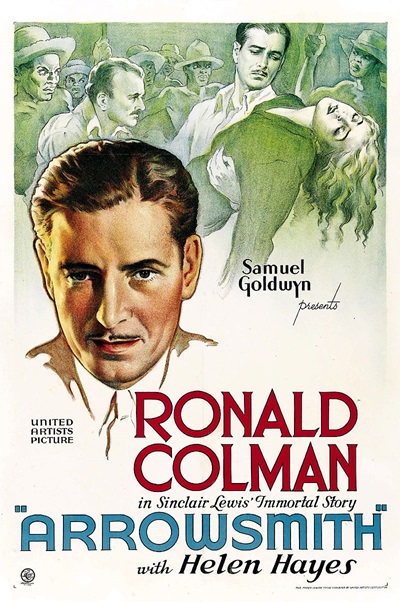
In the 1931 Best Picture nominee Arrowsmith, Ronald Colman stars as Martin Arrowsmith, a doctor who is trying to save lives without compromising his ethics.

Arrowsmith is mentored by the famed bacteriologist, Max Gottlieb (A.E. Anson) and married to a nurse named Leora (Helen Hayes).  At first, Arrowsmith makes his living as the local doctor in Leora’s small hometown in South Dakota.  However, Arrowsmith is ambitious and wants to do more with his life and career than just take care of a small town.  He wants to cure the world of disease.  When he’s offered a position at the prestigious McGurk Institute in New York, he enthusiastically accepts.  Having just suffered a miscarriage, Leora supports Arrowsmith’s decision and travels to New York with him.  No matter what happens, Leora is always there to support her husband, even when he doesn’t seem to appreciate it.

When Arrowsmith thinks that he’s discovered an antibiotic serum that appears to be capable of curing all sorts of diseases, he attempts to stay true to the methods taught to him by Dr. Gottlieb.  He takes his time.  He tests carefully.  He doesn’t rush out and give the serum to everyone.  However, Arrowsmith finds his methods continually sabotaged by his colleagues, who hope to raise money by telling the press about a miracle serum that can “cure all diseases!”  When Arrowsmith later finds himself combatting an outbreak of the Bubonic Plague in the West Indies, he again tries to employ the scientific method but finds himself being pressured by government officials to give his untested serum to every single person on the island.  Eventually, Arrowsmith’s ethics are pushed to their limits when even Leora falls ill.

Arrowsmith was based on a best-selling novel by Sinclair Lewis, though the plot was changed to make the story more palpable for film audiences.  In the novel, Arrowsmith is a bit of cad who regularly cheats on his wife.  In the film, Arrowsmith is passionate and driven but the exact nature of his relationship with wealthy Joyce Lanyon (Myrna Loy) is left so ambiguous that it actually leaves one wondering why the character is in the film at all.  What both the film and the novel have in common is an emphasis on the importance of science and the scientific method.  Arrowsmith’s idealism runs into the harsh reality of life during an epidemic.  Government officials are more concerned with saying that they’ve done something as opposed to considering whether their actions have ultimately done more harm than good.  In its way, Arrowsmith predicted the COVID era.

Arrowsmith was the first John Ford film to be nominated for Best Picture and its financial success allowed Ford the freedom to go on to become one of Hollywood’s most important directors.  Seen today, Arrowsmith feels a bit creaky and self-important, with little of the visual flair that Ford brought to his later films.  Ronald Colman’s performance as Arrowsmith seems a bit stiff, especially when compared to the much more lively (and sympathetic) performance of Helen Hayes.  Arrowsmith is a big and serious film and, if we’re going to be honest, it’s a little bit boring.  Still, it’s interesting to see the issues of today being debated 90 years in the past.

As for the Oscars, Arrowsmith was nominated for Best Picture, Adaptation, Cinematography, and Art Direction.  It lost in all four of the categories in which it was nominated.  That year, Best Picture was won by Grand Hotel, which curiously didn’t receive any other nominations at all.
Lisa Reviews An Oscar Nominee: The Crowd (dir by King Vidor)


Way back when the Academy first started to hand out awards to honor the best films of the year, they actually gave out two awards for best picture.  One of the awards was called Oustanding Production and it’s assumed by most Oscar historians that it was meant to go to the most “entertaining” film of the year.  The other award was called Best Unique and Artistic Picture and it was meant to honor the type of films that might not make a huge amount of money at the box office but which did the most to move cinema forward as an art form.

As a result, when the very first Academy Awards were awarded at the Hollywood Roosevelt Hotel on May 16th, 1929, a popular war film named Wings was named Outstanding Production while F.W. Murnau’s Sunrise was named Best Unique and Artistic Picture.  Sunrise defeated two other nominees, a documentary called Chang and King Vidor’s The Crowd.

It’s long been rumored that, when the votes were first counted, The Crowd originally won Best Unique and Artist Picture but that Louis B. Mayer insisted that the award should go to Sunrise instead.  The head of MGM, Louis B. Mayer reportedly disliked The Crowd, even though it was distributed by his own studio.  Mayer felt that the film was too downbeat and he also resented that King Vidor had resisted Mayer’s demand that the film have a traditionally happy ending.  It’s also been suggested that, since the Academy was largely Mayer’s idea, he felt that, if an MGM film won the initial reward, it would lead to his enemies claiming that Mayer had too much influence over the organization.  That may or may not be true, no one can say for sure.  What we can say for sure, however, is that both The Crowd and Sunrise continue to be recognized as classics of the silent era.

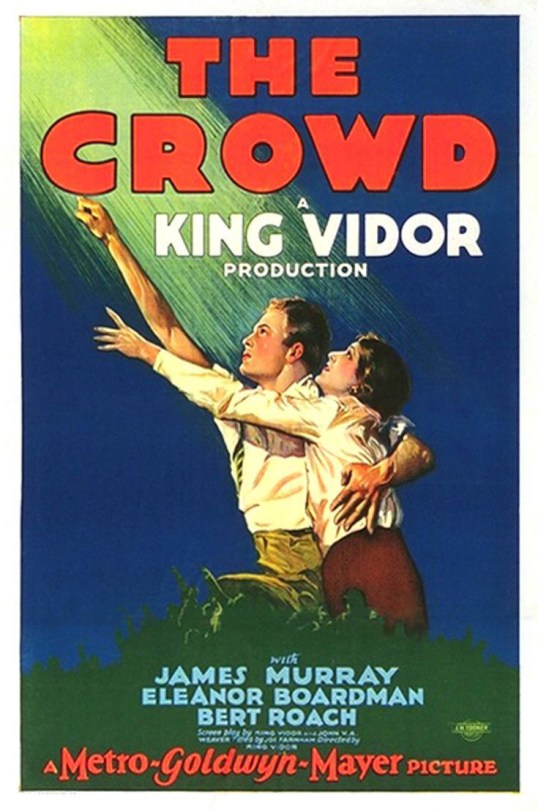
The Crowd tells the story of John Sims (James Muray), who goes to New York when he’s 21, convinced that he’s destined to be someone important.  Sims gets a job at Atlas Insurance, where he’s one of many faceless office workers.  He meets and, after one date, marries Mary (Eleanor Broadman).  They live in a tiny apartment next to an elevated track.  Over the next five years, they raise a family.  They fight often.  Occasionally, they beak up but they always get back together.  Throughout it all, John struggles to prove himself as an individual, just to be continually reminded that he’s only a member of the faceless crowd.

It’s not a particularly happy film.  John starts the film as a member of the crowd and he’s still a member of the crowd when it ends.  If there is anything positive to be found in the film, it’s that John’s family loves him but, even taking that in to consideration, it’s obvious that he and Mary are going to spend their entire lives struggling and that the same fate probably awaits their children.  Knowing that the film was made on the verge of the start of the Great Depression makes John’s story all the more poignant.  If he thinks things are bad now, they’re about to get even worse.

Seen today, The Crowd is still a visually striking film.  Influenced by German expressionism (particularly the work of Sunrise‘s director, F.W. Murnau), Vidor presents New York as being a menacing and frequently surreal world of towering skyscrapers and unfriendly faces.  (Vidor even used the then-unheard of technique of using a hidden camera to capture actual documentary footage of star James Murray dealing with real New Yorkers.)  The Crowd is probably best remembered for the shot where the camera pans up the length of a skyscraper, finally entering the building and showing us the anonymous office workers within.  It’s a shot that perfectly captures the film’s theme of being lost and ignored in an impersonal world.  It’s also a shot that’s been duplicated in a countless number of films.  The Crowd may be 92 years old but its legacy lives on.

Sadly, things did not turn out well for James Murray, the former extra who Vidor cast in the lead role.  The success of The Crowd did not translate into success for Murray.  An alcoholic, Murray ended up living on Skid Row, where he once asked King Vidor for money and reacted with anger when Vidor offered him a role in a new film.  In 1936, Murray was found floating in the Hudson River.  He was 35 years old.

As for the Oscar for Best Unique and Artistic Motion Picture, it was only awarded once.  Starting with the second Oscar ceremony, the Academy merged the two best film awards into one.  Interestingly, the idea of giving out two Best Picture awards was briefly revived in 2018 but the response to the idea was so negative that it was quickly abandoned.

Lisa Watches An Oscar Nominee: San Francisco (dir by W.S. Van Dyke)


San_Francisco_(film)_poster

As I sit here writing this, I’m snowed in, my asthma’s acting up, and our cat is quickly losing patience with me.  On the plus side, however, this weather has given me an opportunity to watch some more of the old best picture nominees that I had saved up on my DVR.

For instance, I just finished watching the 1936 best picture nominee, San Francisco.

San Francisco was one of the first disaster films, a film that follows a group of characters as they attempt to survive the 1906 earthquake that destroyed the town of San Francisco.  And it has to be said that, nearly 80 years after the film was first released, the climatic earthquake remains effective and scary.  San Francisco, of course, was made long before there was any such thing as CGI.  Many of the film’s sets were built on special platforms that were designed to shake back and forth, just like in an actual earthquake.  When you see walls and buildings collapsing in San Francisco, you know that those walls are breaking apart and collapsing for real and the extras running for their life are literally doing just that.  After the earthquake, Clark Gable, as the film’s hero, walks through the ruins of San Francisco with the haunted look of a true survivor.  Gable was such a confident actor that it’s still jarring to see him looking overwhelmed.

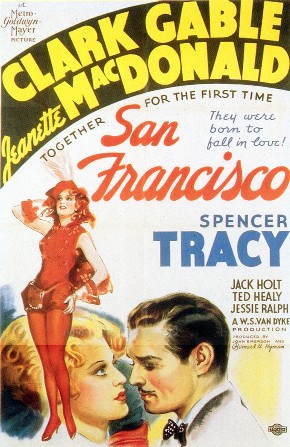
Unfortunately, before you get to that spectacular earthquake, you have to sit through the rest of the film.  It’s a massive understatement to say that the pre-earthquake portion of San Francisco drags.  Clark Gable is Blackie Norton, a notorious gambler and saloon keeper.  Blackie may be a rogue but he’s a rogue with a heart of gold.  His childhood friend, Father Tim (Spencer Tracy), wants Blackie to run for the board of supervisors.  Blackie, however, is more interested in Mary Blake (Jeanette MacDonald), the newest singer at his club.

From the minute she first appears to the very end of the film, Jeanette MacDonald is singing.  Even when she’s not at the center of the scene, you can often hear her singing in the background.  And, after a little while, you just want her to stop singing.  But, whenever that happens, she tries to act and you realize that the only thing more boring than Jeanette MacDonald singing is Jeanette MacDonald acting.

Anyway, the film goes through all of the expected melodrama.  Blackie wants to reform.  Blackie decides not to reform.  Father Tim believes that there’s good in Blackie.  Father Tim gives up on Blackie.  Father Tim decides to give Blackie another chance.  Mary loves Blackie.  Mary fears Blackie.  Mary leaves Blackie.  Mary comes back to Blackie.  Mary leaves Blackie again.  Mary sings.  And sings and sings and sings…

But then, just when you’re about to fall asleep, the city starts to shake and all is forgotten in the wake of a natural disaster.  Even earthquakes serve a purpose…

San Francisco was a huge box office success.  It was nominated for best picture.  Somehow, Spencer Tracy received a nomination for best actor, despite the fact that he’s really not that impressive in the film. (His role is primarily a supporting one and he’s consistently overshadowed by Gable.)  The only Oscar that San Francisco won was for best sound recording and it must be said that, after all these years, the earthquake still sounds terrifying.

As for the film itself, I’d suggest skipping ahead to the earthquake.  That, after all, is the main reason anyone would be watching the film and, by skipping ahead, you’re spared having to sit through an hour and a half of Jeanette MacDonald singing.