“Go ahead and hate your neighbor; go ahead and cheat a friend.
Do it in the name of heaven; you can justify it in the end.
There won’t be any trumpets blowin’ come the judgment day
On the bloody morning after, one tin soldier rides away”
— From One Tin Soldier, the theme song of Billy Jack (1971)
Yesterday, we took a look at The Born Losers, the first film to ever feature the character of future U.S. Senator Billy Jack. The Born Losers ended with former Green Beret-turned-gun-toting-pacifist Billy Jack (played, of course, by Tom Laughlin) saving the girl, killing the bad guy, and getting shot in the back by the police. As Born Losers ended, we were left to wonder whether Billy would survive his wounds or would he just be another victim of the establishment.
Well, audiences had to wait five years to find out.
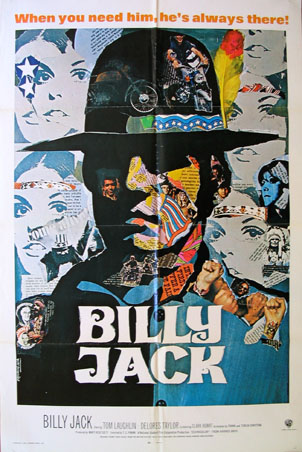
When Laughlin returned to the role in 1971’s Billy Jack, it was revealed that not only had Billy Jack lived but he was now residing in a cave with his wise Native American grandfather. Billy still had little use for civilization but he would occasionally emerge from his cave. Sometimes, it was to protect wild mustangs from being hunted the evil Old Man Posner (Bert Freed) and his sociopathic son Bernard (David Roya). Other times, it was to protect the Freedom School and, even more importantly, the Freedom School’s founder, Jean (played by Laughlin’s wife, Delores Taylor).
The local townspeople viewed the Freedom School with suspicion and whenever the students went into town, they would be harassed by Bernard and his friends. Fortunately, the students could always count on Billy to show up, say a few angry words, and then lose control. Billy may have been a liberal but he was no pacifist. Jean, however, fully embraced nonviolence and she always made it clear that she wasn’t comfortable with Billy providing her kids with a violent example.
Finally, both Jean and Billy’s convictions were put to the test. First off, the bigoted townspeople tried to close the school. Then, Jean was raped by Bernard. And finally, Billy found himself barricaded in an old mission, surrounded by police and national guardsmen. Even as Jean pleaded with Billy to lay down his weapons and to peacefully surrender, Billy made it clear that he was willing to die for his beliefs.
And, as the film ended, you would never guess that Billy Jack would eventually become a member of the U.S. Senate. But, in just a few years, that’s exactly what would happen in Billy Jack Goes To Washington!
Now, of course, Billy Jack is ultimately a product of its time and that’s both a blessing and a curse. To be honest, if anything could transform me from being the socially liberal, economically conservative girl that you all know and love into a card-carrying right-wing extremist, it would be having to spend any time with the students at the Freedom School. They are all so smugly convinced of their own moral superiority that the townspeople almost start to look good by default. Whether they’re attending improv class or disrupting a meeting at town hall, the majority of the students come across like a bunch of rich kids from the suburbs, playing hippy and slumming by hanging out with poor minorities. As you watch them, it’s difficult not to suspect that most of them are going to get bored with rebelling after a year or two and eventually end up growing up to be just like their parents.
Fortunately, the film is saved by the pure sincerity of Laughlin and Taylor. For all the attention that the film gets for the scenes of Billy Jack beating people up, the most compelling scenes are the ones where Jean and Billy Jack debate nonviolence. There’s an honesty and a passion to these scenes, one that proves that Laughlin and Taylor, as opposed to so many other self-styled counterculture filmmakers, were actually serious about their beliefs. Billy Jack is an essential film, not only as a time capsule of the era in which it was made but also as one of the few films to actually make a legitimate attempt to explore what it truly means to embrace nonviolence.
Billy Jack is also a historically important film. When American Independent Pictures withdrew from the production, Laughlin took Billy Jack to 20th Century Fox. When 20th Century Fox looked at the completed film and did not know how to market it, Laughlin distributed the film himself, without the support of a major studio. And, despite what all of the naysayers may have predicted, Billy Jack was a huge hit.
And every indie filmmaker since owes a huge debt of gratitude to Tom Laughlin.

 Through the Shattered Lens