MAN WITH A CAMERA (TV Series) – starring Charles Bronson – S1, E2: The Warning


This episode opens with Mike Kovac (Charles Bronson) receiving an anonymous phone call to come to the corner of Myers St. and Brooklyn Ave., and he’s told to bring his camera! When he gets there, he’s forced at gunpoint by two masked man to take a picture as they kill another man. After the killers drive off, Kovac immediately calls the police. We meet Lt. Abrams (Robert Ellenstein), who tells Kovac that the dead man is a new merchant in town named Sam Bartlett (Bill Erwin) who has been refusing to pay the head of the local protection racket, Glenn Markey (Berry Kroeger). Lt. Abrams asks Kovac to let them plant a story in the paper that says they have an eyewitness to the murder, ace photographer Mike Kovac. Worried that he might be the next man to get killed, Kovac turns him down. Not feeling good about refusing to help the police, Kovac goes to see his dad Anton and tells him the story. Shocked to hear that his son has refused to help the police, especially since it could help put an end to Marky’s reign of terror, Anton asks his son if it’s because he’s afraid. Somewhat shamed into it, Kovac finally agrees and calls Lt. Abrams and tells him they can run the story saying he witnessed the murder. Wouldn’t you know it, the next night Glenn Markey and his funky bunch kidnap Anton in order to force Kovac’s hand. Will Kovac be able to save his dad, and his own skin in the process? Will the police be any help? 

“The Warning” seems to be built upon an irrational request from the police of Mike Kovac… let us plant a fake story and put your life in danger so we can hopefully catch the killer as he tries to kill you. When Kovac refuses to be used that way, as any other rational human being would, Lt. Abrams tells him he’d been told that “Mike Kovac doesn’t scare easily. Guess I heard wrong.” It’s bad enough when anyone implies you’re a coward, but when Mike’s own dad seems disappointed that he’s not helping the police out of fear, Mike is almost forced to help. This is not how it would go down if I found myself in this position, and my dad would be on my side! Even though the premise is somewhat flimsy, there are definitely some good moments in the episode. Once Markey has kidnapped his “Pop,” Kovac turns into the badass Bronson we’ve been waiting for. I enjoyed this tough guy exchange as Markey tries to force Kovac to come with him at gunpoint, not knowing Kovac has brought his own gun:

Markey – “This gun says you’re coming along with me.”

Kovac – “This gun says I’m not.”

Markey – “You’re bluffing, Kovak.”

Kovac – “You just think about that when these slugs start ripping into your body. Maybe it’ll be a comfort to you.”

I also like it when Anton admits he was wrong at the end. After somewhat shaming his son into helping the police, and then having to be rescued later, Anton says, “You were right Michael, these things are dangerous. The next time the police ask for your help, you say NO!” It’s a funny, and more realistic, conclusion to the episode! 

Overall, I enjoyed the episode very much, mainly because of Bronson’s strong central performance. I’m looking forward to seeing where the series goes from here! 
Battles of Chief Pontiac (1952, directed by Felix E. Feist)


A decade before the start of the American Revolution, the British have managed to force the French out of the Great Lakes region.  Fort Detroit has been established to oversee the area and provide protection from the Odawa tribe.  Chief Pontiac (Lon Chaney, Jr.) believes that the Odawa and the White Man can live in peace but his beliefs are challenged when the British bring in a brutal German mercenary, Col. von Weber (Berry Kroeger), to patrol the land.  After Col. von Weber and his soldiers massacre a village, Pontiac and the Odawa prepare for war.

Lt. Kent McIntire (Lex Barker, who was best known for playing the role of Tarzan in several movies) is a Colonial officer and a scout who is convinced that he can broker a peace between the Odawa and the British.  Odawa respects and trusts McIntire but when von Weber tries to wipe the Odawa out by sending them small pox-infected blankets, Pontiac realizes that there can be no peace and he launches an attack on Fort Detroit.

Though hardly a great film, Battles of Chief Pontiac deserves some credit for its sympathetic portrayal of the Odawa People.  From the start, the film makes clear that everything that the Pontiac does, he does out of self-defense.  Even the most enthusiastic of his warriors, Hawkbill (Larry Chance), is not fighting because he wants to fight but he’s fighting because it is evident that von Weber is not going to leave the Odawa any other choice.  Though the small pox-ridden blankets were actually given to a different tribe, just the fact that Battles of Chief Pontiac acknowledges that it happened sets it apart from many other B-movies of the period.  Though not a Native American himself, Lon Chaney, Jr. gives a surprisingly dignified performance as Pontiac and he doesn’t allow the character to become a caricature.  Again, that alone is enough to set Battles of Chief Pontiac apart from a lot of the other films of the period.

Battles of Chief Pontiac still cheats by laying the blame on the Hessians, the German mercenaries who, historically, were not even present in North America until they were hired by the British during the American Revolution, which happened ten years after Pontiac’s siege of Fort Detroit.  Berry Kroeger plays Von Weber as if he was a high-ranking Gestapo officer who somehow found himself in the 18th Century.  By making Von Weber the villain, the film lets the British off the hook.  The only mistakes that the British officers make in Battles of Chief Pontiac is that they trust a German and fail to listen to the advice of the all-American Lex Barker.

Battles of Chief Pontiac has a narrator who sounds like he would have been better suited for an educational filmstrip about hygiene and its epic ambitions are thwarted by its low-budget.  There’s a not very interesting love story between McIntire and a white woman (Helen Westcott) who is being held prisoner by the Odawa.  The movie’s intentions go a long way towards making up for the flaws but they can’t do all the work.  At least, Barker, Chaney, and Kroeger manage to keep thing interesting.

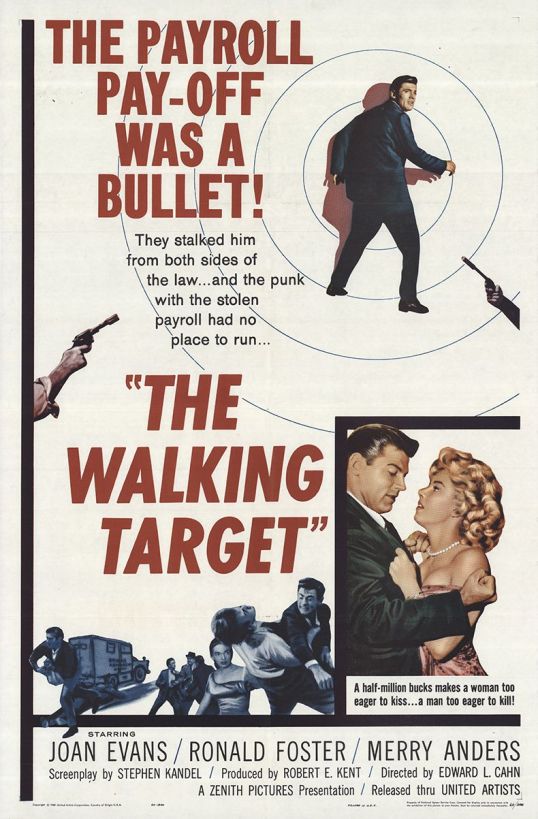
30 More Days of Noir #9: The Walking Target (dir by Edward L. Cahn)


In this 1960 noir, Nick Harbin (Ronald Foster) is a walking target!

That’s because he’s just been released from prison.  As the only survivor of a gang that pulled off a daring payroll robbery, Nick has done his time and he’s ready to get on with his life.  He even got himself an education while he was behind bars.  He’s decided to reform and no longer be the angry criminal that he once was.

But first, there’s a little matter of some money.

Only Nick knows where he buried the loot from the robbery.  Everyone wants it.  The press wants to know because it’ll make a great story.  A nosy detective wants to know because he’s convinced that Nick hasn’t changed his ways.  Susan (Merry Anders), who used to be involved with one of Nick’s criminal associates, wants to know because she’s only in it for the cash.  Susan’s current boyfriend, Dave (Robert Christopher) wants to know because …. well, again, it all comes down to greed.  Greed is also what’s motivating a local gangster to provide backing for Susan and Dave in their quest to find the money.  Dave is even willing to send Susan to seduce Nick.

However, all Nick wants to do is find the money and then split it with Gail (Joan Evans).  Gail is the widow of one of the robbers and Nick wants to do the right thing for her.  Of course, Nick is himself kind of in love with Gail.  Can Nick get the money, find love with Gail, and avoid slipping back into his criminal ways?  It won’t be easy.  Life is never easy when you’re….

THE WALKING TARGET!

Okay, that was a little bit melodramatic on my part but then again, it’s a melodramatic film.  Everyone is constantly plotting and double-crossing.  Appropriately, it all leads to a battle in the desert as modern-day outlaws prove themselves to be no more trustworthy than their vintage ancestors.

The Walking Target is a low-budget noir, one that clocks in at only 70 minutes and which, as a result, doesn’t waste much time when it comes to jumping into its story.  That’s one good thing about these B-movies.  They had neither the budget nor the time for red herrings.  As a result, you pretty much know what you’re going to get before the movies even begins.  The Walking Target features all of the usual tough dialogue and morally ambiguous characters that you would expect to see in a noir.  Merry Anders is an adequate femme fatale, though I do wish that Susan had been a smarter character.  (Nick sees through her way too easily.)  The film opens with the prison’s warden telling Nick that, even though he’s done his time, he’ll always be a no-good crook and that’s the perfect way for a noir to open.  Unfortunately, the film’s cinematography doesn’t really have the right noir look.  There aren’t enough shadows and the film often looks like it could just be an episode of an old TV show.  I guess that’d due to the budget but it really does keep the film from making the transition from being good to being great.

The Walking Target is a diverting-enough film.  I liked Ronald Foster’s uneasy performance as Nick and it was enjoyable to watch everyone plotting and scheming.  The Walking Target is currently available on Prime and I recommend it to anyone looking for a good, if lesser-known, B-noir.

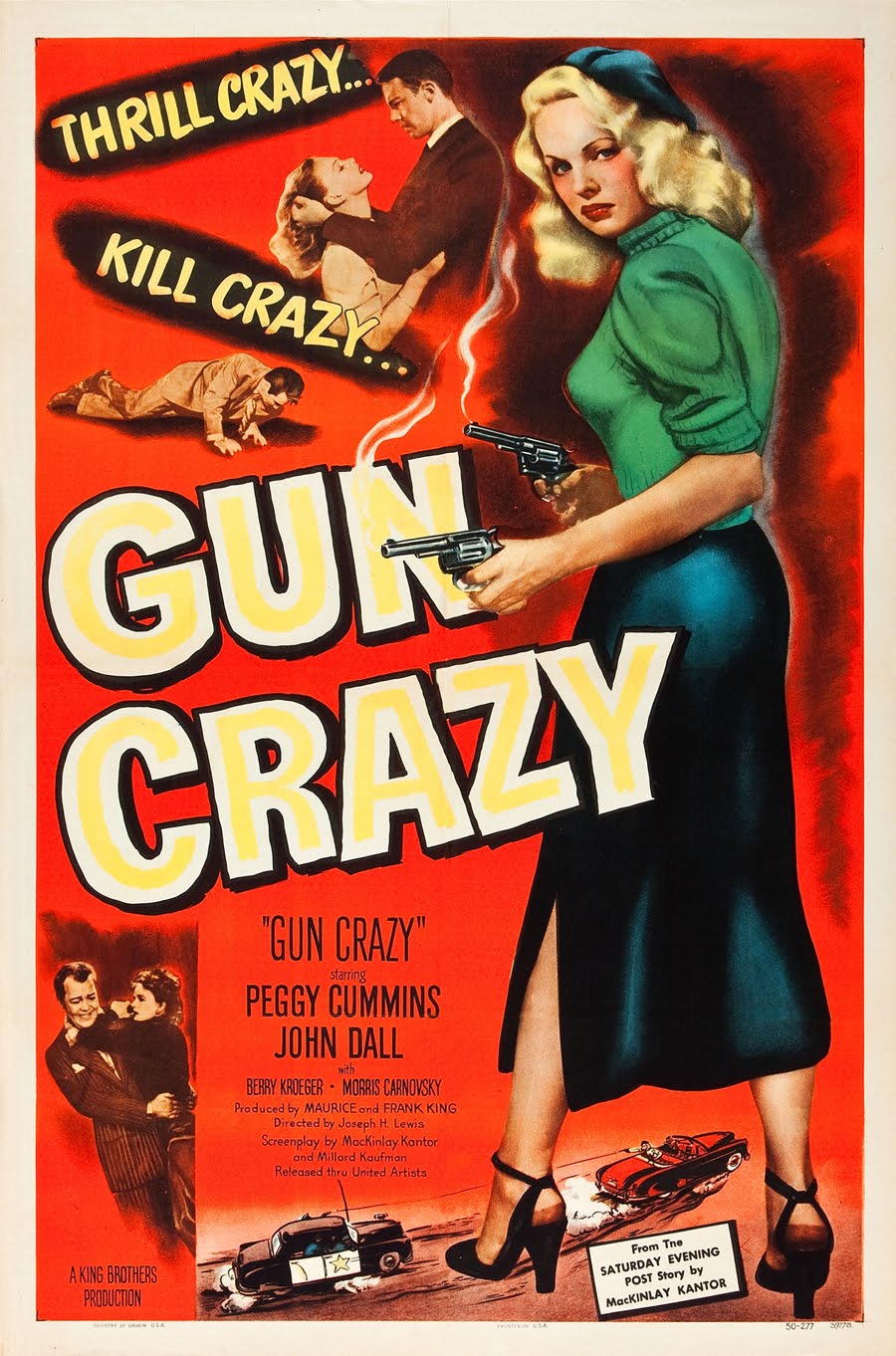
Take the Money and Run: GUN CRAZY (United Artists 1950)


gary loggins's avatarcracked rear viewer

gun1

GUN CRAZY is a thrill ride that will have you hanging on for dear life as it takes its protagonists on a downward-spiraling roller coaster ride that turns straight downhill into rock bottom. This is the ultimate noir, moving at breakneck speed towards its inevitable conclusion, a sordid tale of sex and violence that’s second to none. GUN CRAZY was a huge influence on many later films, especially 1967’s BONNIE & CLYDE, right down to the fashion style of lead Peggy Cummins.

Bart Tare loves guns. So much so that, as an adolescent, he smashes a store window to steal one. Busted by the cops, he’s sent to reform school until he’s of age. After a stint in the Army, Bart returns to his hometown, and with old pals Dave and Clyde, attends a carnival. It’s there he meets Annie Laurie Starr, a trick-shot artist. There’s immediate heat between the two, as their mutual…

View original post 848 more words