What Lisa Marie Watched Last Night: Road House (dir. by Rowdy Herrington)


The other night, I watched an old Patrick Swayze movie called Road House.  The movie was on Channel 64, which is also known as the Ion Network.  Anyway, the movie started at 8:00 and I was really, really tired for some reason so, as the movie started, I made the mistake of grabbing a pillow and curling up on the couch with the cat and, no offense to the memory of Patrick Swayze but, as soon as he showed up on my TV screen, my eye lid started to get so heavy.  My sister Erin sat down beside me and said, “Are you falling asleep?”  “No,” I said and then I was out like a light.

Luckily, Erin turned on the DVR as soon as she heard the sound of my asthmatic wheeze of a snore so when I woke up at 3 in the morning, I sat up and proceeded to watch the final 80 minutes of Road House.

Why Was I Watching It?

Because almost every guy I know seems to be in love with this movie.  When Patrick Swayze died, I though about Dirty Dancing and Donnie Darko.  But almost every guy I know — from my friend Jeff to my cousins in Arkansas to my boss at work to my online friends on twitter — was going, “Road House!”  So, I watched it to see if I could maybe understand what makes the male mind tick.  Plus, I was bored and really, really tired.  And I couldn’t find the remote to change the channel.  (Turns out it was actually underneath me, lost in the cushions of the couch.)

What’s It About

Patrick Swayze plays Dalton, who is apparently a legendary “cooler,” which apparently is what you call a bouncer who thinks he’s too good to be called a bouncer.  He get hired to be a boun–oh, sorry, a cooler — at a bar called the Double Deuce that is located down in Jasper, Missouri.  So, Swayze goes down there and starts cleaning the place up and then it turns out that the entire town is controlled by Brad Wesley (played with a true joie de vivre by Ben Gazzara) and Wesley wants…well, I’m not sure what he wants, to be honest.  I mean, seriously, I was so tired when I started watching this movie.  I’m sure I missed all sorts of nuance and such.  But anyway, Gazzara wants something and Swayze won’t let him have it so there’s a lot of fights at the road house and a car dealer ship gets destroyed and a barn blows up and then eventually Patrick Swayze rips out some guy’s throat with his bare hands.

In between all of this, Swayze recruits his mentor (Sam Elliott) to  come  down and help out.  This leads to Elliott getting murdered but nobody ever thinks to say, “Hey, Patrick — maybe if you had just let Gazzara do his thing, Sam Elliott would still be alive today.”  Also, Swayze romances a local doctor played by Kelly Lynch.  She used to be Gazzara’s girlfriend and she gets upset after seeing Swayze rip out someone’s throat with his bare hands.  But then she ends up skinny dipping  with him about fifteen minutes later so I guess she got over it.

Did I mention that Patrick Swayze rips out someone’s throat with his bare hands?

What Worked

Road House is one of those “so-bad-its-good” type films.  This is a film that sets out to be manly and ends up being so manly that it becomes ludicrous.  But guys are almost always fun to watch when they’re trying to be all guy-like.  (Though not always, as will be discussed under the heading of What Didn’t Work.)

Ben Gazzara is a lot of fun in the role of Brad Wesley.  Seriously, he looks like he had so much fun playing the part.  Usually, it annoys me when a film’s main female character is revealed to be the ex of a total and  complete psycho (and I’m looking at you, Love and Other Drugs) but it totally works here because seriously, Ben Gazzara is the man. 

And Sam Elliott provides all sorts of grizzled, beer-soaked, chain-smoking, unwashed sexiness.

The film features a lot of countryside that doesn’t look much like Missouri but it’s still really pretty.  (Missouri’s really pretty too.  You rock, Missouri!)

Since this film was being shown on television, all of the bare asses and visible nipples were edited out as were all the four-letter words.  However, it was that really weird, half-ass style of editing where you hear Patrick Swayze yelling, “FU—-CK YOU, WESLEY!”  Also, whenever anyone said the F-word, a big blurry dot suddenly appeared over their mouth.  That may not sound like much but at 3 in the morning, it really can cause you to giggle.

At one point, one of the bad guys grabs Patrick Swayze from behind and goes, “I used to FU—-CK Guys like you in prison!”  That line made me laugh way too much.  Plus, the guy saying it was really hot but then Patrick Swayze used his bare hands to rip out of the guy’s throat and that kind of ruined the whole mood.

What Didn’t Work

Well, technically, the entire film didn’t work but that’s kind of the whole point.  Still, for a film that’s supposed to be so bad that it’s good, Road House is still not that good.  It never quite reaches the level of Troll 2 or The Room.  Quite frankly, there’s waaaaaaaaaay too much testosterone rampaging through this movie and the whole time I watched, I kept on thinking about the violence that seems to define day-to-day existence for far too many people. 

Add to that, all of the men seemed to be beating each other up mainly because they were all actually in love with each other but refused to be honest with themselves about it.  Seriously, this movie has some issues.

Plus, Ben Gazzara ends up dead at the end of the film which really upset me because he’s the most likable character in the entire film!  At the very least, he’s got a really nice house.

Both Swayze and Elliott are apparently meant to be legendary bouncers.  They’re so legendary that apparently everyone on the entire planet knows who they are.  Now, I’m curious — are there really legendary bouncers?  I mean, is there like an in-house magazine that all the coolers and bouncers and barmaids subscribe to?  Maybe Patrick Swayze’s character was on the cover a few times.  I mean, I can accept that maybe Swayze would be legendary in a few cities were he had worked but would the citizens of Jasper, Missouri really have the slightest idea who he is? 

“Oh My God!  Just like me!” Moments

Uhmmm…I’m thinking.  There really weren’t any moments that made me go, “Oh my God!  Just like me!”  I mean, I don’t know Tae Kwon Do, I don’t really drink all that much, I’ve never ripped out anyone’s throat with my bare hands, I’ve never fired a shotgun at Ben Gazzara, and I don’t cover myself in body oil before going outside shirtless and practicing Tai Chi.  

Oh, wait a minute!  Much like Kelly Lynch in this movie, I would probably totally freak out if my boyfriend ripped out some guy’s throat.  In fact, I would probably freak out even more than she did.  I mean, even if — like Patrick Swayze in this movie — he made things right by dumping the corpse in a lake and then screaming, “FUCK YOU!” at Ben Gazzara, there’s no way you’d get me to go skinny dipping with him after all of that.  Because the whole time, I would just be like, “That’s great you got everyone to kill Ben Gazzara, sweetie but seriously, I saw you rip someone’s larynx out of their freaking throat.  So, just stand six feet away and keep your hands where I can see them.”

Agck!  Now, I’m kinda freaking out about my own throat.  I mean, is it that easy to do?  *Shudder*  I probably never should have given this that much thought…

Lessons Learned:

Protect your throat at all times.  Seriously, I’m going to start wearing a stainless steel choker every time I leave the house. 
 

Review: Anatomy of a Murder (Dir. by Otto Preminger)


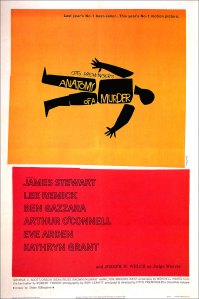
Last Friday, I randomly selected 10 movies from my DVD library and I asked you, this site’s wonderful readers, to vote on which one of those movies I should watch and then review.  234 votes were cast and the winner (by two votes!) is the 1959 courtroom classic Anatomy of a Murder.

First off, a confession of my own.  When I’m not reviewing movies or chattering away on twitter, I work in a law office.  Before anyone panics, I’m not a lawyer, I just hang out with a couple of them.  For the most part, I answer the phone, I schedule appointments, and I keep all the files in alphabetical order.  On a few very rare occasions, I’ve accompanied my boss to court and the thing that has always struck me about real-life courtroom drama is how boring it all really is.  There are no surprise witnesses, no impassioned closing statements, and those all trail rarely, if ever, jump to their feet and start yelling that they’re innocent.  For the most part, real life lawyers are usually just as poorly groomed and bored with their work as the rest of us.  Don’t even get me started on the judges, the majority of whom seem to have judgeships because they weren’t really making the grade as an attorney. 

As a result, it’s rare that I get much out of seeing lawyer-centric movies or tv shows any more.  After seeing the reality of it, I find fictionalized courtroom theatrics to be ludicrous and, for the most part, evidence of a lazy writer.  However, I’m happy to say that last night, I discovered that — no matter how jaded I may now be about the legal process — Anatomy of a Murder is still one of my favorite movies.

Based on a best-selling novel and directed by the notorious Otto Preminger, Anatomy of a Murder tells the story of Paul Beigler (James Stewart), a former district attorney who is now in private practice after having been voted out of office.  Having apparently fallen into a state of ennui, Beigler spends his time drinking with another alcoholic attorney (Arthur O’Connell) and trying to avoid his secretary’s (Eve Arden) attempts to get paid.

However, things change for Beigler when he is hired to defend an army officer named Frederick Manion (Ben Gazzara).  Manion has been arrested for murdering a bar own named Barney Quill.  Manion says that he was justified in committing the murder because Quill raped his wife, Laura (Lee Remick).  Others claim that Manion is himself just a notoriously violent bully and that the openly flirtatious Laura was having an affair with Quill.  Despite strongly disliking Manion and disturbed by Laura’s own obvious instability, Beigler takes on the case.

Beigler decides to argue that Manion was temporarily insane when he shot Quill and that he was acting on “irresistible impulse.”  As shaky as that line of defense might seem, it’s not helped by the fact that Manion himself is a bit of a brute.  Meanwhile, Beigler finds himself facing not the innefectual D.A. in court but instead a young, ambitious prosecutor from the State Attorney General’s Office, Claude Dancer (played by a young and obviously ambitious George C. Scott).  As the trial begins, small hints start to appear that seem to indicate that there’s a lot more to the murder of Barney Quill than anyone realizes…

Director Otto Preminger is an odd figure in film history.  Up until the early 60s, he was a consistently interesting director who made intelligent, well-acted films that often challenged then-contemporary moral attitudes.  However, once the 60s hit, he became something of a parody of the egotistical, old school, autocratic filmmaker and his films seemed to suffer as a result.  Like many of the film industry’s top directors, he found himself adrift once the 60s and 70s hit.  His decline was so dramatic that, as a result, there’s a tendency to forget that he made some truly great and important films, like Laura, Carmen Jones, The Man With The Golden Arm, and, of course, Anatomy of a Murder.

Anatomy of a Murder represents Preminger at his best.  His own natural tendency towards embracing melodrama and shock are  perfectly balanced with an intelligent script and memorable performances.  Whereas later Preminger films would often come across as little more than big screen soap operas, here he makes the sordid believable and compelling.  Preminger has never gotten much attention as a visual filmmaker but here, he uses black-and-white to perfectly capture the grayness of the both the film’s location and the moral issues that the film raises.  He keeps the camera moving without ever calling attention to it.  As a result, the movie has an almost documentary feel to it.

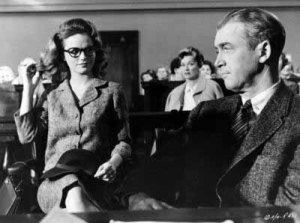
As previously stated, Preminger gets a lot of help from a truly amazing cast.  At first, it’s somewhat strange to imagine a Golden Age icon like Jimmy Stewart appearing in the same film as a dedicated method actor like Ben Gazzara.  These are two men who represent not only different philosophies of acting but seemingly from two different worlds as well.  However, Preminger uses their differing acting styles to electrifying effect.  One of the joys of the movie is watching and contrasting the old style, “move star” turns of James Stewart, Arthur O’Connell, and Eve Arden with the more “naturalistic” approaches taken by their younger co-stars, Gazzara, Lee Remick, and especially George C. Scott.  The contrast in style becomes a perfect reflection of the film’s contrast between what is legal and what is correct.  All the actors, as both individuals and as an ensemble, give memorable performances.  When you look at the cast, you realize that any one of their characters could have been the center of the story without the film becoming any less compelling. 

Lee Remick (a notoriously fragile actress who, for years, I knew solely as the poor woman who kept getting attacked by her adopted son in the original Omen) brings out the best in everyone she shares a scene with.  Whether she’s making Stewart blush or breaking down on the witness stand, she dominates every scene as an insecure young woman who forces herself to be happy because otherwise, she’d have to confront the fact that she’s miserable.  (I should admit that I related more than a bit to Remick’s character.  To me, the movie was about her and therefore, about me.) 

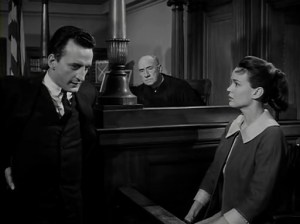
She is perhaps at her best towards the end of the film when she is on the witness stand and is cross-examined by George C. Scott.  Starting out as flirtatious and seemingly confident, Remick slowly and believably falls apart as Scott methodically strips away every layer of defense that, until now, she’s spent the entire movie hiding behind.  By the end of the scene, Remick has shown as every layer of pain that has built up in Laura Manion over the years.  For his part, Scott is simply amazing in this scene.  Determined and focused, Scott doesn’t so much cross-examine Remick but seduces her and the audience along with her.  As a result, when he suddenly turns off the charm and lunges in for his final attack, it’s devastating for everyone watching.  (And, as was correctly pointed out to me by a friend while I was watching the film last night, George C. Scott was quite the sexy beast when he was young.)

Lastly, the film’s judge is played by an actual lawyer by the name of Joseph Welch.  Welch wasn’t a great actor but he did make for a great judge.

Of course, it wouldn’t be a Preminger film is a few contemporary morals weren’t challenged and, at the time it was released, Anatomy of a Murder was considered to be very daring because of its frank discussion of topics like rape and spousal abuse.  It doesn’t seem quite so daring now but it does seem to be remarkably mature in a way that even most modern movies can’t match.  That being said, the film does occasionally embrace the “she must have been asking for it” male viewpoint but still, it’s a remarkably advanced movie for the 1950s.

One of the wonderful things about watching a 51 year-old film is that it provides a chance to see what was considered to be shocking in the years before you or I was born.  From watching this movie, I’ve discovered that, in the year 1959, “panties” was apparently a taboo phrase.  A good deal of the film’s plot revolves around the panties Lee Remick’s character was wearing the night she was raped and their subsequent disappearance.  At one point, there’s even a scene where Welch, Stewart, and Scott struggle to come up with a less offensive term to use when referring to them in the court.  (Scott suggests employing a term he heard in France.)  Seen 51 years later (in a time when we can not only say “thong” in polite conversation but specifically go out of our way to show off the fact that we’re wearing one), this scene, and the actors’ obvious discomfort whenever they have to say the word “panties”, never fails to amuse me.

Preminger’s other grand challenge to the 50s mainstream was in getting Duke Ellington to compose the film’s jazz soundtrack.  At the risk of being called a heretic by some of my closest friends, I’ve never been a big fan of jazz but it works perfectly here.  Ellington, himself, makes a cameo appearance and wow, is he ever stoned.

In conclusion, allow me to thank the readers of the site for “ordering” me to watch, once again, a truly classic film.  Now, seeing as how close the vote was and that I know, for a fact, that some people voted more than once, I think it would be only fair for me to also rewatch and review the other 9 movies (Lost in Translation, Primer, Hatchet For the Honeymoon, Emanuelle in America, Starcrash, Darling, Sole Survivor, The Sweet House of Horrors, and The Sidewalks of Bangkok) in my poll over the next couple of weeks.  I’m looking forward to each and every one of them (well, almost all of them) and, again, thank you for allowing me to start things off with a great film like Anatomy of a Murder.